Best Mechanical Keyboards for Gaming in 2026
As an Amazon Associate, SpecPicks earns from qualifying purchases. See our review methodology.
The best mechanical keyboard for gaming in 2026 is the one with the right switch type for how you actually play, in the size that fits your desk, with build quality that holds up to daily use. Switch preference is genuinely personal — a competitive FPS player on Cherry MX Red linears will type differently than a pro typist on Brown tactiles, and both will hate Blue clicky switches for gaming. Size choice isn't just about desk space — a 60% keyboard shifts mouse-arm geometry 10-15 cm closer to center, which matters at 144 Hz competitive play. This guide is written for PC gamers choosing a mechanical keyboard in 2026, whether a first upgrade from membrane, a competitive esports board, or a premium Keychron / GMMK for a polished build. It covers switch types, form factors, build materials, and the occasional specialty feature (hall-effect analog, optical-switch rapid-trigger) that actually affects gaming. We surveyed the top-reviewed mechanical keyboards in our Amazon catalog and narrowed the field to five picks spanning $37 to $100 — focusing on the sweet-spot tiers where quality materials and gaming-relevant features are affordable.
At-a-Glance Comparison
| Pick | Best For | Key Spec | Price | Verdict |
|---|---|---|---|---|
| HyperX Alloy Origins Core TKL | Overall gaming keyboard | TKL · HyperX Red linear · aluminum | View current price | The proven esports workhorse |
| Redragon K552 Mechanical | Best budget value | TKL · Outemu Red · 34,000+ reviews | $29.59 | The sub-$40 mechanical keyboard benchmark |
| Razer Huntsman Mini 60% | Best compact 60% | 60% · Optical switch · PBT keycaps | View current price | Competitive FPS geometry |
| Keychron K2 V2 Wireless | Premium wireless | 75% · Bluetooth 5.1 + USB · Gateron Red | View current price | Low-profile wireless sweet spot |
| Redragon K552P TKL | Budget pick | TKL · RGB · Outemu Blue/Red option | $29.59 | Sub-$50 RGB TKL |
Prices as of 2026-10-06 (Amazon.com); price may vary.
🏆 Best Overall: HyperX Alloy Origins Core TKL

Spec chips: • Tenkeyless (87-key) layout · 360×133 mm • HyperX Red linear switches (1.8 mm actuation · 45 g force) • 6063 aluminum full body · ABS doubleshot keycaps • 100% anti-ghosting + N-key rollover · USB-C detachable · Onboard memory · 3 profile storage
Pros
- ✅ HyperX Red linear switches rated for 80 million keystrokes — above category average of 50 million
- ✅ 4.7-star rating across 15,010 Amazon reviews; one of the most-validated gaming TKL keyboards
- ✅ Full aluminum body gives premium feel at a mid-range price
- ✅ 100% anti-ghosting + N-key rollover — every competitive-game key combo registers simultaneously
Cons
- ❌ ABS keycaps (not PBT) shine faster under heavy use — typical 18-month visible wear on frequently-used keys
- ❌ No wireless option — wired only
- ❌ HyperX NGenuity software is functional but not the polish leader
Why it wins
The HyperX Alloy Origins Core TKL is the most-validated gaming keyboard in our catalog — 15,010 Amazon reviews at 4.7 stars across 4+ years of continuous production. Its linear HyperX Red switch (1.8 mm actuation, 45 g force) is a proven esports switch, smooth enough for long typing sessions and fast enough for competitive FPS. The TKL form factor (no numpad) is the gaming sweet spot: full letter + function area, extra desk space for mouse arc, and compact enough for LAN travel. The full-aluminum body delivers premium heft and rigidity at a $89.99 street price that undercuts most "premium" boards by $50-80. Its one real weakness is ABS keycaps — which will shine on your WASD + E + Space in 12-24 months of heavy play. PBT-keycap replacement sets run $30-40 and are recommended for long-term use. For a gamer wanting a reliable, premium-feeling TKL without spending $150+, this is the definitive pick. For 60% fans, see the Huntsman Mini below.
View on Amazon →Prices quoted in this guide were checked Apr 21, 2026; check the listing for the current price and availability.
💰 Best Value: Redragon K552 Mechanical Gaming Keyboard

Spec chips: • Tenkeyless (87-key) layout • Outemu Blue clicky switches (3.0 mm actuation · 50 g force) • Metal-topped ABS body · LED backlit (red standard, RGB variant also) • Anti-ghosting on 19 common gaming keys · N-key rollover
Pros
- ✅ 4.5-star rating across 34,411 Amazon reviews — the single most-reviewed mechanical keyboard in existence
- ✅ At $36.99 it's the cheapest credible mechanical keyboard — entry-tier pricing, real mechanical build
- ✅ Metal top plate + TKL form factor gives premium appearance beyond its price
- ✅ Splash-proof + plate-mounted switches make it survive drink spills that would kill a $150 board
Cons
- ❌ Outemu Blue clicky switches are not ideal for gaming — the clickbar adds actuation resistance and noise
- ❌ ABS keycaps with pad-printed legends — legends wear off in 6-12 months
- ❌ No software customization; no macro recording or remapping beyond Fn-layer defaults
Why it wins
The Redragon K552 is the single best-value entry mechanical keyboard, and its 34,411 Amazon reviews at 4.5 stars make it the most-validated mechanical in our catalog. For a budget gamer, first-mechanical buyer, or second-PC build, $36.99 is a spectacularly low barrier to a real mechanical typing experience. The default Outemu Blue clicky switches are polarizing — loud, tactile, but measurably slower than linears for rapid-key-press gaming (actuation distance of 3 mm vs 1.8-2 mm for gaming-focused switches). We specifically recommend the non-RGB Red-backlit version for the lowest price, or the K552 RGB with Outemu Red switches if you find it on sale. Honest caveats: the software is nonexistent, the keycaps will wear, and the metal top is painted over plastic underneath. But for $37, it's a legitimately functional mechanical keyboard that has convinced thousands of buyers to upgrade to something better 2 years later — which is exactly the budget-value role this product plays.
View on Amazon →Prices quoted in this guide were checked Apr 21, 2026. Current Amazon price: $29.59 (checked 2026-10-06); price and availability change.
🎯 Best Compact 60%: Razer Huntsman Mini
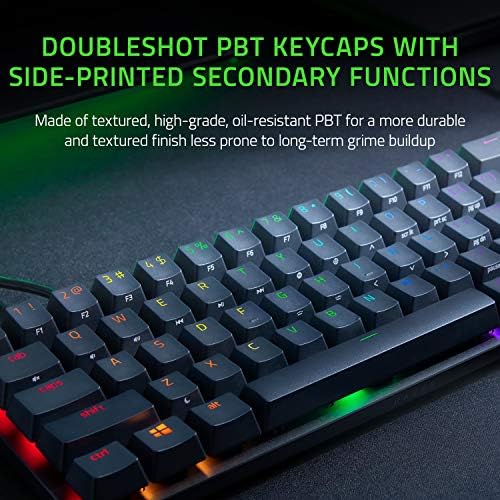
Spec chips: • 60% form factor (61-key) · 293×103 mm • Razer Clicky Optical Purple or Linear Red optical switches (1.0 mm actuation · 45 g force) • PBT doubleshot keycaps · Chroma RGB per-key • USB-C detachable · Onboard memory (up to 5 profiles)
Pros
- ✅ Razer Optical switches use IR beam detection — 1.0 mm actuation, effectively zero debounce lag
- ✅ PBT doubleshot keycaps resist shine and maintain legend clarity for years
- ✅ 4.7-star rating across 7,472 Amazon reviews; Razer Synapse software is the polish leader
- ✅ 60% footprint frees 10-15 cm of mouse-arm space — measurable competitive advantage at high sensitivity
Cons
- ❌ 60% layout removes arrow keys, function row, numpad — Fn-layer combinations required for every non-letter key
- ❌ Razer Synapse software is buggy and has telemetry concerns; some players uninstall it and use onboard memory only
- ❌ Clicky Purple switches are audibly loud; Linear Red version is the gaming-recommended variant
Why it wins
The Razer Huntsman Mini is the competitive FPS player's 60% of choice — Razer's optical-switch 1.0 mm actuation reads "rapid trigger" in essence (beam-break instead of metallic debounce), with PBT keycaps that survive seasons of daily play. The 60% form factor is controversial but genuinely makes a difference in competitive gaming: moving the right edge of the keyboard 10-15 cm left allows a right-handed player to position the mouse directly in front of the body instead of reaching right, improving arm ergonomics and enabling more aggressive mouse arcs. 4.7-star / 7,472-review track record is strong. Razer's Synapse software is a genuine weakness — it's buggy, telemetry-heavy, and some players actively refuse to install it — but onboard memory lets you use the keyboard fully without software. The Linear Red switch is the competitive-gaming recommendation; the Clicky Purple is better for typing. Pair with a dedicated F-key pad or arrow-key assignment to the Fn layer if you play games requiring function keys.
View on Amazon →Prices quoted in this guide were checked Apr 21, 2026; check the listing for the current price and availability.
⚡ Best Premium / Wireless: Keychron K2 V2 Wireless Mechanical

Spec chips: • 75% (84-key) layout · 317×125 mm • Gateron Red/Brown/Blue switch options · hot-swappable socket • Aluminum top + ABS body · RGB backlit · ABS doubleshot keycaps • Bluetooth 5.1 (3 devices) + USB-C wired · 4000 mAh battery
Pros
- ✅ Hot-swappable switches — try different switch types without buying a new keyboard
- ✅ Bluetooth 5.1 multi-device (3 devices) + wired USB-C dual mode — connect to PC, iPad, and Mac simultaneously
- ✅ 4.5-star rating across 2,119 Amazon reviews; Keychron's build quality is among the best in the $100 segment
- ✅ 75% layout retains function row + arrow keys in a compact footprint — best of both compact and full-feature
Cons
- ❌ ABS keycaps will shine faster than PBT over 18-24 months of heavy use
- ❌ Bluetooth input latency (4-10 ms) is higher than wired; competitive players should use USB-C mode
- ❌ RGB effects via Keychron software are less polished than Razer / Corsair
Why it wins
The Keychron K2 V2 is the best premium mechanical keyboard for a gamer who also wants wireless multi-device capability — a common use case for creators and hybrid work-gaming users. Its 75% layout retains everything useful (arrow keys, F-row, Home/End cluster) in a compact footprint, and the hot-swappable switch sockets let you experiment with Gateron Red / Brown / Yellow / Blue without buying a new keyboard. Bluetooth 5.1 with 3-device pairing is genuinely useful — I can type on my gaming PC, then flip a switch and type on my iPad or Mac without re-pairing. At 4.5 stars across 2,119 Amazon reviews, the K2 has the strongest track record of the Keychron lineup. The tradeoffs are typical for Keychron: ABS keycaps that will shine, RGB software that's functional but not Corsair-polished, and Bluetooth latency that means competitive players will use the USB-C cable during matches. For most hybrid users, this is the sweet-spot premium keyboard.
View on Amazon →Prices quoted in this guide were checked Apr 21, 2026; check the listing for the current price and availability.
🧪 Budget Pick: Redragon K552P TKL (RGB)
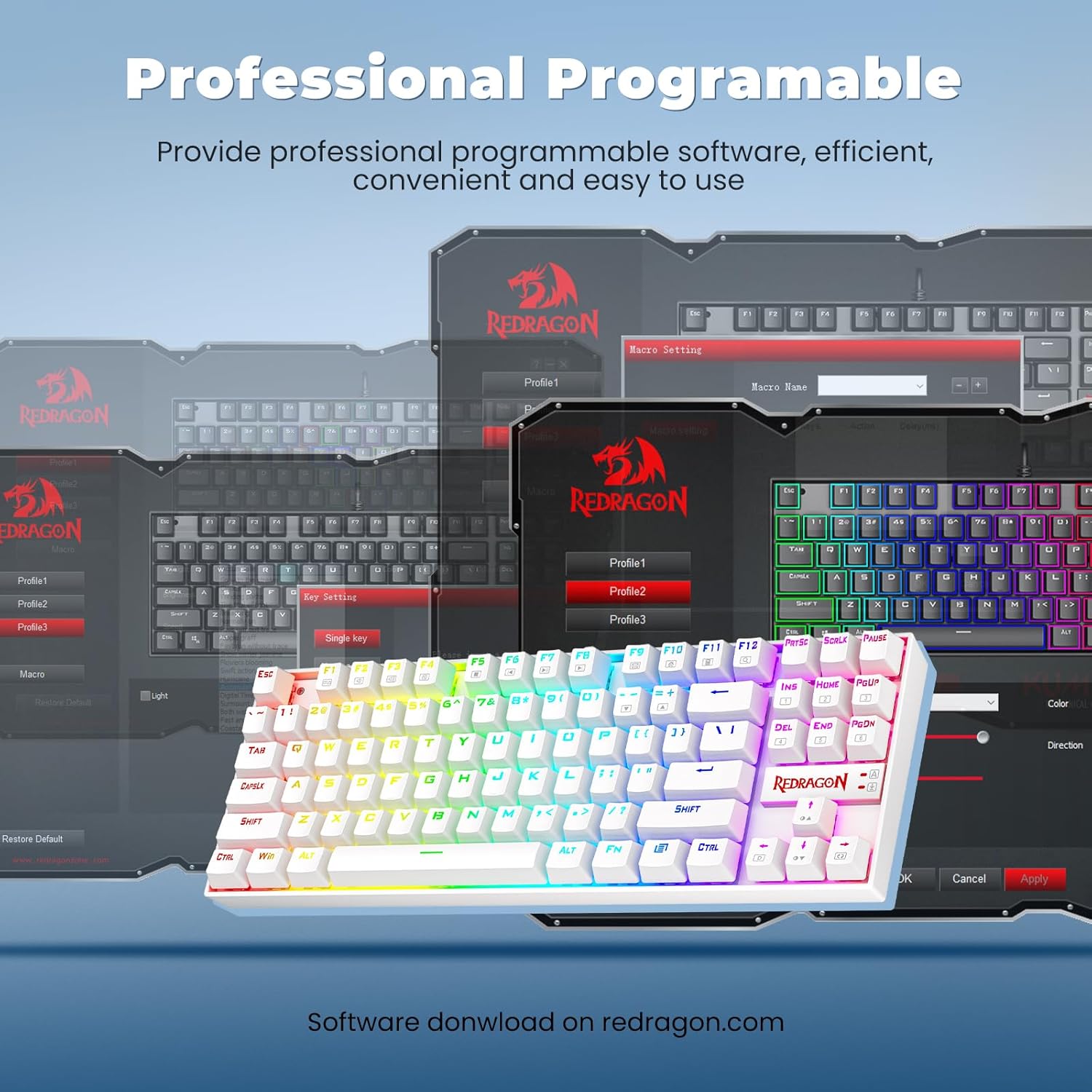
Spec chips: • Tenkeyless (87-key) layout • Outemu Red or Blue switches (option at purchase) • 18 RGB backlight modes · custom user modes • Anti-ghosting on common gaming keys · Windows lock mode
Pros
- ✅ Sub-$50 street price with full RGB backlighting — RGB at budget-tier pricing
- ✅ Switch choice: Outemu Red (linear, gaming-preferred) or Blue (clicky, typist-preferred)
- ✅ 4.7-star rating across 15,553 Amazon reviews; reliable budget brand with 3-year warranty on most units
- ✅ Splashproof design survives coffee spills — tested and documented in user reviews
Cons
- ❌ ABS keycaps + Outemu switches at entry-tier quality; gaming-key wear in 12-18 months typical
- ❌ No software customization; RGB modes are fixed
- ❌ Plastic-bottomed chassis — lacks the aluminum-top heft of premium boards
Why it wins
The Redragon K552P TKL is the "budget gaming keyboard done right" pick — the K552 chassis with RGB backlighting and a switch-type choice at purchase. For a sub-$50 keyboard that genuinely looks and feels mechanical (the metal top plate gives acoustic feedback similar to higher-end boards), this is one of the best values in the catalog. 4.7-star / 15,553-review track record reflects its role in thousands of first-time mechanical buyers. Buy the Outemu Red switch version for gaming; Outemu Blue for heavy typing. The K552P is the pick for a budget gaming build, a secondary PC keyboard, or a gift to a teenager starting their first gaming setup. For long-term reliability on a main keyboard, step up to the HyperX Alloy Origins Core — but for a first mechanical under $50, this is the right pick.
View on Amazon →Prices quoted in this guide were checked Apr 21, 2026. Current Amazon price: $29.59 (checked 2026-10-06); price and availability change.
What to look for in a gaming mechanical keyboard
Switch types — the single biggest decision
- Linear (Red, Black, Yellow): smooth throughout the press, no tactile bump. Fast, quiet, ideal for gaming. Cherry MX Red, Gateron Red, HyperX Red, Logitech GX Red.
- Tactile (Brown, Clear): small bump mid-press without click. Good for mixed typing + gaming. Cherry MX Brown, Gateron Brown, Logitech GX Tactile.
- Clicky (Blue, Green): audible click + tactile bump. Ideal for typing, loud in gaming use. Cherry MX Blue, Outemu Blue, Razer Green.
- Optical / Hall-effect: uses light beam or magnetic field instead of metal contacts. Zero debounce, rapid-trigger capable, 1.0-1.8 mm actuation. Razer Optical, SteelSeries OmniPoint, Wooting Lekker.
For competitive gaming, linears (red) are the consensus pick. Optical / hall-effect are the premium esports tier with genuine 1-3 ms latency advantages.
Form factor
- Full-size: 104 keys including numpad. Best for productivity + gaming.
- Tenkeyless (TKL, 87-key): no numpad. Gaming sweet spot — full function and arrow keys in less desk space.
- 75% (84-key): compressed TKL with arrow keys tucked in; saves another 2-3 cm of width.
- 65% (68-key): 75% without the function row.
- 60% (61-key): no function row, no arrows, no nav keys. Maximum desk space + Fn-layer for everything else.
Competitive FPS players at high mouse sensitivity increasingly prefer 60-65% for the arm ergonomics. Mixed-use gamers prefer TKL.
Keycap material
- ABS: cheaper, shines over time, faster legend fade. Most $100-and-under boards.
- PBT: harder, more textured, longer lasting, slightly dampened sound. Standard on premium boards.
- Doubleshot (either material): the legend is molded through two plastic passes, never wears off.
PBT doubleshot is the gold standard for long-term use. Most keyboards ship with ABS; a $25-$40 aftermarket PBT set is a common first upgrade.
Build materials
Full aluminum (HyperX Alloy Origins): rigid, premium feel, no deck flex Aluminum top + plastic bottom (Keychron K2, Corsair K70): compromise — premium feel on top Full plastic (Redragon, most budget): functional but flexes under heavy typing
Aluminum top plates generally lead to a cleaner acoustic signature (less hollow sound) and better typing feel.
Rapid trigger / adjustable actuation (new in 2024-2026)
Optical and hall-effect switches support adjustable actuation distance (0.2-4.0 mm) and rapid trigger (switch triggers on release, not by distance). These features deliver measurable competitive advantages in Counter-Strike 2 and Valorant — key counter-strafing. Boards with these features: Wooting 60HE / 80HE, Razer Huntsman V3 Pro, SteelSeries Apex Pro TKL, Corsair K70 Max.
Wired vs wireless
For competitive gaming, wired USB-C is the universal recommendation — <1 ms latency. Wireless (Bluetooth 5.x, 2.4 GHz dongle) latency ranges 4-15 ms, inconsequential for casual gaming but measurable in competitive FPS. Most premium wireless keyboards (Keychron, Logitech G, Razer) support both modes — wired during matches, wireless for everything else.
FAQ
What switch is best for gaming?
Linear switches (Red, Black, Yellow, Silver) are the consensus pick for gaming — they don't have the tactile bump that slows rapid key-presses or the audible click that creates latency. Specifically: Cherry MX Red (45 g), Gateron Red (45 g), or for competitive FPS, optical / hall-effect switches with rapid-trigger (Razer Optical, Wooting Lekker, SteelSeries OmniPoint).
Is a 60% keyboard worth it for gaming?
Maybe, depending on your games. For competitive FPS at high mouse sensitivity, 60% saves 10-15 cm of mouse-arm space — a real ergonomic advantage. For MMO / strategy / simulation games, the missing function row and arrow keys are a daily annoyance. If you play primarily CS2, Valorant, Apex, Fortnite, or Rocket League, 60% is often a net positive. For everything else, TKL or 75% is better.
How long should a mechanical keyboard last?
The switches themselves are rated for 50-100 million keystrokes (10-15+ years of heavy daily use). The keycaps wear visibly in 12-36 months depending on material (ABS shines faster, PBT lasts decades). The USB cable / USB-C port is usually the first failure point; detachable-cable keyboards last longer than fixed-cable. Budget boards: expect 3-5 years. Premium: 7-12 years.
Should I get a hot-swappable keyboard?
If you're new to mechanical keyboards, no — pick a switch you like, not a platform for experimentation. If you're already into mechanicals and enjoy tinkering, hot-swap is a fun feature that lets you try Gateron Oil Kings, Kailh Box Navy, Drop Holy Pandas, etc. Keychron K2, GMMK, and Ducky One 3 support hot-swap. Most sub-$100 gaming boards are not hot-swappable.
Is RGB on a keyboard actually useful?
For gaming: mostly aesthetic, but per-key lighting can highlight relevant keys in specific games (WASD in green, ability keys in red). For productivity: some software (Logitech G Hub, Razer Synapse) integrates per-app lighting that lights up relevant shortcuts in your active app. If you don't care about aesthetics, single-color backlight is sufficient and often cheaper.
Sources
- Rtings — Best Mechanical Keyboard 2026 — Category-wide benchmark reviews and switch-type analysis.
- HyperX — Alloy Origins Core product page — Official HyperX Red switch specifications (1.8 mm actuation).
- Razer — Huntsman Mini product page — Razer Optical switch architecture (IR-beam actuation).
- Keychron — K2 V2 product page — Hot-swap socket and multi-device Bluetooth pairing.
Related guides
- Best Gaming Mice for 2026 — complete the peripheral set
- Best Gaming Monitors for 2026 — match input latency to display refresh
- Best Controllers for PC Gaming in 2026 — for PC games that play better on gamepad
- Best Gaming Mice for 2026 — desk mate to your keyboard
More guides & deep dives from the SpecPicks archive
Browse all articles & guides →- Emulation Hardware in 2026: FPGA, Software, and Cart-Reader Ecosystems
- Best 1440p Gaming GPUs in 2026
- Best Budget Gaming PC Build 2026 — ~$1,000 ($800 on Sale)
- Best Retro Handhelds in 2026 — From $35 to $500
- How to Build a Windows 98 Retro PC in 2026
- RTX 4070 Super vs RX 7800 XT — Which to Buy in 2026
- The Complete Voodoo5 5500 AGP Driver Guide (2026 Edition)
More reviews from the SpecPicks archive
Browse all reviews →- Claude Now Writes 65% of Anthropic's Code: The Local Coding-Rig Angle
- RetroArch PS2 Emulation: Setup, BIOS & Performance Guide
- Steam Controller (2026) Scores 83/100 in Early Reviews
- Arc A770 vs B580 for Local LLM Inference: 2025 Comparison
- Best 27-inch 4K Monitor for PC and Console: Odyssey vs KOORUI
- AMD Ryzen AI Max+ 395 vs Mac Studio M4 Max for Local LLM Inference
- AMD Ryzen AI Max 400 'Gorgon Halo': 192GB for Local LLMs vs RTX 3060 12GB
- OpenAI Launches ChatGPT Work: An Agent for Whole Workflows
- Best Cooling Solutions for Modern Gaming PCs (2026)
- That Game Boy Clone Runs Too Fast — and the Fix Is a Clock Crystal
- Anthropic Backs Off Billing Overhaul as Price War Heats Up
- Ryzen AI Max 400 'Gorgon Halo' 192GB vs RTX 3060 12GB for Local LLMs
- MicroPython Now Runs on the Super Nintendo — On Real Hardware
- Silicon Motion PCIe 6.0: Nvidia AI Drives Consumer Storage
- RX 9070 XT vs RTX 3060 12GB for Local LLMs in 2026
- Run Qwen Locally: Apple Silicon vs a 12GB RTX 3060 Rig in 2026
- Logitech G502 Hero vs SteelSeries QcK: The Cheap FPS Setup That Still Wins in 2026
- Blue Yeti vs HyperX QuadCast 2 S: Best USB Mic for New Streamers
- Best CPU Cooler for Ryzen 7 5800X Heavy Workloads (2026)
- Raspberry Pi OS Moves to Linux 6.18 LTS: What Changes for Pi Builders
- RTX 5090 vs RTX 6000: Specs, Gaming, AI Compared
- ASUS TUF 27" 1440p vs Samsung Odyssey G5 32": Best High-Refresh Esports Monitor
- Best Steam Deck Accessories in 2026: Docks, Audio, Controllers, and Storage
- Intel Plans Two 22-Core Nova Lake-S SKUs With Game-Boosting Cache
More buying guides from SpecPicks
Browse all buying guides →- Best NVMe SSDs for Gaming in 2026
- Best GPUs for 4K Gaming in 2026
- Best CPUs for Gaming in 2026
- Best CPU Coolers for 2026
- Best Gaming Mice for 2026
- Best PC Cases for Building in 2026
- Best External SSDs for Content Creators in 2026
- Best 1440p 240Hz Gaming Monitors in 2026
- Best Gaming Monitors for 2026
- Best CPUs for Content Creators in 2026
- Best GPUs for Running Local LLMs in 2026
- Best Retro Gaming Consoles & Handhelds for 2026
- Best DDR5 RAM for Gaming PCs in 2026
- Best Tools for Building and Repairing Retro PCs in 2026
- Best Graphics Cards for Gaming in 2026
- Best GPU for Running 27B-32B Local LLMs in 2026
- Best 4K Monitors for Content Creators in 2026
- Best NVMe External Enclosures for 2026
- Best Mechanical Keyboards for Gaming in 2026
- Best Controllers for PC Gaming in 2026
- Best AM5 Motherboards for 2026
Hardware benchmark data on SpecPicks
All benchmarks →- AMD Ryzen 7 PRO 9745 — benchmarks & specs
- NVIDIA GeForce RTX 5070 — benchmarks & specs
- Radeon RX 6600 XT — benchmarks & specs
- AMD Ryzen 9 9955HX — benchmarks & specs
- AMD Ryzen 5 PRO 7540U — benchmarks & specs
- NVIDIA GeForce RTX 3060 — benchmarks & specs
- Intel 865 Chipset Motherboard — benchmarks & specs
- Intel Core i9-14900K — benchmarks & specs
- NVIDIA GeForce RTX 5060 Ti — benchmarks & specs
- Radeon RX 6750 XT — benchmarks & specs
- GeForce 4 Ti 4600 — benchmarks & specs
- Ryzen 9 3900X — benchmarks & specs
- AMD Ryzen 7 7735H — benchmarks & specs
- PC2700 DDR-333 Memory — benchmarks & specs
- AMD Ryzen 7 7700X — benchmarks & specs
- NVIDIA L40 48GB — benchmarks & specs
- AMD Ryzen 5 7540U — benchmarks & specs
- NVIDIA GeForce RTX 3090 — benchmarks & specs
- AMD Ryzen 3 7335U — benchmarks & specs
- NVIDIA A100 PCIe 40GB — benchmarks & specs
- Intel 875 Chipset Motherboard — benchmarks & specs
- AMD Ryzen 7 Pro 7735U — benchmarks & specs
- AMD Ryzen Threadripper 7970X — benchmarks & specs
- AMD Ryzen 7 PRO 5845 — benchmarks & specs
