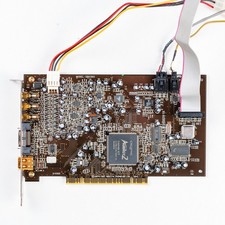
When an Audigy 2 ZS won't detect in Windows 98 SE, the fix is almost never the driver. The real causes, in order, are PCI slot routing, a stale ghost device, or an IRQ conflict with onboard AC97 audio. Reinstalling the driver before clearing those just layers a second failed install on the first. Here's the decision tree that finds the actual fault.
🛒 Want a known-good card to rule out a hardware fault? Buy on eBay, not Amazon: Sound Blaster Audigy 2 ZS.
Start here: is the card seen at the hardware level?
Before touching drivers, confirm the board even sees the card. Enter the BIOS and check that the PCI slot is enabled and that "Plug and Play OS" is set appropriately (on many period boards, setting PnP OS to No lets the BIOS assign resources, which Win98 SE handles more reliably than leaving it to the OS). If the card never appears as an unknown PCI device in Device Manager, the problem is physical or BIOS-level, not the driver.
Branch 1: PCI slot routing
Not all PCI slots are equal on period boards. Some share an IRQ line with the AGP slot or a specific onboard device, and the Audigy can fail to enumerate in a poorly routed slot. Move the card to a different PCI slot — ideally one not shared with the AGP slot per the motherboard manual's IRQ routing table — and reboot. This single move resolves a large share of "not detected" cases.
Branch 2: ghost devices
Windows 98 SE keeps phantom entries from prior sound hardware. A leftover Audigy, SB Live!, or onboard-audio ghost can block a clean detection. Boot to Safe Mode, enable "show hidden devices," and remove every audio entry — real and greyed-out — under Sound, Video and Game Controllers and under unknown devices. Reboot and let Windows redetect the card fresh, then install the driver.
Branch 3: IRQ conflict with onboard AC97
If the motherboard has onboard AC97 audio, it will fight the Audigy for resources. Disable onboard audio in the BIOS before installing the card. Leaving both enabled is a classic cause of a card that's physically present but never initializes, or that installs and then disappears on the next boot. One audio device at a time on Win98 SE.
Then, and only then: the driver
With routing, ghosts, and onboard audio handled, install the period Audigy 2 ZS driver. Let the card be detected first, install the matching Win98 SE driver package, and reboot when prompted. The kX Audio Project drivers are an excellent alternative if the official package misbehaves, and they unlock additional DSP routing on the Audigy hardware.
The decision tree, condensed
- BIOS: PCI slot enabled, PnP OS set to No, onboard AC97 disabled.
- Card not seen at all → move to a non-shared PCI slot.
- Card seen but won't install → Safe Mode, remove all audio devices including ghosts, redetect.
- Still failing → install official or kX Audio driver with the card pre-detected.
- All clear and still dead → test the card in a known-good board; suspect the card itself.
Win98 resource conflicts, step by step
When the Audigy installs but shows a yellow exclamation in Device Manager, you have a resource conflict to resolve by hand. Open the card's properties, check the Resources tab for a conflicting IRQ or I/O range, and uncheck "use automatic settings" to assign a free IRQ if the board allows it. Onboard AC97, USB controllers, and the AGP card are the usual squatters on the IRQ the Audigy wants. Where the BIOS supports it, reserving a dedicated IRQ for the PCI slot the card lives in is the cleanest fix, and it survives reboots better than letting Win98's PnP juggle assignments.
Variant notes: SB0350 vs SB0360
The Audigy 2 ZS shipped in several board revisions — SB0350, SB0360, and various OEM cards. They share the same core driver, but OEM boards occasionally reject the OEM driver package and need the retail Creative Win98 SE driver forced instead. If a detected card refuses its expected driver, try the retail package or the kX Audio Project drivers, which drive the Audigy hardware directly and sidestep some OEM packaging quirks.
Verify before you call it fixed
After install, confirm the card carries no Device Manager warnings, that hardware acceleration is enabled in DirectX (dxdiag's sound page), and that EAX is selectable in a known EAX title. A card that produces sound in Windows but fails in games usually has hardware acceleration turned down or an unresolved IRQ conflict still lurking. Test an actual game with positional audio — generic Windows beeps passing doesn't prove the EAX path works.
Frequently asked questions
My Audigy 2 ZS isn't detected in Win98 SE — is it the driver? Almost never. Check PCI slot routing, clear ghost audio devices in Safe Mode, and disable onboard AC97 in the BIOS first. The driver is the last step, not the first.
Should I disable onboard motherboard audio? Yes. Onboard AC97 audio competes with the Audigy for IRQ and resources on Win98 SE. Disable it in the BIOS before installing the card to avoid conflicts.
What if it installs then disappears on reboot? That's typically an IRQ conflict or a marginal PCI slot. Move the card to a non-shared slot and ensure onboard audio is disabled, then reinstall.
Can I run the Audigy 2 ZS alongside onboard audio? Not reliably on Win98 SE. The two compete for IRQ and resources, which is a frequent cause of the card vanishing after a reboot. Disable onboard AC97 in the BIOS and run the Audigy as the only audio device.