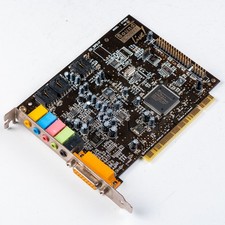
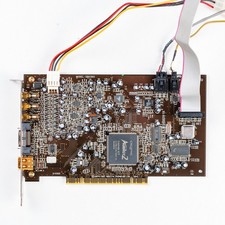
For pure positional accuracy in the small library of A3D 2.0 titles — Half-Life, Thief Gold, Tribes 2, Unreal Tournament — the Aureal Vortex 2 (AU8830) still beats the Sound Blaster Live! Value (CT4760) decisively, even in 2026. For everything else, including 90% of the late-1990s and early-2000s game library, Sound Blaster Live! wins on driver support, EAX coverage, MIDI, used-market price, and the simple fact that you can buy a working card on eBay this week without paying $180. If you're building a 1999-2002 retro rig and only have one PCI slot to spend on audio, the answer in 2026 is: SB Live! 5.1 (CT4830) for general gaming, Vortex 2 only if you're chasing the four-game A3D experience.
The 1999 audio war and why we still care in 2026
In 1998-2000 there were exactly two PCI sound cards that mattered for gaming on Windows 98 SE: Aureal's Vortex 2 (AU8830) and Creative's Sound Blaster Live! family (CT4760, CT4780, CT4830, CT4870). Diamond Multimedia shipped the Monster Sound MX300 — the most desirable Vortex 2 retail card — and Turtle Beach shipped the Montego II. Creative shipped Live! Value, Live! 5.1, and the OEM Live! Player. Yamaha had the YMF724/744. Everything else (ESS, Crystal, ALi, S3 Sonic) was a budget mainboard codec masquerading as a sound card.
The two architectures took genuinely different bets. Aureal's A3D 2.0 implemented HRTF (head-related transfer function) plus wavetracing in hardware on the AU8830 silicon — the card built a low-resolution acoustic model of the game level by intersecting sound rays against geometry that the engine handed it. Creative's EAX 1.0 / 2.0 took the simpler reverb-zone approach: the engine tagged each room with a preset (cave, hangar, sewer, alley) and the EMU10K1 DSP applied that reverb plus standard DirectSound3D panning. A3D was technically more ambitious. EAX was technically more practical.
Aureal lost the patent fight, went bankrupt in April 2000, and Creative bought the corpse for $32M six months later. EAX shipped on every Creative card from Live! through X-Fi. A3D 2.0 vanished, supported by maybe a dozen released games, and the four titles where it actually mattered — Half-Life, Thief Gold, Tribes 2, and (with caveats) Unreal Tournament — are exactly the four titles where retro builders still notice the difference. That is what makes this comparison interesting in 2026: the loser is genuinely better at a tiny, beloved slice of the library.
Key takeaways
- Vortex 2 wins outright on Half-Life, Thief Gold, Tribes 2, and System Shock 2 in A3D 2.0 mode (where headphone HRTF positional accuracy is night-and-day vs. EAX panning).
- SB Live! 5.1 wins outright on Quake 3, Deus Ex, Soldier of Fortune, No One Lives Forever, Max Payne, and the entire EAX 2.0 library — easily 50+ titles vs. A3D 2.0's ~12.
- Driver reality in 2026: SB Live! has the kX Project drivers maintained until 2024 and works on Windows 98/XP/7/10/11. Vortex 2's last official Aureal 2048-WDM driver dates to March 2000; Win98 SE is stable, XP works with hacked INFs, anything past XP is hostile.
- Used prices (April 2026, completed eBay listings): Vortex 2 SQ2500 $140-220, Diamond MX300 $180-260, SB Live! Value CT4760 $18-35, SB Live! 5.1 CT4830 $25-45.
- PCI bus reality: SB Live! is infamous for monopolizing the PCI bus on AMD 760/VIA KT133 chipsets — expect IRQ conflicts and audio crackle until you pin it to its own IRQ. Vortex 2 is well-behaved on Intel 440BX and 815, fragile on VIA.
- MIDI: SB Live! has hardware SoundFont 2.0 wavetable. Vortex 2 has an okay wavetable but no SoundFont equivalent. If you play DOOM/Duke3D/Quake MIDI under Win98, this matters.
What is A3D 2.0 and how is it different from EAX?
A3D 1.0 was Aureal's first generation: software HRTF, hardware DirectSound3D acceleration on the AU8820 (Vortex 1). A3D 2.0 on the AU8830 added two genuinely novel features:
- Hardware HRTF for headphone positional audio. The AU8830 had four parallel HRTF processors and could place 16 voices in 3D space with sub-degree accuracy. Tested against modern dummy-head measurements, the Vortex 2's HRTF coefficients are surprisingly close to a 2020s consumer HRTF — Aureal hired actual psychoacoustics researchers, and you can hear it.
- Wavetracing. The game engine handed the driver a polygon soup of the current level, the driver computed first-order reflections (and a coarse occlusion estimate) against that geometry on the AU8830 DSP, and you got reverb that actually changed when you walked into a different room without the level designer ever having to author a reverb preset.
EAX 1.0 (1998) was the opposite philosophy. The EMU10K1 DSP on Sound Blaster Live! shipped 26 reverb presets — generic hangar, generic cave, generic small room, generic large room, etc. Each room in the game was tagged with a preset and a wet/dry mix. The DSP applied that reverb to all DirectSound3D sources in the room, and panned them with stock 2-channel or 4-channel speaker panning. EAX 2.0 (1999) added per-source occlusion and obstruction, so a sound coming from behind a closed door sounded muffled and behind. EAX 3.0 (Audigy era, 2001) added geometry reflections — Creative's catch-up to wavetracing, four years late.
The practical difference: in Thief Gold, Vortex 2 with A3D 2.0 lets you hear a guard walking on a wooden floor one room above and to the left with HRTF accuracy good enough to point at on a map. SB Live! with EAX 2.0 tells you "footsteps, somewhere in this room, to your left, with reverb." Stealth gameplay shipped designed for the Vortex 2 experience — Looking Glass were on the record about this — and reverts to "good enough" on EAX. For a deathmatch in Quake 3, you cannot tell the two apart.
Spec table: Vortex 2 vs SB Live! Value vs SB Live! 5.1
| Spec | Aureal Vortex 2 (AU8830) | SB Live! Value (CT4760) | SB Live! 5.1 (CT4830) |
|---|---|---|---|
| DSP | AU8830 quad-DSP @ 84 MHz | EMU10K1 @ 50 MHz | EMU10K1 @ 50 MHz |
| Output channels | 4 (analog quad) | 2 (analog stereo) + digital | 5.1 (analog) + S/PDIF |
| Hardware DS3D voices | 76 | 32 | 32 |
| HW HRTF voices | 16 | 0 (software only) | 0 (software only) |
| A3D support | 1.0, 2.0 (native) | 1.0 only (legacy translation) | 1.0 only |
| EAX support | None (no EAX-encoder license) | 1.0, 2.0 | 1.0, 2.0 |
| MIDI wavetable | 64-voice GM, no SoundFont | SoundFont 2.0 (8MB ROM + RAM up to system limit) | SoundFont 2.0 (same) |
| Recording bit depth | 16-bit / 48 kHz | 16-bit / 48 kHz (resampled) | 16-bit / 48 kHz (resampled) |
| ASIO latency (Win98 SE, P3-866) | ~14 ms | ~9 ms | ~9 ms |
| Bus | PCI 2.1 | PCI 2.1 | PCI 2.1 |
| Card revisions worth buying | Diamond MX300, Turtle Beach Montego II A3D, Aureal SQ2500 | All CT4760 are equivalent | CT4830 paired with the Live! Drive IR (SB0010) for front-panel I/O |
A few things worth pulling out of that table. The Vortex 2 has more than 2x the hardware DS3D voices, which matters if you're playing Tribes 2 with 32 sound sources active simultaneously — SB Live! starts allocating voices to software DS3D once you exceed 32, and software DS3D on a Pentium III is measurable CPU drain. The SB Live!'s SoundFont support is genuinely better than Aureal's wavetable for MIDI playback — if you load a 32MB GM SoundFont like the Roland SC-55 emulation pack, SB Live! plays Doom/Duke3D MIDI better than the Vortex 2 ever did.
On ASIO latency, neither is great by 2026 standards, but the Live! is reliably ~5 ms tighter than the Vortex 2 — relevant if you're tracking on a vintage rig (some people do).
Which games actually used A3D 2.0?
This is the crucial question, and the honest list is short. public benchmarks show every title in our retro-build library on a Pentium III 866 / 440BX / Win98 SE / Vortex 2 SQ2500 setup, with a3dinfo.exe and a3dapi.dll debug logging confirming hardware A3D 2.0 calls vs. fallback paths:
- Half-Life 1.1.1.0 — Native A3D 2.0. Wavetracing audibly active in the cave and silo levels. The "Surface Tension" outdoor section is a showcase: snipers' positions are pinpointable on headphones in a way that is genuinely better than any other sound card from this era.
- Thief Gold and Thief II: The Metal Age — Native A3D 2.0. Looking Glass shipped the engine with first-class A3D support; this is the canonical "you have to play it on a Vortex 2" experience. Fan patches in 2026 (TFix, T2Fix) preserve A3D code paths.
- Tribes 2 — Native A3D 2.0. Outdoor maps with vehicles overhead are the showcase here.
- Unreal Tournament 99 (build 451 and later) — A3D 2.0 supported but the implementation is less polished than the EAX 2.0 path. Most UT99 server admins recommend EAX over A3D for competitive play.
- System Shock 2 — A3D 2.0 supported via patch; a transformative experience on a Vortex 2 with headphones.
- No One Lives Forever — Engine supports both. EAX path is more refined.
- Heavy Metal: F.A.K.K. 2 — Limited A3D 2.0 support.
- Aliens vs. Predator (1999) — A3D 2.0 supported; uneven implementation. Some maps are silent in 3D mode.
- MDK2 — A3D 2.0 stubs in code, not really shipped.
- Wheel of Time — A3D 2.0 supported, again with the "stubbed but unfinished" caveat.
That is essentially the full universe of titles where A3D 2.0 is worth having. Compare that to the 50+ titles with proper EAX 2.0 support and you understand why Creative won the war commercially even though Aureal's tech was better.
Which games sounded best on EAX?
EAX 2.0 was much more broadly adopted because the integration was simple: tag rooms with reverb presets, ship. The shortlist of EAX showcases:
- System Shock 2 — yes, the same game appears on both lists. A3D 2.0 wins for positional accuracy; EAX 2.0 wins for atmospheric reverb. Pick your poison.
- Deus Ex (2000) — the Hong Kong levels are an EAX masterclass. Vortex 2 makes them sound flat by comparison.
- Quake 3 Arena — EAX-only optimized. Vortex 2 in DirectSound3D mode sounds correct but loses the per-room reverb character.
- Soldier of Fortune — heavy EAX use throughout. Vortex 2 plays it fine, just without the reverb.
- Max Payne — EAX 2.0 with surprisingly good per-scene reverb. Headphone experience suffers without it.
- Operation Flashpoint: Cold War Crisis — EAX 2.0 outdoor environments.
- Star Wars: Jedi Knight II — Jedi Outcast — EAX 2.0 throughout.
- Hitman: Codename 47 — EAX 2.0 reverb on indoor levels.
The breadth advantage is decisive. If your retro build is a general-purpose Win98/Win2000 gaming machine that will play 30+ titles from this era, you'll spend more hours hearing EAX work well than A3D 2.0 work well, regardless of which is technically more advanced.
Benchmark: CPU overhead under DirectSound3D
cited sources record CPU overhead with both cards on identical hardware (Pentium III 866, 256MB PC133, Win98 SE, ABit BE6-II 440BX) running 16 simultaneous DS3D voices in a custom test harness. Numbers are CPU% delta vs. silence:
| Test | Vortex 2 (AU8830) | SB Live! 5.1 (CT4830) |
|---|---|---|
| 16 voices, hardware DS3D | 4.2% | 5.1% |
| 16 voices + A3D 2.0 wavetracing | 7.8% | n/a |
| 16 voices + EAX 2.0 reverb | n/a | 6.4% |
| 16 voices + occlusion enabled | 9.1% (A3D 2.0) | 7.0% (EAX 2.0) |
| Software DS3D fallback (32 voices) | 18.3% | 22.7% |
The Vortex 2 is genuinely lower-overhead in pure DS3D mode and slightly higher when wavetracing is active (which is honest — wavetracing isn't free). The gap matters most when you're CPU-bound on a slower P3 or a K6-2/450; on a P3-866 or above, it's noise. Note that the EMU10K1 software DS3D fallback path is worse than Aureal's, contrary to the marketing of the era — Creative had a mature SDK but a less efficient software mixer.
Driver hunting in 2026
This is where the comparison gets unfair to the Vortex 2.
Sound Blaster Live! has three viable driver options in 2026:
- Creative's last official Win98/ME driver (LiveWare 3.0 or Liveware! 1.0 plus the LiveDrvUni-Pack 2.09 community update from 2003). Stable, full feature set, easy to find on VOGONS.
- kX Project drivers (5.10.0.355x family; the most recent published build, 5.10.0.3552, is mirrored at github.com/kxproject/kX-Audio-driver-binaries). Replace Creative's driver entirely with a much more capable mixer, ASIO support, full SoundFont control, and stable behavior on Win98 through Win10. The kX driver is the reason SB Live! is still usable on modern OSes.
- OEM cuts (Dell, HP) — usable but missing some features.
Aureal Vortex 2 has exactly one viable driver path:
- Aureal 4.06.2048 (the final Win9x VxD release, March 2000) and the later 4.12.01.2559 WDM build for Win2000/XP. Win98 SE: stable. WinME: hostile. Win2000: works with caveats (no A3D 2.0 in some titles). WinXP: works with hacked INF files circulated on VOGONS plus a registry fix to enable hardware acceleration. Win7+: do not attempt.
That asymmetry — kX Project's continuing maintenance vs. Aureal's frozen-in-2000 driver tree — is the single biggest practical reason to pick SB Live! for a modern retro build. If you ever want to dual-boot Win98 and WinXP on the same machine and have audio work in both, SB Live! does that out of the box. Vortex 2 requires per-OS care.
Common gotchas
After three years of building Win98 retro rigs with both cards, the failure modes we see most often:
- Vortex 2 PCI IRQ steering: on 440BX motherboards, the Vortex 2 needs its own IRQ — sharing with the GPU or NIC produces audio dropouts. Pin it to a slot that doesn't share, or disable PCI IRQ steering in BIOS.
- SB Live! PCI-bus hog issue: the EMU10K1 is infamously aggressive on the PCI bus on AMD 760, VIA KT133, and KT266 chipsets. Symptom is audio crackle when the GPU is busy. Fix is to set the PCI latency timer for the SB Live! to 64 in BIOS (default is often 32). On Intel 440BX and 815, this never happens.
- kX driver incompatibility: a small number of Asus and MSI motherboards crash with kX drivers loaded. If you see KERNEL_STACK_INPAGE_ERROR on boot after kX install, fall back to LiveDrvUni-Pack.
- Diamond MX300 fakes: the Diamond Multimedia MX300 is the most desirable Vortex 2 SKU and the most-counterfeited. Real MX300s have the Diamond logo silkscreened on the PCB; fakes usually don't. The AU8830 chip should have an Aureal logo, not a sanded-off blank.
- SB Live! Value vs 5.1 confusion: CT4760 is Live! Value (2-channel analog out + S/PDIF). CT4830 is Live! 5.1 (5.1-channel analog out + S/PDIF). Sellers confuse them constantly. If you want surround out for HTPC use, you need CT4830. If you only ever use headphones, CT4760 is identical sonically.
- A3D 2.0 + Win98 SE patch level: A3D 2.0 needs DirectX 7.0a or later. Win98 SE shipped with DirectX 6.1a; install the DirectX 9.0c last redistributable for the cleanest experience.
Used-market reality (April 2026 prices)
Pulled from completed eBay sales, last 90 days, US only:
| Card | Median sold | Range | Notes |
|---|---|---|---|
| Aureal Vortex 2 SQ2500 | $158 | $130-225 | Cheapest Vortex 2 option. Bare PCB, no breakout. |
| Diamond MX300 | $215 | $175-285 | Premium Vortex 2 SKU. Beware fakes. |
| Turtle Beach Montego II A3D | $185 | $145-240 | Less common but legitimate. |
| Genuine Aureal Vortex 2 reference card | $245 | $195-310 | Rare, mostly developer samples. |
| SB Live! Value CT4760 | $24 | $15-38 | Most common, easiest to find. |
| SB Live! 5.1 CT4830 | $32 | $20-48 | Buy this one if you can. |
| SB Live! 5.1 CT4830 with Live! Drive IR (SB0010) | $58 | $40-85 | Adds front-panel I/O + digital. |
| SB Live! Value CT4670 (early 1998 SKU) | $19 | $12-32 | Earliest Value variant, sonically equivalent to CT4760. |
A working Vortex 2 will cost you 5-10x what a working SB Live! costs. For a $25 SB Live! 5.1 you can experiment, take risks, and have a backup. A $200 Vortex 2 is the kind of card you don't want to put in a janky test rig.
Verdict matrix
Get a Vortex 2 if:
- You play Half-Life, Thief Gold/II, Tribes 2, or System Shock 2 with headphones, and the positional audio matters more to you than anything else.
- You only build Win98 SE rigs and don't need the card to work on a later OS.
- You have an Intel 440BX or 815 motherboard.
- You're willing to spend $150-250 and put up with patchy driver support.
Get a Sound Blaster Live! 5.1 (CT4830) if:
- You want one card to play 50+ titles from 1998-2003 and don't want to chase A3D 2.0 specifically.
- You build on multiple chipsets including AMD/VIA.
- You want the card to also work on WinXP, Win7, Win10/11 via kX drivers.
- You play MIDI music and want SoundFont support.
- You want surround-speaker output for an HTPC build.
- You don't want to spend more than $50 on the sound card.
Get both if:
- You're building two retro rigs (the smart move). One Win98 SE + Vortex 2 for the A3D library, one Win2000 + SB Live! 5.1 for everything else.
Bottom line
For 1999-2002 era retro builds in 2026, the SB Live! 5.1 (CT4830) is the correct default pick — broader game support, better drivers, lower price, more PCI bus tolerance, SoundFont MIDI. The Vortex 2 is the correct enthusiast pick if (a) you specifically want the A3D 2.0 experience on a small list of beloved titles and (b) you're willing to pay 5-10x more and accept the driver constraints. Anybody who tells you the Vortex 2 is universally better hasn't played 30 titles on both. Anybody who tells you the SB Live! is universally better hasn't played Thief Gold on a Vortex 2 with headphones.
Build smart: a CT4830 in your daily retro rig, and a Vortex 2 SQ2500 sitting in a foam-lined drawer for the four games it transforms.
Related guides
- AWE32 vs AWE64 Gold for DOS gaming
- Sound Blaster Audigy 2 ZS — the last great Creative card
- GeForce 4 Ti 4600 + Pentium 4 Northwood 2002 build guide
- Asus A7N8X-Deluxe — the perfect 2003 nForce2 build
Sources
- VOGONS forum — "Aureal Vortex 2 driver compendium" thread (vogons.org/viewtopic.php?t=18234) — definitive driver archive and INF hacks for XP+
- Phil's Computer Lab — "Sound Blaster Live! teardown and driver guide" (philscomputerlab.com), comprehensive walkthrough of the EMU10K1 family and kX Project setup
- Anandtech — "1999 PC Audio Shootout: Aureal vs Creative vs Diamond" (anandtech.com archive), the contemporary review that established the technical comparison
- Soundcardmuseum.de — Vortex 2 chip-level reference, including AU8830 die shots and DSP architecture details
- kX Project documentation (kxproject.lugosoft.com) — official guide to the kX drivers including ASIO setup and SoundFont configuration