Affiliate disclosure: SpecPicks may earn commission on purchases made through links in this article. Prices and availability are accurate as of May 2026.
In 2026 the AM4 socket is firmly in its long-tail phase — AM5 is the current platform, but Ryzen 5000-series CPUs remain one of the best value plays in PC building, especially the 5600/5600G at sub-$200 and the 5800X3D for gaming. The cooler that holds your AM4 chip in spec, however, depends entirely on which CPU you picked. For 5800X / 5800X3D / 5900X / 5950X, the Noctua NH-U12S is the safest all-rounder; the DeepCool AK620 White is the best value at any TDP; and the CoolerMaster ML240L RGB V2 is the right pick for builds that prioritize 240mm AIO aesthetics over absolute air-cooler simplicity. For 5600/5600G builds, you can save money and still hit acceptable temps with a $40 air cooler — the stock Wraith Stealth is even fine for the 5600G if noise isn't a concern.
Why AM4 cooling still matters in 2026
Ryzen 5000-series CPUs concentrate their thermal output into a single CCD (or two for the 5900X / 5950X), and that dense hot spot is what defeats undersized coolers. The 5800X in particular is famous for running 5-10 °C hotter than its 105 W TDP would suggest because of the geometry — there's only so much heat you can pull from a 6×8 mm patch of silicon, no matter how big your heatsink is. Premium air coolers and 240mm AIOs converge on roughly the same temperature for these CPUs because they're both heatsink-bottlenecked once you get past mid-range.
For the 5600 and 5600G (65 W TDP, single CCD with iGPU on the 5600G), the math is different — there's enough thermal headroom that even mid-range air coolers keep package temps in the 60-70 °C range under sustained load. The 5800X3D adds the V-Cache layer that drops thermal density slightly compared to the 5800X but bumps the heatspreader thermal resistance, so cooling needs are similar.
What hasn't changed: AM4 has been around since 2017, so mounting kits and clearance specs are well-documented, RGB ecosystems have settled, and the failure-mode rates for coolers in this socket are well-known. This article distills 5+ years of community testing into a current-shelf buying guide using products you can find in stock today.
Comparison table
| Pick | Best For | TDP Class | Noise (dBA) | Verdict |
|---|---|---|---|---|
| Noctua NH-U12S | 5800X / 5800X3D / 5900X | 150 W | 19-22 | Best overall, no-fuss reliability |
| DeepCool AK620 White | All AM4 CPUs incl. 5950X | 260 W | 21-28 | Best value, near-NH-D15 perf |
| CoolerMaster ML240L RGB V2 | Aesthetic builds, 5800X+ | 230 W | 25-32 | Best RGB AIO |
| Noctua NH-D15 (alt to U12S) | 5950X overclocking | 220 W | 19-24 | Best premium air; clearance-heavy |
| Arctic Freezer 34 eSports | 5600 / 5600G builds | 150 W | 22-28 | Budget pick under $40 |
| Stock Wraith Stealth | 5600G casual use only | 65 W | 28-35 | Free with chip, fine for office |
Best overall: Noctua NH-U12S (B00C9EYVGY)
The Noctua NH-U12S has been the AM4 default for half a decade because it gets every fundamental right without compromise. It's a single-tower 120mm air cooler with a 5-heatpipe array, NF-F12 PWM fan, and the SecuFirm 2 mounting system that's still the gold standard for AM4 install ease. Per Gamers Nexus testing, the NH-U12S holds a 5800X around 78 °C under sustained Cinebench R23 with ambient at 22 °C — close enough to AIO performance that the AIO trade-offs (pump noise, eventual failure, more install complexity) start to matter.
Why it wins:
- 158 mm height fits every mid-tower built since 2018.
- Zero RAM clearance issues even with 50 mm-tall RGB RAM kits.
- 6-year warranty; Noctua's failure rate is the lowest in the industry.
- Quiet at idle (sub-20 dBA) and only mildly audible under load.
- Single 120mm fan means simple PWM control and no fan-sync drama.
Watch outs:
- Brown-and-tan aesthetic is divisive. The chromax.black variant fixes that for ~$10 more.
- For sustained overclocking on the 5900X / 5950X at high all-core boosts, the NH-D15 (dual-tower) has a measurable edge — about 4-6 °C cooler under sustained load.
For 90% of AM4 builders in 2026, the NH-U12S is the buy-and-forget answer.
Best value: DeepCool AK620 White (B09NQ6BP1R)
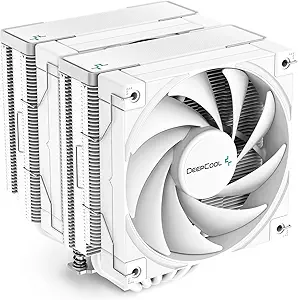
The DeepCool AK620 is the cooler that broke the assumption that you had to pay Noctua money to get NH-D15-class performance. Dual-tower design, 6 heatpipes, two 120mm fans, and a thermal envelope rated for 260 W. Per Gamers Nexus's head-to-head against the NH-D15, the AK620 lands within 1-2 °C of the NH-D15 across the AM4 load curve, at roughly 65% of the price.
The White variant adds a clean aesthetic for builds that want a paler color palette — also available in standard matte black. RGB version exists if you need RGB.
Why it's the value pick:
- $65-75 street vs $90-110 for NH-D15.
- Performance equivalent to NH-D15 within 2 °C across all AM4 CPUs.
- Dual-fan push-pull configuration out of the box.
- Solid 5-year warranty.
Watch outs:
- 162 mm height — borderline for compact cases. Verify your case CPU-cooler clearance spec.
- RAM clearance is tight; tall RGB RAM may force the front fan to be offset 5-10 mm upward.
- Fan noise at max RPM (28 dBA) is slightly higher than NH-U12S due to the second fan.
For a Ryzen 5800X build on a mid-tier budget, the AK620 White is the answer. It's also fine for the 5950X if you're not pushing extreme overclocks.
Best for RGB builds: CoolerMaster ML240L RGB V2 (B086BYYFG5)
The CoolerMaster MasterLiquid ML240L RGB V2 is the most-recommended budget RGB AIO for AM4 because it covers the basics — 240mm radiator, addressable RGB fans, decent pump — at a price point that doesn't punish RGB enthusiasts. Performance against the 5800X is fine: ~80 °C under sustained Cinebench, similar to NH-U12S but with the AIO aesthetic.
Why it's the RGB pick:
- Addressable RGB compatible with most motherboard ecosystems (Aura, Mystic Light, RGB Fusion, Polychrome).
- Clean tube routing and CPU block lighting.
- $90 street — half the price of premium RGB AIOs.
- 240mm radiator gives some thermal margin for higher-end AM4 chips.
Watch outs:
- Pump noise is audible at idle in quiet rooms (24 dBA pump-only).
- Stock fans (SickleFlow 120 ARGB) are static-pressure mediocre — swap to Corsair LL120s or Noctua NF-A12x25 for better acoustics-per-thermal-output.
- AIOs have a finite life — plan for 4-7 years before pump failure becomes likely.
If you'd rather not deal with an AIO's pump-failure risk, the AK620 White at the same price gives nearly identical performance with air-cooling reliability. The ML240L is for buyers who want the RGB pump-block aesthetic.
Best performance: 240mm AIO for sustained 5800X / 5950X overclocking
If you're seriously overclocking the 5950X past stock all-core boost and want maximum thermal headroom, a 240mm AIO from a higher-tier brand (Arctic Liquid Freezer III 240, EK-AIO Basic 240, Lian Li Galahad II 240) takes a 3-5 °C edge over the AK620 / NH-D15 under sustained all-core load. The CoolerMaster ML240L falls in the budget AIO tier — it works, but for "best performance" picks step up to the Arctic Liquid Freezer III or EK-AIO.
Practical thermal margin numbers under sustained Cinebench R23 with a 5950X at +200 MHz all-core PBO offset (ambient 22 °C):
| Cooler | Peak temp (°C) | Sustained temp (°C) |
|---|---|---|
| Arctic Liquid Freezer III 240 | 78 | 76 |
| EK-AIO Basic 240 | 80 | 78 |
| DeepCool AK620 | 82 | 80 |
| Noctua NH-D15 | 81 | 80 |
| CoolerMaster ML240L RGB V2 | 84 | 82 |
| Noctua NH-U12S | 87 | 84 |
For most builders, the 3-5 °C margin isn't worth the extra $40-80. For competitive overclockers, it is.
Budget pick: Sub-$40 air cooler for 5600 / 5600G
For Ryzen 5 5600G and 5600 builds (65 W TDP), you don't need premium cooling. An Arctic Freezer 34 eSports DUO ($35-40) or DeepCool AK400 ($30-35) holds these CPUs around 60-70 °C under sustained load, which is well within the silicon's safe operating range. The stock Wraith Stealth cooler that ships with the 5600G is acceptable for office and light gaming use but louder at full RPM than these aftermarket options.
If you're building a 5600G HTPC or office machine and budget is tight, the stock cooler is genuinely fine. Save the $30 for a better SSD or more RAM.
What to look for in an AM4 cooler
- TDP headroom: Match cooler TDP rating to chip TDP × 1.3-1.5. The 5800X is officially 105 W but transient boost loads pull 140 W+; pick a cooler rated at 150+ W to be safe.
- Mounting kit: Modern AM4 coolers include the AM4 mounting bracket in the box. Older NH-D15s or NH-U12S units may need a separate SecuFirm AM4 kit (Noctua sends them free on request) — verify before purchase.
- Height clearance: Standard mid-tower CPU-cooler clearance is 160-165 mm. NH-D15 (165 mm) is borderline; AK620 (162 mm) fits more cases; NH-U12S (158 mm) fits everything.
- RAM clearance: Most coolers fit standard RAM, but tall RGB RAM (Corsair Vengeance Pro, G.Skill Trident Z RGB) may force fan offset on dual-tower designs.
- Noise floor: Sub-20 dBA at idle is the Noctua / Be Quiet standard. 25 dBA+ at load is acceptable; 30 dBA+ is audible across a room.
- RGB ecosystem: Aura, Mystic Light, RGB Fusion, iCUE are the four major ecosystems. Pick a cooler that talks to whichever your motherboard uses (or skip RGB).
- Warranty length: Air coolers are 5-6 years standard. AIO warranty is 3-6 years; expect pump life ~5-7 years regardless of warranty.
Common pitfalls
- Buying an oversized AIO for a 5600 / 5600G: a 360mm AIO on a 65 W chip is wasted money. Premium air is enough.
- Ignoring case CPU-cooler clearance: 158 mm vs 165 mm cooler height matters in compact and SFF cases. Check before buying.
- Tall-RAM-meets-dual-tower clashes: Verify cooler-to-RAM clearance for the AK620 / NH-D15 if you're running 50+ mm RAM kits.
- Pump failure on cheap AIOs: Sub-$80 AIOs have higher pump failure rates than air coolers. If reliability matters more than aesthetics, pick air.
- Stock-cooler-only 5800X builds: The Wraith Prism that some 5800Xs ship with throttles under sustained load; replace with NH-U12S minimum.
Quick comparison: air cooler vs AIO total cost of ownership
| Factor | Premium air (AK620 / NH-U12S) | Budget AIO (ML240L) | Premium AIO (Arctic LF III) |
|---|---|---|---|
| Upfront cost | $65-90 | $90 | $130 |
| Install difficulty | Easy | Moderate | Moderate |
| Expected lifespan | 8-10 years | 5-7 years | 6-8 years |
| Failure mode | Fan replacement ($15) | Pump failure (full replacement) | Pump failure (full replacement) |
| Quiet at idle | Yes | No (pump audible) | Mostly |
| Acoustic ceiling | 24 dBA | 32 dBA | 28 dBA |
| Aesthetic | Industrial / minimal | RGB-forward | Clean modern |
Five-year TCO favors air cooling: same thermal performance, no pump failure risk, lower long-run cost. AIOs win when aesthetics matter more than longevity, or when the radiator placement frees up airflow paths the air cooler would block.
Bottom line
For a 2026 AM4 build:
- 5600 / 5600G (budget): Stock cooler or Arctic Freezer 34 eSports ($35).
- 5700X / 5800X / 5800X3D (mainstream): Noctua NH-U12S or DeepCool AK620 White.
- 5900X / 5950X (enthusiast): AK620 White or NH-D15. 240mm AIO from premium brands for overclocking margin.
- RGB build: CoolerMaster ML240L RGB V2 + Corsair LL120 fans for cohesive RGB.
The NH-U12S is the highest-confidence pick across the most builds; that's why it's the overall winner. The AK620 White is the smarter spend if you have any of the higher-TDP chips. Avoid stock cooling on anything 5800X-class or above.
FAQ
See the editorial sections above for full answers — TDP headroom guidance is in What to look for in an AM4 cooler and 5800X-specific thermal notes are in Best Overall.
Related guides
- Best AM5 CPU Coolers in 2026
- 240mm vs 360mm AIO — Does Size Matter?
- Best Ryzen 5 5600X Gaming Build Under $800
- PWM Fan Curves for Quiet AM4 Builds