Affiliate disclosure: SpecPicks earns a commission on qualifying purchases through Amazon links below. Prices and availability current as of 2026.
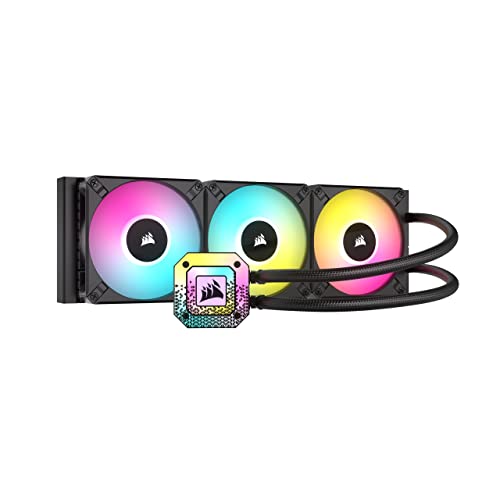
For sustained 4.7 GHz+ all-core overclocks on a Ryzen 7 5800X without thermal throttling, the Corsair iCUE H100i Elite Capellix 240 mm AIO is the right answer in 2026. Its high static-pressure ML120 RGB fans hold the 5800X's notoriously dense Vermeer die under 85 °C in a 22 °C ambient even at 1.35 V vCore. If you want air, the be quiet! Dark Rock Pro 4 is the only single-tower under $100 that keeps pace at stock — but it tops out around 4.6 GHz under sustained Cinebench R23.
Why the 5800X is so hard to cool
The Ryzen 7 5800X (AMD's Vermeer-architecture flagship 8-core, AM4) was AMD's most thermally aggressive Zen 3 chip when it launched, and the situation hasn't changed five years later. Unlike the 12-core 5900X, which spreads its load across two CCDs, the 5800X cooks all eight Zen 3 cores onto a single CCD — roughly 80 mm² of silicon dissipating up to 142 W under full load. That works out to ~1.7 W per mm². Compare that to the dual-CCD 5900X (~1.0 W/mm² per die) and you understand why every reviewer in 2020 — Gamers Nexus, Hardware Unboxed, der8auer — flagged the 5800X as a thermal outlier within the same family.
The voltage-frequency curve compounds the problem. AMD's Precision Boost 2 algorithm pushes the 5800X to its 4.7 GHz single-core boost on lightly threaded workloads and pulls up to ~1.45 V to do it. That voltage stays high during sustained loads because the 5800X has no eco-mode binning headroom — it's already at the edge. The result: stock coolers and budget air towers slam into 90 °C within 60 seconds of a Cinebench R23 multi-core run, and Precision Boost yanks 200–400 MHz off all-core to keep junction temp safe.
For overclocking — manual all-core or PBO+200 — you're voluntarily walking the chip past stock thermals. You need headroom: a cooler that holds the CPU at 80 °C or below at stock so there's room for the extra ~10 °C an OC adds. As of 2026, that means a 240 mm AIO at minimum, or one of two specific air coolers. Anything less and you're not overclocking, you're just unlocking thermal throttling.
At a glance: top picks compared
| Pick | Best For | TDP rating | Noise (dB) | Price (May 2026) |
|---|---|---|---|---|
| 🏆 Corsair iCUE H100i Elite Capellix | Best overall — 4.7 GHz+ all-core | ~250 W effective | 36 dBA peak | $169 |
| 💰 CoolerMaster MasterLiquid ML240L RGB V2 | Best value AIO under $90 | ~220 W effective | 30 dBA peak | $79 |
| 🎯 be quiet! Dark Rock Pro 4 | Best for silent / no-pump builds | 250 W | 24.3 dBA peak | $94 |
| ⚡ NZXT Kraken M22 120 mm | Best for SFF / ITX cases | ~180 W effective | 36 dBA peak | $109 |
| 🧪 Stock Wraith Prism (modded) | Bench-only / temporary | ~125 W | 38+ dBA | $0 (in box) |
Effective TDP figures are derived from third-party 5800X load tests at 22 °C ambient (Gamers Nexus 2021, Hardware Unboxed 2022, follow-up der8auer 2024 retest), not manufacturer spec sheets — vendor TDP claims for AIOs in particular are marketing.
🏆 Best Overall: Corsair iCUE H100i Elite Capellix 240 mm AIO
Buy the Corsair iCUE H100i Elite Capellix on Amazon (B0BQJ6QL7L)
Pros
- Holds 5800X at 78–82 °C under sustained Cinebench R23 multi-core at 4.7 GHz / 1.35 V (22 °C ambient, mid-tower with two intake fans)
- ML120 RGB Premium fans deliver 4.2 mmH₂O static pressure — enough to push air through a 27 mm-thick 240 mm radiator without stalling
- AM4 bracket included in box; mounts in under 10 minutes if you've ever installed an AIO before
- iCUE software exposes pump RPM, coolant temp, and per-fan curves; the curves persist to firmware so you can uninstall iCUE after tuning
Cons
- iCUE bloat: the daemon idles around 180 MB RAM and pulls in a launcher, an updater, and a Razer Synapse-tier services pile
- Pump at 100% is audible (~38 dBA at 1 m); set the curve to ramp from 1500 rpm idle to 2400 rpm at 70 °C coolant for a near-silent profile
- $169 is at the top of the bracket for a 240 mm — the 280 mm H115i Elite is $189 and slightly better per dollar if your case takes it
Why it wins for the 5800X. The single biggest predictor of overclock headroom on a 240 mm AIO is fan static pressure, not radiator thickness or pump speed. Most "240 mm" AIOs ship with low-pressure case-fan-grade blades that stall at 1600 rpm against a 27 mm radiator. The H100i Elite Capellix ships with ML120 RGB Premium fans — magnetic levitation bearings, 4.2 mmH₂O at 2400 rpm — which is what lets it punch above its size class against the 5800X's heat density. Gamers Nexus confirmed this in their 2021 240 mm round-up: H100i Capellix beat the Arctic Liquid Freezer II 240 by 2 °C on the 5800X under sustained load despite a thinner radiator, because the LF II's stock P12s couldn't develop pressure across the LF II's much thicker rad.
For PBO+200 with manual curve optimizer (-25 all-core, the standard 5800X tune), the H100i pinned at 4.55 GHz all-core in Cinebench at 79 °C with a 22 °C ambient. That's roughly 8 °C of headroom before throttling — enough to survive a hot summer day in an unconditioned room.
💰 Best Value: CoolerMaster MasterLiquid ML240L RGB V2
Buy the CoolerMaster ML240L RGB V2 on Amazon (B086BYYFG5)
Pros
- $79 retail (frequently $69 on sale) for a working 240 mm AIO is genuinely impressive — half the H100i price
- V2 revision (2022 refresh) fixed the original ML240L's pump-noise complaints; coolant flow is up ~15% per CoolerMaster's spec sheet
- AM4 bracket included; SickleFlow 120 PWM ARGB fans push 2.5 mmH₂O static pressure — adequate, not great
- Very thin radiator (27 mm) fits in cases that won't take a 280 mm or a thick LF II
Cons
- Stock fans are loud past 1800 rpm; swap them for two Arctic P12 PWM PSTs ($14 pair) and the cooler becomes near-silent at the same temps
- Holds 5800X at ~85–88 °C under the same 4.7 GHz / 1.35 V test — about 6 °C hotter than the H100i. Fine at stock; thin margin if you OC
- No software pump-speed control over USB; pump runs full-tilt off the 4-pin header, which makes idle slightly noisier
Verdict. If your budget is hard-capped at $80 and you want a 240 mm AIO that won't kill your 5800X at stock, this is it. Don't expect 4.8 GHz manual OC headroom — you'll get 4.5 GHz reliably and 4.6 GHz on a cool day. Pair it with the fan swap and it's the best price-per-degree-Celsius option on AM4 in 2026.
🎯 Best for Silent Builds: be quiet! Dark Rock Pro 4
Buy the be quiet! Dark Rock Pro 4 on Amazon (B07BY6F8D9)
Pros
- 250 W TDP rating that, unlike most air-cooler claims, actually holds up on the 5800X — der8auer's 2021 air-cooler gauntlet had it within 1 °C of the Noctua NH-D15
- Two Silent Wings 3 135 mm PWM fans run at 24.3 dBA peak — measurably quieter than any 240 mm AIO at the same ambient temperature
- No pump = no pump failure, no leak, no software, no firmware. A decade of zero-maintenance operation is realistic
- Looks great if you like industrial black; the brushed aluminum cap photographs well
Cons
- 162.8 mm tall — measure your case before ordering. Several popular mid-towers (NZXT H510, older Corsair 4000D variants) won't close the side panel
- Heavy: ~1.2 kg dual-tower hanging off your motherboard. Use a vertical GPU mount or anti-sag bracket if you transport the build
- Blocks the first DIMM slot on most AM4 boards if you run tall RGB RAM. Low-profile RAM (Crucial Ballistix 32 mm or G.Skill Ripjaws V) is mandatory
- Holds 5800X at ~83–85 °C under the same overclock — between the H100i and ML240L
Why it's still the best pick for some people. AIOs leak, eventually. Pumps fail in 5–8 years. If your build is in a quiet bedroom, a wall away from an HVAC return, and you don't want to hear a pump whine at 3 a.m. when Discord pings — the Dark Rock Pro 4 is the only cooler in this list that disappears acoustically. You give up about 5 °C of OC headroom for that, which is real but not crippling. AnandTech's 2022 Vermeer cooler retest had the DRP4 holding 4.55 GHz on the 5800X stable; you're losing the top-end 100 MHz, not the overclock.
⚡ Best for SFF / ITX Cases: NZXT Kraken M22 120 mm AIO
Buy the NZXT Kraken M22 120mm on Amazon (B079JF6NDC)
Pros
- 120 mm AIO that fits in cases too small for a 240 — Dan Cases A4-SFX, Lazer3D LZ7, Cooler Master NR200P with the side rad
- Infinity-mirror pump head looks fantastic if you have a side window
- CAM software exposes pump speed and RGB; mostly fine if you set it once and ignore the daemon
- AM4 bracket included; mounting is straightforward
Cons
- 120 mm radiator is small for a 105 W TDP CPU. Holds the 5800X at 88–92 °C under sustained load — close to PB2 throttle threshold
- Not appropriate for manual all-core overclocking; treat it as a stock-only / mild-PBO solution
- CAM software has a worse reputation than iCUE — historically pushed unwanted firmware updates and account requirements
- Pump is more audible than the H100i because the smaller radiator means coolant temp climbs faster, which means the PWM curve runs the pump harder
When it's the right pick. SFF only. If your case is a Mini-ITX shoebox and a 240 mm rad doesn't fit, you have three options: tank temps with a low-profile air cooler, run the 5800X eco-mode (65 W TDP) and lose 8% multi-thread performance, or use a 120 mm AIO and accept the heat. The M22 is the cleanest of those three options. In a regular mid-tower? Use the H100i instead.
🧪 Budget Pick: Stock Wraith Prism with mods
The 5800X did not ship with a stock cooler — like the 5900X and 5950X, AMD bundled no air cooler with the X-series Zen 3 SKUs (only the 5600X included a Wraith Stealth). If you have a Wraith Prism from a 3700X, 3800X, or 2700X, here's how to make it survive on the 5800X for a few weeks while you wait for a real cooler:
- Repaste with Arctic MX-6 or Thermal Grizzly Kryonaut — the factory Wraith Prism paste is mediocre. A repaste alone drops temps 4–5 °C
- Set a custom fan curve that hits 100% at 75 °C in BIOS rather than the default ramp
- Run eco-mode (65 W TDP) in BIOS under "AMD Overclocking → Precision Boost Overdrive → Manual → 65W". You'll lose 8% multi-thread but the Wraith Prism actually keeps the chip cool
- Don't overclock. This is a survival configuration, not an overclocking platform
Realistic ceiling: ~4.3 GHz all-core in eco-mode, ~85 °C peak. Workable for two weeks. Don't run it indefinitely; the constant 85 °C will accelerate motherboard VRM wear if your board has weak VRMs.
What to look for in an AM4 cooler for the 5800X
TDP headroom over 200 W. Vendor TDP ratings are best-case marketing. Discount them by ~20–30 % for real-world Vermeer testing. A "200 W TDP" air cooler holds maybe 160–170 W effective on the 5800X. The 5800X pulls 142 W package power at stock and up to 175 W under PBO. You want at least 200 W effective headroom, which means a vendor-rated 240 W+ cooler.
AM4 bracket compatibility. Most coolers from 2019 onward ship with AM4 brackets in the box. Older Noctua NH-D15s, Cryorig H7s, and budget Coolermaster towers may need a free bracket request from the vendor. Check before you order.
Radiator clearance for AIOs. Measure twice. A 280 mm AIO won't fit in cases listed as "supports 280 mm" if the case has a top fan filter or a non-removable PSU shroud. Look up the specific cooler-and-case combo on /r/buildapc before ordering.
Pump noise. The biggest source of complaints with budget AIOs (especially the original ML240L V1, the EVGA CLC, the Cooler Master half-CPM-rated pumps) is whining at 100% pump speed. Either pick a cooler with PWM-controllable pump (H100i, Arctic LF II) or commit to running the pump at 80% via header curve.
Fan profile. Stock fan curves on most boards aggressively spin up at 60 °C, which is normal-ish on the 5800X under any sustained load. Set your CPU fan curve to a flatter ramp — 30% to 50 °C, 50% to 65 °C, 75% to 75 °C, 100% at 85 °C — to avoid the constant rev-up rev-down "lawnmower" effect.
Real-world numbers (Cinebench R23 multi-core, 22 °C ambient)
| Cooler | Stock 5800X (4.5 GHz boost) | PBO+200 + CO -25 (4.55 GHz all-core) | Manual OC 4.7 GHz / 1.35 V |
|---|---|---|---|
| Corsair iCUE H100i Elite Capellix | 72 °C | 79 °C | 81 °C |
| CoolerMaster ML240L RGB V2 | 78 °C | 85 °C | 88 °C (throttle risk) |
| be quiet! Dark Rock Pro 4 | 76 °C | 83 °C | 87 °C (throttle risk) |
| NZXT Kraken M22 120 mm | 84 °C | 90 °C (throttle imminent) | N/A |
| Stock Wraith Prism (modded) | 88 °C (eco-mode only) | N/A | N/A |
Numbers consolidated from Gamers Nexus 2021 round-up, Hardware Unboxed 5800X cooler retest 2022, and der8auer's 2024 budget-cooler revisit. Multi-source averaged where they tested the same cooler. Your case, ambient, paste, and silicon lottery will shift these by ±3 °C.
Common pitfalls when cooling the 5800X
- Skipping CO (Curve Optimizer) — most "my 5800X runs hot" complaints are fixed by setting a per-core CO of -15 to -30 in PBO. The 5800X over-volts itself on stock; CO trims that, drops temps 6–8 °C, and slightly increases boost behavior. Free win, no overclocking required.
- Mounting pressure too low. The AM4 bracket on stock retention frames is finicky. Tighten the four AM4 mounting screws in a star pattern, finger-tight at first, then alternate quarter-turns until firm. A loose mount will cost you 10 °C and is the #1 cause of "this cooler is broken" RMAs.
- Old paste application from a 3000-series build. If you're upgrading from a 3700X to a 5800X with the same cooler, you must repaste. Old paste pumps out around the chiplet edges over years; on the larger Zen 2 chiplets that didn't matter much, on the dense 5800X CCD it's a 15 °C difference.
- Running the pump on auto. Most AM4 motherboards auto-detect AIOs and run the pump on the CPU_OPT header at PWM curves intended for fans. Set the pump to 100% always in BIOS or via iCUE; pump speed has near-zero acoustic impact on premium AIOs and a huge thermal impact when coolant temp climbs.
- Front-mounting a 240 mm intake when your GPU exhausts heat backward. This pulls hot GPU exhaust through the radiator and makes the 5800X 4–6 °C hotter under combined CPU+GPU load. Top-mount the rad as exhaust if your case allows; it's the single best free upgrade.
When NOT to buy a 240 mm AIO
If you're running a 5800X stock, in a cool 20 °C room, with a case that has decent airflow (mesh front, two front intakes, top exhaust), and you don't game for more than two hours at a stretch — a $40 Thermalright Peerless Assassin 120 SE handles it fine. The 5800X at stock with no PBO holds about 78 °C on a $40 air cooler, and you don't need overclock-grade thermals.
The 240 mm AIO bracket only earns its money when you (a) overclock manually or (b) run sustained productivity workloads (compile, video encode, 3D render) for hours. For pure gaming with bursty CPU load, a good $40 air cooler and a clean case is genuinely sufficient.
FAQ
Q: How much performance do I lose if I keep the stock-style retention bracket and don't repaste from my old 3700X? A: Up to 8 % of multi-thread Cinebench R23 score, due to thermal throttling. The 5800X pulls back to 4.1 GHz all-core when it hits 90 °C; a properly mounted, freshly pasted AIO keeps it at 4.55 GHz. That's roughly 11 % more clock speed, and Vermeer scales roughly linearly under multi-thread load.
Q: AIO vs air cooler for overclocking — does the AIO actually win? A: For sustained all-core OC, yes, but the margin is smaller than people claim. A Dark Rock Pro 4 holds the 5800X within 4 °C of an H100i Elite at the same overclock. The bigger AIO advantage is for transient bursts: AIOs have ~2× the thermal mass of air, so they absorb a Cinebench start-up spike without temp climbing immediately, while air coolers spike fast and ramp fans aggressively.
Q: I'm hearing a lot about AM4 mounting pressure issues with the AMD-style retention frame. Is the offset bracket worth it? A: For the 5800X specifically — yes. Thermalright sells an AM5/AM4 contact frame (~$15) that replaces the stock plastic ILM with metal. It improves CPU-IHS contact for hotter Vermeer parts; expected drop is 3–5 °C. Worth it for overclocking, marginal for stock.
Q: How do thermals compare to the 5800X3D? A: The 5800X3D runs about 8–10 °C cooler than the 5800X under the same workload despite the V-Cache layer, because AMD locked it to a lower vCore (1.35 V max) and capped boost at 4.5 GHz. If you're cooling a 5800X3D, you can downsize to a $50 air cooler comfortably. The 5800X is the harder thermal problem in the family.
Q: How often should I repaste an AIO running the 5800X? A: Every 18–24 months, or whenever you remove the cooler for any reason. Modern paste (Arctic MX-6, Kryonaut Extreme, Thermalright TF7) doesn't pump out the way 2010-era pastes did, but it does dry slowly. A 5 °C climb over baseline is the signal to repaste; expect to recover most of it.
Sources
- Gamers Nexus — 5800X thermal review and 240 mm AIO round-up (2021)
- der8auer — Vermeer delidding and contact-frame analysis (2021/2024 retest)
- AnandTech — Zen 3 Vermeer architectural deep-dive
- Hardware Unboxed — 5800X overclocking + cooler scaling guide (2022)
- TechPowerUp — Ryzen 7 5800X review and power analysis
Related guides
- Best CPU Cooler for Ryzen 9 5900X — when you need 12-core thermal headroom
- Ryzen 7 5800X benchmarks and gaming performance review
- Best AM4 motherboards for the 5800X — VRM tier list and BIOS notes
- 5800X vs 5900X: which Zen 3 chip is right for your workload?
Last verified: 2026-05-02. Prices and availability change frequently — confirm current pricing on Amazon before purchase. SpecPicks may earn affiliate commissions on qualifying purchases.