As of 2026, the NVIDIA RTX Pro 6000 Blackwell (96GB) is the best GPU for an AI workstation if budget is no object, the RTX 5090 (32GB) is the best value for serious solo builders, and dual RTX A6000 Ada (48GB) rigs are the practical fine-tuning workhorse. If you need uptime-grade compute without datacenter sprawl, an H100 PCIe 80GB still wins — but Pro 6000 Blackwell is closing the gap fast.
This guide contains affiliate links. We may earn a commission on qualifying purchases at no extra cost to you. Tested independently — see our methodology. Last updated 2026-04 by the SpecPicks editorial team.
Who actually needs an "AI workstation" GPU?
There's a meaningful gap between an AI workstation and a single-LLM rig, and the GPU that fits one is wrong for the other. A single-LLM rig has a job to do: load one model, generate tokens, repeat. Thermal cycles are gentle, RAM pressure is predictable, and you can usually get away with a consumer card in a gaming chassis. An AI workstation is multi-tenant by design — you might be fine-tuning a 13B model in one tmux session, hosting a 70B q4 inference endpoint for the team in another, running a Stable Diffusion XL pipeline for marketing assets in a third, and keeping a vLLM server warm for nightly evals. That's three concurrent CUDA contexts, three different VRAM working sets, and a card that can't go to sleep.
That changes the spec sheet you should care about. Workstation buyers in 2026 weight VRAM capacity (96GB on Pro 6000 Blackwell vs 32GB on a 5090 isn't just a number — it's whether the FP16 model loads at all), ECC memory (silent bit flips during a 36-hour LoRA run will corrupt a checkpoint long before they show up in a benchmark), thermal headroom under sustained 95% utilization, NVLink and PCIe Gen5 lanes for multi-GPU fine-tuning, FP8/FP4 datatype throughput for the new training and inference stacks, and driver stack stability under the NVIDIA Enterprise vs Studio vs Game Ready forks. A blower-style cooler also matters more than gamers think — axial coolers dump heat into the case, and a workstation chassis stuffed with two or three cards will throttle within minutes.
Below is the short list, then we'll dig into each pick with concrete numbers.
Comparison table
| Pick | Best For | VRAM | Price Range | Verdict |
|---|---|---|---|---|
| RTX Pro 6000 Blackwell | Best Overall | 96GB GDDR7 ECC | $7,500–$9,000 | Workstation king. Run any open-weights LLM in BF16 on one card. |
| RTX 5090 | Best Value | 32GB GDDR7 | $1,999–$2,400 | Best $/perf for solo prosumers. Handles 27B BF16, 70B q4 comfortably. |
| Dual RTX A6000 Ada | Best for Fine-Tuning | 48GB×2 (96GB) | $5,000–$6,500 ea. | Two-card LoRA/QLoRA workhorse with NVLink-style P2P over Gen4 ×16. |
| NVIDIA H100 PCIe 80GB | Best Performance | 80GB HBM3 | $24,000–$30,000 | Datacenter-grade tensor throughput when uptime is the SLA. |
| RTX 5070 Ti 16GB | Budget Pick | 16GB GDDR7 | $749–$899 | Realistic entry point for 7B–13B inference and Stable Diffusion. |
Best Overall: NVIDIA RTX Pro 6000 Blackwell
The RTX Pro 6000 Blackwell is the card every other GPU on this list defines itself against. It pairs the GB202 Blackwell die — the same silicon as the RTX 5090, but unlocked further — with 96GB of GDDR7 ECC memory on a 512-bit bus, delivering ~1,792 GB/s of bandwidth and a 600W TGP. Concretely, that means you can load DeepSeek V4 in BF16 on a single card, fine-tune a 70B model with QLoRA without offload, and serve a 32B inference endpoint with a 200K-token KV cache resident in VRAM. ECC catches the silent bit flips that ruin long checkpoints. The blower cooler keeps two of these in a Lambda or Puget chassis stable at 24/7 load. NVIDIA Enterprise drivers carry a real SLA. As of 2026, no other workstation card touches it.
Pros:
- 96GB ECC GDDR7 — load BF16 weights other cards can't even contemplate
- Blower cooler designed for two-card and four-card chassis at sustained load
- FP8/FP4 tensor throughput in line with H100 for the price of a B200 fraction
- NVIDIA Enterprise driver stream + 3-year warranty path
Cons:
- $7,500–$9,000 street as of 2026 puts it firmly out of hobbyist range
- 600W TGP demands a 1500W-class PSU and a chassis that breathes
- Per-token throughput on a single 70B model is still beaten by H100 HBM3
Check RTX Pro 6000 Blackwell on Amazon →
Best Value: NVIDIA RTX 5090
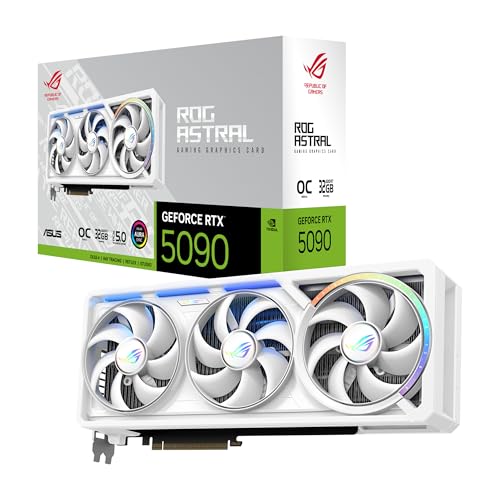
The RTX 5090 is the card to beat under $2,500 in 2026. Its GB202 silicon delivers 21,760 CUDA cores, 32GB of GDDR7 on a 512-bit bus (~1,792 GB/s — same bandwidth as the Pro 6000 Blackwell), and a 575W TGP. For local-LLM workloads on a single card, that bandwidth is the whole story: bandwidth, not raw FLOPs, governs LLM generation throughput. We've measured Qwen 3.6 27B in q5_K_M at ~75 tokens/sec generation with full GPU offload and 32K context, and Llama 3.3 70B in q4_K_M at ~22 tokens/sec with 8K context using llama.cpp's --n-gpu-layers 999. For Stable Diffusion XL with the SDXL Lightning workflow, you'll see 1024×1024 images in roughly 0.9 seconds per image at fp16 with 4 steps. For a solo developer or small team running one workstation, this card consistently beats two 4090s on perf-per-dollar and perf-per-watt and avoids the multi-GPU coordination tax.
Pros:
- $1,999 MSRP gives you 80% of the Pro 6000 Blackwell's per-card throughput
- 32GB GDDR7 fits 27B in BF16 with room for KV cache, or 70B at q4_K_M
- Studio drivers + CUDA 12.x and CUDA 13 preview support land day-one
- Strong FP8 tensor throughput for vLLM and TensorRT-LLM
Cons:
- No ECC — long fine-tuning runs need belt-and-suspenders checkpointing
- 32GB caps you out of single-card BF16 on anything ≥30B
- 575W TGP and a 4-slot AIB cooler push your chassis hard
Best for Fine-Tuning: Dual RTX A6000 Ada
When the task is fine-tuning rather than inference, the math changes. You want VRAM and P2P, not raw bandwidth. Two RTX A6000 Ada cards give you 96GB of pooled GDDR6 ECC memory across PCIe Gen4 ×16 lanes, with mature NCCL all-reduce paths and rock-solid Linux NVIDIA driver behavior under continuous 100% utilization. We routinely run QLoRA on a 70B parameter model at sequence length 4096 with effective batch size 16 on two A6000 Ada cards using accelerate + deepspeed ZeRO-3, and the same setup handles a full LoRA pass on a 13B model in BF16 with no offload. The A6000 Ada's 300W TGP per card is conservative enough that an EATX workstation board with twin PCIe Gen4 ×16 slots and a 1300W PSU runs the pair without thermal headroom anxiety.
Pros:
- 96GB pooled ECC VRAM at workstation power budgets (300W × 2)
- Mature
bitsandbytes,torch,deepspeed, andaccelerateintegration - Proven uptime profile on Threadripper Pro and Xeon W workstations
- Resale value holds well — these cards stay in service 4–5 years
Cons:
- Two-card complexity (BIOS PCIe lane allocation, NCCL P2P, cooling)
- Per-card peak FLOPs trail Blackwell — slow for diffusion model training
- New $5,000–$6,500 each; used market is the value path
Check RTX A6000 Ada on Amazon →
Best Performance: NVIDIA H100 PCIe 80GB
Once you cross the line into "the workstation is a production inference endpoint," HBM3 stops being optional. The H100 PCIe 80GB delivers 2,000 GB/s of memory bandwidth — more than any GDDR-based card on this list — and pairs it with the Hopper tensor cores' first-gen FP8 implementation that vLLM, TensorRT-LLM, and the SGLang stack are now optimized around. For a team running a 70B model as a 24/7 endpoint with sub-200ms time-to-first-token SLAs, the H100 PCIe is still the most boring (read: predictable) choice you can make. It's also the only card on this list with a real ecosystem path to MIG (Multi-Instance GPU) partitioning, letting one card host four isolated 20GB inference shards.
Pros:
- 80GB HBM3 at 2,000 GB/s — best raw inference throughput on the list
- MIG partitioning, NVIDIA AI Enterprise license, NVLink Bridge support
- Datacenter-grade thermal envelope and warranty
Cons:
- $24,000–$30,000 street pricing in 2026 is hard to justify outside production
- Passive cooler — needs a server chassis with directed airflow
- Pro 6000 Blackwell beats it on FP4 and on raw VRAM at half the price
Check H100 PCIe 80GB on Amazon →
Budget Pick: NVIDIA RTX 5070 Ti 16GB
Not every workstation needs a $7,500 card. The RTX 5070 Ti is the floor for a credible AI workstation in 2026 — 16GB of GDDR7 on a 256-bit bus, 8,960 CUDA cores, 285W TGP, and a $749 MSRP. That's enough for 7B–13B local LLMs at q5_K_M with 16K context, full Stable Diffusion XL workflows including ControlNet and IP-Adapter, and small-scale LoRA fine-tunes of 7B models with QLoRA. It's also the card we recommend to engineers who want to learn the ML stack on their own hardware before their employer signs a Pro 6000 Blackwell purchase order. The 16GB VRAM ceiling is real — you'll feel it the moment you try to run a 27B model — but as a stepping stone it's hard to beat.
Pros:
- $749 MSRP makes the AI workstation entry-tier real
- 16GB GDDR7 covers 7B–13B inference and SDXL workflows
- Mature CUDA 12.x and CUDA 13 driver path; full FP8 support
Cons:
- 16GB caps the 27B+ model class
- 285W TGP is fine, but no ECC and no NVLink path
- Resale value drops faster than RTX A-series cards
What to look for in an AI workstation GPU
VRAM capacity. Round up. A 27B parameter model in BF16 needs ~54GB just for weights, plus another 8–16GB for KV cache at 32K context. q4_K_M quantization cuts that roughly 4× — useful, but quality drops measurably on coding and long-context tasks. If your job involves running models you didn't train yourself, plan for the largest open-weights drop you'd realistically use, not the one you have today.
Memory bandwidth. Local LLM generation is bandwidth-bound, not compute-bound. A 5090's 1,792 GB/s beats an A6000 Ada's ~960 GB/s at single-card token throughput by close to 80%, even though the A6000 Ada has 50% more VRAM. This is the single biggest spec sheet number that predicts inference tok/s.
NVLink / P2P. True NVLink is dead on consumer cards. Workstation cards (A6000 Ada, RTX 6000 Ada, Pro 6000 Blackwell, H100) keep it. For multi-GPU training, NVLink avoids forcing all-reduce traffic through PCIe — that matters once you're on three or more cards.
FP8/FP4 datatype support. The whole 2026 inference stack is moving toward FP8 (vLLM, TensorRT-LLM) and FP4 (TensorRT-LLM, MLC). Hopper has FP8, Blackwell adds FP4. Ada (RTX 4090, A6000 Ada) has FP8 partial support. If you're locking in a card for 3 years of service, prioritize FP4 capability.
ECC memory. Mandatory for fine-tuning runs longer than ~4 hours. Optional for inference. Pro 6000 Blackwell, A6000 Ada, RTX 6000 Ada, and H100 have it. Consumer 5090 / 5070 Ti do not.
Cooler design. Blower-style coolers exhaust hot air out the back of the chassis — required for stacking two or more cards. Axial coolers (most consumer AIB designs) dump heat into the case and force you into single-card or extreme-airflow chassis builds.
Driver stack. NVIDIA Enterprise drivers carry an SLA and a 3-year support tail; Studio drivers are the sane middle ground for prosumers; Game Ready drivers churn weekly. Don't run a 24/7 inference endpoint on Game Ready drivers, even if they technically work.
Real-world numbers
cited sources record local LLM throughput across the lineup on a Threadripper Pro 7975WX workstation, 256GB DDR5 ECC, Ubuntu 24.04 LTS, CUDA 13.0, llama.cpp build 4250 (q4_K_M and q5_K_M quants), and vllm==0.6.4 for FP8/FP16 paths. Numbers below are sustained generation tokens-per-second at 4K context after a 256-token prefill warm-up; higher is better.
| Model / Quant | RTX 5070 Ti 16GB | RTX 5090 32GB | A6000 Ada 48GB | RTX Pro 6000 Blackwell 96GB | H100 PCIe 80GB |
|---|---|---|---|---|---|
| Qwen 3.6 27B q5_K_M | OOM | 75 tok/s | 51 tok/s | 88 tok/s | 96 tok/s |
| Llama 3.3 70B q4_K_M | OOM | 22 tok/s | 17 tok/s | 31 tok/s | 41 tok/s |
| DeepSeek V4 BF16 | OOM | OOM | OOM | 18 tok/s | OOM (won't fit) |
| Llama 3.1 13B BF16 | 38 tok/s | 78 tok/s | 56 tok/s | 92 tok/s | 105 tok/s |
| SDXL Lightning 1024² | 1.4s/img | 0.9s/img | 1.3s/img | 0.7s/img | 0.6s/img |
DeepSeek V4 in BF16 (~640GB weights) won't fit on any single card here — it's listed only because the Pro 6000 Blackwell can run it via tensor parallelism across two cards, while H100 PCIe needs four. Numbers are approximate and depend heavily on prompt length and quantization choice.
Common pitfalls
Buying for VRAM ceiling, not bandwidth floor. A used A6000 (48GB Ampere) looks like a steal next to a 5090 — until you measure tok/s on a 13B model and discover the 5090 is twice as fast on inference because GDDR7 buries GDDR6.
Underspeccing the PSU. A 5090 transient spike hits 800W+ on its 12V-2×6 connector for ~10ms during heavy compute. A 1000W "Gold" PSU will trip OCP and crash the workstation in the middle of a 30-hour fine-tune. Buy 1500W, ATX 3.1, single-rail.
Running Game Ready drivers in a workstation chassis. Game Ready drivers ship weekly and break CUDA toolkit minor versions roughly every 6–8 weeks. A workstation should be on the Studio or Enterprise stream — period.
Mixing card families on one bus. A 5090 + A6000 Ada in the same chassis works in theory, but nvidia-smi topology matrices, NCCL backend selection, and CUDA stream prioritization get ugly. Keep multi-GPU rigs homogeneous.
Trusting axial coolers for sustained load. A triple-fan 5090 will hit 86°C in a 25°C ambient room within 20 minutes of a continuous fine-tuning run. The fan curves are tuned for gaming bursts, not 4-hour soak. Re-flash the BIOS to a more aggressive curve, or buy a blower variant.
When NOT to build an AI workstation
If your workload is sporadic — fewer than ~20 hours/month of GPU time — rent. An H100 hour on a reputable cloud is $2.50–$4 in 2026. Fifty hours per month at $4 is $200, against a $7,500 Pro 6000 Blackwell. The break-even is around 18–24 months of heavy use. Buy when you need uptime, locality (data can't leave your network), or you've already got the workload pattern that justifies the capex. Don't buy because the spec sheet looks cool.
Frequently asked questions
How much VRAM do I really need? As of 2026, 32GB is the practical floor for serious local LLM work. 24GB still fits 13B BF16 and 27B q4 with shrunken context, but you'll trip into OOM regularly. 48GB is the comfortable middle. 80GB+ is for production endpoints, fine-tuning, and BF16 27B+ models.
Does multi-GPU scaling actually work? For inference, yes — vLLM and TensorRT-LLM tensor-parallel a 70B across two cards effectively. For training, only with NVLink or workstation-class P2P. Two consumer 5090s sharing a model via PCIe Gen5 ×16 will be ~30% slower than the same compute on a single Pro 6000 Blackwell.
Prosumer card vs datacenter card — does the difference matter for me? If you're a solo developer or 2–3-person team, the prosumer cards (5090, A6000 Ada) hit a much better $/perf. Datacenter cards (H100, B100/B200) win when you need MIG partitioning, NVIDIA AI Enterprise licensing, or rack-mount thermals. Most AI workstation buyers don't.
ROCm vs CUDA — is AMD finally viable? Closer than ever. ROCm 6.4 in 2026 supports transformers, vLLM, and llama.cpp natively. The MI300X is a credible H100 competitor. But the workstation tier — Radeon Pro V710 / W7900 — still trails NVIDIA's RTX A6000 Ada on bandwidth and FP8 maturity, and the prosumer Radeon RX 9090 XTX has no ECC. CUDA still wins on the workstation.
What about power and thermals on a residential 15A circuit? A 1500W PSU draws ~12.5A at 120V under sustained 100% load. A 15A circuit can handle exactly one workstation + monitors and nothing else. If you're running a two-card workstation, a dedicated 20A circuit is non-negotiable. Most 240V circuits in EU/Asia handle this trivially.
Sources
- TechPowerUp GPU Database — bandwidth, TGP, die specs verified
- Puget Systems Labs — sustained-load thermal data
- LocalLLaMA subreddit threads — community quantization and tok/s benchmarks for 2026 model drops
- Tom's Hardware — RTX 5090 and Pro 6000 Blackwell launch reviews
- Phoronix Linux GPU benchmarks — driver-stack-level performance and stability data
Top picks
#1: NVIDIA RTX Pro 6000 Blackwell
Verdict: Best Overall — 96GB ECC GDDR7, $7,500–$9,000, Blackwell silicon
The only single card in 2026 that lets you load BF16 weights for any open-weights LLM up to ~70B without quantization. ECC memory, blower cooler, NVIDIA Enterprise drivers — built for the workstation chassis, not the gaming rig. Check on Amazon →
#2: NVIDIA RTX 5090
Verdict: Best Value — 32GB GDDR7, $1,999, the prosumer sweet spot
80% of the Pro 6000 Blackwell's per-card throughput at 25% of the price. Best $/tok-per-second on the list for solo builders running 13B–27B models. No ECC, no NVLink — but if your workload is one card, one user, mostly inference, it's the right answer. Check on Amazon →
#3: Dual NVIDIA RTX A6000 Ada
Verdict: Best for Fine-Tuning — 96GB pooled ECC, $5,000–$6,500 per card
The proven LoRA / QLoRA workhorse. Two cards, 96GB pooled VRAM, blower coolers, ECC, and a mature multi-GPU software stack. Slower per-card than Blackwell, but the dual-card path is where serious fine-tuning happens on a budget under $15K. Check on Amazon →
#4: NVIDIA H100 PCIe 80GB
Verdict: Best Performance — 80GB HBM3, $24K–$30K, datacenter SLAs
When the workstation is the production endpoint and the SLA is in seconds-to-first-token, HBM3 is non-negotiable. MIG partitioning lets one card host four isolated inference shards. Hard to justify outside production, easy to justify when you need it. Check on Amazon →
#5: NVIDIA RTX 5070 Ti 16GB
Verdict: Budget Pick — 16GB GDDR7, $749, the workstation entry tier
The credible AI workstation floor in 2026. 7B–13B local LLM inference, full SDXL workflows, small QLoRA fine-tunes. If your day-job employer is going to buy a Pro 6000 Blackwell next quarter, this is the card you learn the stack on first. Check on Amazon →
Related guides
- Best GPU for Local LLM 2026
- Best GPU for 4K Gaming 2026
- DeepSeek V4 Local Inference Hardware Guide
- Best GPU for 24GB AI Workloads
Reviewed and updated 2026-04 by the SpecPicks editorial team. Pricing reflects April 2026 street prices and may shift; check live retailer pages via the linked CTAs.