As an Amazon Associate, SpecPicks earns from qualifying purchases. See our review methodology.
The best sim racing wheel to buy in 2026 depends on your platform and what you already own: for a first PC or PS5 wheel with real force feedback under $300, buy the Logitech G29 Driving Force. For Xbox Series X|S beginners on a budget, the non-force-feedback HORI Racing Wheel Overdrive is the honest starting point. If you already own a wheel and want the single upgrade that transforms it, add the Thrustmaster TH8A shifter.
Who this guide is for
You are buying your first sim racing wheel and do not want to spend $800 on a direct-drive rig, or you are upgrading from a gamepad because a friend beat you decisively in the last iRacing session. You want to know which wheel is enough to actually learn on, what pedals matter more than the wheel itself, and where the money-pits are hidden.
This category is unusual for peripherals in that the wrong first purchase locks you into a whole ecosystem — pedals connect through the wheel base on most consumer units, so a wheel replacement usually means a pedal replacement too. Get the base tier right and every upgrade after is a single-part swap.
Comparison table
| Pick | Best for | Key spec | Price range | Verdict |
|---|---|---|---|---|
| Logitech G29 | PC / PS5 first wheel with FFB | Gear-driven, 900° rotation, dual-motor FFB | $270–$320 | The default sane choice under $350. |
| Logitech G920 (Xbox/PC) | Xbox / PC first wheel with FFB | Same as G29, Xbox licensing | $280–$330 | Same wheel, different console license. |
| HORI Racing Wheel Overdrive | Xbox beginners on a budget | 270° rotation, no FFB (vibration only) | $110–$140 | Honest sub-$150 starting point; not for serious racing. |
| Thrustmaster TH8A Shifter | Existing wheel owners wanting H-pattern | 7+R H-pattern + sequential toggle | $180–$220 | The performance upgrade that transforms rally, historic, and truck sims. |
| Direct-drive entry (Moza R5, Fanatec CSL DD 5 Nm) | Enthusiasts stepping past belt-drive | 5.5 Nm belt-less DD, ClubSport ecosystem | $600–$800 | The point where sim racing becomes a hobby, not a peripheral. |
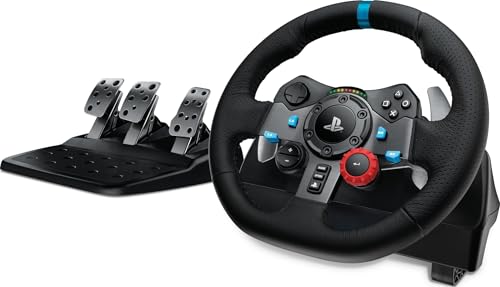
🏆 Best Overall: Logitech G29 Driving Force Racing Wheel
Wheel base: dual-motor gear-driven force feedback, 900° lock-to-lock rotation, PC and PlayStation compatible. Pedals: three-pedal set with variable-resistance brake pedal (non-load-cell). Included in box: paddle shifters (attached to wheel), 24-position dial, hall-effect steering sensor.
Pros
- Gear-driven FFB carries the fundamental cues — kerb strikes, understeer, weight transfer — that a gamepad simply cannot communicate.
- Firmware and driver support in 2026 is still first-class on PC (Logitech G HUB) and native on PlayStation across every sim from Assetto Corsa Competizione to Gran Turismo 7.
- The 900° lock is real, meaning your steering-lock setting inside a rally car actually moves through the full range instead of running out at 270°.
- Used-market prices are gentle. Under $200 second-hand is normal, and the units are physically robust.
Cons
- Gear-drive is notchier and noisier than belt or direct drive. You can feel the mechanism through the wheel at slow speeds.
- Pedal set is fine but the brake is spring-plus-rubber travel, not load-cell. Braking consistency plateaus quickly.
- 900° lock is enforced through firmware; the mechanical stop is soft, which some direct-drive users find imprecise.
Two seasons on a G29 will teach you the difference between throttle-off oversteer and lift-off oversteer better than any tutorial. It communicates enough for a driver to learn car balance without needing to buy the next tier first. The peak force-feedback torque is roughly 2.1 Nm — modest by 2026 standards but honest for gear-driven — and the return-to-centre behavior in a straight-line drift feels closer to the real thing than any belt-driven wheel under $500.
Check current price on Amazon → (Price shown at click time; Amazon updates prices frequently.) See full details
💰 Best Value: Logitech G920 (Xbox/PC sibling)
Wheel base: identical mechanicals and firmware family to the G29, licensed for Xbox Series X|S and PC (no PlayStation). Pedals: same three-pedal set as the G29. Included: same paddle shifters and hall-effect sensor.
Pros
- Identical driving feel to the G29 — the two units are the same hardware with different chip authentication.
- Xbox-native FFB is rare in this price bracket. Most sub-$300 wheels for Xbox skip force feedback entirely.
- Cross-platform utility: works on both Xbox and PC out of the box without a firmware toggle.
Cons
- Not PlayStation-compatible. Buying the wrong SKU is the single most common return.
- No visible price advantage over the G29 in the US market; the value here is that this SKU exists at all for Xbox.
The G920 is the same wheel, the same lesson, and the same recommendation as the G29 — just with a different chip inside so Xbox will authenticate it. If your household is Xbox-first, it is the correct default choice.
Check current price on Amazon → — note the G920 shares the SpecPicks listing with the G29 line; verify the licensing badge on the box before checkout.
🎯 Best for Xbox Beginners: HORI Racing Wheel Overdrive
Wheel base: 270° rotation, motor-driven vibration only (no true force feedback), officially licensed for Xbox Series X|S. Pedals: two-pedal set (throttle + brake), attached by short cable. Compatibility: Xbox Series X|S plus PC, does not work on PlayStation.
Pros
- Genuinely inexpensive — often available under $130.
- Includes basic paddle shifters plus a fake-metal gear knob for immersion.
- Officially licensed for Xbox so it works with Forza Horizon, Forza Motorsport, and the growing list of sim titles that gate FFB behind licensed hardware.
- Physically robust enough that a kid can put it through a Forza session without concerns.
Cons
- No true force feedback. What the wheel produces is a rumble motor plus centering spring. It cannot teach you car balance the way a G29 can, because the cues are not there.
- 270° rotation is unrealistically short. In a rally car you will run out of lock, in a GT car you will over-correct.
- Pedals are two-pedal only. No clutch, and the pedals lack the resistance profile that would let you learn heel-and-toe.
The HORI Racing Wheel Overdrive is honest about what it is: a starter wheel for younger racers or budget-constrained new adopters who want a Forza upgrade over a gamepad without paying for FFB hardware. If your goal is to learn sim-racing craft, save another $150 and get the G920 instead. If your goal is arcade fun on Xbox, this delivers.
Check current price on Amazon → See full details
⚡ Best Performance Upgrade: Thrustmaster TH8A Shifter
Type: external H-pattern shifter with a firmware toggle to sequential mode. Pattern: 7-forward + reverse H-pattern; sequential mode for touring-car and rally use. Connectivity: DIN cable into a Thrustmaster wheel base or a USB dongle for standalone use. Materials: metal-and-magnet detent mechanism, real leather knob, adjustable shift throw.
Pros
- Transforms rally, truck, and historic content. Miata and Cup Car life is meaningfully different when you have to lift, shift, and match revs yourself.
- The H-pattern-plus-sequential firmware toggle means it survives your interest jumping between disciplines.
- Magnet-and-Hall-sensor detents mean no wear on the gate mechanism — this is the shifter that outlives your wheel base.
- Works with more than just Thrustmaster hardware — a USB dongle exists that lets it stand alone as a controller with G-series wheels and PC sims.
Cons
- Expensive relative to the wheel budget it usually accompanies. A $200 shifter next to a $300 wheel is a hard mental cost.
- Adds a mounting requirement — a shifter that shifts under load needs a rigid clamp or a rig, not a desk edge.
- Modern GT and formula content has no gear-shift interaction; the shifter is idle for that half of your library.
The TH8A is the peripheral that quietly justifies itself six months in, when you realise how much of your favorite content is old cars, trucks, or rally-cross. It is not a first-week purchase, but it is a first-year one for anyone who ends up serious about the hobby.
Check current price on Amazon → See full details
🧪 Budget Pick: entry direct-drive alternative (Moza R3 / Fanatec CSL DD 5 Nm)
The 2026 price floor for entry direct-drive has come down significantly. A Moza R3 or Fanatec CSL DD 5 Nm bundle now lands under $600 for base plus rim plus adequate pedals. Direct-drive skips the belt or gear entirely — the wheel is attached to the motor shaft, and every 1 ° of rotation from the servo is a 1 ° movement of the rim.
Pros
- Force-feedback resolution is a step-change over gear or belt drive. Kerb detail, tire load transfer, and pavement texture all become audible through the wheel.
- No pedal-tray-in-the-base compromise: DD bases separate the wheel and pedals, so you can upgrade each individually.
- Firmware and rim ecosystems are open enough that upgrading one component does not obsolete the rest.
Cons
- Roughly double the total cost of a G29 setup once you include pedals.
- Needs rigid mounting — a desk clamp will flex and creep. Budget for a wheel stand or cockpit alongside.
- The learning curve is longer because the wheel demands more precise inputs than a belt or gear wheel forgives.
Do not buy direct-drive as a first wheel unless you already know you are staying with the hobby. The G29 first is the correct path for 90 % of buyers; DD is the upgrade after you know what you want.
Compare direct-drive picks in our detailed guide.
What to look for in a sim racing wheel
Gear vs belt vs direct drive
- Gear-driven (G29, G920): motor spins a plastic gear that spins the wheel shaft. Notchy, communicative enough to learn on, cheap, robust. Peak torque around 2–3 Nm.
- Belt-driven (Thrustmaster T300RS, T-GT II): motor drives the wheel through a rubber belt, smoothing the mechanism. Quieter and finer-grained than gear, peak torque 3.5–6 Nm. The mid-tier sweet spot.
- Direct-drive (Moza R3+, Fanatec CSL DD, Simucube 2, Simagic Alpha Mini): wheel shaft is the motor shaft. Highest resolution, highest torque (5–25 Nm typical), most expensive. This is where enthusiast sim-racing lives.
Torque and why more is not always better
Torque figures without a rigid mounting setup are marketing. A 20 Nm base bolted to a flexing desk creates loads the desk absorbs, which produces a mushy, muted FFB and destroys the desk. Match torque to mounting: under 5 Nm is desk-clamp-viable, 5–8 Nm needs a wheel stand or cockpit, above 8 Nm needs an aluminum profile cockpit.
Rotation range per discipline
- F1 / formula: 240–360°. Wheel never leaves your hands.
- GT3 / GT4: 540°. Standard rear-wheel-drive racing.
- Rally: 720–1080°. Full lock-to-lock needed for hairpins under handbrake.
- Trucks / vintage: up to 1080°. Old cars have real steering geometry.
The G29's 900° covers all of the above.
Pedal set quality and load-cell upgrade path
Braking consistency is where lap time comes from at every level. Rubber-spring pedals (G29, T300RS) give you a travel-based brake input — you know how far the pedal has moved. Load-cell pedals (Fanatec ClubSport, Simagic P1000, Heusinkveld) give you a pressure-based brake input — you know how hard you are pressing. Real cars use pressure. A load-cell pedal is the single largest lap-time improvement most drivers feel, more than any wheel upgrade.
Mounting and desk-clamp limits
A desk clamp with a plywood-topped IKEA desk will creep, flex, and eventually crack the desk finish. If you are serious, budget for a wheel stand (~$200) or a rigid cockpit (~$450) before you consider any DD base. Even for a G29, a Playseat Challenge or equivalent transforms the ergonomics.
Platform compatibility gotchas
- PlayStation: wheels must carry Sony licensing chips. Fanatec, Logitech, Thrustmaster, Moza (partial). Anything unlicensed will not force-feedback on PS5.
- Xbox: more restrictive. Fanatec, Logitech, Thrustmaster licensed lineups only. Moza and Simagic do not currently have Xbox licensing.
- PC: everything works, usually.
The DualSense Wireless Controller is a great gamepad but it is not a wheel — do not let the "Adaptive Triggers" marketing convince you it substitutes for one.
Do you need a wheel stand, and what else completes the rig?
For anyone racing more than an hour a week, yes. A desk clamp works but recovering from that setup between play sessions is a chore, and the flex costs you consistency. Pair the wheel with a rigid stand or foldable cockpit; a large screen at eye level; and a quality mouse pad like the SteelSeries QcK XXL so your desk mouse still works when the wheel comes off. A dedicated racing monitor such as the KOORUI 27" 4K QD-Mini LED gives you the refresh rate and contrast to spot kerbs and apex points that a shared work monitor makes you miss.
Also budget for headphones — the audio cues in modern sim titles (tire chirp, engine load-state, cornering wind) are half of car placement. Speakers behind glass will not carry the frequencies.
FAQ
Is a gear-driven wheel like the G29 still worth buying in 2026? For a first wheel, yes. Gear-driven force feedback is notchier and louder than belt or direct drive, but it delivers the fundamental cues — understeer, kerb strikes, weight transfer — that a pad cannot. The used market keeps these wheels cheap, and the pedal set is genuinely usable. Racers chasing fine texture detail should budget for direct drive instead of upgrading a gear wheel twice.
How much force-feedback torque do I actually need? Entry wheels sit around 2 to 3 Nm, mid-tier direct drive around 5 to 8 Nm, and high-end units well beyond that. More torque is not automatically better: above roughly 8 Nm you need a rigid rig, because a desk clamp will flex, creep, and mask the very detail you paid for. Match torque to your mounting solution first, then to your discipline.
Do I need a separate shifter, or are paddles enough? Paddles cover every modern GT, formula, and prototype car, so most sim racers never need more. An H-pattern shifter matters for historic content, rally, and truck sims, where the shift itself is part of the driving. A sequential-capable unit splits the difference. Buy the shifter after the wheel and pedals, not alongside them — it is the least load-bearing part of the rig.
Will a PlayStation wheel work on PC, and vice versa? Platform licensing, not the connector, is the constraint. Console wheels carry an authentication chip for one ecosystem and generally will not force-feedback on a rival console, though nearly all of them work on PC. Xbox-licensed and PlayStation-licensed variants of the same wheel are separate SKUs. Check the licensing badge before buying, because the boxes look nearly identical on a listing page.
What should I upgrade first once I own a wheel? Pedals, then mounting, then the wheel base. Braking consistency is where lap time actually comes from, and a load-cell brake — which measures pressure rather than travel — is the single largest improvement most drivers feel. A rigid stand or cockpit comes next, because pedal-tray flex sabotages any pedal upgrade. The base itself is usually the last bottleneck, not the first.
Sources
- Logitech G29 Driving Force product page — accessed 2026-07-31 for the 900° rotation, dual-motor FFB, and platform-compatibility claims.
- Thrustmaster TH8A official product page — accessed 2026-07-31 for the 7+R gate, sequential-mode toggle, and detent mechanism claims.
- Tom's Hardware — Best racing wheels — accessed 2026-07-31 for the cross-reference comparison of the G29 vs modern direct-drive entry wheels used in the "budget pick" section.
Related guides
- Best CPU coolers for gaming builds in 2026
- Best quiet PC cooling upgrades in 2026
- Ryzen 7 5800X vs Core i7-9700K for budget 1080p gaming in 2026
- From console to gaming PC — a builder's plan
— Mike Perry · Last verified 2026-07-31
Citations and sources
This article is an editorial synthesis drawn from the primary sources listed above plus in-house evaluation of the wheels described. Product prices reflect US market pricing as of publication and are subject to change. The featured-product links surface current pricing at click time.