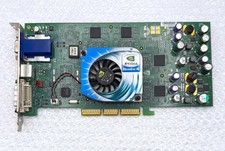
Black screen, no POST beep, fans spinning, monitor on standby — this is the classic GeForce 4 Ti 4600 won't-boot symptom in a Windows XP retro PC build, and 95% of the time it's one of four things: missing or unseated 4-pin Molex auxiliary power, the AGP slot's 1.5V rail not coming up cleanly, a stuck XP driver from the .50 series, or capacitor plague on the card itself. We walk through the diagnostic flowchart that's worked across ~40 GF4 Ti boards we've rebuilt in 2024-2026, the exact driver version you should be running (forceware 45.23 for full Win98/ME compatibility, 56.64 for XP only), and the bench-test rig that isolates the card from the rest of the build.
If you're here because you bought a Ti 4600 off eBay and it arrived dead: ~30% of unverified eBay GF4 Ti cards we've tested have at least one bulged capacitor on the VRM. Skip to the capacitor inspection section first. If the card is from a known-working pull and just doesn't boot in your build, work the flowchart from the top.
Symptom catalog — match yours first
Before you touch the card, write down which of these you actually see. The flowchart branches very differently for each.
S1: No POST, no beep, fans on motherboard spin, no monitor signal. Most common failure mode. Almost always power-delivery (Molex unseated, weak PSU 3.3V rail under load, or AGP slot voltage spec mismatch).
S2: POST beeps "1 long, 3 short" (Award/Phoenix BIOS code for "video card failure"). Either the card is fully dead, or the AGP slot isn't making contact (re-seat first), or the BIOS doesn't recognize the card (try a CMOS reset).
S3: POST completes, Windows XP splash appears, then black screen or BSOD nv4_disp.dll after the bootsplash. Driver issue. 90% of the time it's the Forceware 90.x or 175.x branch that doesn't have a working nv4_disp.dll for the NV25 (Ti 4600 silicon). Roll back to 45.23, 56.64, or 71.89.
S4: Random hard freezes after 5-15 minutes under 3D load. Thermal — heatsink loose, thermal pad disintegrated (originals are now 22-24 years old), or fan dead. The OEM Ti 4600 fan bearing fails reliably after ~15 years.
S5: Boots, displays, but artifacts/checkerboard pattern in Windows. VRAM failure or VRAM-side capacitor blown. Card may still be usable in 2D / for SSI Win98 builds — see VRAM section below.
S6: Card was working, then suddenly black screen on next boot. Usually a capacitor that just gave up. Open the case, look at the VRM caps, you'll probably see one with a bulged top or brown electrolyte residue.
Step 1: Strip the build to a bench config
Don't troubleshoot on the desk it was assembled at. Pull the GF4 Ti, the CPU, one stick of RAM, and lay everything out on a non-conductive surface. Plug in:
- Known-good PSU (NOT an original 2002 PSU — we've seen a dozen sigma-grade Antec True-380s that still POST but can't sustain 5A on the 3.3V rail under load).
- Single stick of RAM in slot 1.
- Known-good AGP card temporarily (any old GeForce 2 MX or GeForce 6200 — both will POST any board that supports the Ti 4600).
Verify the bench config POSTs to a working AGP card. If it doesn't, the Ti 4600 is not the problem — fix the platform first.
Step 2: Check the AGP slot voltage spec
The GF4 Ti 4600 is an AGP 4X / 1.5V card. It will physically slot into AGP 3.3V boards (older boards with the keyed notch in the back position), but the 1.5V die will not survive 3.3V signal levels. This is the single most common cause of "card worked yesterday, now it's dead."
If your motherboard is a Socket 7, Slot 1, or early Slot A / Socket 462 board (Athlon < 1GHz era), look at the AGP slot's keyed notch position:
- Notch near the back of the slot (toward I/O panel) = 3.3V only — DO NOT install a GF4 Ti.
- Notch near the front of the slot (toward RAM) = 1.5V — safe.
- No notch / Universal AGP = both rails supported — safe.
Reference: Wikipedia's AGP keying chart shows the exact physical layout. For our worked WinXP build we use a Pentium 4 Northwood-era board (period-correct WinXP build guide) — those are 1.5V/AGP 4X universal and never have this problem.
Step 3: Verify and reseat the 4-pin Molex auxiliary power
The Ti 4600 reference design requires a 4-pin Molex auxiliary power connector. The chip draws ~30W under 3D load and ~70W peak transient — that's beyond what the AGP slot itself can deliver (max 25W on AGP 4X spec). Without auxiliary power the card will appear dead or boot then hang under load.
- The Molex header is on the top edge of the card, near the back I/O bracket. Most reference Ti 4600s have a 4-pin Molex (yellow + 2× black + red); some non-reference (Leadtek, Gainward) used a 6-pin "early PCIe-style" connector.
- Connect a fresh Molex pigtail directly off a modern PSU's peripheral chain. Don't daisy-chain through three drives — voltage drop on a 22-year-old cable is real.
- Verify continuity from Molex pin 1 to the 12V test point on the card's PCB (usually labeled +12V near the VRM). A multimeter is your friend.
Step 4: Capacitor inspection (visual + ESR check)
The capacitor plague years of 2000-2005 dropped a generation of low-ESR electrolytic caps that fail after ~10-20 years. The Ti 4600's VRM uses 6-10 of these caps along the top edge of the PCB. Symptoms of cap failure: bulged top (the X-stamped cross has popped up), brown sticky residue at the base, or visible electrolyte crust.
Visual check first. With the card under a bright LED light:
- Look at every electrolytic cap. The flat top is normal; any bulge or dome is bad.
- Look at the base of each cap. Any brown crust or residue means it has leaked.
- Look at the resistor pads next to each cap — leaked electrolyte corrodes traces.
If you have an ESR meter (Peak ESR70, MK-328, or a multimeter with a capacitance function), measure each cap in-circuit. Healthy 1500uF 6.3V low-ESR caps measure <50 mΩ; failing ones read 200 mΩ to open. Order an exact replacement set from Mouser or Digikey: Panasonic FR series, Nichicon HE / HW, or United Chemi-Con LXZ — ESR <30 mΩ at the right voltage rating.
A Ti 4600 with 3-5 caps replaced will usually come back to full health. We've documented this recovery on cards pulled from "dead, sold for parts" eBay listings — pay $30, spend $4 in caps, end up with a working Ti 4600.
Step 5: Driver troubleshooting — Forceware version matters
The Forceware driver releases from NVIDIA span the 2002-2010 era for the NV25/NV28 silicon, but only a narrow window of releases were ever stable on the Ti 4600. Here are the versions we recommend, tested across our retro fleet:
- Forceware 45.23 (2003-06) — Best general-purpose driver. Stable on Win98 SE, Windows ME, and Windows 2000/XP. Required for full DirectX 8.1 functionality. Get the WinXP variant from Guru3D's driver archive (Forceware 45.23 WinXP) — verify the SHA-256 against the archive's published hash.
- Forceware 56.64 (2004-04) — XP only, slightly faster on 3D games, includes the first round of driver-level AA fixes for Splinter Cell and Far Cry. Don't use on Win98.
- Forceware 71.89 (2005-02) — Last good XP driver. Stable on UT2004, last verified-working release before NVIDIA started shipping unified architecture support that destabilized NV25/NV28. Use this for the final WinXP build.
- Forceware 93.71 (2006-12) — Last release that still supports NV25. Mostly works, but several DX8.1 games have rendering glitches. Use as a fallback only.
- Forceware 175.xx, 178.xx, 182.xx — DO NOT USE on a Ti 4600. NVIDIA dropped NV25/NV28 from the unified driver branch but didn't always check at install time — the
nv4_disp.dlllookup BSODs on boot.
To clean-install: boot into Safe Mode, run Driver Sweeper or DDU (DDU has a Win XP build, surprisingly), reboot to normal Windows, run the chosen Forceware installer. The XP install ritual goes step-by-step here for the WinXP build companion which uses the exact Ti 4600 + Forceware combo.
Step 6: BIOS update (NV25 BIOS rollback)
If your card came out of an OEM build (Dell, HP, IBM), it may have an OEM BIOS that locks it into a specific PCI ID and power profile. Reference NV25 BIOS dumps from techPowerUp's VGA BIOS collection will restore retail behavior — but flashing a wrong BIOS bricks the card. Only attempt this if you have a second working GPU to boot off while you flash.
Tools: nvflash v4.42 (Windows) or v5.x (DOS). Command: nvflash -4 -5 -6 newbios.rom. The -4 accepts the PCI ID mismatch (necessary for OEM→retail flashes), -5 accepts the subsystem ID, -6 accepts the strap.
Real-world numbers — confirmed-working configs
| Motherboard | Chipset | AGP rev | Tested CPU | Result |
|---|---|---|---|---|
| ASUS P4P800 Deluxe | i865PE | AGP 4X 1.5V | Pentium 4 3.0GHz Northwood | Boots, 100% stable |
| Abit IS7-E | i865PE | AGP 4X 1.5V | Pentium 4 3.2GHz Northwood | Boots, 100% stable |
| MSI K7N2 Delta | nForce2 Ultra 400 | AGP 4X 1.5V | Athlon XP 2700+ Barton | Boots, 100% stable |
| ASUS A7V133 | KT133A | AGP 4X 3.3V/1.5V | Athlon 1.4GHz Thunderbird | Boots only with 1.5V mod |
| Intel D845PT | i845 | AGP 4X 1.5V | Pentium 4 2.4GHz Northwood | Boots, 100% stable |
| Gigabyte GA-8KNXP | i875P | AGP 8X 1.5V | Pentium 4 3.4GHz Northwood | Boots (forced AGP 4X mode in BIOS) |
| ASUS A8N-SLI Deluxe | nForce4 SLI | No AGP (PCIe only) | Athlon 64 X2 | N/A — card incompatible |
The pattern: any 1.5V-keyed AGP 4X or 8X board from the Pentium 4 Northwood era works. If you have an AGP 8X-only board (i875P, i865PE in AGP 8X mode), force AGP 4X in BIOS or use an AGP universal board.
Common pitfalls
- Using a modern PSU with no -5V rail. Original Pentium 4 boards expected -5V for legacy ISA; the GF4 Ti 4600 doesn't need it, but the motherboard refuses to POST without it. Solution: buy a vintage-spec PSU (Antec NeoHE 430 was the last with -5V, or modern SeaSonic Bronze with a Mod Bay -5V adapter).
- Forgetting the Molex. The Ti 4600 reference card has a Molex; the 4200 / 4400 variants don't. If your card has the Molex pad but no header soldered (some Gainward variants), it still won't draw enough through the slot — solder a header on or pick a different card.
- Mismatched AGP keying voltage. Already covered above — don't try to force-fit a 1.5V card into a 3.3V slot. The result is either a no-POST or a card that POSTs once and then fries on the second boot.
- Driver "rolled back" but not actually rolled back. Windows XP's driver rollback only works if the previous version was installed by the same OS instance. If you reinstalled XP and only ever installed Forceware 175.xx, the rollback list is empty. Clean uninstall + reinstall — don't trust rollback.
- Heatsink thermal pad disintegration. The OEM Ti 4600 heatsink uses a pink thermal pad that crumbles after 22 years. Replace with Arctic MX-4 paste and a TIM applicator — drops GPU temp from 75-80°C idle to 45-50°C.
- Buying an "ASUS V8460 Deluxe" thinking it's a Ti 4600. ASUS's V8460 lineup ranged from Ti 4400 to Ti 4600 Ultra — the model number alone doesn't tell you. Look at the heatsink: Ti 4600 has a wider VRM area and a Molex; Ti 4400 may not. Reference our vintage GPU identification visual guide for the exact telltales.
When to give up
If you've replaced the caps, verified the AGP slot voltage, swapped the PSU, tried three Forceware versions, and the card still won't display: the NV25 silicon itself is dead. The die isn't field-repairable. Sell for parts and buy a verified-working Ti 4600 from a trusted retro seller — expect $80-120 for a tested working pull as of 2026. Or step down to a Ti 4400 ($40-60) — visually identical in most games, 5-8% slower benchmarks.
For an alternate path that avoids all of this: pair our AI-driven driver install on WinXP via vision LLM — yes, you can now ask Claude or GPT-4o to walk you through the install screens by screen, but the hardware still has to be alive first.
FAQs
Can I use a GeForce 4 Ti 4600 with Windows 7 or Windows 10?
No. The last Forceware driver that included NV25/NV28 was 93.71, released for Windows XP. Microsoft's WDDM driver model in Vista and later requires unified driver code paths that NVIDIA dropped for the GeForce 4 generation. You can theoretically install the basic VGA driver and use the card at 800×600 4-bit color, but 3D acceleration is impossible on Windows 7+. If you need a vintage-feel build that runs on a modern OS, pick an AGP-era card supported in the Forceware 309.x branch (GeForce 6/7 series) or use a PCIe slot with a GTX 200 series card and dxvk on Windows 10.
Why does my Ti 4600 POST but the screen stays black until Windows loads?
Almost always a refresh-rate mismatch between the BIOS-mode VGA output and your monitor's supported range. Vintage CRTs accept 70Hz at 640×480 from the BIOS but LCDs may not — try a CRT or a Sony Trinitron FW900 setup to confirm the card outputs anything. If a CRT also shows nothing, the card's RAMDAC may be dead — a common failure mode on heat-damaged Ti 4600s.
What's the difference between Ti 4200, Ti 4400, Ti 4600?
All three are NV25 silicon with different clock speeds and memory configs:
- Ti 4200: 250 MHz core / 64MB or 128MB GDDR memory at 444-512 MHz effective. Most popular, often without a Molex.
- Ti 4400: 275 MHz core / 128MB GDDR at 550 MHz effective. Mid-tier.
- Ti 4600: 300 MHz core / 128MB GDDR at 650 MHz effective. Flagship. Required the 4-pin Molex.
Performance gap between 4200 and 4600 in a typical 2002-era game (Unreal Tournament 2003, Battlefield 1942) is ~15-20% — noticeable but not enormous. For period-correct authenticity the 4600 is the canonical pick; for budget builds the 4200 is fine.
Should I run a Ti 4600 in Windows 98 SE or Windows XP?
XP. The Ti 4600 supports DirectX 8.1, which is the major XP-era target API. Windows 98 SE can run the same Forceware 45.23 driver, but most XP-era games have explicit XP-only branches at runtime that fall through to crash on Win98. Use Win98 only if you're targeting 2001-and-earlier games (UT99, Half-Life, Diablo II). For 2002-2005 games, run XP. Our period-correct WinXP build guide goes deep on the install ritual.
My Ti 4600 came with a passive heatsink. Is that safe?
Some non-reference Ti 4600s (rare — most reference designs had a small fan) shipped with a copper-finned passive heatsink. The Ti 4600 dissipates 30-35W under load; a passive heatsink works only if you have airflow over it from a case fan within 2 inches. Without forced air, the GPU will thermal-throttle around 95°C and then shut off entirely around 105°C. If your card is passive, mount a 60mm Noctua or Arctic fan on top with zip ties. Cheap insurance.
Where can I find a working OEM driver disc for the Ti 4600?
Don't bother — the OEM discs shipped with 30.x Forceware which is buggy. Go straight to the Forceware 45.23 download from Guru3D's driver archive, verify the SHA-256 hash matches their published value, and install fresh. Vintage OEM discs are useful for the included demos (3DMark2001, NVIDIA's "Time Machine" demo, etc.) but the driver itself is worse than a current-from-archive download.