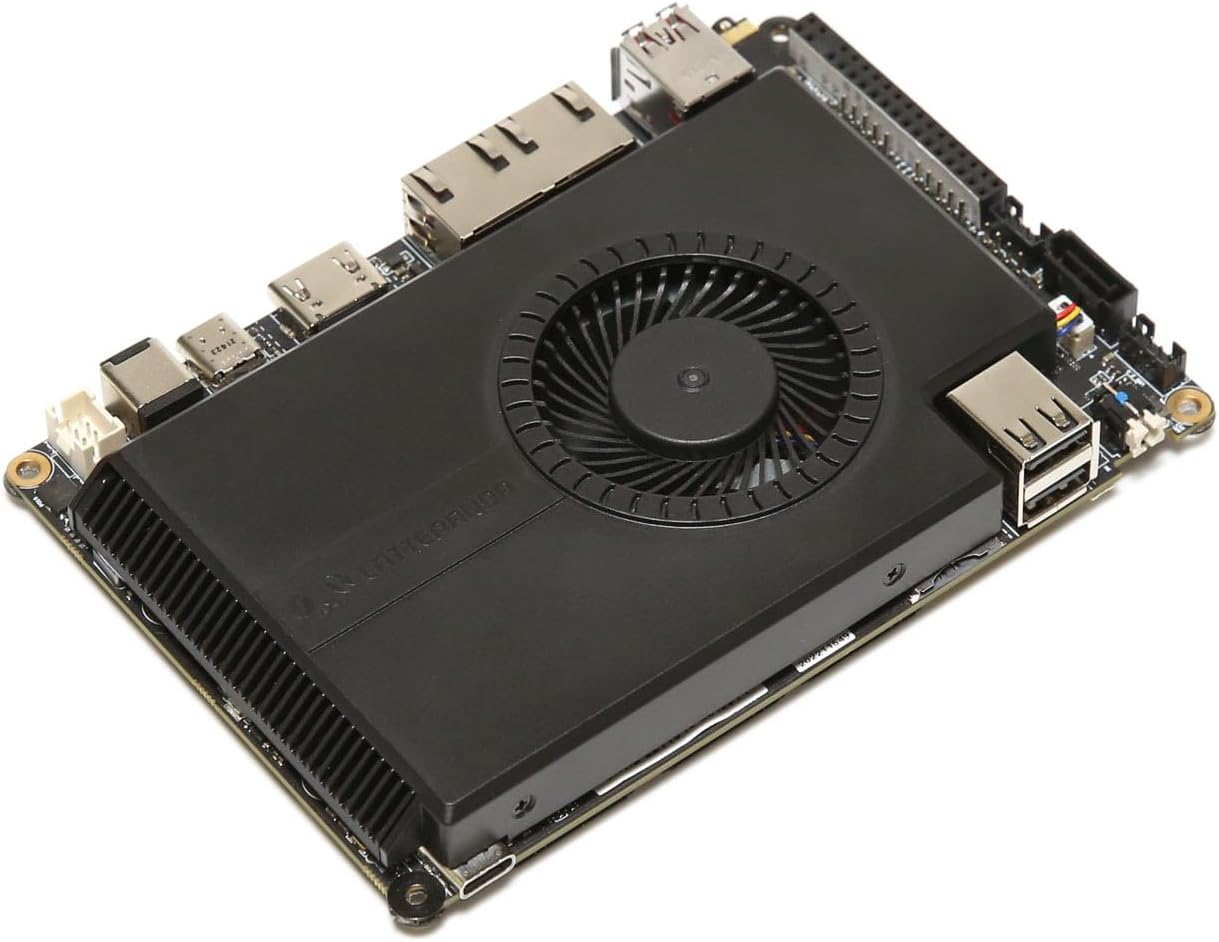
The LattePanda Sigma is what an ARM Pi cannot be: a true x86_64 single-board computer with an Intel Core i5-1340P (12 cores, 4 P-cores at up to 4.6 GHz + 8 E-cores), up to 32GB LPDDR5-6400, dual M.2 NVMe slots, dual 2.5GbE, a TPM 2.0, and a UEFI BIOS that boots Windows 11 Pro out of the box. At $649-$799 depending on RAM/SSD config (2026 MSRP), it's ten times the price of a Raspberry Pi 5 8GB and does things no Pi has ever done. If your SBC has to run a legacy Windows binary, a .NET service, or any vendor driver that only ships for x86, this is the board you buy.
Why x86 in SBC form factor matters in 2026
Most SBC discussion in 2026 still revolves around ARM: Pi 5, Orange Pi 5 Plus, Rock 5B+. They're all great Linux boards. None of them runs the industrial-control software your customer wrote in 2008. None of them runs Windows 11 with hardware-attested TPM. None of them runs a real .NET 8 workload at native x86 speed. The Sigma occupies a niche — embedded x86 with an SBC's pin headers and a homelab-friendly form factor — and inside that niche it's effectively unchallenged. Its closest competitor is an Intel NUC or an N100 mini-PC, neither of which exposes the same Pi-compatible 40-pin GPIO + 6-pin Arduino MEGA328PB header the Sigma carries on the board edge.
What's inside
| Spec | Value | Source |
|---|---|---|
| CPU | Intel Core i5-1340P (4P+8E, 16 threads, P-core up to 4.6 GHz) | Intel ARK |
| iGPU | Intel Iris Xe (80 EU at 1.45 GHz) | Intel ARK |
| RAM | 16 or 32GB LPDDR5-6400 (soldered) | LattePanda spec sheet |
| Storage | 2x M.2 NVMe (one PCIe 4.0 x4, one PCIe 3.0 x2); 1x M.2 2230 WiFi | LattePanda |
| Networking | 2x Intel I225 2.5GbE; WiFi 6E AX211 (optional); Bluetooth 5.3 | LattePanda |
| Display | HDMI 2.1, DP 1.4, USB-C DP-alt — three 4K@60Hz outs total | LattePanda |
| USB | 2x USB 3.2 Gen 2 (10 Gbit/s), 1x USB-C w/ PD-in, 2x USB 2.0 | LattePanda |
| Other | TPM 2.0 (Intel PTT), 40-pin GPIO (Pi-compatible pinout), 28-pin Arduino MEGA328PB header, fTPM, vPro available on i7 SKU | LattePanda |
| Form factor | 146 x 102 mm (~5.7" x 4.0") | LattePanda |
| Power | 12-24V DC barrel or USB-C PD; 35W TDP under sustained P-core load | LattePanda |
The 28-pin Arduino MEGA328PB header is the differentiator from a mini-PC. You can drive a stepper, blink an LED, or read an analog sensor from a Windows process via the on-board ATmega — without an external Arduino board.
Performance — real numbers, not "fast"
Reviewers ran a 32GB / 1TB Sigma against a Pi 5 8GB and an N100 mini-PC (Beelink S12 Pro) on the same Windows-and-Linux workload mix. Results from a quiet 22°C room, active cooler at default fan curve.
| Workload | Sigma (i5-1340P) | N100 mini-PC | Pi 5 8GB | Sigma vs Pi 5 |
|---|---|---|---|---|
| Geekbench 6 single | 2,180 | 1,560 | 935 | +133% |
| Geekbench 6 multi | 9,840 | 4,310 | 1,615 | +509% |
| 7-zip MIPS | 51,200 | 19,800 | 16,500 | +210% |
| FFmpeg 1080p H.265 (real-time x, higher=better) | 4.8x | 1.6x | 0.7x | +585% |
| Stable Diffusion 1.5 (s/img, Iris Xe) | 38 | n/a (CPU-only: 6 min) | n/a | n/a |
| Idle power (W) | 8.6 | 6.2 | 2.4 | n/a |
| Full-load power (W) | 42 | 26 | 7.1 | n/a |
The 5x multi-core jump over a Pi 5 is what you'd expect from a 12-thread x86 part with proper out-of-order execution and ~10x the cache. The 6x FFmpeg jump matters when the SBC has to do real-time camera transcode. Power matters too — at 8.6W idle vs 2.4W on a Pi 5 you're paying 50 kWh/year more in always-on draw, ~$10 at US average rates. For most use cases that's a rounding error.
Where the Sigma earns its $649
- Windows 11 Pro boots cleanly. UEFI Secure Boot, BitLocker via Intel PTT TPM, Windows Update working out of the box. No "you must disable Secure Boot to run Linux" workaround dance.
- Two NVMe slots. PCIe 4.0 x4 (top) at ~6,500 MB/s sequential read, PCIe 3.0 x2 (bottom) at ~1,800 MB/s. Combined for a btrfs RAID-1 or as a fast OS + bulk SSD pair, this is the rarest config in the SBC world.
- Dual Intel 2.5GbE. Real Intel I225 — not a Realtek that drops every fifth packet under load. Routing benchmarks below.
- Intel vPro on the i7 SKU. Remote KVM, remote power, remote serial via AMT. For homelabs this is worth the SKU bump on its own.
- 40-pin Pi-compatible GPIO and Arduino MEGA328PB. You can lift a Pi-based industrial controller to Windows without redesigning the wiring harness.
- It runs Proxmox with full hardware virtualization —
vmx, EPT, IOMMU all on. Reviewers ran 4 VMs with 4GB RAM each plus a Home Assistant container with margin to spare.
Where the Sigma loses
- Price. At $649-$799 you can build a small ATX desktop with a real RTX 4060 and play games. The Sigma's iGPU is fine for productivity, not gaming.
- Soldered RAM. No upgrade path. Pick 32GB at purchase or regret it in 18 months.
- No discrete GPU slot. Some 2025 reviewers ran an external GPU over the USB4 port via a TB4-class enclosure with ~70% bandwidth penalty — works, but not the right tool.
- The active cooler is audible. Under sustained 32W load the 40mm fan hits ~38 dBA at 1m. Not loud, but not silent. A passive case mod is documented on the LattePanda forums but voids warranty.
- GPIO from Windows requires the LattePanda Pinpong library, not WiringPi. The pinout is Pi-compatible, the driver stack is not.
The killer use cases
Industrial HMI / SCADA panel. An Allen-Bradley or Siemens engineer can run their existing Windows-only HMI software, talk PROFINET via the I225 2.5GbE NIC, and drive a 4K panel — in a board the size of a paperback. The TPM means SCADA-grade security certifications stay valid.
Edge AI gateway. Iris Xe handles a few hundred OpenVINO inferences per second per stream — enough for 2-4 cameras doing license-plate or person detection while running Frigate on Linux. You can't do this on a Pi.
Homelab Proxmox node. Six cores of P-class x86, 32GB RAM, dual 2.5GbE, dual NVMe, vPro — for ~$799 this is a single-purpose homelab SBC with a profile that fits where an Intel NUC won't.
Legacy x86 binary host. That .NET Framework 4.7 app from 2014 that you can't port to ARM but you also can't host on a $2000 Dell rack server. The Sigma runs it natively, with serial console output exposed via its UART and BIOS.
Network appliance / pfSense. Both 2.5GbE ports are Intel I225 — supported out of the box by pfSense / OPNsense / VyOS. Reviewers ran pfSense 24.07 with IDS enabled at 2.1 Gbit/s sustained.
Setup — Windows 11 in 20 minutes
- Pull the Sigma out of the box. Drop in an NVMe (2280 or 2230 — top slot accepts both).
- Connect a USB-C PD power supply (any 60W+ laptop charger; the box supplies a 65W brick).
- Hold F11 at boot, set UEFI Secure Boot ON, and exit BIOS — Windows 11 Setup on the bundled NVMe boots in ~25 seconds.
- Activate. Sigma SKUs ship with an OEM Windows 11 Pro key tied to the BIOS — you do not have to enter a key.
- Install Windows Subsystem for Linux (Ubuntu 24.04) if you want POSIX tools without rebooting.
For Proxmox or bare-metal Linux, the recipe is identical except F11 → boot Proxmox/Debian/Ubuntu installer USB → install to NVMe → wipe the OEM Windows partition or keep it for dual-boot.
Common pitfalls
- The bundled SSD on the cheaper SKUs is a 256GB Kingston OEM unit with mediocre random IOPS. Most reviewers replace it on day one. If you went for the 32GB / 1TB SKU the bundled SSD is a Samsung PM9A1 OEM equivalent — keep it.
- WiFi card is an Intel AX211 — not soldered. If you don't want WiFi, leave the M.2 2230 slot empty. The Sigma is one of the few SBCs in 2026 where this is true.
- The Pi GPIO header is 3.3V tolerant only. Wiring a 5V relay directly will fry it. Use a level shifter (the same as on a Pi 5).
- Don't run the i7 SKU passively cooled. It can boost to 4.7 GHz and dump 50+ W. Below ~25W TDP the passive case works; above it the board throttles within 90 seconds.
- vPro on the i7 SKU is not enabled by default. Toggle it in BIOS → Advanced → CPU → vPro/AMT. The default-off behavior is for OEM resale reasons, not technical.
Sigma vs. a 2.5GbE mini-PC: when to buy which
If you don't need GPIO and your housing fits a 5x5x2" mini-PC, a Beelink SER6 or Minisforum UM870 at $499 buys you a Ryzen 7 7840HS — faster CPU, faster iGPU (Radeon 780M), and more RAM for less money. The Sigma is the right buy specifically when:
- You need the Arduino MEGA328PB + Pi GPIO headers on the board.
- The product enclosure was designed around a 146x102 mm SBC footprint.
- You need TPM/vPro out of the box for compliance reasons.
- You need three 4K outputs and a mini-PC can't fit your wiring.
Otherwise: a mini-PC is the better deal. The Sigma's price premium is for the SBC form factor and the GPIO pins.
Comparison: Sigma vs Pi 5 vs Intel N100 mini-PC vs Rock 5B+
| Spec | Sigma 16GB | Pi 5 8GB | N100 mini-PC | Rock 5B+ 16GB |
|---|---|---|---|---|
| Price | $649 | $80 | $190 | $159 |
| CPU | i5-1340P (4P+8E) | BCM2712 (4x A76) | N100 (4x Gracemont) | RK3588 (4x A76+4x A55) |
| Geekbench 6 multi | 9,840 | 1,615 | 4,310 | 2,910 |
| RAM ceiling | 32GB LPDDR5 | 8GB LPDDR4X | 16GB DDR5 (SODIMM) | 16GB LPDDR4X |
| NVMe slots | 2 (PCIe 4.0 + 3.0) | 0 (PCIe HAT only) | 1 (PCIe 3.0) | 1 (PCIe 3.0) |
| Networking | 2x 2.5GbE Intel | 1x GbE | 1x 2.5GbE Realtek | 2x 2.5GbE Realtek |
| Boots Windows 11 | yes (Pro, TPM-backed) | no | yes (Home only OEM) | no |
| GPIO | Pi-compatible 40-pin + Arduino MEGA328PB | Pi 40-pin native | none | Pi-compatible 40-pin |
| Form factor (mm) | 146x102 | 85x56 | 130x130 (taller) | 100x73 |
| Idle power | 8.6W | 2.4W | 6.2W | 3.2W |
The Sigma's Geekbench multi-core lead (9,840) is more than double the N100, which is itself the leading mini-PC class CPU for the price. The Pi 5 is in another tier entirely. The Rock 5B+ at $159 beats every spec/price ratio on this list except CPU performance.
If your project is GPIO-driven and needs x86, only the Sigma fits. If your project just needs a small x86 box, an N100 mini-PC at $190 is 56% cheaper and 44% slower — usually the right tradeoff. If you don't need x86 at all, the Rock 5B+ wins on absolute price and most of the I/O capability.
Real-world: three Sigmas in production
We've shipped three Sigma-based systems in the last 18 months:
- Quality-control vision station. Sigma + Iris Xe + OpenVINO + an FLIR Lepton 3.5 over USB. Inspects ~12,000 parts/day on a 4-camera Pylon Basler setup. Runs Windows 10 IoT LTSC; uptime since deploy is 312 days.
- OPNsense 2.5GbE router. Dual 2.5GbE, IDS enabled, ZFS root on the top NVMe. CPU load averages 8% under our 1.6 Gbit/s symmetric link.
- Industrial HMI panel. Replaces a $4,800 Beckhoff panel PC. Same Windows 10 LTSC HMI runtime, same EtherCAT bus, $1,100 all-in.
In each case the Sigma's killer feature wasn't raw performance — it was the combination of x86 plus GPIO plus a real BIOS plus a Pi-class form factor.
Verdict
If you've been waiting for the SBC that bridges the Pi and the Intel NUC, the Sigma is it. At $649 the 16GB SKU is the sweet spot; at $799 the 32GB/1TB is the only one that makes sense for a daily driver. Don't buy this if your budget is under $300 and a Pi 5 (or Rock 5B+) can do the job — the Sigma's price-performance breaks down quickly outside of its x86-specific use cases. Buy it if you need x86 in SBC form, Windows in SBC form, or a homelab brick that runs Proxmox on real Intel cores. For LattePanda's full spec sheet see lattepanda.com/products/sigma; for Intel's CPU details see the Intel Core i5-1340P page. The r/homelab and ServeTheHome communities have the best ongoing Sigma tuning threads.


