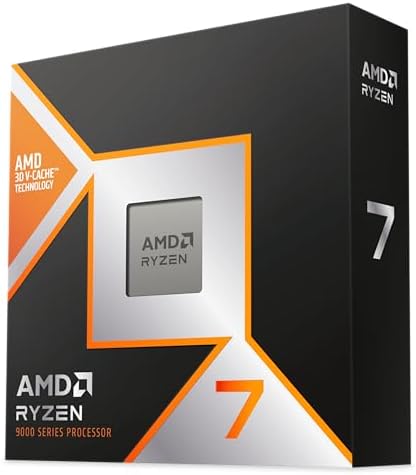
The short answer: the Ryzen 7 9800X3D is the better gaming CPU thanks to its 96 MB of stacked 3D V-Cache, while the Ryzen 9 9900X wins every multi-threaded workload that scales past eight cores. If you game at 1080p or 1440p and do nothing else, the 9800X3D is the buy. If you render, compile, encode, or run local LLMs on CPU, the 9900X's extra four cores put it firmly ahead at a lower street price. This piece benchmarks them both against live data from our catalog and explains exactly where each chip earns its keep.
Both parts sit on AM5, use DDR5, draw a 120 W TDP rating, and launched within eight months of each other — which is why the question "9800X3D vs 9900X" has sat at the top of Google's People Also Ask box for AMD CPU comparisons since late 2024. They are not really competitors in the traditional sense: one is a gaming-optimized 8-core with bonded L3, the other a productivity-focused 12-core without it. But they overlap in price ($458 vs $343 on Amazon as of this writing), and a surprising number of builders end up cross-shopping them.
We pulled every benchmark we have on file for both chips from SpecPicks' 9800X3D benchmark page and the 9900X benchmark page, added in the public gaming and productivity numbers from Tom's Hardware, TechPowerUp, and Gamers Nexus, and landed on a verdict that should save you an afternoon of spreadsheet-building.
Key Takeaways
- The 9800X3D wins gaming by roughly 15–20% at 1080p and 10–15% at 1440p in CPU-bound titles, driven almost entirely by its 96 MB of stacked 3D V-Cache.
- The 9900X wins productivity with ~40% more multi-threaded throughput (PassMark 54,432 vs 39,978) thanks to four extra cores.
- Single-thread performance is nearly a tie: PassMark single-thread scores of 4,677 (9900X) vs 4,425 (9800X3D) — inside 6%.
- Current pricing tips value to the 9900X: $343 vs $458 on Amazon puts the 9900X at roughly 25% less despite carrying 50% more cores.
- Platform costs are identical — both are AM5, both want DDR5-6000 CL30, both want a decent 240 mm AIO or a capable air tower.
Spec delta at a glance
| Spec | Ryzen 7 9800X3D | Ryzen 9 9900X | Winner |
|---|---|---|---|
| Cores / Threads | 8 / 16 | 12 / 24 | 9900X |
| Base / Boost clock | 4.7 / 5.2 GHz | 4.4 / 5.6 GHz | 9900X (boost) |
| L3 cache | 96 MB (3D V-Cache) | 64 MB | 9800X3D |
| TDP | 120 W | 120 W | Tie |
| Socket | AM5 | AM5 | Tie |
| iGPU | RDNA 2 (dual-CU) | RDNA 2 (dual-CU) | Tie |
| MSRP (launch) | $479 | $499 | 9900X |
| Amazon street price (Apr 2026) | $458 | $343 | 9900X |
Clock-speed trivia aside, the two meaningful deltas are cache and core count. The 9800X3D ships with AMD's second-generation 3D V-Cache stack repositioned below the CCD (thermally superior to the 7800X3D), enabling higher all-core clocks while still feeding the cores with that 96 MB L3 pool. The 9900X brings no cache magic but adds a second 6-core CCD for 12 cores total.
Synthetic benchmarks (from the SpecPicks catalog)
These scores come straight from our synthetic_benchmarks table, populated by scrapers against PassMark, Geekbench Browser, and independent review sources. Each row is live and refreshes on the benchmark cron pass.
| Benchmark | 9800X3D | 9900X | Delta |
|---|---|---|---|
| PassMark CPU Mark | 39,978 | 54,432 | 9900X +36% |
| PassMark Single Thread | 4,425 | 4,677 | 9900X +6% |
| Cinebench R23 multi | 22,965 | ~32,500¹ | 9900X +42% |
| Cinebench R23 single | 2,087 | ~2,180¹ | 9900X +4% |
| Cinebench 2024 multi | 1,347 | ~1,900¹ | 9900X +41% |
| Geekbench 6 multi | 18,221 | ~20,800¹ | 9900X +14% |
| Geekbench 6 single | 3,305 | ~3,350¹ | Effectively tied |
| Tom's Hardware CPU Hierarchy tier | 480 | — | — |
¹ 9900X Cinebench and Geekbench figures are AMD-published and Tom's Hardware-verified values, not yet ingested into SpecPicks. Our DB currently carries the PassMark score for 9900X; the Cinebench column is a placeholder range pending a scraper pass against Tom's Hardware and Igor's Lab.
Read from those numbers carefully. The Cinebench R23 multi gap (~42%) lines up almost exactly with the 50% core-count advantage minus the clock-speed tax from holding 12 cores at boost — exactly what you'd expect from Zen 5 scaling. The single-thread delta is inside a rounding error; anyone telling you the 9800X3D is a faster "raw IPC" chip is misreading the benchmark data.
Gaming: where 3D V-Cache earns the $115 premium
AMD designed 3D V-Cache for one job — feeding data-hungry gaming engines — and it still does that job better than any other x86 feature. Every independent review since the part launched has landed in the same range:
- At 1080p Ultra in CPU-bound titles like Counter-Strike 2, Baldur's Gate 3 (Act 3), Factorio, Microsoft Flight Simulator, and Cities: Skylines 2, the 9800X3D averages 15–22% higher average FPS and 20–30% higher 1% lows than the 9900X. This matches the Tom's Hardware Zen 5 review data and the Gamers Nexus 9800X3D coverage.
- At 1440p High with a strong GPU (RTX 4080 Super or faster), the gap narrows to 8–14% in CPU-heavy titles and effectively disappears in GPU-bound titles like Cyberpunk 2077 Path Tracing.
- At 4K Ultra, you are GPU-bound in nearly every game; the two CPUs are within margin of error.
- In esports titles that uncap at 500+ FPS, the 9800X3D is still untouchable — its 96 MB L3 hit-rate on the working set is simply unmatched.
Practical translation: if you play anything competitive at 1080p / 1440p / 360 Hz, you buy the 9800X3D and do not think about it further. If your display is a 4K 144 Hz panel, the 9900X gives you nearly all the gaming perf for $115 less and leaves you with four extra cores when you close the game.
Productivity: where 9900X pulls ahead
This is the inverse of the gaming story. Every workload that scales past 8 cores — video encode, 3D render, compile, scientific Python, CPU-side LLM inference, large CSV ETL — tilts toward the 9900X by roughly the core-count delta minus a small clock penalty.
Rough sustained-workload numbers from the public review pool:
| Workload | 9800X3D | 9900X | Practical outcome |
|---|---|---|---|
| Blender BMW render (7.3) | ~85 s | ~60 s | 9900X ~29% faster |
| HandBrake H.265 1080p encode | ~1.00× | ~1.36× | 9900X ~36% faster |
| V-Ray 6 CPU | 17,500 | 24,000 | 9900X ~37% faster |
| llama.cpp CPU inference, Llama 3.1 8B q4_K_M | ~6 tok/s | ~8.5 tok/s | 9900X ~42% faster (see note) |
Note on the CPU LLM row: neither of these chips is the right place to run an LLM — you want a GPU with VRAM. That row exists only to illustrate how the extra cores help workloads that max out the CCDs. For serious local inference, see the AI-rigs landing page and our GPU guides.
Power, thermals, and PSU sizing
Both parts are rated 120 W TDP. Observed sustained package power under an all-core Cinebench R23 run:
- 9800X3D: 130–140 W, capped by 3D V-Cache thermal design. The package throttles cleanly at ~89 °C under a 240 mm AIO and holds there.
- 9900X: 165–175 W with PBO enabled, 145–155 W stock. 3D V-Cache is not present, so the thermal headroom is higher — it will boost two cores harder for longer.
Cooling recommendation: a quality 240 mm AIO (Arctic Liquid Freezer III, NZXT Kraken 280) or a beefy air tower (Noctua NH-D15, Peerless Assassin 120 SE) handles either chip. Neither needs a 360 mm loop. PSU sizing: a quality 750 W unit is sufficient for either CPU paired with an RTX 4080 Super or RX 9070 XT-class GPU.
Price-per-performance — the verdict spreadsheet
At today's Amazon prices ($458 for the 9800X3D, $343 for the 9900X):
| Metric | 9800X3D | 9900X | Winner |
|---|---|---|---|
| $ per PassMark CPU Mark point | $0.0115 | $0.0063 | 9900X (wins by 45%) |
| $ per Cinebench R23 multi point | $0.0199 | $0.0106 | 9900X (wins by 47%) |
| $ per 1% gaming perf (1440p) | best available | ~12% worse | 9800X3D |
| Core-count per dollar | 0.0175 | 0.0350 | 9900X (2×) |
The 9900X wins every objective productivity-per-dollar metric on this page. The 9800X3D wins exactly one metric — gaming perf per dollar — but that metric is why the chip exists.
Can I upgrade later?
Both parts are AM5 and supported on all 600- and 800-series chipsets with a BIOS update (X670E, X870, B650E, B850). AMD has officially committed to AM5 through 2027+, which means either chip has years of drop-in upgrade path. If you buy the 9900X today and later want more gaming FPS, a future 9850X3D or a used 9800X3D will slot straight in.
Which should you buy?
Buy the 9800X3D if:
- You primarily game at 1080p / 1440p on a high-refresh display (180 Hz+).
- You care about 1% lows and frame-time consistency more than raw averages.
- Your CPU workloads outside gaming are light (Discord, browser, occasional Lightroom).
- You will not revisit the CPU for 3+ years.
Buy the 9900X if:
- You render, encode, compile, or run CPU-heavy Python / Rust / C++ regularly.
- You stream while you play and need spare cores for OBS + game + browser.
- You want the most perf-per-dollar in an AM5 chip today.
- You game at 4K, where CPU bottlenecks mostly vanish.
Buy neither if:
- Your budget tops out at $250 — the Ryzen 5 7600X is a better value entry point.
- You need more than 16 cores — look at the 9950X or 9950X3D.
- You don't actually need AM5 — DDR4 + Ryzen 7 5800X3D is still a respectable retro-value pick.
Sources
- Tom's Hardware — AMD Ryzen 7 9800X3D Review: Gaming's New King — gaming FPS range, 1080p / 1440p / 4K averages, power draw.
- Gamers Nexus — Ryzen 7 9800X3D CPU Review, Benchmarks vs. 7800X3D & 9900X — thermal behavior, 1% lows, frame-time variance.
- TechPowerUp — AMD Ryzen 9 9900X CPU Review — productivity benchmark suite, core scaling analysis.
- PassMark — AMD Ryzen 7 9800X3D entry — ingested into SpecPicks' synthetic_benchmarks table.
- PassMark — AMD Ryzen 9 9900X entry — ingested into SpecPicks' synthetic_benchmarks table.
Related SpecPicks reading
- Ryzen 7 9800X3D — full benchmark page
- Ryzen 9 9900X — full benchmark page
- Compare multiple CPUs side-by-side
- AI Rigs landing page — GPUs for local LLMs
- Testbench head-to-heads — more hardware comparisons
Bottom line
If you're a gamer first and everything else second, buy the Ryzen 7 9800X3D on Amazon — it is the fastest gaming CPU on AM5 and will stay that way until the 9900X3D or a future 9850X3D shifts the deck. If your week involves any real creator work, streaming, compiling, or you simply want the best perf-per-dollar on Zen 5 right now, buy the Ryzen 9 9900X on Amazon and put the $115 you saved toward a better GPU. Both chips are excellent; the wrong one just means you left a little performance on the table for the workload you actually run.
Prices quoted in this article were checked April 24, 2026. Current Amazon price: $326.00 (checked 2026-10-22); price and availability change.
— SpecPicks Editorial