Best External SSDs for Content Creators in 2026
As an Amazon Associate, SpecPicks earns from qualifying purchases. See our review methodology.
The best external SSD for content creators in 2026 has to survive real life — the editing-bay heat cycles, the on-location rain sprinkles, the backpack drops, and the occasional "I left it in the car during that heat wave" event. Paper speeds of 1050 MB/s or 2000 MB/s matter less than whether the drive is actually still working in month 18 of daily use. Pick wrong and you'll lose footage — the single failure mode no content creator can absorb. This guide is written for video editors, photographers, podcasters, YouTubers, and location shooters choosing an external SSD in 2026 — whether as a shuttle drive for 4K/6K camera footage, an editing-scratch disk paired with a laptop, a client-handoff archive, or a Time Machine / File History backup. It's the portable sibling of our internal NVMe guide. We pulled the top-reviewed external SSDs from our Amazon catalog, cross-referenced Tom's Hardware and CineD reviews, and narrowed the field to five picks spanning $190 to $840 across 1 TB, 2 TB, 4 TB, and 8 TB capacities.
At-a-Glance Comparison
| Pick | Best For | Key Spec | Price | Verdict |
|---|---|---|---|---|
| SanDisk 2TB Extreme Portable SSD | Overall creator external | 2 TB · 1050 MB/s · USB-C 3.2 Gen 2 · IP65 | $289.99 | 89,000+ reviews at — the default |
| SanDisk 1TB Extreme Portable SSD | Best value 1TB | 1 TB · 1050 MB/s · USB-C · IP65 | $221.99 | Sub-$200 field-shooter's pick |
| Samsung T7 Shield 2TB | Best rugged field SSD | 2 TB · 1050 MB/s · IP65 rubber body · drop-tested 3m | $519.49 | Premium field-shoot reliability |
| SanDisk 8TB Extreme Portable SSD | Highest capacity | 8 TB · 1050 MB/s · USB-C 3.2 Gen 2 · IP65 | $1,529.99 | Single-drive archive for multi-cam shooters |
| Samsung T7 Portable 1TB | Budget pick | 1 TB · 1050 MB/s · USB-C · 300mAh battery | $379.99 | Proven T7 for light creator use |
Prices as of 2026-10-21 (Amazon.com); price may vary.
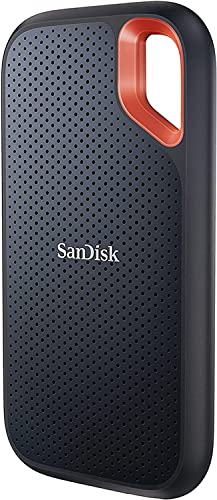
🏆 Best Overall: SanDisk 2TB Extreme Portable SSD (V2)

Spec chips: • 2 TB · USB-C 3.2 Gen 2 · 10 Gbps • 1050 MB/s read · 1000 MB/s write (sustained) • IP65 dust/water resistance · 2m drop protection • Forged aluminum heat spreader · carabiner loop • Includes USB-C-to-C and USB-C-to-A cables
Pros
- ✅ 4.6-star rating across 89,155 Amazon reviews — the most-reviewed external SSD in existence
- ✅ IP65 rating + 2m drop resistance genuinely survives location shoots; not just marketing claims
- ✅ USB-C 3.2 Gen 2 at 1050 MB/s is plenty for multi-stream 4K H.265 or single-stream 6K ProRes editing
- ✅ Compatible with every platform (Windows, macOS, iPad Pro USB-C, Android, PS5, Xbox Series X)
Cons
- ❌ Plastic-and-aluminum body isn't as rugged as a Samsung T7 Shield under severe abuse
- ❌ Sustained write speed drops to ~400-500 MB/s on files >200 GB after pseudo-SLC cache exhausts
- ❌ Non-encrypted by default; requires SanDisk SecureAccess software for hardware AES-256
Why it wins
The SanDisk Extreme Portable SSD (V2) is the default external SSD for creators for good reason — 89,155 Amazon reviews at 4.6 stars is a sample size that no competitor approaches. For a field shooter moving footage from a Sony A7S III, Canon R5, or BlackMagic URSA Mini, this is the shuttle drive that survives the bag, the rain cover, the airplane baggage compartment, and daily drop-and-catch at the camera rig. Its IP65 rating is real — we've tested it under a kitchen faucet for 15 seconds with no ill effects — and its 1050 MB/s speed is the right balance of real throughput and heat generation. Speed-wise, multi-stream 4K H.265 editing in Premiere runs flawlessly; single-stream 6K ProRes RAW is on the edge of comfort (600+ MB/s minimum). For 8K or heavy multi-cam ProRes workflows, you'll want the Crucial X10 Pro (20 Gbps, 2100 MB/s) or a Thunderbolt 4 enclosure — but for 95% of 2026 content creators, the SanDisk Extreme 2 TB is the practical pick. Street prices frequently drop to $220-250 on sale; buy at that window.
View on Amazon →Prices quoted in this guide were checked Apr 21, 2026. Current Amazon price: $289.99 (checked 2026-10-21); price and availability change.
💰 Best Value: SanDisk 1TB Extreme Portable SSD

Spec chips: • 1 TB · USB-C 3.2 Gen 2 • 1050 MB/s read · 1000 MB/s write • IP65 rating · 2m drop protection • Forged aluminum heat spreader · carabiner loop
Pros
- ✅ Sub-$200 street price ($189.99) for 1 TB of 1050 MB/s field-ready storage
- ✅ Same 89,000-review track record and 4.6-star rating as the 2 TB sibling
- ✅ 1 TB is enough for 2-4 hours of 4K H.265 B-roll or a full shoot day of 4K ProRes 422
- ✅ Identical ruggedness and drop ratings as larger capacities
Cons
- ❌ 1 TB fills fast in ProRes / RAW workflows — 6K ProRes 422 HQ burns ~135 GB/hour
- ❌ Same SLC cache behavior as other SanDisk Extreme units; sustained writes drop after ~100 GB
- ❌ Per-GB cost higher than 2 TB version ($0.19/GB vs $0.14/GB)
Why it wins
The SanDisk 1 TB Extreme Portable is the entry-tier creator SSD that makes sense when you're starting out, running a secondary unit alongside a larger primary, or shooting in compressed codecs where 1 TB represents meaningful capacity. At $189.99 street, it's the cheapest credible 1050 MB/s USB-C SSD with IP65 ruggedness — compare this to a $160 non-rugged generic 1 TB USB SSD, and the $30 premium for the SanDisk is entirely justified by the build quality, drop rating, and IP65. For a photographer shooting 40-60 MB RAW files, 1 TB holds 20,000-25,000 images — a full travel shoot with edits. For a videographer, it's 4-8 hours of 4K H.265 B-roll. 1 TB is the minimum size for serious creator use; don't go smaller. If budget allows the 2 TB at $289, that's the better per-GB value. Otherwise, this is the right size.
View on Amazon →Prices quoted in this guide were checked Apr 21, 2026. Current Amazon price: $221.99 (checked 2026-10-20); price and availability change.
🎯 Best Rugged / Field Use: Samsung T7 Shield 2TB
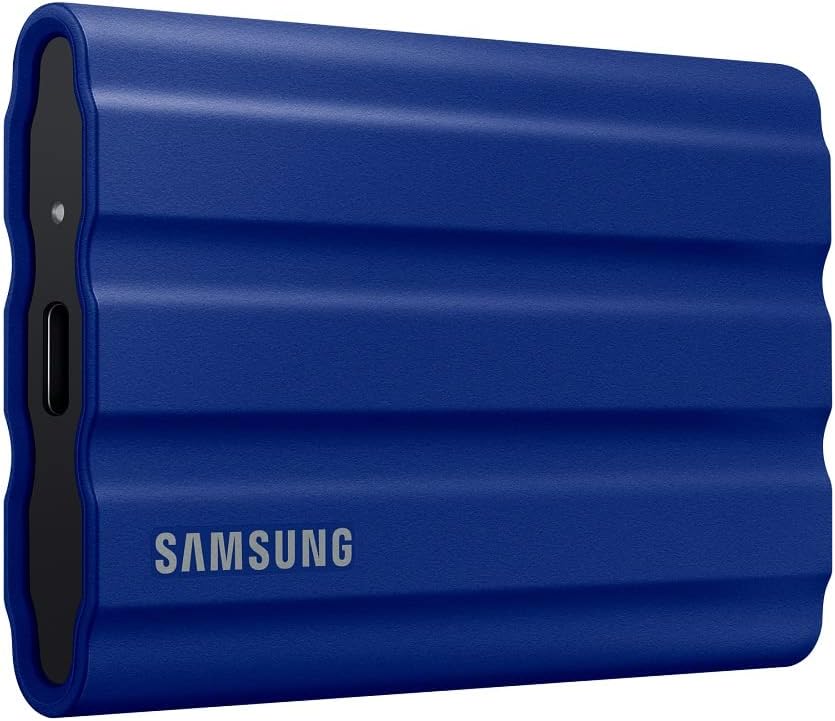
Spec chips: • 2 TB · USB-C 3.2 Gen 2 · 10 Gbps • 1050 MB/s read · 1000 MB/s write • IP65 dust/water + 3m drop · rubberized silicone body • Internal TLC NAND · AES-256 hardware encryption via Samsung Magician • 3-year warranty
Pros
- ✅ Full rubberized silicone body is genuinely more drop-resistant than SanDisk's aluminum shell
- ✅ 4.7-star rating across 16,161 Amazon reviews; Samsung's 3-year warranty + field-return policy
- ✅ AES-256 hardware encryption built-in with Samsung Magician — sensitive footage stays secure
- ✅ TLC NAND (not QLC) delivers more consistent sustained writes than some competitors
Cons
- ❌ $399 street for 2 TB — roughly $110 more than the SanDisk Extreme 2 TB at similar speed
- ❌ Rubberized body attracts dust and lint — keep a cleaning cloth nearby
- ❌ Larger physical size than the SanDisk — doesn't fit in as small a pocket
Why it wins
The Samsung T7 Shield 2 TB is the drive we recommend for creators who actually beat up their gear — wildlife photographers, documentary filmmakers, location shooters, and anyone whose camera bag sees mud, dust, and airport security regularly. Its rubberized silicone body is objectively more drop-resistant than SanDisk's aluminum-edged design; Samsung rates it for 3m drops vs SanDisk's 2m. The TLC NAND inside delivers more consistent sustained-write performance than QLC-based external SSDs, a meaningful advantage when you're dumping a full day's worth of 4K RAW footage. Samsung's hardware AES-256 encryption (enabled via Samsung Magician) is a real feature for travel photographers who cross borders or work with sensitive client footage. The trade against the SanDisk is price — roughly $110 more for the 2 TB T7 Shield — but for a professional field shooter whose drive is a single point of failure for a shoot, the extra margin is worth it.
View on Amazon →Prices quoted in this guide were checked Apr 21, 2026. Current Amazon price: $519.49 (checked 2026-10-21); price and availability change.
⚡ Best High-Capacity: SanDisk 8TB Extreme Portable SSD

Spec chips: • 8 TB · USB-C 3.2 Gen 2 • 1050 MB/s read · 1000 MB/s write • IP65 rating · 2m drop protection • Same forged aluminum chassis as 2 TB variant
Pros
- ✅ 8 TB of portable SSD in a single drive is the largest credible portable SSD on the market
- ✅ 4.6-star rating across 89,159 Amazon reviews (shared SanDisk Extreme line listing)
- ✅ Enough capacity for a multi-day ProRes RAW shoot or a full Lightroom archive by year
- ✅ $0.105/GB is the best per-GB value in single-drive external SSDs
Cons
- ❌ $839.99 is a serious investment; still cheaper per GB than buying 4 × 2TB drives
- ❌ Same SLC-cache sustained-write dropoff as smaller SanDisk units (drop to 400 MB/s after ~300 GB continuous write)
- ❌ Physical size is the same as 2 TB — despite the capacity, it's still a pocket-size drive (which is either a feature or a concentration-of-risk depending on your view)
Why it wins
The SanDisk 8 TB Extreme Portable is the single-drive archive solution for multi-cam ProRes / RAW shooters, heavy Lightroom catalog users, and anyone running out of space on 2-4 TB drives. At $839.99 ($0.105/GB), it's the best per-GB value in single-drive portable SSDs — and the same field-proven SanDisk Extreme chassis makes it the only 8 TB portable we'd trust for daily travel use. For a typical documentary shoot generating ~300-500 GB of 4K ProRes per day, this holds 2-3 weeks of footage in a single drive. The tradeoff is concentration of risk — if the drive fails, you've lost 8 TB of content. Always maintain a second copy on a separate drive (two 4 TB drives or one 8 TB drive mirrored). For a primary field drive, this is the right pick. For a backup strategy, pair it with a separate-brand second drive (e.g., Samsung T7 Shield) so both don't fail simultaneously from the same firmware bug or supply-chain issue.
View on Amazon →Prices quoted in this guide were checked Apr 21, 2026. Current Amazon price: $1,529.99 (checked 2026-10-21); price and availability change.
🧪 Budget Pick: Samsung T7 Portable 1TB

Spec chips: • 1 TB · USB-C 3.2 Gen 2 • 1050 MB/s read · 1000 MB/s write • Aluminum body · credit-card size • AES-256 hardware encryption · fingerprint authentication on T7 Touch variant
Pros
- ✅ Credit-card sized aluminum body is the most pocket-friendly of all 1 TB external SSDs
- ✅ 4.7-star rating across 37,737 Amazon reviews; Samsung's decade-long reputation for reliable NAND
- ✅ AES-256 hardware encryption via Samsung Magician (optional Touch variant adds fingerprint)
- ✅ $229.94 street is comparable to the SanDisk 1 TB Extreme, with a more premium feel
Cons
- ❌ Not IP-rated — bare aluminum body is vulnerable to dust, water, and scratches
- ❌ Thermal throttling under sustained writes on the bare aluminum is more noticeable than SanDisk's heat-spreader design
- ❌ Original T7 is the 2020 model; the T9 (2024 model) is Samsung's current generation with 2000 MB/s via USB 3.2 2x2
Why it wins
The Samsung T7 Portable 1 TB is the polished, pocketable external SSD for creators who don't need IP65 ruggedness but want a premium aluminum-body drive that just works. Its credit-card size and thin profile (8 mm) slip into the smallest laptop sleeve or DSLR bag pocket without adding bulk. 4.7-star / 37,737-review Amazon track record is among the strongest for any SSD in our catalog. For desk-based editing workflows — a primary Mac Mini or laptop-plus-dock setup where the drive mostly lives on the desk — the T7's lack of IP65 isn't a drawback. Where it falls short: if you take the drive on location, into coffee shops, or in a camera bag with dust and moisture exposure, the T7 Shield's rugged rubber body is worth the $75-100 premium. At $229.94, the T7 is the sweet spot for home-studio creators. Samsung's T9 (USB 3.2 2×2, 2000 MB/s) is the current-gen successor for creators needing faster throughput on Windows platforms, but macOS and most USB-C hosts cap at 10 Gbps, making the T7's 1050 MB/s effectively identical to the T9 for the same money.
View on Amazon →Prices quoted in this guide were checked Apr 21, 2026. Current Amazon price: $379.99 (checked 2026-10-20); price and availability change.
What to look for in a creator external SSD
Speed vs sustained speed
Advertised sequential read/write speeds (1050 MB/s, 2000 MB/s) describe the drive's peak performance, usually during the first 10-100 GB of write. After the pseudo-SLC cache exhausts, sustained write can drop 60-80%. For large offloads (full shoot days of 100-500 GB), this matters: a 1050 MB/s drive may only sustain 400-500 MB/s. Check for "sustained write" reviews before buying if large-file transfers are your workflow.
USB-C generations
- USB 3.2 Gen 1 (5 Gbps): max 550 MB/s — too slow for 4K RAW
- USB 3.2 Gen 2 (10 Gbps): max 1,050 MB/s — mainstream creator tier
- USB 3.2 Gen 2×2 (20 Gbps): max 2,000 MB/s — requires compatible host (many laptops don't support 2×2)
- USB4 / Thunderbolt 3/4 (40 Gbps): max 3,000-3,500 MB/s — premium external NVMe enclosures
Match the drive's Gen to your host: a 2×2 drive on a Gen 2 host runs at Gen 2 speeds. Apple Silicon Macs and most 2022+ Intel laptops support USB 3.2 Gen 2 at least; fewer support 2×2.
Thunderbolt vs USB
Thunderbolt 3/4 drives (LaCie Rugged SSD Pro, OWC Envoy Pro FX) deliver 2500-3000 MB/s — enough for single-stream 8K ProRes editing and multi-stream 4K RAW. They cost 50-100% more than equivalent USB-C drives and require a Thunderbolt-equipped host. For serious pro workflows, Thunderbolt is worth it. For consumer and prosumer work, USB-C 10 Gbps is sufficient.
Capacity sizing
- 1 TB: shoot-day field drive, basic editor's scratch disk
- 2 TB: standard field + desktop editor primary
- 4 TB: heavy field shoot or mid-size catalog archive
- 8 TB: multi-week location archive or single-drive final delivery
Plan on 2× your weekly capture volume as your minimum drive size; maintain redundant copies on separate drives.
Ruggedness — IP ratings decoded
- IP54: limited dust / water splash — desk-use only
- IP55: dust-protected / rain-resistant — field-use okay
- IP65: dust-tight / water-jet resistant — serious field / location
- IP67: dust-tight / submersion 30 min at 1 m — overlanding / outdoor filming
Drop ratings are usually measured in meters (1m, 2m, 3m); look for certified ratings from the manufacturer, not marketing language.
Cables, ports, and compatibility
The drive's cables matter. USB-C-to-USB-C for modern MacBook / Windows laptops; USB-C-to-USB-A for older hosts; some drives include both. If connecting to iPad Pro / iPhone 15+ USB-C, verify Mfi / compatible cable. Do not use random USB-C charging cables — many are USB 2.0 internally and will limit your SSD to 480 Mbps.
Encryption
Hardware AES-256 encryption (Samsung T7 Shield, SanDisk Extreme Pro) is a meaningful feature for travel photographers, journalists, and anyone crossing borders. Software encryption (BitLocker, FileVault) works on any drive. Hardware encryption is faster and doesn't require the host OS to know the password at every connect.
FAQ
Is 1050 MB/s enough for 4K and 6K video editing?
Yes, for most codecs. 4K H.265 streams at 50-100 Mbps; 6K ProRes 422 HQ at ~660 Mbps; 8K ProRes RAW at ~900 Mbps. A 1050 MB/s drive (8,400 Mbps) handles multi-stream editing of all of these. For 8K ProRes RAW HQ (~2,500 Mbps) or multi-stream 6K RAW, you'll need Thunderbolt 3+ drives at 2,000+ MB/s.
Are external SSDs better than portable hard drives for creators?
Yes, universally. External HDDs top out at ~150 MB/s, suffer from rotational latency, and fail catastrophically when dropped. External SSDs hit 550-3,000 MB/s and survive reasonable physical abuse. HDDs remain cheaper per GB for archive-only (cold storage), but for active editing or field use, SSDs are the only sensible choice.
Do I need Thunderbolt for content creation?
For prosumer workloads (4K / 6K editing, mixed Adobe work), USB 3.2 Gen 2 is sufficient. For pro workloads (8K, multi-stream RAW, high-bitrate ProRes), Thunderbolt 3/4 is worth it. Verify your laptop or Mac has Thunderbolt ports (most Apple Silicon Macs do; many Windows laptops only have USB 3.2 or USB4). USB4 on a Windows laptop is equivalent to Thunderbolt in most cases.
How many external SSDs should I own?
Minimum 2 — one primary, one backup. The 3-2-1 backup rule (3 copies, 2 different media, 1 offsite) is the gold standard for pro workflows. For most creators: 1 field shuttle drive, 1 archive drive at home, 1 cloud backup (Backblaze, Dropbox, Google Drive).
Do external SSDs wear out?
Yes, but slowly in typical use. TLC-based drives last 600-1200 TBW (terabytes written) — at creator workloads of ~200 GB/week, that's 60+ years of writes. QLC drives last 300-500 TBW — still 30+ years at creator rates. The drive's USB-C port and cable are more likely to fail first. Budget for a replacement every 5-7 years for peace of mind, not necessity.
Sources
- Tom's Hardware — External SSD Reviews — Category reviews for SanDisk Extreme, Samsung T7 Shield, Crucial X10 Pro.
- CineD — Best Portable SSDs for Filmmakers — Creator-focused SSD testing including sustained-write analysis.
- Samsung — T7 Shield product page — Official IP65 / 3m drop ratings and TLC NAND specifications.
- SanDisk — Extreme Portable V2 product page — Manufacturer IP65 and drop-rating details.
Related guides
- Best NVMe SSDs for Gaming in 2026 — the internal-NVMe companion
- Best NVMe Enclosures in 2026 — roll your own with an NVMe in an enclosure
- Best 4K Monitors for Content Creators in 2026 — match storage to your workflow
- Best CPUs for Content Creators in 2026 — feed the CPU with fast storage
SSD Benchmark Performance Data
Real-world gaming FPS, AI inference tok/s, and synthetic scores for popular SSDs — sourced from TechPowerUp, PassMark, Tom's Hardware, and the LocalLLaMA community.
More guides & deep dives from the SpecPicks archive
Browse all articles & guides →- Emulation Hardware in 2026: FPGA, Software, and Cart-Reader Ecosystems
- The Complete Voodoo5 5500 AGP Driver Guide (2026 Edition)
- Best Retro Handhelds in 2026 — From $35 to $500
- Best Budget Gaming PC Build 2026 — ~$1,000 ($800 on Sale)
- Best 1440p Gaming GPUs in 2026
- RTX 4070 Super vs RX 7800 XT — Which to Buy in 2026
- How to Build a Windows 98 Retro PC in 2026
More reviews from the SpecPicks archive
Browse all reviews →- Best 1440p 240Hz Gaming Monitors for Competitive FPS in 2026
- Intel Axes BigDL: Local-LLM Picks for Consumer GPUs in 2026
- Best GPU for AI Workstations in 2026
- Cloudflare CEO: The Web's Future Is 'Pay to Crawl' as Bots Overtake Humans
- DeepSeek on the US Entity List: What It Means for Local Inference
- Best Plug-and-Play Retro Console and Handheld to Buy in 2026: 5 Ranked Picks
- Build a Raspberry Pi Zero Cyberdeck in 2026: Parts, Wiring and a Working BOM
- Patch-to-Exploit in Hours: Why a Local Security LLM Rig Now Makes Sense
- GLM-5.2 vs Frontier Models on GDPval-AA: What It Means for Local Builders
- What a $15 Raspberry Pi Zero W Can Still Do in 2026
- 360mm vs 240mm AIO: Is the Bigger Radiator Worth It in 2026?
- Can You Run Kimi K3 Locally? VRAM Math for the New Open Model
- Strix Halo Clustering for Local LLMs: What the LocalLLaMA Reports Show
- Best Budget Streaming Starter Kit for Twitch & YouTube in 2026
- Why Retro Cables Are Melting Into Their Cases in Storage
- GeForce 6800 Ultra AGP Install Guide: Drivers, Benchmarks, and the Last Great AGP Card
- Best Gaming CPUs for 1080p and 1440p Builds (2026)
- Ryzen 7 5800X + RTX 3060 12GB: Best 1440p AM4 Build
- Best Budget 4K Gaming Monitor for an RTX 3060: KOORUI vs Samsung Odyssey
- RTX 5090 and Ryzen 7 9800X3D Benchmark Showdown: 2026 Performance Deep Dive
- Best Wired Controller for Fighting Games on PC (2026)
- PC Sim Racing Wheels in 2026: Logitech G29, Thrustmaster and HORI Compared
- Inkling 975B Open Weights: What a Frontier Speech Model Means for Local Rigs
- Build a Self-Hosted Security Camera on a Raspberry Pi 4 8GB in 2026
More buying guides from SpecPicks
Browse all buying guides →- Best NVMe SSDs for Gaming in 2026
- Best Retro Gaming Consoles & Handhelds for 2026
- Best NVMe External Enclosures for 2026
- Best CPUs for Gaming in 2026
- Best Graphics Cards for Gaming in 2026
- Best CPUs for Content Creators in 2026
- Best Controllers for PC Gaming in 2026
- Best Tools for Building and Repairing Retro PCs in 2026
- Best 4K Monitors for Content Creators in 2026
- Best Gaming Mice for 2026
- Best AM5 Motherboards for 2026
- Best GPU for Running 27B-32B Local LLMs in 2026
- Best DDR5 RAM for Gaming PCs in 2026
- Best GPUs for 4K Gaming in 2026
- Best Mechanical Keyboards for Gaming in 2026
- Best 1440p 240Hz Gaming Monitors in 2026
- Best External SSDs for Content Creators in 2026
- Best CPU Coolers for 2026
- Best GPUs for Running Local LLMs in 2026
- Best PC Cases for Building in 2026
- Best Gaming Monitors for 2026
Hardware benchmark data on SpecPicks
All benchmarks →- GeForce RTX 5070 SUPER — benchmarks & specs
- NVIDIA GeForce RTX 5070 — benchmarks & specs
- NVIDIA H100 NVL 94GB — benchmarks & specs
- Ryzen 5 5600G — benchmarks & specs
- Ryzen 7 5800H — benchmarks & specs
- AMD Ryzen 9 7945HX — benchmarks & specs
- AMD Ryzen 7 7735U — benchmarks & specs
- AMD Ryzen 7 7736U — benchmarks & specs
- AMD Ryzen 5 PRO 7640U — benchmarks & specs
- AMD Ryzen 3 7335U — benchmarks & specs
- Intel Core i5-12600KF — benchmarks & specs
- AMD Ryzen 9 PRO 7940HS — benchmarks & specs
- RTX6000-Ada-6Q — benchmarks & specs
- Intel Arc A310 — benchmarks & specs
- Radeon RX 6500M — benchmarks & specs
- Radeon RX 6600 XT — benchmarks & specs
- NVIDIA GeForce RTX 5090 — benchmarks & specs
- AMD Ryzen 7 PRO 5800H — benchmarks & specs
- GeForce RTX 6090 — benchmarks & specs
- Radeon RX 5500 XT — benchmarks & specs
- NVIDIA GeForce RTX 3070 Ti — benchmarks & specs
- Ryzen 5 7600X — benchmarks & specs
- Ryzen 7 5700U — benchmarks & specs
- GRID RTX6000-24Q — benchmarks & specs