Best NVMe External Enclosures for 2026
As an Amazon Associate, SpecPicks earns from qualifying purchases. See our review methodology.
For most people, the SSK M.2 NVMe/SATA enclosure is the best pick: 10 Gbps USB-C, and it takes both NVMe and SATA M.2 drives. An enclosure turns an internal M.2 SSD (a spare one, or a new one bought for the job) into a fast external drive, usually for less per terabyte than a pre-built portable SSD. Pick the wrong enclosure, and you'll end up with thermal throttling, USB driver flakiness, or a missing TRIM pass-through that lets the drive's write speed sag as it fills (over USB, TRIM travels as the SCSI UNMAP command and needs the enclosure's bridge chip to pass it through, per ArchWiki). This guide is written for content creators, PC builders, and anyone who wants to repurpose a retired NVMe drive or build a fast external SSD at a price/GB below pre-built options. All five picks are 10 Gbps USB enclosures (USB 3.1/3.2 Gen 2, about 1050 MB/s). 20 Gbps USB 3.2 Gen 2×2 and Thunderbolt/USB4 enclosures are not ranked here; the "What to look for" section covers when they are worth the premium. We pulled the top-reviewed NVMe enclosures from our Amazon catalog and narrowed the field to five picks, $18.99 to $44.99 at the Amazon prices we checked on Sep 30, 2026, that cover every serious use case.
At-a-Glance Comparison
| Pick | Best For | Key Spec | Amazon price (Sep 30, 2026) | Verdict |
|---|---|---|---|---|
| SSK M.2 NVMe/SATA SSD Enclosure | Overall NVMe enclosure | USB 3.1 Gen 2 · 10 Gbps · aluminum · NVMe + SATA | $18.99 | 21,500+ reviews · the default |
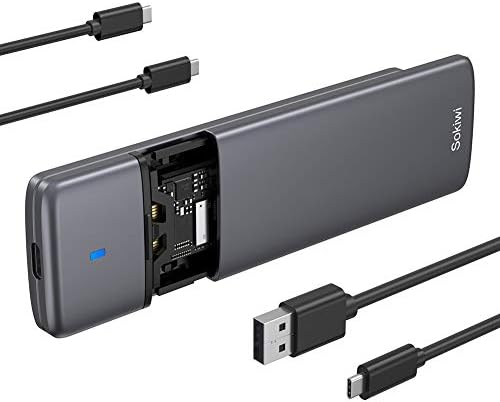
| Sokiwi Tool-Free NVMe/SATA SSD Enclosure | Best value tool-free | USB 3.2 Gen 2 · 10 Gbps · no-screw design | $25.70 | Pop-in drive swap in seconds |
| Alxum NVMe M.2 SATA IDE Enclosure | Legacy-compatible | NVMe + SATA M.2 + IDE · USB 3.2 Type-C | $44.99 | Covers retro + modern drives |
| ACASIS NVMe SSD Reader Adapter | Best for frequent drive swaps | USB-C 10 Gbps · tool-free M.2 tray · hinged lid | $27.06 | Cable-free drive swapping |
| AOKO NVMe to USB 3.2 SSD Reader Docking | Budget docking station | USB 3.2 10 Gbps · dock-style enclosure | $28.99 | Vertical dock form factor |
🏆 Best Overall: SSK M.2 NVMe/SATA SSD Enclosure

Spec chips: • USB 3.1 Gen 2 · 10 Gbps · USB-C host port • Supports NVMe (PCIe) + SATA M.2 SSDs · 2230 / 2242 / 2260 / 2280 • Aluminum alloy heat-dissipation body · thermal pad included • UASP / TRIM pass-through supported • Includes USB-C to USB-C + USB-C to USB-A cables
Pros
- ✅ 4.5-star rating across 21,513 Amazon reviews — the most-validated NVMe enclosure in existence
- ✅ Dual-protocol (NVMe + SATA M.2) means a single enclosure works with virtually any M.2 SSD you own
- ✅ Aluminum alloy body with thermal pad provides real heat dissipation — NVMe drives don't throttle under sustained loads
- ✅ UASP + TRIM pass-through preserves SSD performance and lifespan
Cons
- ❌ 10 Gbps USB 3.1 Gen 2 caps at 1050 MB/s — a Gen 4 NVMe drive's peak 7000 MB/s speed is wasted
- ❌ Screwless mounting on early versions; newer models have improved lock mechanism
- ❌ Basic design — no fan, no USB-C PD, no external status LEDs
Why it wins
The SSK M.2 NVMe/SATA Enclosure is the universal recommendation for NVMe enclosures, with 21,513 Amazon reviews at 4.5 stars — the highest-reviewed NVMe enclosure in existence. For under $20, it provides everything a content creator or PC builder needs: dual-protocol support (NVMe + SATA M.2), 10 Gbps USB 3.2 Gen 2 speeds (saturating at ~1000 MB/s sustained), aluminum body with thermal pad, UASP + TRIM pass-through, and USB-C + USB-A cables in the box. For a repurposed NVMe drive becoming an external SSD, this is the no-compromise pick. Its real limitation is USB 3.2 Gen 2 10 Gbps — an NVMe Gen 4 drive's internal 7000 MB/s is capped to 1050 MB/s through the USB bottleneck. For most creator work (4K H.265 editing, Lightroom catalogs, general file transfers), 1050 MB/s is plenty. For 8K ProRes RAW or multi-stream 6K ProRes, you'd need a faster USB 3.2 Gen 2×2 (20 Gbps) or Thunderbolt 3 enclosure — which cost 2-4× as much.
View on Amazon →Price sourced from Amazon.com. Last checked Sep 30, 2026. Price and availability subject to change.
💰 Best Value Tool-Free: Sokiwi M.2 NVMe/SATA SSD Enclosure Adapter

Spec chips: • USB 3.2 Gen 2 · 10 Gbps • Tool-free drive installation · clip-in design · NVMe + SATA M.2 • Aluminum body + thermal pad · 2230 / 2242 / 2260 / 2280 • LED status indicator · USB-C detachable cable
Pros
- ✅ True tool-free drive swap — push-to-open clip design, no screwdriver, no fiddly tiny screws
- ✅ 4.5-star rating across 2,383 Amazon reviews; newer "premium budget" tier
- ✅ Same 10 Gbps USB 3.2 Gen 2 performance as the SSK Best Overall pick
- ✅ Aluminum body + thermal pad delivers comparable thermal performance
Cons
- ❌ Less-validated track record than the SSK pick (2,383 vs 21,513 reviews)
- ❌ Clip mechanism can wear out over many dozens of drive swaps
- ❌ Premium over SSK for the tool-free feature alone ($25.70 vs $18.99)
Why it wins
The tool-free M.2 NVMe enclosure is for the content creator or IT professional who swaps NVMe drives frequently — perhaps as part of a data-hoarding workflow, a repair workflow, or a redundant-backup rotation. The 30-second drive-swap time (vs 3-5 minutes fiddling with tiny screws on the SSK enclosure) adds up if you do this often. 4.5-star rating across 2,383 reviews is solid for this newer product tier. Performance is identical to the SSK — same 10 Gbps USB 3.2 Gen 2 controller, same aluminum body, same thermal pad. For a casual user who mounts an NVMe drive once and leaves it, the SSK's lower price makes it the better buy. For repeat swapping, the tool-free version's ergonomics justify the roughly $7 premium.
View on Amazon →Price sourced from Amazon.com. Last checked Sep 30, 2026. Price and availability subject to change.
🎯 Best Legacy + Modern Compatibility: Alxum NVMe M.2 SATA IDE Enclosure

Spec chips: • USB 3.2 Gen 2 · 10 Gbps · Type-C host • Supports: NVMe M.2 + SATA M.2 + IDE / PATA • Tool-free · aluminum body · thermal pad • Includes IDE power cable and adapter for legacy 2.5"/3.5" IDE drives
Pros
- ✅ Only enclosure in our catalog supporting IDE / PATA — critical for retro PC archival work
- ✅ Three-in-one protocol support (NVMe + SATA M.2 + IDE) covers modern SSDs to 1990s hard drives
- ✅ 4.4-star rating across 576 Amazon reviews; specialty product with growing adoption
- ✅ Perfect for retro-PC enthusiasts imaging old IDE drives before their ATA interfaces fail
Cons
- ❌ More expensive than single-protocol enclosures ($44.99 vs $18.99 for the SSK)
- ❌ IDE adapter cable is external and bulky; adds complexity when not needed
- ❌ Smaller sample size means less-validated reliability
Why it wins
The Alxum 3-in-1 Enclosure is the specialty pick for retro PC restorers and collectors who need to image and archive old IDE / PATA hard drives from the 1990s-2000s. As those drives age and ATA controllers become harder to find, having a USB-to-IDE interface in the same enclosure as a modern NVMe adapter is a practical archival workflow. The 4.4-star / 576-review track record is solid for this niche product. For 95% of users, a simple NVMe-only enclosure (SSK pick) is fine. For retro enthusiasts who need to recover files from a 2003 laptop's PATA drive, or a Compaq Presario's Deskstar, this is the right tool. Combines well with the retro PC tools from our retro-pc-tools guide.
View on Amazon →Price sourced from Amazon.com. Last checked Sep 30, 2026. Price and availability subject to change.
⚡ Best for Frequent Drive Swaps: ACASIS NVMe SSD Reader Adapter

Spec chips: • USB-C 10 Gbps · USB 3.2 Gen 2 • Tool-free hinged lid · integrated M.2 tray • Aluminum body · thermal pad · LED activity • Supports NVMe + SATA M.2 · 2230 / 2242 / 2260 / 2280
Pros
- ✅ Hinged-lid design is the fastest drive-swap mechanism in the enclosure market
- ✅ ACASIS is one of the more reputable enclosure / dock brands; 4.6-star rating across 1,121 reviews
- ✅ Same 10 Gbps USB 3.2 Gen 2 performance as higher-reviewed SSK pick
- ✅ Dock-style form factor is more stable on a desk than cable-dangling enclosures
Cons
- ❌ Smaller sample size vs the SSK pick's 21,513
- ❌ Dock form factor is bulkier — not as pocket-friendly for travel
- ❌ Price premium over SSK for the hinge mechanism alone ($27.06 vs $18.99)
Why it wins
The ACASIS NVMe SSD Reader Adapter is the prosumer-tier pick for users who swap NVMe drives more than once a month — IT professionals imaging drives, hobbyists rotating backup drives, or data hoarders cycling through a shelf of M.2 drives. The hinged-lid mechanism (pull hinge, drop drive in, close lid, drive locks in) is measurably faster than screwless-clip alternatives and avoids the wear-out mode of frequent clip-open/close cycles. 4.6-star / 1,121-review Amazon track record is solid. Performance matches the SSK enclosure — same USB 3.2 Gen 2 10 Gbps controller — and ACASIS's reputation for reliable adapter products supports the premium over generic-brand alternatives. For frequent swappers, this saves real time. For occasional use, the SSK pick is better value.
View on Amazon →Price sourced from Amazon.com. Last checked Sep 30, 2026. Price and availability subject to change.
🧪 Budget Pick: AOKO NVMe to USB 3.2 SSD Reader Docking

Spec chips: • USB 3.2 · 10 Gbps · USB-C + USB-A compatible • Vertical dock form factor · NVMe + SATA M.2 • Hot-swap capable · LED power / activity • No tools required
Pros
- ✅ Vertical dock form factor keeps the drive stable on a desk during long-running jobs
- ✅ Hot-swap capable — insert / remove drives while host is powered
- ✅ 4.3-star rating across 282 Amazon reviews
- ✅ USB-C + USB-A compatibility means it works on every host from 2015 onwards
Cons
- ❌ Smaller sample size with mixed feedback; some reports of docking-connector wear after 100+ swaps
- ❌ Vertical dock is not pocketable; desk-bound by design
- ❌ Basic thermal design — no large heatsink, so sustained transfers may throttle NVMe drives
Why it wins
The AOKO NVMe Docking Station is the budget docking pick for workflows that want a drive-visible desktop setup — copying files from a drive, imaging drives, or running backup jobs where the drive stays in the dock for hours. The vertical form factor is more stable than cable-dangling enclosures for multi-hour operations. 4.3-star / 282-review track record is acceptable; it's a newer product with less-validated longevity than the SSK pick. For an occasional data-transfer task, this works fine. For a primary-use external SSD, the SSK enclosure is more pocket-friendly and has a substantially larger validation base.
View on Amazon →Price sourced from Amazon.com. Last checked Sep 30, 2026. Price and availability subject to change.
What to look for in an NVMe enclosure
USB generation — bandwidth matching
- USB 3.0 / USB 3.1 Gen 1: 5 Gbps · 500 MB/s max — old, underpowers NVMe
- USB 3.1 Gen 2 / USB 3.2 Gen 2: 10 Gbps · 1050 MB/s max — current mainstream
- USB 3.2 Gen 2×2: 20 Gbps · 2000 MB/s max — rare, requires compatible host
- USB4 / Thunderbolt 3/4: 40 Gbps · 3000-3500 MB/s max — premium, requires TB host
For most content creators, USB 3.2 Gen 2 (10 Gbps) is sufficient — 1050 MB/s is plenty for 4K H.265 editing and mixed workflows. USB4 / TB3/4 enclosures are worth the premium only for 8K RAW and multi-stream ProRes workflows.
UASP and TRIM pass-through
UASP (USB Attached SCSI Protocol) delivers 30-50% better performance than older "bulk-only transport" protocols on the same hardware. Nearly all modern NVMe enclosures support UASP; confirm before buying.
TRIM is the SSD maintenance command that keeps performance high over time. Older enclosures blocked TRIM pass-through, so the drive's sustained write speed degraded as free blocks ran out. Over USB, TRIM is sent as the SCSI UNMAP command, which works only when the enclosure's bridge chip and the UASP driver pass it through (ArchWiki: External SSD with TRIM support). Modern enclosures (SSK, ACASIS, ORICO) pass TRIM through to the drive. Verify TRIM support in reviews before buying a no-name enclosure.
Thermal design
NVMe drives (especially Gen 4 / Gen 5) generate significant heat under sustained workloads. Enclosures with thermal pads + aluminum bodies dissipate this heat and prevent thermal throttling. Enclosures with plastic bodies or no thermal pad will throttle after 50-100 GB of continuous transfer.
Ideal: aluminum body + thermal pad on both sides of the drive + external heat-spreading fins Acceptable: aluminum body + single-side thermal pad Avoid: plastic-only bodies for any serious use
Cable compatibility
Verify the enclosure ships with both USB-C-to-USB-C (for modern laptops) and USB-C-to-USB-A (for older desktops / servers). Some cheap enclosures ship with USB 2.0-only cables that limit the enclosure to 480 Mbps — a $30 NVMe enclosure with a bad cable becomes functionally equivalent to a 2005 USB stick.
NVMe drive compatibility
Confirm the enclosure supports your drive's length (2230, 2242, 2260, 2280) and protocol (PCIe NVMe, SATA M.2, or both). Most dual-protocol enclosures (SSK, Sokiwi, Alxum) auto-detect. Some NVMe-only enclosures are cheaper but won't accept a SATA M.2 drive.
Optional features
- LED indicators: useful for knowing when transfers are active vs idle
- Power button: useful for battery-powered laptop work (prevent constant drive spin)
- USB-C PD pass-through: rare on enclosures but useful if you connect to a laptop via a single cable
FAQ
Is a 10 Gbps enclosure enough for 4K video editing?
Yes, for most 4K workflows. 4K H.265 streams at 50-100 Mbps; 4K ProRes 422 HQ at ~440 Mbps. A 10 Gbps enclosure hitting 1050 MB/s (8400 Mbps) has plenty of headroom for 4K and even single-stream 6K ProRes 422 HQ (~660 Mbps). For multi-stream 6K or 8K workflows, step up to USB 3.2 Gen 2×2 (20 Gbps) or Thunderbolt.
Should I pay for a Thunderbolt 3/4 NVMe enclosure?
Only if your workflow requires 2000+ MB/s sustained read/write. OWC Envoy Express, ACASIS TB4 enclosures, and Kingston Workflow Station are the quality Thunderbolt 3/4 picks ($150-350 range). They're 3-10× the price of USB-C enclosures for 2-3× the speed. For 8K video, multi-stream RAW, or high-end audio production, worth it. For standard content creation, USB 3.2 Gen 2 is sufficient.
What's the maximum drive size an NVMe enclosure supports?
Standard enclosures support up to 8 TB M.2 NVMe drives — effectively every M.2 drive currently on the market. Some older enclosures had 2 TB or 4 TB limits; modern units (2022+) universally support 8 TB.
Does enclosure thermal performance matter?
Yes, for sustained transfers. A good aluminum-body enclosure with thermal pad keeps drive temps below 65°C during extended transfers; a cheap plastic enclosure lets the drive climb to 85-95°C and throttle. If you move large files (50+ GB in single sessions), prioritize thermal design.
Can I use an old NVMe enclosure with a Gen 5 NVMe drive?
Yes, but the enclosure's controller caps the speed at its maximum (usually 10 Gbps / 1050 MB/s). A $15 USB 3.2 Gen 2 enclosure works with any M.2 NVMe drive from Gen 3 through Gen 5 — you just don't get Gen 5's raw speed. For that, you need a USB4 / Thunderbolt enclosure.
Sources
- Tom's Hardware — External SSD Reviews — NVMe enclosure benchmarks and UASP / TRIM documentation.
- ServeTheHome — NVMe Enclosure Tests — Sustained-transfer thermal testing for M.2 enclosures.
- USB-IF — USB 3.2 Specification — Official USB bandwidth tier documentation.
- r/DataHoarder — Enclosure Recommendations — Community-aggregated NVMe enclosure reliability data.
- ArchWiki — Solid state drive: External SSD with TRIM support — How TRIM passes over USB as SCSI UNMAP, and the bridge-chip support it needs.
Related guides
- Best NVMe SSDs for Gaming in 2026 — drives to pair with enclosures
- Best External SSDs for Content Creators in 2026 — pre-built external SSD alternatives
- Best 4K Monitors for Content Creators in 2026 — match storage to editing monitor
- Best Tools for Building and Repairing Retro PCs in 2026 — retro-data-archival companion
More guides & deep dives from the SpecPicks archive
Browse all articles & guides →- The Complete Voodoo5 5500 AGP Driver Guide (2026 Edition)
- Best Budget Gaming PC Build 2026 — ~$1,000 Parts List
- How to Build a Windows 98 Retro PC in 2026
- Emulation Hardware in 2026: FPGA, Software, and Cart-Reader Ecosystems
- RTX 4070 Super vs RX 7800 XT — Which to Buy in 2026
- Best 1440p Gaming GPUs in 2026
- Best Retro Handhelds in 2026 — From $35 to $500
More reviews from the SpecPicks archive
Browse all reviews →- Best GPU for 1440p Gaming Under $300 in 2026
- Microsoft + Nvidia Agent PCs vs a DIY RTX 3060 12GB Local-Agent Box
- A Red Hat Engineer Went Back to AMD Ryzen for His Linux Desktop
- Best Mini PC Deals 2026 for Local AI and Home Labs
- RTX 5090 AIO Cooler: Liquid Cooling Options in 2026
- Best Used Ryzen CPU for Budget AM4 Gaming Upgrades in 2026
- Raspberry Pi LLM Projects: What Actually Runs in 2026
- Blue Yeti vs HyperX QuadCast 2 S: Best USB Mic for Streaming
- Pelican-Style Filament Dry Box: The Adafruit Build, Explained
- Windows 98 SE on >512MB RAM: The vcache Fix Explained (2026)
- Raspberry Pi OS Gets a Desktop Refresh: What Changes for Pi 4 Users
- CompactFlash as a Hard Drive: The Win98 Retro Storage Guide
- Running Windows XP Off a 2.5-inch SATA SSD via an IDE Adapter (2026 Guide)
- LG UltraGear 52G930B 52-inch 5K gaming monitor review: Extreme in every respect
- What Non-Gaming Tasks People Actually Run on Steam Deck
- Best Steam Deck Docked Setup for a 4K Desk in 2026: Dock, Monitor, Storage
- Best Compact DIY NAS Setup in 2026: A Buyer's Guide
- AI coding assistants ranked — Claude Code, Cursor, GitHub Copilot, Aider
- How to run Qwen 3 32B on Apple M4 Max
- Best Gaming Monitors for Console and PC in 2026
- Best SSD for Steam Deck and Handheld PCs in 2026
- Logitech G502 Hero in 2026: Is the FPS Mouse King Still Worth It?
- Local AI Image Generation: Best AMD GPUs for 2026
- 3D Printed Glow-Spike Bracelet: Adafruit Builder's Guide 2026
More buying guides from SpecPicks
Browse all buying guides →- Best Tools for Building and Repairing Retro PCs in 2026
- Best Mechanical Keyboards for Gaming in 2026
- Best CPUs for Content Creators in 2026
- Best Gaming Mice for 2026
- Best NVMe External Enclosures for 2026
- Best CPUs for Gaming in 2026
- Best GPUs for Running Local LLMs in 2026
- Best Gaming Monitors for 2026
- Best CPU Coolers for 2026
- Best GPU for Running 27B-32B Local LLMs in 2026
- Best External SSDs for Content Creators in 2026
- Best DDR5 RAM for Gaming PCs in 2026
- Best 1440p 240Hz Gaming Monitors in 2026
- Best PC Cases for Building in 2026
- Best AM5 Motherboards for 2026
- Best Controllers for PC Gaming in 2026
- Best 4K Monitors for Content Creators in 2026
- Best NVMe SSDs for Gaming in 2026
- Best Graphics Cards for Gaming in 2026
- Best Retro Gaming Consoles & Handhelds for 2026
- Best GPUs for 4K Gaming in 2026
Hardware benchmark data on SpecPicks
All benchmarks →- Ryzen 7 7800X3D — benchmarks & specs
- Radeon RX 6500M — benchmarks & specs
- AMD Ryzen 9 7900X3D — benchmarks & specs
- Ryzen 7 9850X3D — benchmarks & specs
- GRID RTX6000-8Q — benchmarks & specs
- AMD Ryzen Threadripper PRO 7975WX — benchmarks & specs
- AMD Ryzen 3 PRO 5355GE — benchmarks & specs
- AMD Ryzen Threadripper PRO 9995WX — benchmarks & specs
- Intel Arc A380E — benchmarks & specs
- GeForce RTX 4080 — benchmarks & specs
- AMD Ryzen Threadripper PRO 9985WX — benchmarks & specs
- Apple M1 Pro 10 Core 3200 MHz — benchmarks & specs
- RTX6000-Ada-3A — benchmarks & specs
- Ryzen 7 5700U — benchmarks & specs
- NVIDIA H100 PCIe 80GB — benchmarks & specs
- NVIDIA GeForce GTX 1650 SUPER — benchmarks & specs
- Ryzen 5 5625U — benchmarks & specs
- AMD Ryzen 7 PRO 9745 — benchmarks & specs
- AMD Ryzen 9 5900HS — benchmarks & specs
- GeForce RTX 5060 Ti 8GB — benchmarks & specs
- Ryzen 7 5700X — benchmarks & specs
- DDR5-8000 CL38 32GB (2x16) — benchmarks & specs
- Apple M2 Pro 12 Core 3480 MHz — benchmarks & specs
- Ryzen 7 1700 — benchmarks & specs