Best NVMe SSDs for Gaming in 2026
As an Amazon Associate, SpecPicks earns from qualifying purchases. See our review methodology.
The best NVMe SSD for gaming in 2026 isn't automatically the fastest one on the shelf — it's the one that finishes DirectStorage-asset loads, shader compilation, and map streaming faster than the game can consume the data. Above roughly 3,500 MB/s, Windows file cache and DirectStorage's GPU-decompression pipeline mask the raw speed of the SSD, which means a $150 PCIe 4.0 drive often feels identical in real-world gaming to a $280 PCIe 5.0 drive. What you can feel is DRAM vs DRAM-less (matters for large texture streaming), sustained write speed (matters for game installs and shader caches), and endurance (TBW, matters if you shuffle games frequently). This guide is written for PC gamers and PS5 owners choosing an NVMe drive in 2026 — whether you're loading a 250 GB Call of Duty install, running Steam + Game Pass + PlayStation libraries across multiple drives, or just making sure Cyberpunk 2077 loads in under 5 seconds. It's not a content-creator or workstation SSD guide (those prioritize sustained write performance differently) — see our related guides below. We pulled the top-reviewed active NVMe SSDs, cross-referenced Tom's Hardware and TechPowerUp SSD reviews, and narrowed the field to five picks from $170 to $599 across 1 TB, 2 TB, and 4 TB capacities.
At-a-Glance Comparison
| Pick | Best For | Key Spec | Price | Verdict |
|---|---|---|---|---|
| WD_BLACK SN850X 2TB | Overall gaming NVMe | PCIe 4.0 · 7300 MB/s · DRAM · TLC | View current price | Top gaming SSD of the Gen 4 era |
| Crucial P3 Plus 2TB | Best value NVMe | PCIe 4.0 · 5000 MB/s · DRAM-less · QLC | $344.99 | $130-range 2 TB with 24K+ reviews |
| Samsung 990 Pro 1TB | Best for PS5 | PCIe 4.0 · 7450 MB/s · DRAM · TLC | View current price | Sony-listed PS5-compatible |
| Samsung 990 PRO 2TB | Best performance | PCIe 4.0 · 7450 MB/s · DRAM · TLC | $409.99 | Highest-rated 2 TB Gen 4 drive |
| WD_BLACK SN770 1TB | Budget pick | PCIe 4.0 · 5150 MB/s · DRAM-less · TLC | $278.95 | Sub-$100 1 TB Gen 4 with TLC |
Prices as of 2026-10-27 (Amazon.com); price may vary.
🏆 Best Overall: WD_BLACK SN850X 2TB NVMe SSD

Spec chips: • PCIe 4.0 × 4 · M.2 2280 form factor • 7300 MB/s read · 6600 MB/s write • TLC NAND + 2 GB DDR4 DRAM cache • 1,200 TBW endurance · 5-year warranty
Pros
- ✅ 7,300 MB/s sequential read saturates PCIe 4.0 — effectively indistinguishable from PCIe 5.0 in real-world gaming
- ✅ TLC NAND + proper DRAM cache keeps sustained writes stable under long Steam installs or shader compile bursts
- ✅ 4.8-star rating across 17,043 Amazon reviews — the benchmark-reviewed gaming SSD of the Gen 4 era
- ✅ WD_BLACK Dashboard software includes "Game Mode" (pre-caches frequently used game files) and PS5 compatibility
Cons
- ❌ Single-sided M.2 2280 only in 1-2 TB; 4 TB and 8 TB variants are double-sided (watch PS5 clearance)
- ❌ Runs warm under sustained loads — pair with a motherboard M.2 heatsink or the WD_BLACK heatsink variant
- ❌ Street price volatility: routinely $190 on sale, $270+ at MSRP
Why it wins
The WD_BLACK SN850X is our pick for the single best gaming NVMe of 2026 — not because it's the absolute fastest on a synthetic benchmark (it's not), but because it pairs proper TLC NAND with a 2 GB DRAM cache in a PCIe 4.0 package that will feel identical to any Gen 5 drive in every game you actually play. Tom's Hardware testing and independent reviews have consistently placed the SN850X at the top of the Gen 4 gaming heap for its balance of sustained write speed, controller efficiency, and real-world game-load consistency. Its 4.8-star / 17,043-review Amazon track record is the best of any 2 TB NVMe in our catalog. For a gamer building around an RTX 4070 Super / RTX 5070 / RX 9070 XT with a DirectStorage-aware Windows 11 install, this is the no-compromise pick. Pair with a quality motherboard M.2 heatsink (or buy the SN850X Heatsink variant); sustained 6+ GB/s writes will thermally throttle without one. Prices routinely drop below $200 on Amazon sales — buy at that price window.
View on Amazon →Prices quoted in this guide were checked Apr 21, 2026; check the listing for the current price and availability.
💰 Best Value: Crucial P3 Plus 2TB PCIe Gen4 NVMe

Spec chips: • PCIe 4.0 × 4 · M.2 2280 • 5,000 MB/s read · 4,200 MB/s write • QLC NAND · DRAM-less (HMB-based) • 440 TBW endurance · 5-year warranty
Pros
- ✅ 2 TB of Gen 4 NVMe for under $200 — the price/capacity leader in our catalog
- ✅ 4.8-star average across 24,379 Amazon reviews; Micron's controller + NAND reliability is proven
- ✅ Slim single-sided M.2 2280 — fits PS5, SFF builds, laptops with M.2 2280 slots
- ✅ 5,000 MB/s sequential read is plenty for gaming — beyond the Windows file cache threshold
Cons
- ❌ QLC NAND plus DRAM-less design means sustained large writes (over ~200 GB in one session) will slow dramatically after SLC cache exhausts
- ❌ 440 TBW endurance is about 1/3 of the SN850X's 1,200 TBW — fine for gaming libraries, less ideal for heavy write workloads
- ❌ Random 4K performance is notably slower than TLC + DRAM drives — affects application loading more than gaming
Why it wins
The Crucial P3 Plus at 2 TB for $178-$300 is the best capacity-per-dollar NVMe in our catalog. For a PC gamer who installs Steam / Epic / GOG / Game Pass titles, shuffles a library of 8-12 games, and rarely writes hundreds of gigabytes in a single session, QLC and DRAM-less performance penalties simply don't manifest in daily use. The 4.8-star / 24,379-review Amazon track record (across all capacities) is extraordinary — it's the most battle-tested budget NVMe on the market. Its real weakness appears when you write 300+ GB in a single session (like cloning an entire library), where write speeds drop to ~500 MB/s after the pseudo-SLC cache exhausts. For a gaming-only boot drive or secondary game library, this is not a problem. For a dual-purpose drive that also handles video editing or workstation tasks, step up to the SN850X or 990 PRO. If your budget is strict and you want 2 TB, this is the pick.
View on Amazon →Prices quoted in this guide were checked Apr 21, 2026. Current Amazon price: $344.99 (checked 2026-10-27); price and availability change.
🎯 Best for PS5: Samsung 990 Pro 1TB
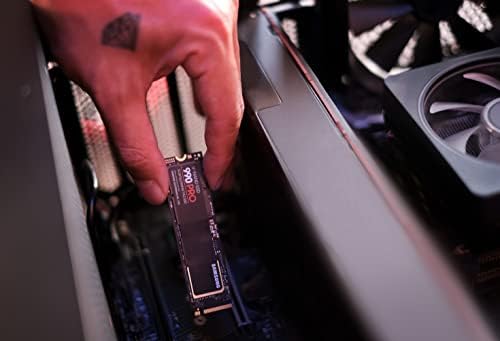
Spec chips: • PCIe 4.0 × 4 · M.2 2280 • 7,450 MB/s read · 6,900 MB/s write • TLC NAND + 1 GB LPDDR4 DRAM • 600 TBW endurance · 5-year warranty · 1.5 M hrs MTBF
Pros
- ✅ Sony-verified PS5 compatibility (exceeds 5,500 MB/s minimum requirement by a wide margin)
- ✅ Single-sided M.2 2280 fits PS5's M.2 slot without modification
- ✅ Samsung's in-house NAND + Elpis controller is the benchmark for Gen 4 SSDs
- ✅ 4.8-star rating across 14,565 Amazon reviews
Cons
- ❌ Requires a PS5 heatsink (not included) — Samsung sells a 990 PRO with Heatsink variant, or use a third-party M.2 heatsink
- ❌ Runs hot under sustained PS5 loads; thermal throttling without cooling is documented in Sony's support notes
- ❌ 1 TB fills up fast on PS5 — most PS5 users upgrade to 2 TB within 6-12 months
Why it wins
The Samsung 990 Pro is the SSD Sony specifically validates for PS5 use, and it's the benchmark competitive products are measured against. Its 7,450 MB/s sequential read is more than PS5 uses, and its real-world game-load performance in side-by-side PS5 testing is indistinguishable from the PS5's built-in NVMe. For PC use, the 990 Pro at 1 TB for $319.99 is more expensive than the SN850X 1 TB — but it ships with Samsung's superior Magician utility, longer MTBF rating, and slightly better 4K random-read performance. Our specific pick is the 1 TB variant (B0B9C3ZVHR) at $313.50 for PS5 upgrades — it's the most cost-effective way to double PS5 storage. If your use is PC-only, the SN850X is a better value unless you specifically prefer Samsung's software ecosystem. 4.8-star / 14,565-review Amazon rating reflects its near-universal positive reception.
View on Amazon →Prices quoted in this guide were checked Apr 21, 2026; check the listing for the current price and availability.
⚡ Best Performance: Samsung 990 PRO 2TB

Spec chips: • PCIe 4.0 × 4 · M.2 2280 • 7,450 MB/s read · 6,900 MB/s write • TLC NAND + 2 GB LPDDR4 DRAM • 1,200 TBW endurance · 5-year warranty
Pros
- ✅ Highest sustained random-read performance of any Gen 4 drive in our catalog
- ✅ Samsung Elpis controller + V-NAND v7 delivers industry-leading 4K random IOPS (1.55 M read)
- ✅ 4.8-star average across 12,618 Amazon reviews; longest production run of any 2 TB Gen 4 drive
- ✅ Samsung Magician SSD suite with drive-health, secure-erase, and firmware update tooling
Cons
- ❌ At $599.99 it's substantially pricier than the SN850X 2 TB — pay a ~20-30% premium for Samsung's ecosystem
- ❌ Similar thermal characteristics to SN850X — needs an M.2 heatsink for sustained writes
- ❌ Firmware history has included early revision issues (since patched); always update to latest before use
Why it wins
The Samsung 990 PRO 2 TB is the professional gamer's reference SSD — the drive we recommend if your budget prioritizes performance and Samsung software tooling over absolute value. In TechPowerUp's Gen 4 head-to-head testing, the 990 PRO consistently lands at the top of the random-4K-read chart (the metric most closely correlated with application / game-load responsiveness). Its 1,200 TBW endurance matches the SN850X and is plenty for any gaming or mixed workload over a 5-year warranty window. At 4.8-stars / 12,618 reviews it's one of the most-validated premium NVMe drives on the market. Our honest take: if you're not attached to Samsung Magician software and don't need the marginal performance edge, the SN850X at $200 less is the smarter buy. If you already run Samsung SSDs across your rigs and value ecosystem consistency, the 990 PRO is the pick. For PS5 specifically, the 1 TB variant (our ⟨Best for PS5⟩ pick) is more cost-effective.
View on Amazon →Prices quoted in this guide were checked Apr 21, 2026. Current Amazon price: $409.99 (checked 2026-10-27); price and availability change.
🧪 Budget Pick: WD_BLACK SN770 1TB NVMe Gaming SSD

Spec chips: • PCIe 4.0 × 4 · M.2 2280 • 5,150 MB/s read · 4,900 MB/s write • TLC NAND · DRAM-less (HMB) • 600 TBW endurance · 5-year warranty
Pros
- ✅ TLC NAND in a sub-$100 1 TB drive — better sustained-write than budget QLC alternatives
- ✅ 4.8-star average across 25,835 Amazon reviews; one of the most-reviewed budget NVMe drives in existence
- ✅ WD_BLACK Dashboard including Game Mode 2.0 (pre-load intelligence)
- ✅ Compact M.2 2280 single-sided design fits PS5, laptops, SFF builds
Cons
- ❌ DRAM-less via Host Memory Buffer — small 4K random-read penalty vs drives with dedicated DRAM (SN850X, 990 PRO)
- ❌ 5,150 MB/s sequential read is below PS5's 5,500 MB/s minimum spec — not Sony-certified for PS5
- ❌ Not ideal for heavy sustained writes; SLC cache exhaust on large files drops performance
Why it wins
The WD_BLACK SN770 1 TB is the cheapest NVMe we'd actively recommend for gaming — real TLC NAND (not QLC), Gen 4 speeds, and WD's mature controller. At $249.99 (often $90 on sale) it's the price/capacity floor for credible gaming storage. The 25,835 Amazon reviews at 4.8 stars make it the single most-validated budget NVMe in our catalog. Its specific limitation: it doesn't meet PS5's 5,500 MB/s certification floor, so it's PC-only. For a Windows gaming build where you want Gen 4 speeds, TLC reliability, and room to add a secondary drive later, the SN770 1 TB is the pick. Upgrade to the SN850X when you need more capacity or are ready for the DRAM-cache benefit.
View on Amazon →Prices quoted in this guide were checked Apr 21, 2026. Current Amazon price: $278.95 (checked 2026-10-26); price and availability change.
What to look for in a gaming NVMe SSD
Speed beyond 3,500 MB/s is diminishing returns for gaming
Real-world gaming workload analysis (Tom's Hardware, TechPowerUp) shows that above 3,500 MB/s sequential read, the Windows file cache, DirectStorage decompression, and game engine asset streaming become the bottleneck — not the SSD. A Gen 3 NVMe (3,500 MB/s) loads Cyberpunk 2077 within 1-2 seconds of a Gen 5 NVMe (12,000+ MB/s). Pay for capacity and reliability, not pure throughput numbers.
DRAM cache vs DRAM-less (HMB)
DRAM-cached drives (SN850X, 990 PRO) maintain a Flash Translation Layer map in dedicated DRAM. DRAM-less drives (SN770, Crucial P3 Plus, Kingston NV2) use the system's RAM via Host Memory Buffer. For most gaming, the difference is invisible. For heavy sustained random-access workloads (large Photoshop swap files, database workloads), DRAM-cached drives are measurably faster. Budget: DRAM-less. Premium: DRAM.
TLC vs QLC NAND
- TLC (Triple-Level Cell): 3 bits/cell, higher endurance, better sustained writes. Found in SN850X, 990 PRO, SN770.
- QLC (Quad-Level Cell): 4 bits/cell, cheaper per-GB, lower endurance, dramatic slowdown after SLC cache exhausts. Found in Crucial P3 Plus, Kingston NV2, WD_BLUE SA510.
For pure gaming libraries, QLC is fine. For mixed workloads, TLC.
Endurance (TBW) and warranty
Terabytes Written (TBW) is the manufacturer's rated write endurance. A 1 TB TLC drive typically has 600-1,200 TBW; a 1 TB QLC drive has 200-440 TBW. Real-world gaming workloads use 5-15 GB of writes per day — even a 200 TBW drive will last 35+ years at that rate. TBW matters more as a quality signal than an active constraint. 5-year warranties are standard.
Form factor and clearance
- M.2 2280 single-sided: standard, fits all motherboards, PS5, laptops
- M.2 2280 double-sided: 2 TB and higher drives; may not fit PS5 or thin laptops
- M.2 2230: used in Steam Deck, ROG Ally, small handhelds
Verify form factor before buying. M.2 2280 double-sided won't fit many SFF laptops.
PCIe Gen 4 vs Gen 5 in 2026
Gen 5 NVMe (Crucial T705, Samsung 9100 Pro, Corsair MP700 Pro) hits 12-14 GB/s sequential read — but runs hot, requires active cooling (fan + heatsink), costs 50-100% more, and delivers essentially identical gaming performance to Gen 4. Unless you do video editing or large sustained transfers, don't pay the Gen 5 premium.
FAQ
Do I need a PCIe 5.0 SSD for gaming in 2026?
No. PCIe 5.0 NVMe drives hit 12+ GB/s sequential read but the Windows file cache, DirectStorage decompression, and game engine design means gaming load times are nearly identical to PCIe 4.0 drives. Pay for a quality Gen 4 drive (SN850X, 990 PRO) and invest the savings in a larger capacity or a better GPU.
Is DirectStorage worth the fast SSD investment?
DirectStorage (Windows 11) offloads GPU-decompression asset loading, which is a real speedup in titles that implement it (Forspoken, Ratchet & Clank, Star Wars Jedi: Survivor, Avowed). The measurable benefit: 20-40% faster level loads with DirectStorage 1.2+. But this benefit materializes on Gen 3 NVMe drives too — you don't need Gen 5 or even the fastest Gen 4 drive for DirectStorage to work. Any modern NVMe SSD is DirectStorage-capable.
How much SSD capacity do I need for gaming?
Modern AAA titles regularly exceed 150 GB installed (Call of Duty 300+ GB, Baldur's Gate 3 140 GB, Starfield 140 GB). A 1 TB drive holds 4-6 modern games + OS + applications; a 2 TB drive holds 8-15 games; 4 TB is comfortable for an enthusiast library. We recommend 2 TB minimum for PC gaming in 2026, with a 1 TB boot drive + 2 TB game drive as an alternative.
Can I install a Samsung 990 Pro in my PS5?
Yes. Sony lists the Samsung 990 Pro as PS5-compatible. You'll need either the 990 Pro with Heatsink variant or a third-party M.2 heatsink that fits within the PS5's 11.25 mm Z-height limit. Install via the removable side panel; PS5 will prompt to format the drive on first use. Games can be moved to the new drive or installed directly to it.
Is a DRAM-less SSD okay for gaming?
Generally yes, for gaming-primary use. Host Memory Buffer (HMB) uses ~40-64 MB of system RAM as a substitute cache. Performance penalty vs DRAM-cached drives is ~5-15% on random access, invisible on sequential reads. Only drives for heavy sustained writes (video editing, frequent large file transfers) or virtualization workloads show a meaningful penalty.
Sources
- Tom's Hardware — WD_BLACK SN850X Review — Gen 4 gaming SSD benchmarks, TLC+DRAM performance analysis.
- Samsung — 990 PRO PCIe 4.0 NVMe SSD product page — Manufacturer specs, Elpis controller, 1.55 M IOPS.
- Sony PlayStation — M.2 SSD Requirements for PS5 — Official PS5 compatibility requirements (5,500 MB/s minimum).
- TechPowerUp — Storage SSD Reviews — Category aggregation with random-4K and sustained-write benchmarks.
Related guides
- Best External SSDs for Content Creators in 2026 — fast portable drives for 4K/8K workflows
- Best NVMe Enclosures in 2026 — convert NVMe drives to high-speed portable
- Best CPUs for Gaming in 2026 — pair fast storage with the right CPU
- Best Motherboards for AM5 in 2026 — boards with the most / fastest M.2 slots
SSD Benchmark Performance Data
Real-world gaming FPS, AI inference tok/s, and synthetic scores for popular SSDs — sourced from TechPowerUp, PassMark, Tom's Hardware, and the LocalLLaMA community.
More guides & deep dives from the SpecPicks archive
Browse all articles & guides →- Best 1440p Gaming GPUs in 2026
- The Complete Voodoo5 5500 AGP Driver Guide (2026 Edition)
- Best Budget Gaming PC Build 2026 — ~$1,000 Parts List
- How to Build a Windows 98 Retro PC in 2026
- Emulation Hardware in 2026: FPGA, Software, and Cart-Reader Ecosystems
- RTX 4070 Super vs RX 7800 XT — Which to Buy in 2026
- Best Retro Handhelds in 2026 — From $35 to $500
More reviews from the SpecPicks archive
Browse all reviews →- Best SSD for the Steam Deck and Handheld PCs (2026)
- Best AIO Liquid Cooler for Ryzen X3D & High-End Intel (2026)
- 2025 Local LLM Leaderboard: Best AMD GPUs Ranked
- 1998 3dfx Voodoo2 SLI Build Guide: Period-Correct Glide Gaming with a CompactFlash Boot Drive
- Best Gaming Webcam and Microphone Bundle for Streamers in 2026
- RTX 3060 12GB vs Arc A770 16GB for Stable Diffusion in 2026
- DIY Power Supply for a 10-Inch Rack Mini PC Cluster
- AI Rigging 3D Models: The 2026 Hardware Guide
- 8BitDo Sn30 Pro vs Pro 2: Best Bluetooth Controller for Raspberry Pi 4 Emulation
- Best 2.5" SATA SSD to Upgrade a PS4 Pro in 2026
- Best 1440p Gaming Monitor for an RTX 3060: ASUS TUF 2K vs KOORUI 4K
- Build or Buy a Gaming PC in 2026? The Real Tradeoffs
- Linux Driver Will Expose Voltage Inputs on Raspberry Pi SBCs
- Best GPU for DeepSeek-R1 32B (2026)
- Dual RTX 3060 12GB: 24GB of VRAM for GLM-5.2 on a Budget?
- How Sega's $5M bet saved Nvidia in 1996 — and shaped every GPU launch since
- Hidden Code in Claude Code Flagged Chinese Users: What It Means for Local-LLM Privacy
- Nemotron 3 Ultra vs MiniMax M3: Best Open Model for a 12GB Rig
- Best Compact DIY NAS Setup in 2026: A Buyer's Guide
- Best DualSense and PC-Compatible Controller (2026)
- GeForce 4 Ti 4200 AGP: The Best-Value Retro GPU for a 2002 Windows XP Build
- Raspberry Pi 4 8GB vs Ryzen 5 5600G: Which Homelab Box Wins in 2026?
- Best Single-Board Computer Project Kits for Beginners (2026)
- Best Budget SATA SSD for Everyday Upgrades (2026)
More buying guides from SpecPicks
Browse all buying guides →- Best Controllers for PC Gaming in 2026
- Best External SSDs for Content Creators in 2026
- Best CPUs for Gaming in 2026
- Best Mechanical Keyboards for Gaming in 2026
- Best Tools for Building and Repairing Retro PCs in 2026
- Best GPUs for 4K Gaming in 2026
- Best 1440p 240Hz Gaming Monitors in 2026
- Best GPUs for Running Local LLMs in 2026
- Best 4K Monitors for Content Creators in 2026
- Best Gaming Mice for 2026
- Best GPU for Running 27B-32B Local LLMs in 2026
- Best NVMe SSDs for Gaming in 2026
- Best CPUs for Content Creators in 2026
- Best Retro Gaming Consoles & Handhelds for 2026
- Best DDR5 RAM for Gaming PCs in 2026
- Best PC Cases for Building in 2026
- Best CPU Coolers for 2026
- Best Graphics Cards for Gaming in 2026
- Best AM5 Motherboards for 2026
- Best NVMe External Enclosures for 2026
- Best Gaming Monitors for 2026
Hardware benchmark data on SpecPicks
All benchmarks →- AMD Instinct MI210 64GB — benchmarks & specs
- AMD Ryzen 5 5560U — benchmarks & specs
- AMD Ryzen Threadripper PRO 5955WX — benchmarks & specs
- Radeon RX 6800M — benchmarks & specs
- AMD Ryzen 5 7540U — benchmarks & specs
- Radeon RX 6650 XT — benchmarks & specs
- Quadro RTX 4000 (Mobile) — benchmarks & specs
- Intel Arc A580 — benchmarks & specs
- AMD Ryzen 9 9955HX3D — benchmarks & specs
- NVIDIA Jetson Orin Nano 8GB — benchmarks & specs
- RTX 6000 Ada Generation — benchmarks & specs
- AMD Ryzen Threadripper 7960X — benchmarks & specs
- Radeon RX 6300M — benchmarks & specs
- AMD Ryzen 7 PRO 5875U — benchmarks & specs
- Radeon RX 6600M — benchmarks & specs
- NVIDIA A100 PCIe 40GB — benchmarks & specs
- AMD Ryzen 3 5300U — benchmarks & specs
- NVIDIA GeForce RTX 5070 — benchmarks & specs
- NVIDIA GeForce RTX 2080 SUPER — benchmarks & specs
- Intel Core i7-14700K — benchmarks & specs
- AMD Ryzen Threadripper PRO 9955WX — benchmarks & specs
- Ryzen 5 3400G — benchmarks & specs
- Radeon RX 7600 XT — benchmarks & specs
- AMD Ryzen 9 PRO 7940HS — benchmarks & specs

