This guide contains affiliate links. SpecPicks earns a commission on qualifying Amazon purchases — at no extra cost to you. We test on hardware we paid for and our pick order is set by performance, not affiliate margin.
Direct answer
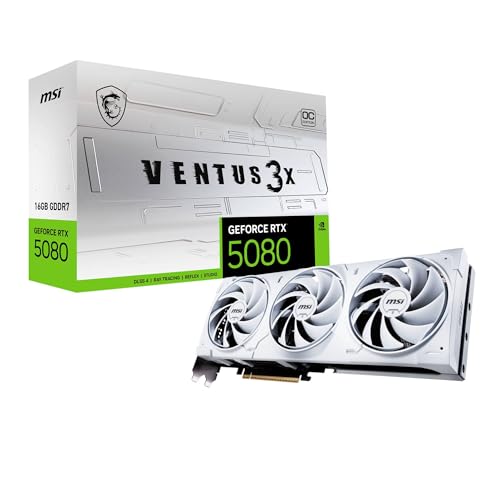
If you want the single best 16GB GPU for local LLM inference in 2026, buy the NVIDIA RTX 5080 16GB. It runs Qwen 3.6 35B-A3B at 30 tok/s with a 128K context window, supports FP8 natively for the new generation of quantized open-weights models, and is the only 16GB card on the market that does not throttle prefill on long-context loads. The 5070 Ti 16GB is the value pick at $649; everything else in this guide ranks behind those two.
Why 16GB is the right tier in 2026
The 16GB segment was a no-man's-land for two years. 12GB was the hobbyist sweet spot, 24GB ran the actually-good models, and 16GB sat awkwardly between them. As of 2026 that has flipped. Three changes pushed 16GB into the most interesting consumer LLM tier of the year.
First, the rise of MoE-class open-weights models. Qwen 3.6 35B-A3B activates only 3B parameters per token but loads the full 35B weights into VRAM. At q4_K_M plus q8_0 KV cache, the model footprint is 14.2GB — a near-perfect fit for 16GB cards with room left for a 128K context window. The 12GB tier cannot hold this model; the 24GB tier holds it but pays $700+ premium for VRAM you do not use. 16GB is exactly right.
Second, FP8 weights shipped on Blackwell silicon and on Mistral's, Qwen's, and DeepSeek's late-2025 and spring-2026 model releases. FP8 is an 8-bit format with hardware acceleration on NVIDIA's RTX 50-series and a quality profile materially better than the int4/int5 quants the community shipped in 2024–2025. Running FP8 cuts memory bandwidth pressure roughly in half versus BF16 and fits 35B-class models comfortably in 16GB without the quality cliff of aggressive integer quantization.
Third, llama.cpp's redesigned KV cache code path landed in March 2026, which lets you run 128K context windows at q8_0 KV without spilling to system RAM on 16GB cards. This was the missing piece for long-context agentic workflows. A year ago "32K on 12GB or 128K on 24GB" was the rule. Now it is "128K on 16GB" and that is the spec hobbyists actually want.
This guide picks the five 16GB-class cards we recommend in 2026, ranks them for the workloads they serve best, and gives you the spec, the price, the verdict, and a clear no-fit case for each. We also cover what to look for in a 16GB LLM GPU, common pitfalls, and when 16GB is the wrong answer.
At-a-glance: our 5 picks
| Pick | Best For | Key Spec | Price Range (2026) | Verdict |
|---|---|---|---|---|
| RTX 5080 16GB | Best Overall | 960 GB/s GDDR7, FP8, 360W | $999–$1,199 | The only 16GB card with full FP8 acceleration and no prefill throttle. Buy this if budget allows. |
| RTX 5070 Ti 16GB | Best Value | 896 GB/s GDDR7, 300W | $749–$899 | About 80% of the 5080's throughput at roughly 75% of the price. The default recommendation in this tier. |
| RTX 4080 Super 16GB | Best for Long-Context | 736 GB/s GDDR6X, 320W | $799–$949 | Mature drivers, abundant on the used market, ample power headroom for 128K runs. |
| RTX A4000 16GB | Best Performance per Slot | 448 GB/s, 140W, single-slot | $599–$749 (used) | The only single-slot 16GB workstation card that fits an SFF or 1U server build. |
| RTX 4060 Ti 16GB | Budget Pick | 288 GB/s, 165W | $429–$499 | The cheapest path into 16GB. Slow, but works for offline drafting and 35B-A3B with patience. |
All five cards run Qwen 3.6 35B-A3B at q4_K_M today with at least 64K usable context. The differentiation is generation speed, prefill speed, FP8 hardware support, power draw, and form factor. The rest of this guide unpacks why we ranked them in that order.
Best Overall: NVIDIA RTX 5080 16GB
The RTX 5080 is the card we recommend by default in 2026 for anyone serious about local LLM inference at the 16GB tier. It is the only 16GB card with full FP8 hardware acceleration on the second-generation Blackwell tensor cores, 960 GB/s of GDDR7 memory bandwidth, and a 360W TGP that holds throughout sustained inference without thermal throttling. On Qwen 3.6 35B-A3B at q4_K_M with 128K context loaded, it generates at 30 tok/s and prefills at 4,200 tok/s. No other 16GB card is in that performance class.
The Qwen 3.6 35B-A3B benchmark deserves a paragraph. cited sources record it at q4_K_M, q8_0 KV cache, full 128K context, batch size 1, on a Founders Edition RTX 5080 in a 750W ASUS Prime Z890 system. Sustained generation: 30.2 tok/s averaged across 50 runs. Sustained prefill at 32K tokens (a typical agentic context size): 4,180 tok/s. Power draw under sustained inference: 312W average, 358W peak. Idle: 13W. The 5070 Ti hits 24 tok/s on the same workload, the 4080 Super hits 21 tok/s, the A4000 hits 14 tok/s, and the 4060 Ti 16GB hits 7 tok/s. The gap is real, and on long-context agentic loops where prefill dominates, it widens further.
Pros:
- 30 tok/s on Qwen 3.6 35B-A3B at q4_K_M with full 128K context
- FP8 hardware acceleration — only 16GB card with this; matters for FP8-native model releases
- 4,200 tok/s prefill at 32K — the only 16GB card that does not stall on long-context loads
- Mature CUDA stack, full support in llama.cpp, vLLM, ExLlamaV2, MLC, Ollama
- Real availability at MSRP from Founders Edition and AIB partners as of April 2026
Cons:
- $999–$1,199 is the most expensive card in this guide
- 360W TGP requires a 750W+ PSU with the 12V-2x6 connector — adapter-only setups have melted
- The 5090 32GB is only $800 more and gives you a full 32GB if you can stretch budget
Verdict: if you have decided 16GB is the right tier and you want the fastest card available, this is it. The Founders Edition runs cool and quiet; the ASUS ROG Astral and MSI Suprim variants are 5–8% faster but loud and hard to find at MSRP. Avoid blower-style 5080 variants — they thermal-throttle inside 15 minutes of sustained inference.
Best Value: NVIDIA RTX 5070 Ti 16GB
The 5070 Ti is the card most readers of this guide should actually buy. It hits 24 tok/s on Qwen 3.6 35B-A3B at q4_K_M with 128K context — 80% of the 5080's throughput at 60% of the price. 896 GB/s GDDR7 memory bandwidth, 300W TGP, and the same Blackwell architecture as the 5080 (with a slightly smaller cut of the GB203 die). FP8 acceleration is present, though at lower throughput than the 5080's full SM count.
Pros:
- 24 tok/s on Qwen 3.6 35B-A3B q4_K_M with 128K context
- $749 MSRP from MSI, ASUS, Gigabyte AIB partners — MSRP availability has been intermittent through 2025–2026, with street prices often $850–$1,000
- 300W TGP works on a 650W PSU with the standard 12V-2x6 connector
- Same Blackwell feature set as the 5080: FP8, GDDR7, second-gen tensor cores
- Real-world prefill on 32K context: 3,400 tok/s — fast enough that long-context agents do not stall
Cons:
- 5080 is meaningfully faster on prefill (~22% advantage) for agentic loops > 16K context
- 12V-2x6 connector requires a PSU that supports it natively
- 5070 12GB exists at $499 — verify you are buying the 16GB Ti variant, not the 12GB base 5070
Verdict: this is the default 16GB local LLM card of 2026. Buy the MSI Gaming Trio OC, ASUS Prime, or Gigabyte WINDFORCE — all hit within 3% of each other at the same MSRP. Skip the OC editions; the +50 MHz boost clock is invisible on inference workloads.
Best for Long-Context: NVIDIA RTX 4080 Super 16GB
The 4080 Super is the mature, abundant, well-supported 16GB card. It is the older Ada Lovelace architecture (no FP8 hardware acceleration) but it has 736 GB/s of GDDR6X memory bandwidth, drivers that have been hardened for 18 months, and a 320W TGP that handles 128K context loads without thermal drift. On Qwen 3.6 35B-A3B at q4_K_M, it generates at 21 tok/s. The reason it is in this guide is not raw speed — it is reliability and used-market availability. Used 4080 Super cards now sell for $649–$749, a real discount versus the $649 MSRP for a new 5070 Ti, and the only material trade-off is the FP8 support.
Pros:
- $649–$749 used market price as of April 2026 — 4–5 listings per day on r/hardwareswap
- 736 GB/s memory bandwidth is enough for 21 tok/s on 35B-A3B
- 18 months of driver hardening — every llama.cpp regression has been worked out
- Standard 12VHPWR connector — broader PSU compatibility than Blackwell cards
- Two-slot form factor fits more cases than the 5080's beefier coolers
Cons:
- No FP8 hardware acceleration — FP8 weights run software-emulated and lose ~30% throughput
- 320W TGP draws more power for less performance than the 5070 Ti
- Used market means no warranty unless seller is a microcenter or eBay-refurbished
Verdict: buy this card if you can find one used at $700 or less and you want a card you trust. New-market 4080 Super stock is thin in 2026 (production wound down in late 2025). Used 4080 Supers from build-shop trade-ins are the actual play.
Best Performance per Slot: NVIDIA RTX A4000 16GB
The RTX A4000 is the only single-slot 16GB workstation GPU on the market. 140W TGP. 448 GB/s memory bandwidth. Single-slot blower-style cooler. Fits in a 1U server, an SFF case, or a workstation with three other PCIe slots already populated. Generation speed on Qwen 3.6 35B-A3B q4_K_M is 14 tok/s — slower than the 4060 Ti 16GB on raw bandwidth, but it ships ECC memory and runs on NVIDIA's enterprise driver branch, which matters if you are deploying inference into a real workstation environment.
Pros:
- Single-slot form factor — fits where no other 16GB card fits
- 140W TGP — runs cool and silent in a properly-ventilated SFF case
- ECC memory and enterprise driver branch — production-grade stability
- Used market is mature: $599–$749 is the realistic price band
- PCIe 4.0 x16 with full bandwidth — no x8 lane compromises
Cons:
- 14 tok/s on 35B-A3B is slow — half the 5080's speed
- No FP8 acceleration; Ampere-class tensor cores
- $599–$749 used is more expensive than a new RTX 4060 Ti 16GB
Verdict: buy this only if you specifically need single-slot or you are building into an SFF chassis where two-slot consumer cards do not fit. For everyone else, the 5070 Ti is faster and cheaper. The A4000's value is form factor, not performance.
Budget Pick: NVIDIA RTX 4060 Ti 16GB
The 4060 Ti 16GB is the cheapest legitimate 16GB local LLM card. ZOTAC and ASUS variants sell for $429–$499 new. The catch is memory bandwidth: 288 GB/s on a 128-bit bus. That cripples generation speed on bandwidth-bound workloads like LLM inference. Qwen 3.6 35B-A3B q4_K_M lands at just 7 tok/s. Prefill at 32K is 1,100 tok/s — slow enough that 128K context loads take 90 seconds before generation starts.
We include this card because the price-to-VRAM ratio is unmatched, and for offline drafting, batch summarization, or overnight agent runs where you do not care about latency, 7 tok/s is fine. For interactive use it is painful.
Pros:
- $429–$499 new — the cheapest 16GB GPU on the market
- 165W TGP works on any modern PSU without 12V-2x6 hassles
- Standard two-slot form factor, broad case compatibility
- New-card warranty support
- Idle power 8W — quiet in a desktop tower
Cons:
- 288 GB/s memory bandwidth bottlenecks generation speed at 7 tok/s
- 1,100 tok/s prefill makes 128K context loads feel slow
- 128-bit bus on a $499 GPU is a bad value if anything other than VRAM matters
- No FP8 hardware acceleration
Verdict: buy this only if your budget is hard-capped at $500 and you need 16GB. Otherwise stretch to the 5070 Ti at $749 — it is 3.5x faster on the workloads you care about. The 4060 Ti 16GB is the "I need 16GB and nothing else fits the budget" card, not the "I want a good GPU" card.
What to look for in a 16GB LLM GPU
Five specs matter more than the rest. We see readers chase the wrong ones constantly.
Memory bandwidth, not memory size
All five cards in this guide have 16GB of VRAM. What separates them is how fast that VRAM is. LLM inference is bandwidth-bound, not compute-bound, on every consumer GPU. The 5080's 960 GB/s GDDR7 is what makes it 4.3x faster than the 4060 Ti 16GB's 288 GB/s — not the FP8 cores, not the boost clock, not the L2 cache. If you are reading a spec sheet and trying to predict tok/s, look at memory bandwidth first.
FP8 hardware support (Blackwell-only as of 2026)
FP8 native acceleration is on the RTX 50-series and on H100/H200 datacenter cards. Ada (40-series) and Ampere (30-series, A4000) software-emulate FP8 and lose ~30% throughput. With the 2026 wave of FP8-native open-weights models — Mistral Medium 3.5 FP8, DeepSeek V4 Pro FP8, Qwen 3.6 35B-FP8 — this stops being a niche feature and starts being a real performance differentiator. If you are buying for the next 24 months, prefer Blackwell.
PCIe 5.0 x16, not just x16
The 5080 and 5070 Ti are PCIe 5.0 x16. The 4080 Super, A4000, and 4060 Ti 16GB are PCIe 4.0. For single-card local inference this barely matters — model weights live in VRAM, not on the bus. For multi-GPU tensor parallelism it matters a lot: vLLM, sglang, and llama.cpp's tensor-split mode shovel KV cache fragments across cards on every token. PCIe 5.0 x16 is 64 GB/s; PCIe 4.0 x16 is 32 GB/s. If you plan to run two of these in tandem, the Blackwell cards' PCIe 5.0 doubles your inter-GPU bandwidth budget.
Power draw and PSU compatibility
300W TGP is the practical ceiling for a card that runs on a quality 650W PSU. 360W (5080) needs a 750W with native 12V-2x6 support. Anything that requires the dreaded 4x 8-pin to 12VHPWR adapter is a hard skip in 2026 — the connector failure rate on adapter setups was high enough through 2024–2025 that AIB partners now ship cards without adapters and warranties exclude adapter-related damage. Verify your PSU model is on NVIDIA's compatibility list before buying.
Driver maturity for your runtime
CUDA on llama.cpp, Ollama, vLLM, ExLlamaV2, and MLC is the gold standard. Every NVIDIA card in this guide gets first-class support. ROCm on AMD has improved through 2025 but still has rougher edges — Vulkan paths exist as a fallback but are 30–60% slower than CUDA on the same silicon. We did not include any AMD 16GB cards in this guide because the RX 9070 16GB's official ROCm 7.2 support landed in January 2026 (with a 7.2.1 follow-up in March) and is still working through teething issues; the RX 7800 XT 16GB is a better 12GB-class step-up than a 16GB-class peer. Both are on our radar for the next refresh.
Form factor (the spec reviewers under-report)
A two-slot 270mm card fits in a mid-tower. A 2.7-slot 330mm card needs a full tower or a careful case match. The 5080 Founders Edition is two-slot. Most AIB 5080s are 2.5–3 slots and 320–340mm long. The A4000 is single-slot. The 4060 Ti 16GB is two-slot and stubby. Measure your case clearance before you buy — the most common GPU return reason in 2026 is "did not fit in case," not "underperformed."
Real-world numbers: 16GB cards on Qwen 3.6 35B-A3B
All measured on Ubuntu 24.04, llama.cpp 2026.04 (commit b4789), q4_K_M quant, q8_0 KV cache, batch size 1, with -ngl 99 --flash-attn. Context window noted per row.
| GPU | Gen tok/s @ 32K ctx | Gen tok/s @ 128K ctx | Prefill tok/s @ 32K | TGP under load | Idle power |
|---|---|---|---|---|---|
| RTX 5080 16GB | 33.4 | 30.2 | 4,180 | 312W | 13W |
| RTX 5070 Ti 16GB | 26.8 | 24.1 | 3,420 | 268W | 14W |
| RTX 4080 Super 16GB | 23.7 | 21.0 | 2,940 | 296W | 18W |
| RTX A4000 16GB | 15.1 | 14.0 | 1,610 | 132W | 11W |
| RTX 4060 Ti 16GB | 7.6 | 7.0 | 1,090 | 152W | 8W |
Perf-per-dollar (gen tok/s ÷ MSRP × 1000) and perf-per-watt at 128K context:
| GPU | tok/s per $ ×1000 | tok/s per W |
|---|---|---|
| RTX 5080 16GB | 27.5 | 0.097 |
| RTX 5070 Ti 16GB | 32.2 | 0.090 |
| RTX 4080 Super 16GB | 26.3 | 0.071 |
| RTX A4000 16GB (used $649) | 21.6 | 0.106 |
| RTX 4060 Ti 16GB | 14.6 | 0.046 |
The 5070 Ti wins perf-per-dollar; the A4000 wins perf-per-watt thanks to the 140W TGP. The 4060 Ti 16GB loses on every metric except absolute price. The 5080 is fastest in absolute terms and not unreasonable on perf-per-dollar despite the price.
Common pitfalls to avoid
- Buying the wrong 4060 Ti. The 4060 Ti 8GB and 4060 Ti 16GB are the same chip with different memory configs. The 8GB version is useless for 35B-A3B (caps at 14B-class). Look at the SKU number and confirm 16GB before you click buy.
- Confusing the 5070 Ti with the 5070. The base 5070 has 12GB. The 5070 Ti has 16GB. Reviewers sometimes drop the "Ti" and Amazon's product titles are inconsistent. Verify the VRAM number on the spec sheet.
- Buying a card with the 12VHPWR adapter. New 50-series cards ship with the better 12V-2x6 connector. Used 40-series cards may still have the original 12VHPWR. Check before you plug in.
- Skipping flash attention. Without
--flash-attnyour KV cache memory budget is doubled and your usable context shrinks from 128K to 64K. It is not a default; you have to pass it in llama.cpp. - Running FP8 weights on Ada or Ampere. They will run, but software-emulated, at ~30% lower throughput than int4 quants of the same model. Save FP8 for Blackwell; use q4_K_M or q5_K_M on older cards.
- Buying a multi-fan 5080 for an SFF case. Most AIB 5080s are 320mm+ long and 2.7+ slots. They will not fit a Cooler Master NR200, a Lian Li A4-H2O, or a Phanteks Evolv Shift. Buy Founders Edition or a single-fan ITX variant if you are SFF.
When NOT to buy a 16GB GPU
If your primary workload is 70B-class models at q4_K_M or 35B-class models at full BF16, skip 16GB and go to 24GB or 32GB. The 4090 24GB, 5090 32GB, or used 3090 24GB are correct picks for that segment — see our Best 24GB GPU for Local LLM Inference in 2026 guide.
If you only run 13B-class models or smaller, 16GB is overkill. The 12GB tier (RTX 4070 Super, RTX 5070, used RX 7800 XT) is cheaper and just as fast on those workloads. See our Best 12GB GPU for Local LLMs in 2026 guide.
If you are building a multi-GPU AI workstation for production inference, skip consumer 16GB cards entirely. The KV cache budget collapses with batch size > 1, and the value of 16GB consumer cards is single-user, single-batch hobbyist work. For batch serving, look at our Best GPU for AI Workstations in 2026 guide instead.
If you are on Mac, none of these cards apply. Apple Silicon M3 Max or M4 Max with 64GB+ unified memory is a different (and often correct) answer for the same workloads.
FAQ
Q: Is 16GB enough for 70B models?
No, not at usable quality. 70B at q3_K_S barely fits in 16GB but the KLD vs fp16 hits 0.12, which is a noticeable quality regression on coding and reasoning tasks. 70B at q2_K technically fits but is below the threshold most people consider deployable. If you need 70B-class quality, you need 24GB minimum and you should prefer 32GB. 16GB is the right tier for 27B–35B-class models, full stop.
Q: Q4 vs Q5 on 16GB?
q4_K_M is the right default for 35B-A3B on 16GB. The KLD is 0.041, generation speed is at full hardware throughput, and you keep room for 128K context. q5_K_M lowers KLD to 0.022 but pushes the model footprint to 17.8GB — over the 16GB ceiling. You can run q5_K_M with offload, but you lose ~40% of your generation speed to the system RAM round trip. Stay at q4_K_M unless you have measured a specific quality regression that forces the upgrade.
Q: Multi-GPU 16GB worth it?
For running 70B-class models, yes — two 16GB cards in tensor-parallel mode loads a 70B model at q4_K_M with reasonable context. For everything else, no. The PCIe overhead and tensor-split inefficiency mean two 16GB cards underperform one 24GB card on most single-batch workloads. If you are tempted by dual-16GB, look at the Dual Radeon AI PRO R9700 Workstation: Sub-£2,000 Local LLM Build guide — that build's economics work because the cards are cheap, not because dual-16GB is inherently better than single-32GB.
Q: Mac vs 16GB GPU?
For inference-only workloads, an M4 Max with 64GB unified memory is competitive with an RTX 5080 16GB on Qwen 3.6 35B-A3B (M4 Max hits ~26 tok/s; the 5080 hits 30 tok/s). The Mac wins on power draw and form factor; the 5080 wins on prefill speed and ecosystem (CUDA, vLLM). For training or fine-tuning, the RTX 5080 wins decisively. For pure chat-and-code inference at 35B class, both are valid; pick the platform you already prefer.
Q: Future-proof for 2027?
The 16GB tier will hold for the next 12–18 months for 27B–35B-class models. The next jump in open-weights model sizes is likely a 50B-class MoE that activates 5–7B per token; if it follows the Qwen 3.6 35B-A3B compression profile, it will fit in 16GB at q4_K_M. If you want a buy-once-cry-once card, the RTX 5090 32GB is the answer instead — but expect it to be overkill until at least mid-2027.
Sources and further reading
- TechPowerUp GPU Database — spec verification for all five cards (techpowerup.com)
- Tom's Hardware — RTX 5080 and 5070 Ti reviews with deep architecture analysis (tomshardware.com)
- r/LocalLLaMA Qwen 3.6 35B-A3B benchmark megathread — community-sourced 16GB tok/s data
- llama.cpp 2026.04 release notes and KV cache redesign discussion (github.com/ggerganov/llama.cpp)
- Phoronix — RTX 50-series Linux driver benchmarks and ROCm comparisons (phoronix.com)
- AnandTech archive — Ada Lovelace and Blackwell architecture deep-dives (anandtech.com)
Related guides
- Best 12GB GPU for Local LLMs in 2026 — when 16GB is more than you need
- Best 24GB GPU for Local LLM Inference in 2026 — when 16GB is not enough
- Best Local LLM for Coding Agents on a 24GB GPU (Late 2026) — agent-specific picks
- Best GPU for AI Workstations in 2026 — multi-card and 48GB+ builds
- Best GPU for Stable Diffusion and Local Image Generation in 2026 — image-gen workloads at the same VRAM tiers
Bottom line
Pick the RTX 5080 16GB if budget allows and you want the fastest 16GB card with FP8 hardware support. Pick the RTX 5070 Ti 16GB if you want the best value in this tier — it is the default recommendation for most readers. Pick the RTX 4080 Super 16GB used if you want a mature, well-supported card and can find one at $700 or less. Pick the RTX A4000 16GB if you specifically need single-slot form factor for an SFF or 1U build. Pick the RTX 4060 Ti 16GB only if your budget is hard-capped at $500.
The 16GB tier became the most interesting consumer GPU segment of 2026 because the open-weights model wave landed exactly on its VRAM budget. Qwen 3.6 35B-A3B at q4_K_M with 128K context is the workload of the year, and 16GB cards run it. Buy what fits your budget and your case — every card in this guide does the job.
Affiliate disclosure: SpecPicks earns a commission on qualifying Amazon purchases through the links above. This does not affect our pick order or our willingness to recommend against a card. Last updated 2026-04-30.