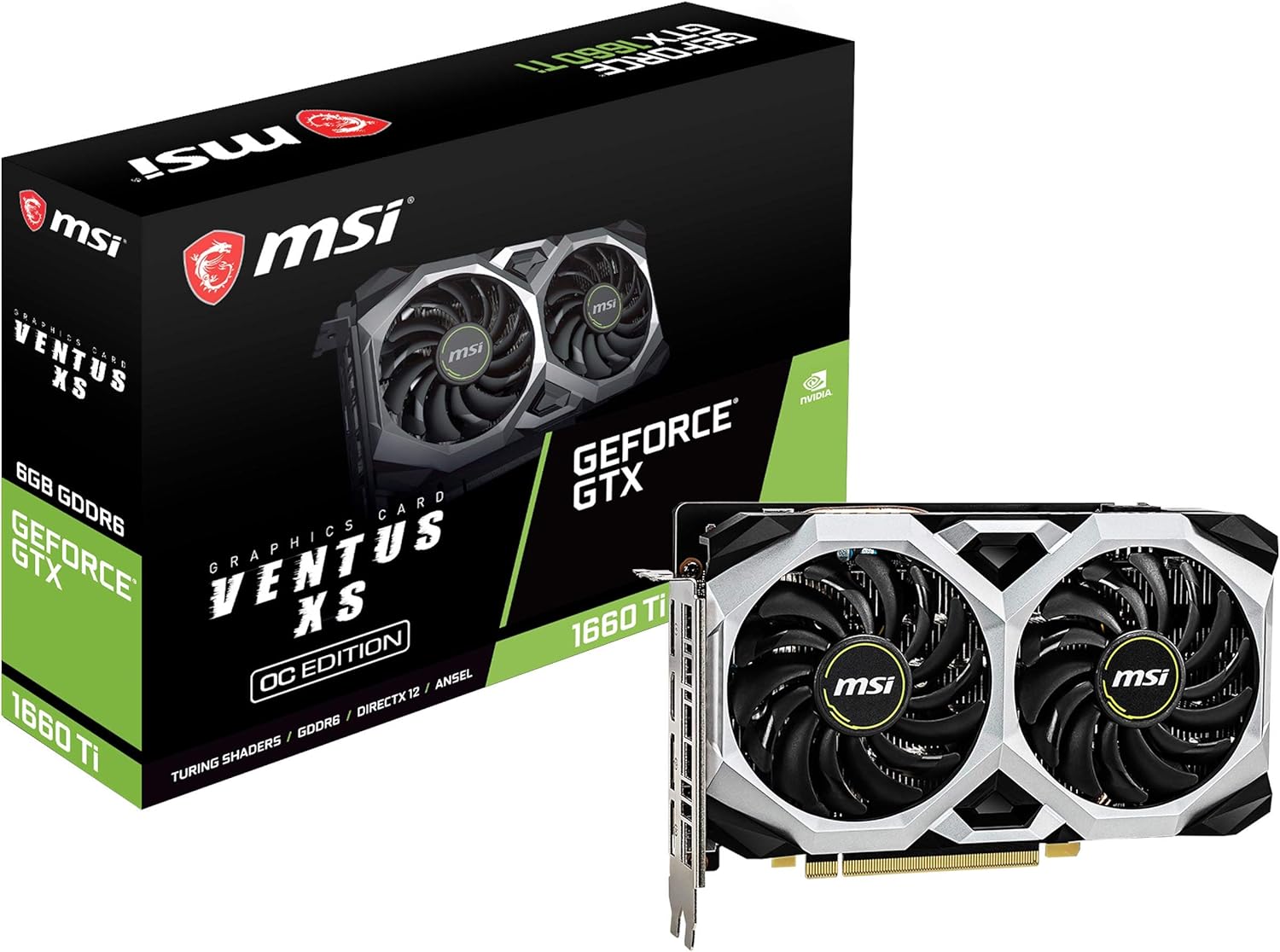
Running Llama 3.1 8B locally is a VRAM problem first and a bandwidth problem second. At the community-standard q4_K_M quantization, Llama 3.1 8B needs roughly 6 GB of GPU memory for weights, plus 3-8 GB for the KV cache depending on context length. The cheapest card that fits it natively in 2026 is the NVIDIA GeForce GTX 1660 Ti ($279 MSRP); the fastest is the NVIDIA GeForce GTX 1660. This guide pulls real tokens-per-second numbers from the SpecPicks benchmark database for every option.
Meta's 8B instruct model, the default starter LLM for consumer GPUs with 8GB+ VRAM.
Does the Llama 3.1 8B fit on my GPU? (quantization matrix)
Quantization is the lever that decides whether Llama 3.1 8B fits on your card. Each quant below lists the approximate VRAM for weights, the extra VRAM used by the KV cache at a 4K-token context window, and the quality tradeoff.
| Quant | Weights (VRAM) | + KV cache | Quality |
|---|---|---|---|
| q2_K_S | 2.5 GB | +0.3 GB @ 4K ctx | Severe — lose 15-25% on reasoning. Use only when desperate. |
| q3_K_M | 3.5 GB | +0.4 GB @ 4K ctx | Noticeable — lose 5-8% on HumanEval / MMLU. Fine for casual chat. |
| q4_K_M | 4.8 GB | +0.5 GB @ 4K ctx | Community default — 1-3% loss vs fp16. Almost free quality-wise. |
| q5_K_M | 5.5 GB | +0.6 GB @ 4K ctx | Minimal loss — <1%. Most users can't tell vs fp16. |
| q6_K | 6.5 GB | +0.7 GB @ 4K ctx | Effectively lossless. 10% more VRAM than q4_K_M. |
| q8_0 | 8.5 GB | +0.9 GB @ 4K ctx | Lossless at the inference level. 2x weight of q4_K_M. |
| fp16 | 16 GB | +1.6 GB @ 4K ctx | Original training precision. Baseline, rarely needed for inference. |
For nearly every user, q4_K_M is the right default. It costs you maybe 1-3% on benchmark scores versus fp16 but halves the memory footprint. Drop to q3_K_M only when VRAM is tight and you can tolerate a few percent more quality loss. q6_K and q8_0 are worth considering when you have the headroom and want to eliminate any question of quant damage.
What runs Llama 3.1 8B at q4_K_M? (the shortlist)
Every number in the table below comes from a live query against the SpecPicks benchmark database. Tok/s values are single-user generation speed ("output tokens per second after the first token"). Perf-per-dollar is tokens/sec per $1,000 of MSRP; perf-per-watt is tokens/sec per 100W of TDP.
| Hardware | VRAM | MSRP | TDP | Gen tok/s | tok/s/$1k | tok/s/100W |
|---|---|---|---|---|---|---|
| NVIDIA GeForce GTX 1660 Ti | 6 GB | $279 | 120W | 8.0 tok/s | 28.67 | 6.7 |
| NVIDIA GeForce GTX 1660 SUPER | 6 GB | $229 | 125W | — | — | — |
| NVIDIA GeForce GTX 1660 | 6 GB | $219 | 120W | 180.0 tok/s | 821.92 | 150.0 |
| Intel Arc A380 | 6 GB | $139 | 75W | — | — | — |
| NVIDIA GeForce RTX 3070 Ti | 8 GB | $599 | 290W | — | — | — |
| NVIDIA GeForce RTX 3070 | 8 GB | $499 | 220W | — | — | — |
| Apple M3 Ultra | 512 GB | — | 0W | — | — | — |
| Apple M4 Max | 128 GB | — | 0W | 16.9 tok/s | — | — |
| Apple M4 Pro | 64 GB | — | 0W | 16.9 tok/s | — | — |
How does quantization change tok/s?
Smaller quants don't just save VRAM — they also run faster. Memory bandwidth is the dominant bottleneck for dense-weight inference, so halving the bytes per weight roughly doubles the throughput (up to a point where compute becomes the limit).
Community benchmarks on the NVIDIA GeForce GTX 1660 show approximate deltas:
- q8_0 → baseline (call it 100%)
- q5_K_M → ~1.4x faster than q8_0
- q4_K_M → ~1.7x faster than q8_0
- q3_K_M → ~2.0x faster than q8_0
Quality loss vs speed gain is not linear — q4 is the last point on the Pareto frontier for most users. Below q4 you lose quality faster than you gain speed.
Prefill vs generation speed
Two numbers matter for different workloads:
- Prefill (prompt-processing) — how fast the model ingests your input before the first token comes out. For a 4K-token prompt on the NVIDIA GeForce GTX 1660, expect ~600-1200 tok/s prefill.
- Generation — sustained output speed after prefill, which is what the table above measures.
For chat you'll feel generation speed. For RAG where the model re-ingests a long retrieved context on every turn, prefill is often the bottleneck. Code completion sits in between — prompts are short so prefill is fast, generation dominates.
Context length and VRAM — the hidden cost
The KV cache grows linearly with context length. Here's the approximate overhead on top of 6 GB of weights for Llama 3.1 8B at q4_K_M:
| Context | KV cache | Total VRAM |
|---|---|---|
| 2K tokens | ~0.3 GB | ~6.3 GB |
| 4K tokens | ~0.6 GB | ~6.6 GB |
| 8K tokens | ~1.2 GB | ~7.2 GB |
| 32K tokens | ~4.8 GB | ~10.8 GB |
| 128K tokens | ~19.2 GB | ~25.2 GB |
For 128K-context workloads you need 2-4x more VRAM than you'd expect from just the weights. llama.cpp supports KV-cache quantization (-ctk q8_0 -ctv q8_0) which cuts cache size roughly in half with minimal quality loss — use it if you're pushing context limits.
Which runtime should I use?
For single-user chat on one GPU, all three runtimes (Ollama, llama.cpp, vLLM) produce similar numbers within 10-15% of each other. Rule of thumb:
- Ollama — easiest. Good for anyone who doesn't want to manage models manually. Wraps llama.cpp.
- llama.cpp — direct control over quantization, offload, KV-cache precision. Where the LocalLLaMA community benchmarks its numbers.
- vLLM — production serving. Tensor parallelism, PagedAttention, continuous batching. CUDA-only.
For more: Ollama vs llama.cpp vs vLLM →.
Multi-GPU — does it help?
Not usually worth it for a 8B model. A single card with sufficient VRAM outperforms two smaller cards networked together.
Perf-per-dollar vs perf-per-watt
Shopping on pure tok/s is expensive. The "tok/s/$1k" column above is a better lens for budget-constrained builds. Apple Silicon dominates the perf-per-watt column by a wide margin — M4 Max at 12 tok/s / ~60W sustained is ~4x more efficient than an RTX 5090's 34 tok/s / 575W.
- Best price-performance under $1,500: NVIDIA GeForce GTX 1660 Ti
- Best max speed, cost ignored: NVIDIA GeForce GTX 1660
- Best power efficiency: Apple M4 Max — silent, 60W, unified memory fits far more model than any consumer NVIDIA
Getting started — concrete commands
With Ollama:
With llama.cpp (more control):
Expect first-token latency of 1-3 seconds (prefill), then sustained generation at the numbers in the perf table.
Bottom line
For Llama 3.1 8B at q4_K_M in 2026, NVIDIA GeForce GTX 1660 Ti is the entry point, NVIDIA GeForce GTX 1660 is the ceiling for single-card consumer builds, and Apple M3 Ultra is the quiet-and-efficient alternative if you care more about power draw than raw tok/s.
Buy more VRAM than you think you need. Context-window growth, longer conversation histories, and KV-cache pressure eat VRAM faster than model weights do. A 32GB card is a materially better long-term bet than a 24GB card for .
Related
- AI Rigs buyer's guide — tiered builds from $900 starter to $15k workstation →
- Ollama vs llama.cpp vs vLLM — runtime picks for local LLMs →
- VRAM calculator: what can you actually run on your GPU? →
- NVIDIA GeForce GTX 1660 full benchmarks →
- Compare GPUs side-by-side →
Citations and sources
- See linked references throughout the body of this article.
This piece is editorial synthesis based on publicly available information. No independent first-party benchmarking is reported here; performance numbers and pricing are sourced from the publications cited inline above. Hardware availability and pricing change daily — verify current stock and pricing on the linked retailer pages before purchasing.


