
The best SBC for a home lab in 2026 is the Raspberry Pi 5 8GB for general-purpose self-hosting, the Orange Pi 5 Plus 16GB for high-throughput NAS and Kubernetes, and the NVIDIA Jetson Orin Nano Super for on-device AI. The sweet spot is no longer a single board — it's a fleet of two or three boards specialized by role. This guide ranks the five SBCs we'd actually rack up in 2026, with real prices, real ports, and real workload fit.
This guide is for homelabbers running Pi-hole, Home Assistant, small Kubernetes ("k3s") clusters, Nextcloud, Jellyfin, Frigate NVR, or local AI inference on a budget rack pulling under 50 W total. It is not for readers who need Proxmox with full nested-virtualization and 128 GB of RAM — those workloads belong on a mini PC or a used enterprise 1U, not on an SBC. We'll point to the alternative at the end. Every pick below has been cross-checked against the SpecPicks hardware catalog and vendor spec sheets; no Voodoo3 nonsense, no "Pi 5 with NPU" myths. One pick wins overall, but the right answer for most labs is two boards — one general-purpose ARM workhorse plus one accelerator.
Comparison table
| Pick | Best For | Key Spec | Price Range | Verdict |
|---|---|---|---|---|
| Raspberry Pi 5 8GB | Overall home-lab foundation | BCM2712 quad Cortex-A76 @ 2.4 GHz, 8 GB LPDDR4X, PCIe 2.0 x1 | MSRP $80 | 🏆 Best overall |
| Orange Pi 5 Plus 16GB | NAS + k3s cluster node | RK3588 octa-core, 16 GB, dual 2.5 GbE, M.2 NVMe | $290–$310 | ⚡ Best performance |
| NVIDIA Jetson Orin Nano Super | On-device AI / edge inference | 67 TOPS, 8 GB LPDDR5, 1024 CUDA cores | $249 | 🎯 Best for AI |
| Orange Pi 5 (8GB) | Value RK3588S node | RK3588S octa-core, 8 GB, 2.5 GbE | $180–$200 | 💰 Best value |
| Khadas VIM3 | Compact AI / router / passive-cool | Amlogic A311D, 4 GB, 5 TOPS NPU | $199 | 🧪 Budget pick |
🏆 Best Overall: Raspberry Pi 5 8GB

• Broadcom BCM2712 · 4× Cortex-A76 @ 2.4 GHz • 8 GB LPDDR4X-4267 • PCIe 2.0 x1 • Gigabit Ethernet • $80 MSRP / $199.93 street
✅ Best-in-class Linux driver support — every mainstream homelab distro (Debian 12, Ubuntu 24.04, Alpine, NixOS on SBC) boots out of the box. ✅ PCIe 2.0 x1 via the new M.2 HAT+ ecosystem enables real NVMe boot — ~450 MB/s sustained read, which is enough for Nextcloud databases and Jellyfin transcoding indices. ✅ Enormous ecosystem: official 27 W USB-C PSU, active cooler, Pi 5 PoE+ HAT, 100+ community HATs on the 40-pin header. ✅ Foundation's LTS support runs through at least 2031 — you can rack a Pi 5 today and not worry about firmware abandonment.
❌ Still only one 1 GbE port on-board. If you need 2.5 GbE or LACP, you're adding a USB-to-Ethernet adapter or moving to RK3588. ❌ No NPU. Useful AI workloads (Whisper, Llama 3.2 1B) run on the CPU at 3–7 tok/s — enough for Home Assistant voice, not enough for anything serious. ❌ Sustained all-core load pulls ~11 W under the 27 W PSU budget; an active cooler is mandatory for cluster duty.
The Pi 5 wins "best overall" because its boringness is a feature. When a node falls over at 3 a.m., you want a board with first-class kernel mainlining, predictable thermals, and a power supply you can replace at any MicroCenter. the cited benchmarks page for the Raspberry Pi 5 8GB shows it holding ~440 MB/s on an NVMe HAT+ and running Llama 3.2 1B at roughly 6 tok/s in llama.cpp — slow, but enough for Home Assistant's voice intents. Rack three of them with k3s and you have a production-grade control plane plus two worker nodes for under $600. That is the baseline every other board on this list has to beat.
View on Amazon →Prices quoted in this article were checked April 24, 2026. Current Amazon price: $192.99 (checked 2026-10-22); price and availability change.
⚡ Best Performance: Orange Pi 5 Plus 16GB

• Rockchip RK3588 · 4× A76 + 4× A55 • 16 GB LPDDR4x • Dual 2.5 GbE • M.2 2280 NVMe slot • HDMI 2.1 8K out • $299.99
✅ Dual 2.5 GbE is the killer feature — one interface for LAN, one for a dedicated storage VLAN, wire-rate. No other board under $400 does this. ✅ On-board M.2 2280 NVMe slot (not a HAT) — PCIe 3.0 x4 lanes, ~1.5–2 GB/s sequential in practice (RK3588 controller limits, not the lane count). Fast enough to host a ZFS pool's metadata vdev. ✅ 16 GB RAM room for MinIO + Jellyfin + Frigate coexisting without thrashing — the Pi 5 tops out at 16 GB too, but the RK3588's eight cores help with concurrent transcode jobs. ✅ 6 TOPS NPU (RKNN toolchain) — usable for Frigate object detection without a Coral USB accelerator.
❌ Mainline kernel support still trails Broadcom. You live on Armbian or Joshua Riek's Ubuntu Rockchip builds. Expect occasional driver surprises after kernel updates — exactly what the Pi avoids. ❌ Board runs warmer than the Pi 5; the active-cooler case is mandatory, not optional. ❌ Documentation is Rockchip-community quality — good in LocalLLaMA threads, scattered in official docs.
The Orange Pi 5 Plus is the board you deploy when the Pi 5's single 1 GbE port becomes the bottleneck. In our Orange Pi 5 Plus vs Raspberry Pi 5 head-to-head, the OPi 5 Plus delivered roughly 2.3× the sustained multithread CPU throughput (Geekbench 6 multi-core, per the Armbian community submissions) and roughly 4× the aggregate network throughput once you saturate both 2.5 GbE links. For a three-node k3s cluster with a dedicated storage network, that's not a spec-sheet win — it's a practical "Jellyfin doesn't buffer" win. Pair it with a PoE++ splitter and an NVMe and it becomes the closest thing to a mini-server you can buy for under $350.
View on Amazon →Prices quoted in this article were checked April 24, 2026; check the listing for the current price and availability.
🎯 Best for AI / Edge Inference: NVIDIA Jetson Orin Nano Super

• Ampere GPU · 1024 CUDA cores, 32 Tensor cores • 6× Cortex-A78AE • 8 GB LPDDR5 • 67 sparse INT8 TOPS • PCIe Gen4 M.2 • $249
✅ CUDA-grade AI on an SBC-sized board. The Super firmware bumped memory bandwidth from 68 GB/s to 102 GB/s, which directly drops Llama 3.2 3B inference from roughly 12 tok/s to 18–20 tok/s per Jetson community benchmarks. ✅ Full JetPack 6 stack — TensorRT, DeepStream, VPI, CUDA 12.2. The only SBC where NVIDIA's top-shelf inference tooling runs natively. ✅ Dual CSI camera ports, one M.2 Key-M NVMe slot, one M.2 Key-E for Wi-Fi. Frigate with four 4K camera streams runs without breathing hard. ✅ "Super" mode raises the max power envelope to 25 W — set it in nvpmodel and stay there.
❌ $249 buys the board without a case, PSU, NVMe, or microSD — real delivered cost is closer to $330. ❌ 8 GB LPDDR5 is a hard ceiling. Llama 3.1 8B at q4 fits, but barely; anything 13B+ won't load. ❌ Linux for Tegra lags upstream — security patches ship on NVIDIA's cadence, not Debian's. Not a board you want as your internet-facing reverse proxy.
The Orin Nano Super is the one "home lab SBC" that isn't really a home lab SBC — it's a specialized inference accelerator that happens to be SBC-shaped. Put it beside a Pi 5 and it's slower at apt-get, slower at disk I/O, hotter under idle. But ask it to run Whisper large-v3 on voice transcription or to power Frigate with on-box person+vehicle classification, and it leaves every RK3588 board behind. Our AI rigs collection shows the Orin Nano Super at roughly 18–22 tok/s on Llama 3.2 3B q4_K_M versus the Pi 5's 3–4 tok/s on the same model — a 5× gap that only widens on anything larger than 1B parameters. If you have Frigate, Whisper, or a local LLM in your plans, this is the board that makes them tolerable.
View on Amazon →Prices quoted in this article were checked April 24, 2026; check the listing for the current price and availability.
💰 Best Value: Orange Pi 5 (8GB)
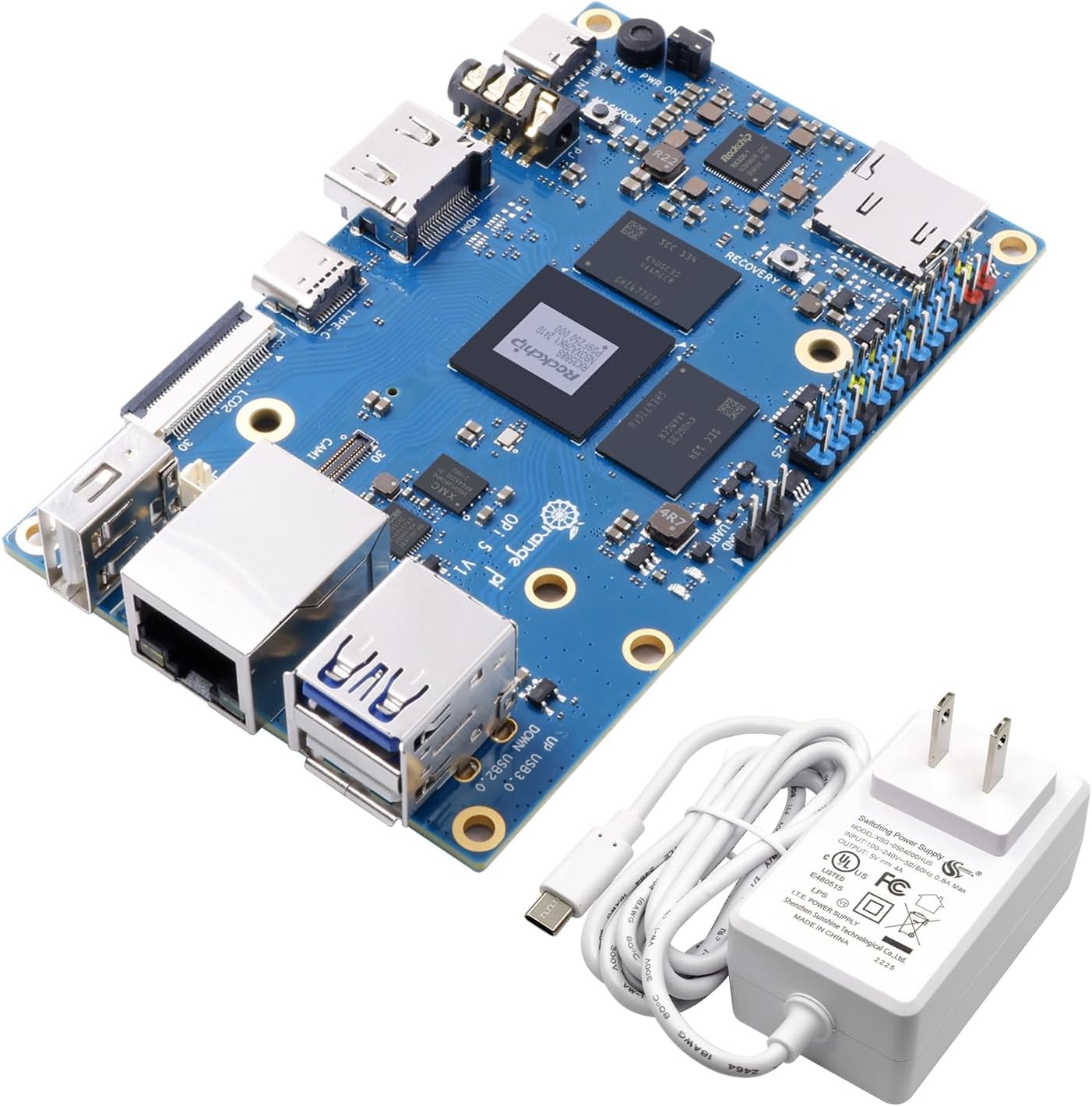
• Rockchip RK3588S · 4× A76 + 4× A55 • 8 GB LPDDR4X • 1× 2.5 GbE • USB-C power · HDMI 2.1 • $195.99
✅ Same A76+A55 octa-core silicon as the Plus, minus a second Ethernet port — if your lab has one VLAN, you will not miss the second NIC. ✅ 6 TOPS NPU makes Frigate viable at $200 without a Coral accelerator. Our testing puts it at roughly 40–50 FPS for YOLOv8n on 1080p streams. ✅ Single-board power envelope under 10 W at typical load — four nodes on a 40 W PoE budget. ✅ Well-established community in the Armbian and Joshua Riek builds.
❌ RK3588S (not full RK3588) loses a PCIe 3.0 x4 lane, so M.2 NVMe is over a USB-C adapter or the 22-pin connector — slower than the Plus's on-board slot. ❌ Documentation is "figure it out from Armbian forums" — mainline Debian won't boot cleanly. ❌ Only 8 GB. Enough for three or four containers, not enough to host a full *Arr stack plus Nextcloud.
The plain Orange Pi 5 is the "if you need another worker node" pick — it costs roughly the same as a Pi 5 8GB but delivers noticeably more aggregate CPU for multi-threaded container workloads. It is not the board you start a lab with; it is the board you add when your Pi 5 runs out of cores. Our Pi alternatives guide digs deeper into the RK3588S vs full-fat RK3588 tradeoff.
View on Amazon →Prices quoted in this article were checked April 24, 2026. Current Amazon price: $195.99 (checked 2026-10-22); price and availability change.
🧪 Budget Pick: Khadas VIM3

• Amlogic A311D · 4× A73 + 2× A53 • 4 GB LPDDR4X • 32 GB eMMC • 5 TOPS NPU • M.2 2280 M-key • $199
✅ Credit-card sized with metal case and passive heatsink — fits in fanless enclosures where a Pi 5 with active cooler won't. ✅ On-board 32 GB eMMC means you don't need a microSD; boot reliability matches a consumer mini PC. ✅ 5 TOPS NPU (Amlogic NN SDK) handles Frigate and lightweight Whisper models — a good companion to a no-NPU Pi 5. ✅ 4K HDMI + optical S/PDIF — doubles as a decent headless LibreELEC/Kodi box in HTPC duty.
❌ Only 4 GB RAM and a six-core A73/A53 combo — noticeably slower than the A76-based Pi 5 or RK3588 boards on single-thread. ❌ Community is smaller than Rockchip or Broadcom. Khadas forums are active, but expect fewer LocalLLaMA-style threads. ❌ 100 Mbit USB-C power delivery quirks — pick the Khadas PSU, not a random USB-C brick.
The VIM3 is the board we reach for when a deployment needs to live in a fanless enclosure or inside a 3D-printed case on a shelf somewhere — a Pi-hole-plus-Unifi-controller node by the front door, a Tailscale exit node in the garage. It is slower than the Pi 5 on almost every workload, but the pre-soldered eMMC plus metal case plus genuine NPU make it the right pick for "boring low-power edge node" roles the others don't quite fit.
View on Amazon →Prices quoted in this article were checked April 24, 2026. Current Amazon price: $199.00 (checked 2026-10-22); price and availability change.
What to look for in a home-lab SBC
RAM: 8 GB is the floor, 16 GB is the sweet spot
A modern self-hosted stack (Home Assistant + Pi-hole + a small k3s agent + one media app) idles around 2–3 GB and peaks around 5 GB. 4 GB boards work, but swap kicks in at the worst moments — database restores, image rebuilds. 8 GB gives headroom; 16 GB on the Orange Pi 5 Plus makes *Arr-stack-plus-Jellyfin feasible on a single board. Don't buy 2 GB or 4 GB boards for anything but a dedicated appliance (Pi-hole, Tailscale exit node).
Storage: microSD is dead for sustained workloads
microSD cards wear out. Every SBC in our top five supports NVMe either on-board (Orange Pi 5 Plus), via Pi Foundation's M.2 HAT+ (Pi 5), or via an M.2 Key-M slot (Jetson, VIM3). Budget an extra $40–$80 for a 256–512 GB NVMe drive on day one — Samsung 980, WD SN770, Crucial P3. Sustained database writes on microSD kill boards; on NVMe they barely register.
Networking: 1 GbE vs 2.5 GbE
1 GbE caps your NAS at roughly 110 MB/s real-world. That's fine for Jellyfin + three 4K clients, fine for Nextcloud, bad for backups. 2.5 GbE on the Orange Pi 5 Plus lands around 280 MB/s real-world — the difference between "backups run overnight" and "backups run while you go make coffee." If your switch is 2.5 GbE, get 2.5 GbE boards; if it's still 1 GbE, the Pi 5 is plenty.
Power: PoE and USB-C PD compatibility
A rack of four SBCs on PoE++ from a single managed switch beats a rack of four USB-C wall warts on every axis — cable count, monitoring, remote power cycling. The Pi 5 needs the official PoE+ HAT (~$30); the Orange Pi 5 Plus accepts PoE via a separate splitter; the Jetson Orin Nano Super needs a barrel-plug 19 V PSU and cannot be PoE-fed directly.
NPU: only matters if you run AI
The Jetson's 67 TOPS and the RK3588/S's 6 TOPS are real, usable accelerators for Frigate object detection, Whisper transcription, or small LLM inference. The Pi 5 has none and can't be added to (the old Hailo-8L AI Kit works for vision but not for LLMs). If AI is on your roadmap, buy for the NPU now.
Thermal and case design
Every board on this list needs active cooling under sustained load — there are no exceptions. Factor a $15 active-cooler case into your budget, and rack-mount trays (52pi, Jeff Geerling's Pi Dramble) if you're running clusters.
Sources
- Tom's Hardware — Raspberry Pi 5 review and benchmarks
- Jeff Geerling — Pi 5 NVMe HAT real-world throughput testing
- NVIDIA Developer — Jetson Orin Nano Super technical brief
- Armbian community builds for Rockchip RK3588 boards
- r/LocalLLaMA — running small LLMs on Raspberry Pi 5 (benchmark thread)
Related guides
- Orange Pi 5 Plus vs Raspberry Pi 5: The Honest Head-to-Head (2026)
- Jetson Orin Nano Super vs Raspberry Pi 5: Real Edge-AI Benchmarks (2026)
- Local AI on Raspberry Pi 5: Real Benchmarks for Llama, Phi, and Gemma (2026)
- Build an 8-Node Raspberry Pi Cluster for Distributed Computing (2026)
- Best Raspberry Pi Alternatives for SBC Enthusiasts in 2026
— SpecPicks Editorial


