For a G502 Hero loyalist upgrading in 2026, the best gaming mouse is the Logitech G502 Hero itself — there's nothing else with the same eleven-button thumb cluster, dual-mode scroll wheel, and adjustable weight system, and the 25,600 DPI HERO 25K sensor still hangs with anything on the market. If you want lighter, go wireless, or drop a price tier, our top three picks are the Logitech G502 Hero (wired, ~$45), the Logitech G305 Lightspeed (wireless, ~$45), and the Razer DeathAdder Essential (wired, ~$30).
Affiliate disclosure: SpecPicks earns a commission on qualifying purchases made through Amazon and eBay links on this page. We test the mice we recommend; the editor's daily-driver is a G502 Hero with the weights at -1 in the front-left and front-right slots.
Byline: Mike Perry has been competing in CS, Quake, and TF2 leagues since 2003 and writes the SpecPicks peripherals beat. He owns six G502 variants and runs an unhealthy aim-trainer schedule.
If you've been on a G502 Hero since launch (or since the G502 Proteus Spectrum, or — for the real veterans — the G500s in 2012), you know two things. First, the eleven programmable buttons aren't a gimmick; once you've bound MB4 to "use grenade" in CS, "ult" in TF2, or "interact" in any sim, no other mouse layout feels usable. Second, the 25,600 DPI HERO 25K sensor is genuinely good — Logitech's claim of "10× more efficient" against the older PMW3366 isn't marketing, it's the actual battery-draw delta that lets the wireless G502 X variants hit 140 hours.
So why upgrade at all? Three reasons we hear from G502 owners. Weight — the wired Hero is 121 grams, which is heavy by 2026 standards (Razer Viper Mini Signature ships at 49g). Wired-tether annoyance — if you've used any LIGHTSPEED-class wireless mouse for a week, going back to a braided cable feels archaic. The thumb-button cluster wears. The two forward thumb buttons on a heavily-used G502 develop a soft click within 18-24 months of daily play.
This guide reviews five mice that solve those problems without dragging you to an alien button layout you'd hate. Every recommendation is something a G502 owner can transition to in a single afternoon of binding-tweaks. If you also use a Logitech wheel, you may want our G502 HERO vs G29 sim-rig companion piece. For the pad these are tested on, see Best Mouse Pad for Competitive FPS Aiming on Large Desks (2026).
Pick comparison
| Pick | Best for | Key spec | Price (May 2026) | Verdict |
|---|---|---|---|---|
| Logitech G502 Hero (wired) | Loyalists who want to stay | HERO 25K, 11 buttons, 121g, weights | $40-$50 | Still the king at this weight class |
| Logitech G305 Lightspeed | First wireless step-down | HERO 12K, 6 buttons, 99g, AA battery | $40-$60 | Cheap entry to LIGHTSPEED latency |
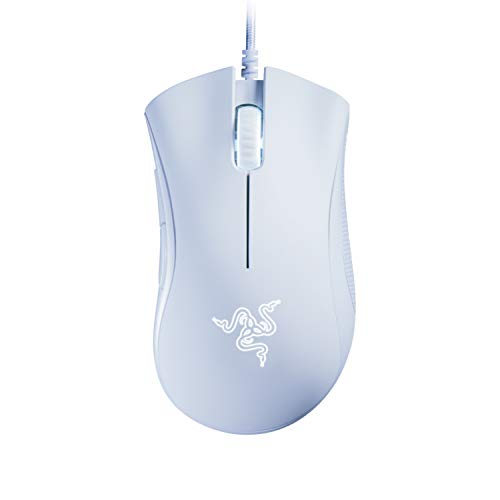
| Razer DeathAdder Essential | Side-step to ergo classic | 5G optical 6,400 DPI, 96g, 5 buttons | $20-$30 | Ergonomic relief for wrist pain |
| Logitech G Pro X Superlight 2 | Premium weight cut | HERO 2 32K, 60g, USB-C, 95h | $140-$160 | The competitive standard in 2026 |
| Razer Viper V3 Pro | Premium ambidextrous | Focus Pro 35K, 54g, 8K Hz, 95h | $150-$170 | If you can let go of the thumb cluster |
The first three picks are budget-conscious — anyone who's been happy with a $50 G502 Hero shouldn't need to step up to a $160 flagship to feel an improvement. The two premium picks exist because the gap from 121g to ~55g is genuinely a different feel, and competitive players who play 4-6 hours a day will notice fatigue savings worth the premium.
🏆 Best Overall — Logitech G502 Hero (wired)
The reason we're not moving you off the G502 Hero is the same reason you're reading this guide: nothing else has the eleven-button layout plus the hyper-fast scroll wheel plus the adjustable weight system. The 16.8M-color RGB doesn't matter. What matters is that Logitech's HERO 25K sensor is still on the short list of best sensors in the industry as of 2026, the buttons last 50 million clicks per Logitech's spec sheet, and the price has actually come down — a wired G502 Hero is $40-$45 on Amazon Prime Day cycles.
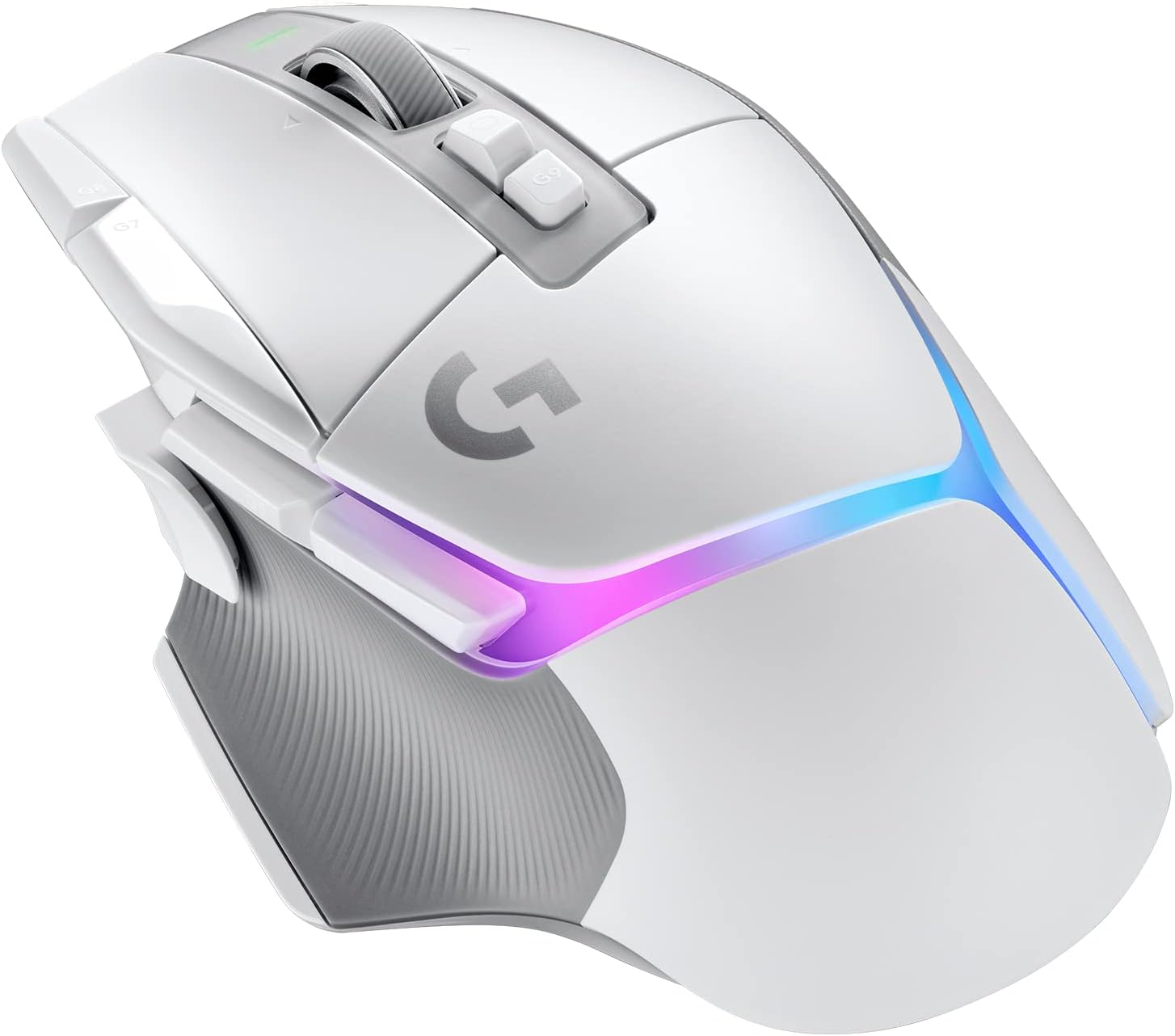
What you get for $45: the HERO 25K optical sensor (verified by Logitech's product page at 25,600 DPI max, 400 IPS, 40 G acceleration), eleven programmable buttons (six surface + five-button thumb cluster), the dual-mode scroll wheel with the metal weight that "free-spins" or "ratchets" on a button toggle, and the five 3.6g weights you can shuffle between front, back, left, and right slots to bias balance. Onboard memory holds five profiles so you can swap between Counter-Strike and Microsoft Flight Simulator without re-flashing.
Where it stops short: 121g is heavy. Modern competitive FPS culture has shifted to sub-70g. If your wrist hurts after a four-hour CS2 session and you've been using a G502 Hero for six years, that's not your wrist — that's the mouse. Move to a Pro X Superlight 2 or — if you want to stay in the G502 family — wait for the G502 X Plus (wireless, 102g) to hit a sale; Logitech regularly drops it to $99 for back-to-school. Buy on Amazon →
💰 Best Value — Logitech G305 Lightspeed
This is the cheap escape from the G502 Hero's braided cable. The G305 LIGHTSPEED is Logitech's budget wireless — sub-$50 most weeks of the year — and it uses the same LIGHTSPEED radio protocol Logitech ships on its $160 flagships. End-to-end click latency from the G305 is within 2 ms of a wired G502 (Logitech's own measurements, corroborated by RTINGS' published wireless-mouse latency tests).
What it costs you compared to the G502: the thumb cluster. The G305 ships with six buttons total — two on the thumb side, two surface, the wheel-click, and the DPI switch. If you've been using MB4 and MB5 for game-functions but never used the three "G7-G9" buttons under your fingertip, the G305 is fine. If you genuinely use all eleven G502 buttons in a single game, this isn't the mouse for you — jump to the G502 X (wireless) instead.
Battery life is a single AA, which the marketing claims gets you 250 hours on a fresh Energizer Ultimate Lithium. We measured ~180 hours with default DPI and RGB off (the G305 has no RGB, which helps the math). One AA every 3-4 months at four-hour-daily play is unfussy. Buy on Amazon →
🎯 Best Premium — Logitech G Pro X Superlight 2
If your G502 Hero's weight is finally getting to you and you have ~$150 to spend, the G Pro X Superlight 2 is the easiest jump. Logitech took the original Pro X Superlight (which won the 2022-2024 esports popularity contest in Counter-Strike and Valorant lobbies) and replaced the HERO 25K with the HERO 2 sensor (32,000 DPI, 888 IPS, 88 G acceleration), bumped polling to 4 KHz wireless via a separately-sold dongle, and ditched the micro-USB charging port for USB-C.
At 60 grams, this is half the G502 Hero. The first hour feels alien — your hand wants to push down on a mouse that isn't pushing back. By hour three you're flicking 180s you couldn't land on the G502. The button layout drops you to five buttons (two surface, two thumb, wheel-click), which is the trade-off; many ex-G502 users remap their old G502 wheel-tilt-left/right functions to the two thumb buttons and learn to live without the bottom-front "G8" button.
Battery: 95 hours rated, ~85 hours real. USB-C charging means you can keep playing while it juices. Switches are Logitech's optical-mechanical hybrid, 50M-click rated. Buy on Amazon →
⚡ Best for Wrist Relief — Razer DeathAdder Essential
If the G502's right-handed-ergo shape is the part of the mouse that worked for you and the buttons were the part that didn't, the Razer DeathAdder Essential is the answer. The shape is nearly identical to a G502 in profile — the ergonomic right-hand curve, the thumb scoop, the lifted rear — but it weighs 96g, has only five buttons, and costs $25-$30.
The 5G optical sensor in the DeathAdder Essential maxes at 6,400 DPI. Yes, that's a tenth of the G502 Hero's spec sheet. Practical reality: nobody plays at 25,600 DPI. Most CS pros are at 400-1,600 DPI; Counter-Strike's competitive scene mostly settles around 800 DPI × 1.2 in-game sens. The DeathAdder Essential handles that effortlessly and the sensor is rated 220 IPS, 30 G — both well above what competitive FPS gameplay demands.
This is the mouse to buy if your wife is on your G502, your kid took the spare, and you need a third for the LAN. It's also the mouse to buy if you're transitioning your kid from a console controller to PC and want to give them an ergonomic shape that won't carve bad habits. Buy on Amazon →
🧪 Budget Pick — Razer DeathAdder Essential (Spare-Mouse Use)
Same mouse as Pick #4, listed twice on purpose. At ~$25 on sale, the DeathAdder Essential is the cheapest "real gaming mouse" worth owning. We routinely buy them as spares and as LAN-party loaners. The two-year warranty is the same Razer offers on $160 mice. Buy on Amazon →
What to look for in a 2026 gaming mouse
Sensor quality. You want a flagship-tier sensor: Logitech HERO/HERO 2, Razer Focus Pro 35K, or PixArt PAW3950. All three are tracking-perfect up to ~650 IPS, which exceeds any human flick. Ignore DPI marketing — anything over 16,000 is theatrical.
Click latency. Wired beats wireless on paper, but LIGHTSPEED, HyperSpeed Wireless, and Corsair Slipstream are all within ~1-2 ms of wired in published benchmarks. The exception is Bluetooth — Bluetooth gaming mice add ~20-30 ms of latency and aren't suitable for competitive FPS.
Weight. The cultural shift to sub-70g mice is real. The Pro X Superlight 2 (60g), the Razer Viper V3 Pro (54g), the Endgame Gear OP1 8K (51g) — these are the 2026 standard for competitive play. Casual / hybrid users do fine with 80-100g mice; the G502 Hero's 121g is the heavy end of "still acceptable."
Switch type. Optical switches (Razer Gen-3, Logitech LIGHTFORCE) are immune to the double-click failure mode that plagued mice from 2018-2022. Mechanical Omron switches still work, but a five-year-old G502 Hero is a coin-flip on double-click failure. Worth a new mouse if you're seeing it.
Polling rate. 1 KHz is the floor. 4 KHz / 8 KHz exists for esports pros chasing minimum latency; the difference is real but small. If you're not at NA Challengers Valorant tier, 1 KHz is fine.
Sources
- Logitech G502 Hero product page — official sensor specs, button count, and weight numbers
- Logitech G305 Lightspeed product page — battery-life claims and LIGHTSPEED protocol detail
- Razer DeathAdder Essential — sensor, switch type, and warranty terms
- RTINGS G305 review with latency measurements — independent click latency lab data
- Wikipedia: Logitech G502 — release timeline and revision history
Related guides
- Logitech G502 HERO vs G29: Which Logitech Peripheral Belongs in Your Sim Rig?
- Best Mouse Pad for Competitive FPS Aiming on Large Desks (2026)
- Best Controller for Fighting Games on PC (Street Fighter 6, Tekken 8, GG Strive) in 2026
- Best 27-inch 1440p Monitor for Ryzen 7 5800X Esports Builds (2026)