Best PC Cases for Building in 2026
As an Amazon Associate, SpecPicks earns from qualifying purchases. See our review methodology.
The best PC case in 2026 is the one that stays out of the way: enough airflow for a hot CPU and a long graphics card, cable routing that forgives a first-time builder, radiator mounts that take a 360 mm AIO without adapters, and a GPU clearance figure you can trust once front fans are fitted. Pick wrong and you fight a loud, hot or cramped build every day. This guide is for builders assembling a first gaming rig, moving an old tower into a current chassis, or putting together a showcase build.
What changed in the September 2026 re-check. In September 2026 every pick was re-checked against current listings and the latest published review testing. Three of the April picks came out. The original Corsair 4000D Airflow no longer has a current Amazon price we can track, and Corsair has replaced it with the FRAME 4000D (released January 2025), which now takes the top slot. The iCUE 220T RGB Airflow and the base Hyte Y70 listings no longer pass our listing-quality checks, so the Lian Li Lancool 216 and the Fractal Design North replace them. The Hyte Y70 Touch Infinite stays, with its screen specs corrected to the current 14.9-inch panel. The Cooler Master MasterBox Q300L remains the budget pick.
Each pick is ranked on published thermal testing from Gamers Nexus, Tom's Hardware and TechPowerUp, the manufacturer's clearance figures, and the listing's rating across its review count. Airflow comes first and looks come second. Mesh-front cases run cooler than solid-front designs of the same shape, which Gamers Nexus showed with the original 4000D in its Airflow and solid-panel versions.
At-a-Glance Comparison
| Pick | Best For | Key Spec | Price | Verdict |
|---|---|---|---|---|
| Corsair FRAME 4000D RS ARGB | Overall mid-tower | ATX · 3× 120 mm ARGB fans · GPU 430 mm · dual 360 mm radiators | $99.99 | The 4000D's successor, with more room |
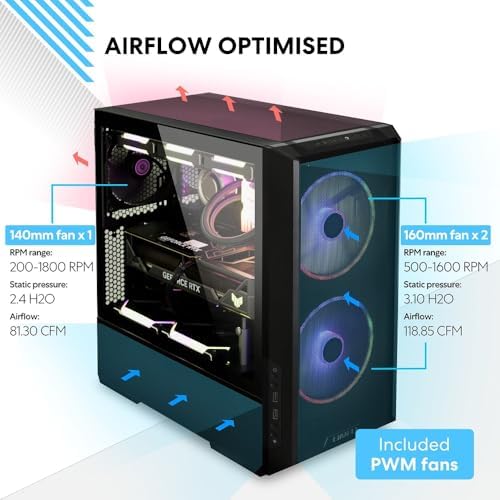
| Lian Li Lancool 216 | Maximum airflow | E-ATX · 2× 160 mm + 1× 140 mm fans · GPU 392 mm | $99.99 | Best-in-class CPU thermals for the money |
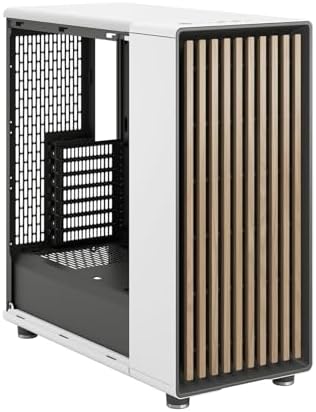
| Fractal Design North | Design-led builds | ATX · oak front · 2× 140 mm fans · USB-C 20 Gbps | $123.99 | A case that looks like furniture |
| Hyte Y70 Touch Infinite | Premium showcase | Dual chamber · 14.9" 2560×682 touchscreen · PCIe 4.0 riser | $394.99 | The PC as a second display |
| Cooler Master MasterBox Q300L | Budget pick | mATX · magnetic dust filters · modular I/O | $29.99 | Credible compact case at the budget tier |
Prices as of 2026-10-06 (Amazon.com); price may vary.
🏆 Best Overall: Corsair FRAME 4000D RS ARGB Modular Mid-Tower

Spec chips: • ATX mid-tower (also mATX / ITX, reverse-connector boards) • 3 × RS120 ARGB PWM fans pre-installed in front • Radiators: front, top and side up to 360 mm, two at once · rear 120/140 mm • GPU clearance: 430 mm (405 mm with front fans) · CPU cooler: 170 mm · PSU: 220 mm • Front I/O: 1 × USB 3.2 Gen 2 Type-C, 2 × USB Type-A
Pros
- ✅ Direct successor to the 4000D, with far more GPU room: 430 mm, against the original's 360 mm
- ✅ Three ARGB fans in the box; Gamers Nexus measured CPU temps averaging 43 °C over ambient at its 27 dBA noise-normalized test
- ✅ InfiniRail mounting lets front and roof fans slide to where the heat is
- ✅ Front USB-C as standard, which the original 4000D Airflow lacked
Cons
- ❌ 4.7 stars across 1,746 Amazon reviews at our last check, a much shorter track record than the original 4000D's
- ❌ The modular panels and rails add build steps a first-timer may not need
- ❌ The GPU clearance drops to 405 mm once front fans are fitted, so measure a flagship card against that figure, not 430 mm
Why it wins
The original 4000D Airflow topped this guide in April because it combined a mesh front, simple cable routing and room for a 360 mm AIO. The FRAME 4000D keeps that recipe and fixes its weak points. Gamers Nexus titled its review "Corsair Remembered How to Make a Case" and measured the RS ARGB configuration at 43 °C over ambient on CPU load at a 27 dBA noise target. TechPowerUp's and KitGuru's stress tests also put it among the cooler mid-towers they had tested. The bigger changes are practical. GPU clearance rises to 430 mm (405 mm with front fans), so the longest current triple-slot cards fit. It holds two 360 mm radiators at once, and front USB-C comes as standard. The RS ARGB model ships with three RS120 ARGB fans that run on a motherboard's standard 5 V ARGB header, so no proprietary controller is needed. It suits most builders, first-timers included, and it leaves room for the next GPU upgrade.
View on Amazon →Price and availability change often — check the Amazon listing for the current price.
🎯 Best for Airflow: Lian Li Lancool 216

Spec chips: • Mid-tower · E-ATX (under 280 mm) / ATX / mATX / ITX · 480.9 × 235 × 491.7 mm • 2 × 160 mm front fans + 1 × 140 mm rear fan pre-installed • Radiators: front 360 mm · top 360 mm · bottom 240 mm • GPU clearance: 392 mm · CPU cooler: 180.5 mm · PSU: 220 mm • Front I/O: 1 × USB Type-C, 2 × USB 3.0
Pros
- ✅ Two 160 mm front intakes, a size few cases ship with, move a lot of air at low speed
- ✅ Tom's Hardware Editor's Choice; the tallest CPU cooler clearance here (180.5 mm) suits big air coolers
- ✅ Rear PCIe fan bracket can point an extra fan straight at the graphics card
- ✅ Mesh on the front, top and PSU shroud side
Cons
- ❌ 4.7 stars across 958 Amazon reviews at our last check, the smallest review base of these five picks
- ❌ Reviewers found GPU temperatures a few degrees behind the best cases tested, even though CPU cooling leads
- ❌ The RGB version's front fans need Lian Li's separate controller to adjust the lighting
Why it wins
The Lancool 216 is the pick for builders who care about temperatures first. Tom's Hardware gave it an Editor's Choice award, and its reviewer noted that the case packs so many unique features it is easy to forget how little it costs. TechPowerUp's thermal stress test placed it among the strongest CPU performers it has measured, with GPU temperatures only a few degrees behind the leaders. The design explains the result. Two 160 mm fans sit behind a fine-mesh front, and the modular motherboard I/O lets you raise or lower the board to suit an air cooler or an AIO. A rear bracket takes an extra fan aimed at the GPU. It fits a 392 mm graphics card and a 180.5 mm tower cooler, and it has front USB-C. Choose it over the FRAME 4000D if you run a large air cooler or want the most intake airflow for the money. Choose the Corsair if you want the longer GPU clearance.
View on Amazon →Price and availability change often — check the Amazon listing for the current price.
🎨 Best Design-Led Case: Fractal Design North

Spec chips: • ATX / mATX / ITX · 447 × 215 × 469 mm • Real oak front with mesh inserts · tempered-glass side • 2 × Aspect 14 PWM front fans included • Radiators: front up to 360 mm · top up to 240 mm · rear 120 mm • GPU clearance: 355 mm · CPU cooler: 145 mm · PSU: 255 mm • Front I/O: 1 × USB Type-C 20 Gbps, 2 × USB Type-A 5 Gbps
Pros
- ✅ Wood-slat front and brass details look at home in a living room or office
- ✅ 4.7 stars across 3,392 Amazon reviews at our last check, the deepest review record among this guide's premium-priced picks
- ✅ Mesh behind the wood keeps it an airflow case, and it ships with two 140 mm fans
- ✅ Fast 20 Gbps front USB-C
Cons
- ❌ 145 mm CPU cooler clearance rules out the tallest tower air coolers
- ❌ Top radiator support stops at 240 mm, so a 360 mm AIO has to go in the front
- ❌ 355 mm GPU clearance is the tightest here among full-ATX picks; measure long flagship cards
Why it wins
Showcase cases usually trade airflow for glass. The North takes the other route: it looks distinctive through its materials, a real oak front with brass details, while keeping mesh panels for intake. Fractal lists 355 mm of GPU clearance, a 145 mm CPU cooler limit, front radiators up to 360 mm and two Aspect 14 fans in the box. That covers most builds short of a very long flagship card or an oversized tower cooler. It replaces the base Hyte Y70 as this guide's design pick. The Y70's dual-chamber glass box remains an option through the Touch Infinite below, but the North suits builders who want the PC to blend into a room rather than put the parts on display.
View on Amazon →Price and availability change often — check the Amazon listing for the current price.
⚡ Best Premium / Flagship: Hyte Y70 Touch Infinite (LCD Touchscreen)

Spec chips: • Dual-chamber ATX mid-tower · three-piece panoramic glass • Integrated 14.9" 2560×682 IPS touchscreen, 60 Hz, 10-point touch · Hyte Nexus software • 4-slot vertical GPU mount with included PCIe 4.0 x16 riser • Radiators: 360 mm side and top · up to 10 fans · no fans included
Pros
- ✅ The 14.9-inch touchscreen, larger and brighter than the original Y70 Touch panel, works as a second display for system stats, chat or widgets
- ✅ 4.8 stars across 3,115 Amazon reviews at our last check
- ✅ Included PCIe 4.0 riser and 4-slot vertical GPU mount
- ✅ Room for up to 10 fans and two 360 mm radiators
Cons
- ❌ Ships with no fans, so budget for a full set on top of the case
- ❌ The screen takes video from your graphics card through a DisplayPort cable, which uses one GPU output
- ❌ The highest price of these five picks by a wide margin; compare it with the listings above before committing
Why it wins
The Y70 Touch Infinite is the case for a build meant as a centerpiece. Its front corner holds a 14.9-inch, 2560×682 IPS touchscreen, larger than the original Y70 Touch's 14.2-inch panel and rated at 500 nits against 300. It is driven through a DisplayPort connection from your GPU and managed in Hyte's Nexus software. Around it you get the Y70's dual-chamber layout, a three-piece panoramic glass shell, a 4-slot vertical GPU mount with a PCIe 4.0 riser, and support for 360 mm radiators on the side and top. Reviewers note the catch: no fans come in the box, so the real cost is the case plus a full set of fans. We recommend it for second builds and upgrades, where the core PC already works and the goal is looks and a useful extra screen.
View on Amazon →Price and availability change often — check the Amazon listing for the current price.
🧪 Budget Pick: Cooler Master MasterBox Q300L mATX

Spec chips: • Micro-ATX / Mini-ITX mini-tower • 1 × 120 mm fan pre-installed · room for 240 mm AIO and up to 5 fans • GPU clearance: 360 mm · CPU cooler: 159 mm · PSU: 160 mm • Modular front I/O panel · magnetic dust filters · transparent side panel
Pros
- ✅ One of the lowest-priced credible compact cases in our catalog
- ✅ 4.5 stars across 13,978 Amazon reviews at our last check, the longest track record in this guide
- ✅ Surprisingly roomy for its size: 360 mm GPU clearance and a 159 mm CPU cooler limit
- ✅ The I/O panel moves to the front, top or bottom to suit your desk layout
Cons
- ❌ Only one fan included, so plan on adding at least two intake fans
- ❌ Transparent acrylic side panel, not tempered glass, and it scratches more easily
- ❌ PSU length is capped at 160 mm, which rules out some longer high-wattage units
Why it wins
The MasterBox Q300L has held the budget slot for years. 13,978 Amazon reviews at 4.5 stars make it the most-validated budget case in our catalog. It is a sensible home for a first PC build, a secondary or office PC, or a budget gaming rig. It takes a 360 mm graphics card, a 159 mm tower cooler and a 240 mm liquid cooler, and its perforated panels and magnetic filters keep it breathing better than its size suggests. It is not an airflow champion out of the box, with only one rear fan, so adding two 120 mm intakes is the cheapest thermal upgrade you can make. It is not meant for a premium build; look at the FRAME 4000D or Lancool 216 for that.
View on Amazon →Price and availability change often — check the Amazon listing for the current price.
What to look for in a PC case
Airflow first — it determines everything else
A case's front panel design has a large effect on thermal performance. Mesh-front cases such as the FRAME 4000D, the Lancool 216 and the Fractal Meshify line run cooler under sustained load than solid-front designs of the same shape, as Gamers Nexus showed by testing the 4000D in both versions. If you can see daylight through the front panel, it is an airflow case. If the front is solid metal or thick glass, expect thermal compromises.
GPU clearance — measure, don't trust marketing
High-end triple-fan graphics cards now run well past 330 mm, and the listed clearance is often measured without front fans or a radiator. The FRAME 4000D, for example, lists 430 mm, and that drops to 405 mm with front fans fitted. Check the figure for your actual fan and radiator layout, and leave margin for the power connector.
Radiator support
AIO mounting is the most common thermal question for modern builds. Confirm the case supports your radiator size with fan thickness: a 27 mm radiator plus 25 mm fans is a 52 mm stack. Top mounts can clash with tall RAM heatsinks, and some cases cap the top position below 360 mm (the Fractal North takes 240 mm on top). Check every position you plan to use.
PSU clearance
PSU shrouds are standard now. Check your PSU's length against the case limit: these picks range from 160 mm (Q300L) to 255 mm (North). Modular PSUs make routing much easier, because non-modular units crowd the shroud with unused cables.
Cable management
Good cable management means routing channels behind the motherboard tray, integrated tie-down points or Velcro straps, and at least 25 mm of space behind the tray for cables and rear SSD mounts. Budget cases skimp on all three.
Front I/O — USB-C, not just USB-A
A 2026 case should have at least one front USB-C port, or you will plug into the back every time you connect a modern phone, external SSD or headset. Four of these five picks have one; the budget Q300L does not.
Dust filters
Mesh-front cases need dust filters, and magnetic ones on the top and bottom are the easiest to clean. Expect to vacuum or rinse filters every few months in a dusty room, less often in a clean one.
FAQ
Is a 360 mm AIO actually worth the case size premium?
For high-power CPUs such as a Ryzen 9 or Core i9 under sustained all-core load, a 360 mm radiator gives useful extra thermal headroom over 240 mm. For Ryzen 7 / Core i7 class chips, 240–280 mm is usually enough. Match the radiator to the CPU's sustained power, not to "just in case," and check that your case takes it in the position you want: the Fractal North takes 360 mm only in the front.
Mid-tower ATX vs mATX — which is right for me?
Mid-tower ATX cases fit full-size ATX motherboards, longer graphics cards and 360 mm AIOs comfortably. mATX cases such as the MasterBox Q300L fit mATX and mini-ITX boards and typically 240 mm AIOs. For a modern gaming build, ATX is the safer choice because it leaves room for future parts. mATX makes sense for deliberately compact or budget builds.
Does vertical GPU mounting actually help?
Not for temperatures. Vertical mounting is mainly about looks, and it can hurt GPU cooling if the fans end up close to the glass. If you mount vertically, leave a generous gap between the card and the side panel and use a riser rated for your GPU's PCIe generation. The Hyte Y70 Touch Infinite includes a PCIe 4.0 riser; most cases do not.
How important is dust filtering?
Very. Dust builds up in GPU and radiator fins over time and cuts their cooling. Cases with removable magnetic filters, such as the Q300L, are much easier to maintain. If your case lacks filters, third-party magnetic mesh filters are cheap to add.
Do I need to replace the included fans?
Usually no. The fans bundled with the FRAME 4000D RS ARGB, the Lancool 216 and the North are what the reviewers above tested. The exceptions are cases that ship with one fan or none. The Q300L has one, so add intakes. The Y70 Touch Infinite ships with none, so budget for a full set.
Sources
- Gamers Nexus — Corsair FRAME 4000D RS ARGB review — Noise-normalized CPU/GPU thermals, clearances and release date.
- TechPowerUp — Corsair FRAME 4000D thermal stress test — Independent thermal testing of the FRAME 4000D.
- Tom's Hardware — Lian Li Lancool 216 review — Editor's Choice verdict, fan layout and specs.
- TechPowerUp — Lian Li Lancool 216 RGB thermal stress test — CPU and GPU thermal results against other cases.
- Fractal Design — North technical specifications — Clearances, radiator support and front I/O.
- Yahoo Tech (PCMag) — Hyte Y70 Touch Infinite review — Touchscreen specs and the lack of included fans.
- Gamers Nexus — Corsair 4000D Airflow vs solid-panel review — Mesh-front versus solid-front thermal comparison.
Related guides
- Best CPU Coolers for 2026 — match cooler size to case clearance
- Best AM5 Motherboards for 2026 — pick the right motherboard format
- Best Graphics Cards for Gaming in 2026 — check GPU length against case
- Best Gaming Monitors for 2026 — complete the setup
More guides & deep dives from the SpecPicks archive
Browse all articles & guides →- Emulation Hardware in 2026: FPGA, Software, and Cart-Reader Ecosystems
- Best 1440p Gaming GPUs in 2026
- RTX 4070 Super vs RX 7800 XT — Which to Buy in 2026
- Best Budget Gaming PC Build 2026 — ~$1,000 ($800 on Sale)
- The Complete Voodoo5 5500 AGP Driver Guide (2026 Edition)
- How to Build a Windows 98 Retro PC in 2026
- Best Retro Handhelds in 2026 — From $35 to $500
More reviews from the SpecPicks archive
Browse all reviews →- Microsoft Mirage and Persistent-Memory Video Gen: How Much VRAM You Actually Need
- Linux Beats Windows 11 on AMD's Ryzen 9 9950X3D2
- Athlon 64 + Radeon 9800 Pro Windows XP Build (2026 Revival): CompactFlash-to-IDE Boot Guide
- Open-Source NVIDIA NVK Vulkan Driver Now Supports DLSS
- Sound Blaster Audigy 2 ZS vs Sound Blaster Live! on Windows 98: Which Wins for Late-90s Gaming?
- gpt-oss 20B: RTX 3060 12GB vs Ryzen 5 5600G CPU-Only (2026)
- Best Streaming Setup Gear for Beginners in 2026
- Windows NT Now Boots on the Nintendo GameCube: What the Homebrew Port Actually Runs
- Best Gaming Room Lighting in 2026: LED Strips and Ring Lights
- ESP32-S3 vs RP2350 vs Nordic nRF54L15: Which MCU for On-Device AI in 2026?
- How to Build a $2000 Home AI Rig in 2026: Used RTX 3090 Guide
- Using an LLM to Fix Win98 Voodoo & TNT Driver Installs
- IPEX-LLM + Ollama vs a CUDA RTX 3060 Rig
- Best Single-Board Computer Kits for Beginners (2026)
- 768GB Optane vs RTX 3060 12GB: The Trillion-Param LLM Reality
- Turtle Beach Recon 50 in 2026: Is the $40 Gaming Headset Still Worth It?
- Local LLM Inference on the RTX 3060 12GB: 2026 Quantization Playbook
- 1998 3dfx Voodoo2 SLI Build Guide: Period-Correct Glide Gaming with a CompactFlash Boot Drive
- Best CPU Cooler for a Ryzen 5800X Under PBO + Manual Overclock in 2026
- 007: First Light Is Great on Steam Deck
- Anker's Thus Chip Claims 150x AI Boost: No Benchmarks Yet
- Ryzen 7 5800X vs Core i7-9700K: Best Budget 1080p Gaming CPU in 2026
- How Secure Is My Homelab Compared to Big Companies?
- Windows 98 vs Windows 2000 for a GeForce-Era Retro Gaming Build
More buying guides from SpecPicks
Browse all buying guides →- Best CPUs for Gaming in 2026
- Best Tools for Building and Repairing Retro PCs in 2026
- Best DDR5 RAM for Gaming PCs in 2026
- Best CPU Coolers for 2026
- Best AM5 Motherboards for 2026
- Best CPUs for Content Creators in 2026
- Best Graphics Cards for Gaming in 2026
- Best External SSDs for Content Creators in 2026
- Best NVMe External Enclosures for 2026
- Best GPU for Running 27B-32B Local LLMs in 2026
- Best 4K Monitors for Content Creators in 2026
- Best Retro Gaming Consoles & Handhelds for 2026
- Best Controllers for PC Gaming in 2026
- Best Gaming Mice for 2026
- Best GPUs for 4K Gaming in 2026
- Best NVMe SSDs for Gaming in 2026
- Best 1440p 240Hz Gaming Monitors in 2026
- Best Gaming Monitors for 2026
- Best PC Cases for Building in 2026
- Best Mechanical Keyboards for Gaming in 2026
- Best GPUs for Running Local LLMs in 2026
Hardware benchmark data on SpecPicks
All benchmarks →- AMD Ryzen 7 7840HS — benchmarks & specs
- Ryzen 7 2700 — benchmarks & specs
- AMD Ryzen 9 PRO 5945 — benchmarks & specs
- Intel Core i5-12600KF — benchmarks & specs
- Ryzen 5 4600G — benchmarks & specs
- Ryzen 5 2600X — benchmarks & specs
- AMD Ryzen 7 PRO 5845 — benchmarks & specs
- NVIDIA GeForce GTX 1050 Ti — benchmarks & specs
- Ryzen 3 2200G — benchmarks & specs
- AMD Ryzen 9 5980HX — benchmarks & specs
- Intel Arc B370 GPU — benchmarks & specs
- RTX 6000 Ada Generation — benchmarks & specs
- RTX 5000 Ada Generation — benchmarks & specs
- Ryzen 7 9700X — benchmarks & specs
- AMD Ryzen 7 PRO 7730U — benchmarks & specs
- Radeon RX 6750 GRE 12GB — benchmarks & specs
- Ryzen 7 5700 — benchmarks & specs
- NVIDIA H100 NVL 94GB — benchmarks & specs
- Apple M2 Max 12 Core 3680 MHz — benchmarks & specs
- AMD Ryzen 9 7940H — benchmarks & specs
- AMD Instinct MI355X 288GB — benchmarks & specs
- DDR5-8000 CL38 32GB (2x16) — benchmarks & specs
- Radeon RX 6800 — benchmarks & specs
- AMD Ryzen 5 PRO 9645 — benchmarks & specs