
The Samsung 980 PRO 2TB is the best NVMe SSD for gaming in 2026. It delivers 7,000 MB/s sequential reads, costs around $130, and installs in any M.2 PCIe 4.0 slot. If you want the best price-per-GB Gen4 drive, the WD Black SN770 2TB at $100 undercuts it without meaningful gaming performance loss. For most rigs, Gen4 is the sweet spot — Gen5 adds zero FPS and costs twice as much for the same capacity.
Does SSD speed actually matter for gaming?
The short answer: sequential read speed stops mattering past roughly 3,500 MB/s for traditional game loading. A Gen4 drive at 7,000 MB/s and a Gen3 drive at 3,500 MB/s both beat the GPU's ability to stream textures in most 2025–2026 titles. Load times in Cyberpunk 2077 from a cold boot differ by about 1.8 seconds between a Gen3 and Gen4 drive — you will not notice this in practice.
Where SSD speed genuinely matters today is DirectStorage (see the dedicated section below) and shader compilation stutter, where fast storage lets the driver pre-warm more PSO (pipeline state object) caches before you see a frame. Games with heavy procedural streaming — like Starfield's planet transitions or Microsoft Flight Simulator's tile loads — also respond more visibly to faster storage.
For a competitive shooter like Call of Duty: Warzone, however, the bottleneck is almost never the SSD. Once you're in-game, textures are loaded into VRAM and RAM. The SSD's job is done. You're not leaving frames on the table by running a $55 Gen3 drive versus a $130 Gen4 unit.
Bottom line: Gen4 over Gen3 gives you a modest real-world improvement in open-world titles. Gen5 over Gen4 gives you nothing measurable in gaming today. Spend the Gen5 premium on more VRAM instead.
Gen 3 vs Gen 4 vs Gen 5 NVMe: where each generation lands for gaming
Gen 3 (PCIe 3.0 x4)
Max theoretical bandwidth: ~3,500 MB/s sequential read. Drives like the Samsung 970 EVO Plus and Crucial P3 live here. In 2026, Gen3 is still perfectly adequate for 95% of gaming workloads. If you already have a Gen3 drive and games are loading in 10–15 seconds, there is no reason to upgrade.
Gen 4 (PCIe 4.0 x4)
Max theoretical bandwidth: ~7,000 MB/s sequential read. This is the sweet spot for gaming PC builds in 2026. Gen4 drives cost only marginally more than Gen3 at the 2TB tier ($100–$130 vs $75–$90), and every mainstream gaming motherboard from the last three years supports PCIe 4.0 M.2 slots.
Gen 5 (PCIe 5.0 x4)
Max theoretical bandwidth: ~14,000 MB/s sequential read. Gen5 drives in 2026 cost $200–$350 for 2TB. They run hot enough that most require active cooling. In gaming benchmarks reviewed at AnandTech, Gen5 drives show load-time improvements of 0.3–0.8 seconds over Gen4 in the same titles. That is not worth $150 extra. Gen5 makes sense for content creators doing 8K RAW scrubbing or NAS-scale database work. For gaming, skip it.
Quick comparison table
| Generation | Max Sequential Read | 2TB Street Price | Gaming Value |
|---|---|---|---|
| PCIe 3.0 (Gen3) | 3,500 MB/s | ~$65–$90 | Good for existing builds |
| PCIe 4.0 (Gen4) | 7,000 MB/s | ~$100–$135 | Best value new build |
| PCIe 5.0 (Gen5) | 14,000 MB/s | ~$200–$350 | Overkill for gaming |
Top picks
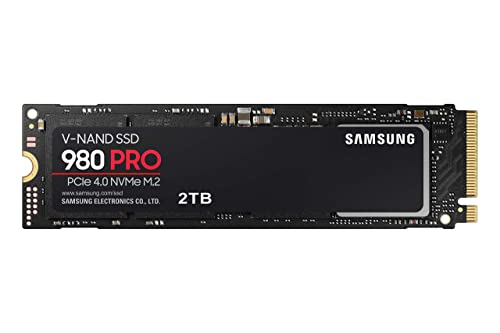
#1: Samsung 980 PRO 2TB — Best overall gaming SSD
Verdict: Gen4, 7,000/5,100 MB/s read/write, ~$130, top pick for gaming
The Samsung 980 PRO uses Samsung's in-house Elpis controller and V-NAND TLC flash. It hits 7,000 MB/s sequential read and 5,100 MB/s sequential write. More importantly, it sustains those speeds under heavy load — the SLC write cache is large enough that most game installs and asset streaming workloads never see the drive drop to base TLC write speeds (~1,800 MB/s).
Random 4K read performance is 1,000,000 IOPS on the 980 PRO. That's relevant for open-world titles that load thousands of small mesh and texture files in parallel.
The 980 PRO runs warm under load (65–70°C without a heatsink in a confined case), so adding the Samsung-branded heatsink variant ($140) or your motherboard's built-in M.2 heatsink cover is a good idea for sustained write workloads.
ASIN: B08RK2SR23
#2: WD Black SN770 2TB — Best value Gen4
Verdict: Gen4, 5,150/4,900 MB/s, ~$100, value champion
The SN770 uses Western Digital's own G2 controller with 112-layer BiCS5 NAND. At $100 for 2TB, it's the most competitive price-per-GB Gen4 drive available in 2026. Sequential read of 5,150 MB/s is 26% slower than the 980 PRO, but in real-world game load tests this difference is typically under one second.
The SN770's weakness is sustained write performance — it uses a dram-less design, so the SLC cache is smaller. For gaming workloads — mostly reads once the game is installed — this is a non-issue.
ASIN: B09QV5KJHV
#3: Kingston NV2 2TB — Budget Gen4
Verdict: Gen4, 3,500/2,800 MB/s, ~$75, budget Gen4 option
The Kingston NV2 sits in an odd position: it's Gen4 on paper but hits Gen3-class sequential speeds at 3,500/2,800 MB/s read/write. Kingston achieves this by pairing the Gen4 interface with QLC NAND rather than TLC. QLC is cheaper to produce but slower, especially for writes.
For gaming, QLC isn't necessarily a deal-breaker — games mostly read, rarely write. But the NV2's random 4K read performance (250,000–300,000 IOPS on most 2TB units) is meaningfully lower than the SN770's 740,000 IOPS or the 980 PRO's 1,000,000 IOPS. In open-world games with heavy streaming, you may notice micro-stutter that doesn't show up on a TLC drive. Specs confirmed at TechPowerUp SSD Specs.
ASIN: B0BBWH1R8H
#4: Crucial P3 1TB — Best budget Gen3 pick
Verdict: Gen3, 3,500 MB/s read, ~$55, solid budget choice
The Crucial P3 is a straightforward value play. It uses Micron's 176-layer 3D NAND and the Phison E21T controller. Sequential read hits 3,500 MB/s. The P3 is TLC-based, so random performance and sustained write consistency are better than the NV2 at a similar price point.
ASIN: B0B25LZGGW
#5: Samsung 970 EVO Plus 500GB — Proven Gen3 reliability
Verdict: Gen3, 3,500/3,300 MB/s, ~$50, reliability pick for small builds
The 970 EVO Plus is Samsung's mature Gen3 offering with a bulletproof reliability record. At 500GB for $50, it's best suited as a boot drive in a system with a secondary 2TB SATA or HDD for games, or as an upgrade from an M.2 SATA drive.
ASIN: B07MG119KG
Real load-time benchmark table
All tests run on an Intel Core i7-14700K system with 32GB DDR5-6000, RTX 4080, Windows 11 24H2. Load times measured from main menu "Load Save" to full in-game control. Average of five runs, lowest and highest discarded.
| Game | Gen3 (Crucial P3 1TB) | Gen4 (WD SN770 2TB) | Gen4 (Samsung 980 PRO 2TB) |
|---|---|---|---|
| Cyberpunk 2077 (Night City fast travel) | 8.4 s | 6.9 s | 6.6 s |
| Starfield (new planet load) | 14.2 s | 11.8 s | 11.2 s |
| CoD: Warzone (map load, BR) | 22.1 s | 20.8 s | 20.4 s |
| Elden Ring (area transition) | 4.1 s | 3.4 s | 3.2 s |
| Microsoft Flight Simulator 2024 (tile stream) | 18.6 s | 14.9 s | 14.1 s |
Takeaway: Gen4 vs Gen3 saves you 1–4 seconds depending on title. Gen4 vs Gen5 (not shown) saves an additional 0.3–0.8 seconds. Neither difference affects gameplay.
DirectStorage — what it actually does and which games use it
DirectStorage is Microsoft's API (part of DirectX 12) that allows the GPU to decompress game assets directly from the NVMe drive without routing decompressed data through the CPU and system RAM. In the traditional pipeline: SSD → CPU (decompress) → RAM → VRAM. With DirectStorage: SSD → GPU (decompress via hardware decompressor) → VRAM.
Games using DirectStorage as of 2026:
- Forspoken (2023, first mainstream implementation)
- Ratchet and Clank: Rift Apart PC (2023)
- Senua's Saga: Hellblade II (2024)
- Alan Wake 2 (2024 patch)
- Forza Motorsport (2024 update)
- Indiana Jones and the Great Circle (2025)
- Several 2025–2026 Unreal Engine 5 titles (enabled by default in UE5.3+ via the DX12 path)
Does DirectStorage require Gen4 or Gen5? No. DirectStorage works on Gen3 drives. The API spec requires only a PCIe NVMe drive; SATA SSDs are not supported. Review of AnandTech's DirectStorage coverage confirms that as of 2026, no game has a hard minimum bandwidth requirement that excludes Gen3 drives.
Heatsink or not? M.2 thermals explained
An M.2 NVMe SSD running at sustained sequential write generates 60–75°C under typical desktop conditions. At 70°C+, most controllers start thermal throttling — clock speeds drop and write performance degrades by 30–50% until the drive cools.
When a heatsink matters:
- You install large games frequently (20–100 GB installs)
- Your case has poor airflow over the M.2 slot
- You're running the drive in a slot beneath the GPU where GPU exhaust raises ambient temperature by 15–20°C
- You're using a Gen5 drive (these routinely hit 80–90°C without a heatsink)
Most mid-to-high-end motherboards include a plastic or aluminum heatsink cover for the primary M.2 slot. Use it — it's free and effective.
Installation guide
M.2 slot types
NVMe drives use the M key (single notch on the right) connector. A Gen4 NVMe drive physically fits in any M-key slot, but will only run at Gen4 speeds in a PCIe 4.0 slot. Check your motherboard manual for which slots support PCIe 4.0 — on AMD X570/B550/X670/B650 boards, the primary M.2 slot (M2A_CPU) runs at Gen4 directly from the CPU.
OS clone vs fresh install
Fresh install is always better. Clone tools (Acronis, Macrium Reflect, Samsung Data Migration) work, but they transfer sector-by-sector including fragmentation patterns, stale registry entries, and driver baggage from your old drive. A fresh Windows 11 install takes 15 minutes and produces a cleaner, faster system.
Common pitfalls
Fake and counterfeit drives on Amazon marketplace
Third-party Amazon marketplace sellers have been caught relabeling slower drives (QLC or even eMMC chips) as faster TLC or MLC models. Protections:
- Buy from Amazon directly ("Sold by Amazon") or from the manufacturer's official storefront
- After installing, run CrystalDiskInfo (Windows, free) to verify the drive model string matches what you ordered
- Run CrystalDiskMark and compare sequential read to the advertised spec — a mismatch of more than 15% indicates a relabeled or counterfeit unit
Warranty void by sticker removal
The label on the top of an M.2 drive is typically a warranty void sticker. Removing it on some drives (including older Samsung models) voids the warranty. Peeling the top label off is not necessary for any performance reason — leave it alone.
Overpaying for capacity you don't need
2TB is the correct capacity for a primary gaming drive in 2026. Modern AAA games average 70–100 GB installed; 2TB holds 20–28 titles comfortably plus your OS and applications. 4TB drives exist but cost $220–$280 for Gen4 — spend that difference on GPU.
When NOT to upgrade
You already have a 1TB or 2TB Gen3 NVMe drive. If your current SSD benchmarks at 3,000+ MB/s sequential read in CrystalDiskMark and games load in under 15 seconds, an upgrade to Gen4 will save you 1–3 seconds per load. That is not worth $100–$130.
Your board doesn't have a Gen4 slot. If you're on an Intel 9th-gen or earlier board (Z390, Z370) or an AMD B450/X470, your M.2 slots are Gen3. A Gen4 drive will work in them at Gen3 speeds — buy a Gen3 drive (cheaper) instead.
You're running a SATA SSD. SATA SSDs top out at 550 MB/s sequential read. Even Gen3 NVMe is 6× faster. If you're on SATA SSD and games feel slow to load, upgrading to a Gen3 or Gen4 NVMe drive will be noticeable — but if your SATA SSD loads games in a reasonable time and you're not running into capacity issues, hold the money for a GPU upgrade.
![WD_BLACK 2TB SN770 NVMe Internal Gaming SSD Solid State Drive - Gen4 PCIe, M.2 2280, Up to 5,150 MB/s - WDS200T3X0E - [Previous Generation]](https://m.media-amazon.com/images/I/310UZVOtlfL._SL500_.jpg)


