The best Raspberry Pi 4 starter kit for a first-time robotics builder in 2026 is the Freenove Ultimate Starter Kit paired with a Raspberry Pi 4 8GB — 435+ components, a 962-page tutorial, 25 guided projects, and enough GPIO headroom to build anything from a line-following robot to a webcam-controlled arm.
This article contains affiliate links. If you buy through our links, SpecPicks earns a small commission at no extra cost to you.
| Last verified: May 2026
Why the Pi 4 (Not Pi 5) Is Still the Right First Robotics Board in 2026
You might expect this guide to lead with the newer Raspberry Pi 5, released in late 2023. For most robotics beginners in 2026, the Pi 4 8GB is still the better starting point — and the gap is wider than it looks.
The Pi 5 is a faster single-board computer in raw compute terms: the Cortex-A76 cores and the RP1 I/O chip add about 2-3x performance in CPU-bound workloads. But robotics isn't primarily about raw CPU throughput. It's about hardware peripherals, software ecosystem, and power management on a mobile chassis.
HAT compatibility is the biggest factor. The robotics HAT ecosystem — motor driver boards, servo controllers, LIDAR breakouts, IMU boards, camera mounts — was built overwhelmingly for Pi 4. Adafruit's Motor HAT, Pimoroni's Inventor HAT, WaveShare's robot base boards, and dozens of smaller manufacturers specify Pi 4 and do not guarantee Pi 5 compatibility. The Pi 5's new PCIe FFC connector and updated power architecture changed the mechanical and electrical expectations for HAT designs. Early Pi 5 robotics HATs started arriving in 2024, but in 2026, the Pi 4 ecosystem is still four times larger.
Power draw on a mobile robot is the second factor. The Pi 5 requires a 5V/5A (25W) USB-C power supply at peak load — roughly 2A more than a Pi 4 under heavy compute. On a battery-powered mobile robot, that extra current means either a larger battery pack or shorter run time. A Pi 4 8GB under full ROS2 load pulls 3.5-4.5W for the board alone; motors and peripherals sit on separate regulated rails in most designs. Pi 5's higher idle draw (roughly 3W vs Pi 4's 1.5W) cuts into battery budgets that beginners rarely think to account for.
Software ecosystem maturity is the third factor. The Freenove kit's 962-page English-language tutorial (available on GitHub) was written for Pi 4. ROS2 Humble Hawksbill's verified installation guide covers Pi 4 on Ubuntu 22.04 ARM64. Most community tutorials, Hackster.io project pages, and YouTube series assume Pi 4. For a first-time builder, having a tutorial that matches your exact hardware is worth more than the extra 20% compute headroom.
The Pi 4 8GB can run ROS2 Humble with a navigation stack, handle a 640x480 camera stream at 15 fps, and control 4-6 servos via a GPIO HAT simultaneously. That's enough for the first six months of a robotics learning journey.
Comparison Table
| Pick | Best For | Includes | Total Price Range | Verdict |
|---|---|---|---|---|
| Pi 4 8GB + Freenove Ultimate Kit | Best Overall | 435+ items, 25 projects, camera module | $120-160 combo | Strongest all-in-one start |
| Pi 4 8GB standalone + breadboard pack | Budget builders with existing sensors | Pi 4, SD card, breadboard, jumpers | $80-100 | Lean kit for tinkerers |
| Pi 4 8GB + 8BitDo SN30 Pro | Game-controller robot teleop | Pi 4, Bluetooth gamepad | $100-130 | Best for remote-controlled builds |
| Pi 4 8GB + Freenove Ultimate (re-pick) | Best Performance all-in-one | 435+ items, full project book | $120-160 | Top total value |
| Pi 4 4GB + Freenove Starter Kit | Budget first project | Pi 4 4GB, core sensors | $80-110 | Right entry for tight budgets |
Best Overall: Freenove Ultimate Starter Kit + Raspberry Pi 4 8GB
Why it wins: The Freenove Ultimate Starter Kit has become the de facto standard recommendation in the Raspberry Pi community for a reason: it packs 435+ components (resistors, LEDs, transistors, capacitors, buttons, potentiometers, buzzers, servos, stepper motors, ultrasonic sensors, camera module, and more) with a 962-page tutorial document that walks through every single component in plain English — with Python code samples that actually work on modern Raspbian/Pi OS.
Pros:
- 435+ components cover sensors, actuators, and passive components for 25 complete projects
- 962-page tutorial with Python code hosted on GitHub
- Includes a camera module compatible with Pi 4's CSI connector
- 8GB RAM on the Pi 4 gives headroom for ROS2, OpenCV, and TensorFlow Lite simultaneously
- English documentation quality is consistently praised in Amazon reviews
- Components labeled clearly — beginners can identify parts without a component reference chart
Cons:
- Does not include a robot chassis — you need to source wheels, motors, and a frame separately if you want a mobile robot
- The camera module is a basic fixed-focus unit; for computer vision at speed, you'll eventually want a Pi Camera Module 3
- Kit arrives in separate SKUs — you purchase Pi 4 8GB and Freenove kit independently
The 8GB tier is non-negotiable for this build recommendation. Once you load Ubuntu 22.04, install ROS2 Humble, add the camera pipeline, and run a navigation stack, you're looking at 3.5-4 GB of RAM in active use. With 8GB, you have room to run Gazebo in headless mode on the same board for simulation without swapping to SD card. The ROS2 official Pi 4 installation guide details the RAM requirements at each step.
The starter progression with this kit is well-designed: you start with LED blink (lesson 1), work through buttons, analog sensors, displays, servos, and ultrasonic distance sensing before hitting the robot projects in the final chapters. By the time you're building the obstacle-avoiding robot in lesson 20, you've already wired and coded every subsystem it uses in isolation.
Check the Freenove Ultimate Starter Kit on Amazon
Check the Raspberry Pi 4 8GB on Amazon
Verdict: For a first-time builder who wants to learn electronics and robotics from scratch with the least friction, the Freenove Ultimate + Pi 4 8GB is the answer. Buy these two together and you have a full semester of projects without needing anything else except a microSD card and the official Pi 5.1V/3A USB-C power supply.
Best Value: Pi 4 8GB Standalone + Breadboard Pack
Why it's here: If you already own resistors, jumper wires, LEDs, and basic sensors from a previous Arduino or Raspberry Pi project, buying the full Freenove kit is redundant. The Pi 4 8GB standalone board paired with a basic breadboard and jumper wire pack runs $80-100 and leaves the component selection entirely to you.
Pros:
- No redundant components — you buy exactly what you need
- Pi 4 8GB board is the same compute platform as the full Freenove combo
- Leaves budget for a specific sensor or HAT for your project
- The Raspberry Pi 4 official documentation is free and comprehensive
Cons:
- No guided project structure — you need to design your own learning path
- Sourcing individual components is slower and requires more research
- Not ideal for absolute beginners with no prior electronics experience
This is the pick for the builder who already knows how to read a resistor color code, wire a voltage divider, and follow a GPIO pinout diagram. If that's you, the standalone Pi 4 8GB gives you a powerful platform without paying for a box of parts you already have in your desk drawer.
Verdict: Best choice for returning makers or engineers who want a Pi 4 upgrade rather than a complete learning kit.
Best for Game-Controller Robot Teleop: Pi 4 8GB + 8BitDo SN30 Pro
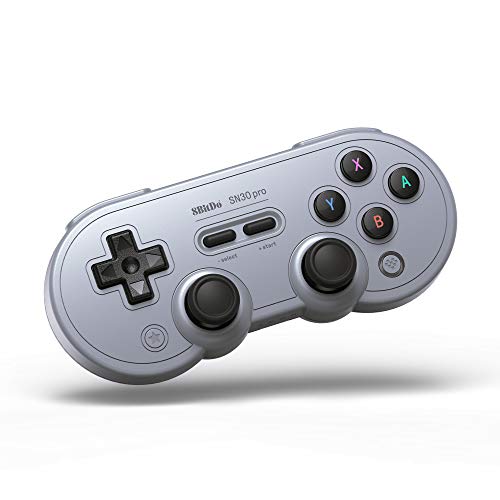
Why it's here: Remote-controlled robots — the kind you drive with a joystick while watching a camera feed on a laptop — are one of the most satisfying first mobile robot builds. The 8BitDo SN30 Pro is a compact Bluetooth gamepad with a 2.4 GHz USB dongle mode and genuine Linux HID support, making it plug-and-play with the Pi 4's evdev input system. No kernel drivers, no proprietary SDK.
Pros:
- 8BitDo SN30 Pro pairs to Pi 4 via Bluetooth in under 60 seconds
- Full dpad + two analog sticks + 6 buttons — full ROS2 joy_node compatible
- Linux HID support means it works out of the box with joystick package on Pi OS
- 1020 mAh internal battery runs 18+ hours — no AA battery replacement during robot demos
Cons:
- Requires a separate motor controller HAT to translate joystick input to PWM motor signals
- No haptic feedback — you lose the tactile sense of motor stall or obstacle collision
- The Pi 4 needs to be running and accessible via SSH or local display for initial pairing
The combination of a Pi 4 8GB and an SN30 Pro is particularly strong for building the teleop layer of a more complex robot — once you've built your chassis and wired your motors to an Adafruit Motor HAT or WaveShare Motor Driver, you add the gamepad as the human input device with roughly 40 lines of Python code using the inputs library or ROS2's joy package. Hackster.io's Raspberry Pi project library has several gamepad-controlled Pi robot builds with full wiring diagrams.
Check the 8BitDo SN30 Pro on Amazon
Verdict: If your goal is a remote-controlled robot you can drive around a room on day one, the Pi 4 8GB + SN30 Pro combo gets you to joystick-controlled motor output faster than any other kit in this guide.
Best Performance: Pi 4 8GB + Freenove Ultimate (All-in-One Pick)
The Freenove Ultimate + Pi 4 8GB is also the performance recommendation because it's the only kit in this guide that covers every layer of a robotics build in one box: sensing (ultrasonic, light, temperature), actuation (servo, stepper, DC motor), communication (camera, UART, I2C), and visual output (LCD, LED matrix). No other single purchase puts all of these in your hands on day one.
For performance-focused first builders — people who want to run TensorFlow Lite object detection while simultaneously navigating by ultrasonic sensor — the 8GB tier is doing real work. The Pi 4 8GB running a MobileNetV2 object detector at 640x480 with TFLite typically achieves 10-14 fps, leaving 4 cores available for servo control and sensor polling. That's a workable real-time system for a tabletop robotic arm or a tracked vehicle.
Check the Freenove Ultimate Starter Kit on Amazon
See also: LattePanda Sigma vs Raspberry Pi 4 for Edge AI 2026
Budget Pick: Pi 4 4GB + Freenove Starter Kit
Not everyone needs 8GB. The Pi 4 4GB runs every project in the Freenove tutorial without issue. Where it struggles: running ROS2 with Gazebo simulation on the same board, or running three concurrent computer vision pipelines. For a first robotics project that stays in the "sensor + actuator + Python" space rather than the "full ROS2 navigation stack" space, 4GB is completely capable.
Pros:
- Pi 4 4GB costs roughly $20-30 less than the 8GB model
- The Freenove starter kit variant (smaller component count) pairs well with a defined first project
- Handles servo control, distance sensing, camera streaming, and line-following without RAM pressure
Cons:
- Headless ROS2 Humble is feasible on 4GB; desktop ROS2 is not
- If you later want to add computer vision, 4GB becomes a constraint
- The price difference between 4GB and 8GB Pi 4 has compressed as 4GB stock thinned — check current pricing
Verdict: Right pick if your first project is well-defined and doesn't involve ROS2 desktop or simultaneous CV + navigation. If you're unsure, pay the extra $20 for 8GB.
What to Look for When Buying a Pi 4 Robotics Kit
Pi 4 vs Pi 5 Power Draw
The Pi 4's USB-C power input needs a 5.1V/3A (15.3W) rated supply for stable operation under load. The official Raspberry Pi 15W USB-C power supply is the safest choice. Third-party 5V/2A chargers cause undervoltage warnings (the rainbow square in the corner of Pi OS) under GPIO load. Pi 5 requires a 5V/5A supply — the HAT ecosystem for Pi 4 was not designed for this current and you may damage lower-spec HATs on Pi 5 by accident.
GPIO HAT Compatibility
Always check your HAT or expansion board against the Pi 4 GPIO pinout before ordering. The Pi 4's 40-pin GPIO header is mechanically identical to Pi 3, Pi Zero 2W, and Pi 400 — but the Pi 5's GPIO header has the same pin count with different voltage characteristics on certain pins. If a HAT lists "Pi 4 compatible" and not "Pi 5 compatible," use it on a Pi 4.
Kit Camera Quality
The Freenove kit includes a basic OV5647 sensor camera (the same sensor used in the original Pi Camera Module 1). It's adequate for distance-based object detection (YOLO on low resolution) but not for tracking fast-moving objects or high-accuracy OCR. For vision applications beyond basic detection, upgrade to the Pi Camera Module 3 (Sony IMX708, autofocus, 12MP) at $25-35 as a follow-on purchase.
Included Cabling and microSD Card
The Freenove Ultimate kit does not include a microSD card — you need a Class 10 or UHS-I rated card at 32GB minimum. A 64GB card gives you room to install Ubuntu 22.04 alongside Pi OS without partitioning workarounds. SanDisk and Samsung are the two most reliable brands for Pi use; Kingston and no-name cards have higher failure rates on high-write robotics workloads.
Official 5.1V/3A PSU
Do not cheap out on the power supply. GPIO HATs draw current through the Pi's voltage rails, and a marginal power supply causes intermittent resets under motor load — one of the most frustrating debugging experiences in robotics. Budget $8-12 for the official Raspberry Pi USB-C power supply or an Anker equivalent rated 5V/3A.
Verdict Matrix
| Scenario | Recommendation |
|---|---|
| You're building your first robot from scratch with no parts | Freenove Ultimate + Pi 4 8GB |
| You already have sensors and jumper wires from another project | Pi 4 8GB standalone + breadboard pack |
| Your goal is a remote-controlled robot you can drive on day one | Pi 4 8GB + 8BitDo SN30 Pro |
| You want the full kit but your budget is tight | Pi 4 4GB + Freenove Starter Kit variant |
| You need ROS2 + Gazebo + camera pipeline on one board | Pi 4 8GB (only the 8GB tier) |
| You want to run Pi 5 | Wait for Pi 5 HAT ecosystem to mature — target 2027 |
Sources
- Raspberry Pi 4 Official Documentation
- Freenove Ultimate Starter Kit Tutorial Repository on GitHub
- ROS2 Humble Installation Guide for Raspberry Pi
- Hackster.io Raspberry Pi Robotics Projects
Related Guides
- Best USB Microphone for Raspberry Pi Project Channel 2026
- LattePanda Sigma vs Raspberry Pi 4 for Edge AI 2026