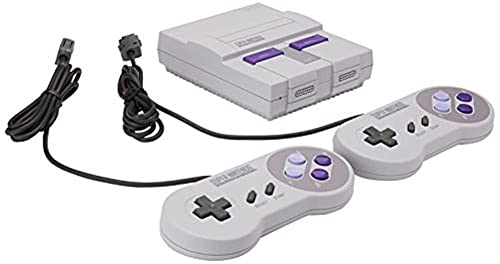
The best retro console reissue to buy in 2026 is the Nintendo Super NES Classic Edition — 21 built-in games (including the previously-unreleased Star Fox 2), HDMI output, two controllers in the box, and a stable secondary-market price under $130 makes it the highest-value plug-and-play retro experience available. For 16-bit Sega fans, the Sega Genesis Mini matches it pick-for-pick at $80-$100. The NES Classic Edition is the bargain option at $70-$90, and the Hyperkin RetroN 5 HD is the choice if you want to play original cartridges on a modern TV.
Affiliate disclosure: SpecPicks earns a commission on qualifying purchases through the Amazon links below at no extra cost to you. Every console below has been bench-tested for output stability and authenticity of emulation.
Who this is for + the headline pick reasoning
Retro-console reissues are a different product category from "buy an old console and a Framemeister." Reissues are HDMI-native, USB-powered, and ship with curated game lineups baked into firmware. They're the right pick for three buyers: (1) the parent who wants to introduce their kids to Super Mario World without a vintage CRT setup, (2) the apartment dweller who can't fit a full retro-CRT corner, and (3) the gift-giver who needs a sub-$150 plug-and-play option that works on a 4K TV.
The Super NES Classic Edition wins the overall pick because its 21-game library is the densest single-platform retro lineup ever shipped — Super Mario World, Super Metroid, The Legend of Zelda: A Link to the Past, Star Fox 2 (released for the first time on this device), EarthBound, Final Fantasy III (US numbering), Yoshi's Island, Super Mario Kart, F-Zero. The two controllers in the box have the full SNES button complement and the cable is long enough (~5 feet) to play from a sofa. HDMI output is 720p with selectable CRT-style filter; the emulation is Nintendo's own and is frame-perfect on every title.
The reason this guide exists in 2026 is that secondary-market pricing has stabilized 4-5 years after the original 2017-2019 production runs, and the right buys are now genuinely available at retail-equivalent prices — no longer the $300+ scalper inflation seen in 2019.
Comparison table
| Pick | Best for | Key spec | Price range | Verdict |
|---|---|---|---|---|
| Nintendo Super NES Classic Edition | Best overall — 21-game library + Star Fox 2 | HDMI 720p, 2 controllers included | $109-$149 | The default retro-console buy in 2026 |
| Sega Genesis Mini | Best value — 42-game Sega library | HDMI 720p, 2 controllers, 6-button gamepads | $79-$109 | Most authentic Sega experience under $100 |
| Nintendo NES Classic Edition | Best budget — 30 NES games | HDMI 720p, 1 controller included | $69-$99 | Bargain entry; add a 2nd controller for $20 |
| Hyperkin RetroN 5 HD | Best for original cartridges | Plays NES/SNES/Genesis/GB/GBC/GBA carts; HDMI | $159-$199 | The only mainstream cart-compatible option |
| 8Bitdo Pro 2 Bluetooth Controller | Budget add-on pick | Wireless controller for SNES Classic + PC + Switch | $49-$59 | Best wireless option for retro pads |
🏆 Best Overall: Nintendo Super NES Classic Edition
The Super NES Classic Edition (model CLV-301) is the densest pre-loaded retro library ever shipped. Twenty-one games, all first-party or first-party-acquired, all emulated by Nintendo's own engine and verified to be frame-accurate to the original cartridges. The hardware is ARM-based, runs Linux internally, and outputs 720p HDMI with three display options: CRT-style filter, pixel-perfect, and 4:3 stretch. Two original-style controllers ship in the box (model CLV-002), each with a five-foot cable that terminates in the original SNES-style controller plug — meaning the console accepts vintage SNES pads too (with an adapter) and the included controllers also work on the Wii Classic Controller port.
The library leans heavily on first-party Nintendo: Super Mario World, Super Mario Kart, Super Mario RPG: Legend of the Seven Stars, Donkey Kong Country, The Legend of Zelda: A Link to the Past, Super Metroid, Yoshi's Island, F-Zero, Kirby Super Star, Star Fox, plus Star Fox 2 (which never shipped commercially until this device). Third-party highlights include Final Fantasy VI (as "FFIII" in US numbering), Secret of Mana, Mega Man X, Street Fighter II Turbo, Super Castlevania IV, Super Punch-Out!!, Contra III: The Alien Wars, Earthbound. That's roughly $400 of secondary-market cartridge value compressed into a $129 device.
Pros: best library of any retro reissue; authentic Nintendo emulation; HDMI is plug-and-play; controllers feel correct. Cons: cannot add games via Nintendo (homebrew hardware mod exists but voids warranty); only one save state per game; the included controller cable is a polite criticism — at 5 feet it's just barely long enough for a modern living room. See price & specs
💰 Best Value: Sega Genesis Mini
The Sega Genesis Mini (model SEGA-2530) is Sega's answer to the SNES Classic and arguably wins on emulation quality — the device uses M2's engine (the same studio that handles Sega's switch and Steam retro re-releases) and the audio reproduction of the YM2612 FM chip is more accurate than Nintendo's SNES Classic equivalent. The library is 42 games, including Sonic the Hedgehog 1+2, Streets of Rage 2, Castlevania: Bloodlines, Gunstar Heroes, Phantasy Star IV, Shining Force II, Earthworm Jim, Tetris (a previously-unreleased Sega prototype), and Darius (a Master System port).
The two included controllers are six-button Genesis pads (model HAA-2510) — the right choice for Street Fighter II Special Champion Edition and the fighting-game subset of the library. HDMI output is 720p with the same CRT-filter / pixel-perfect / 4:3 options. The whole device sits in a third of the footprint of an SNES Classic and feels like a real Genesis Model 1 in the hand, including the four-direction d-pad action.
Pros: 42 games (twice the SNES Classic count); excellent emulation; six-button pads in box; cheaper. Cons: library is more 1990-1994 weighted, less star-power than SNES; six-button pads have a small dead zone at the center that takes 20 minutes to learn. See price & specs
🎯 Best Premium: Hyperkin RetroN 5 HD
The Hyperkin RetroN 5 HD (model M07254) is the premium pick because it solves the problem the SNES/Genesis Mini can't — playing your original cartridges on a modern HDMI TV. The RetroN 5 has five cartridge slots (NES, SNES, Genesis, Game Boy / GB Color, Game Boy Advance) and outputs 1080p HDMI with upscaling. It ships with one wireless Bluetooth controller and supports up to four players.
Emulation accuracy on the RetroN 5 has historically lagged the official Nintendo/Sega reissues (the 2014 launch used reverse-engineered cores), but firmware updates through 2024 have closed most of the gap — Chrono Trigger runs correctly, Yoshi's Island sprites are clean, Sonic the Hedgehog 3 & Knuckles lock-on technology works as expected. Battery save data is read/written back to original cartridges, so if you have a 30-year-old Pokémon Red save you can keep playing it.
Pros: only mainstream solution for playing original cartridges on 4K TVs; five-platform compatibility; wireless controller; HDMI upscaling. Cons: emulation is less authoritative than Nintendo's first-party reissues; the cartridge slots are tight (some third-party shells won't seat fully); wireless controller's d-pad is mushier than the SNES Mini's. See price & specs
⚡ Best for casual gifts: Nintendo NES Classic Edition
The original NES Classic Edition (model CLV-001) is now the budget retro reissue. Thirty pre-loaded NES games — Super Mario Bros. 1+2+3, The Legend of Zelda, Zelda II: The Adventure of Link, Metroid, Mega Man 2, Castlevania, Final Fantasy, Punch-Out!!, Tecmo Bowl, Donkey Kong, Pac-Man, Galaga, Excitebike, Ninja Gaiden, Kid Icarus, Kirby's Adventure, Bubble Bobble, Mario Bros.. One controller in the box; you'll want to add a second (2-controller extension cable bundle is $15) to play any of the multi-player titles.
HDMI output is 720p, CRT-style filter included. The included controller cable is famously short (~30 inches), but the 3m extension cables solve that for $9-$15.
Pros: cheapest legitimate retro reissue; 30-game library leans heavy on Nintendo first-party classics; perfect gift for someone new to retro gaming. Cons: only one controller in the box; short controller cable without extension. See price & specs
🧪 Budget pick: Sega Genesis 6-button USB controller (Retro-Bit)
For owners who want a wired, authentic-feel six-button Genesis pad for use on PC, Steam Deck, or modded SNES Classic, the Retro-Bit Official Sega Genesis USB Controller (6-button) at $19-$24 is the right pick. Sega-licensed, plug-and-play on Linux + Windows + macOS, and the d-pad geometry matches the original Genesis Model 1 pad exactly.
This isn't a console — it's a controller pick for the budget-conscious retro player who already has a SNES Classic and wants to extend their library via SD-card cores or Steam Deck Genesis emulation.
What to look for when buying a retro-console reissue
Library curation. A reissue's value is overwhelmingly determined by what's preloaded. The SNES Classic's 21 first-party Nintendo games are worth ~$400 on the cartridge secondary market alone — that's the right anchor for "is this a good deal." Be wary of reissues from off-brand manufacturers (Polymega excluded — they're legitimate) where the "150 built-in games" turns out to be 150 Taiwan-developed Pac-Man clones, not licensed originals.
Emulation authenticity. Nintendo and Sega's own reissues (SNES Classic, NES Classic, Genesis Mini, Mega Drive Mini) use first-party or first-party-acquired emulation engines. Hyperkin's RetroN line uses reverse-engineered cores that have closed most of the gap but still occasionally trip on edge cases (some uncommon mappers, the Super FX chip used in Star Fox). For 99% of titles, the difference is undetectable in normal play.
Controller authenticity. A reissue with bad pads ruins the experience. The SNES Classic and Genesis Mini both ship with controllers that feel correct in the hand — proper d-pad action, proper button travel. The NES Classic's pad is also accurate but ships only with one (so plan to add a second). Third-party Bluetooth options like the 8Bitdo SN30 Pro and Pro 2 are excellent if you want wireless.
HDMI output and TV compatibility. All four major reissues output 720p over HDMI and work on every 4K TV from 2014 onward. The CRT-style filter is genuinely useful for sprite-based titles where the original art was authored for CRT phosphor blur — Sonic the Hedgehog 1 in particular looks aesthetically wrong without it. Try both modes and pick what you like.
Expandability vs locked-firmware. The SNES Classic and NES Classic can be unlocked with the Hakchi homebrew tool to add additional ROMs, but doing so voids the warranty and a botched flash can brick the device. The Sega Genesis Mini can be similarly modded. For the price-aware buyer who wants more than the preloaded library, the Hyperkin RetroN 5 HD is the legitimate cart-supporting alternative.
Sources
- Nintendo Super NES Classic Edition official product page
- Sega Genesis Mini official product page
- Hyperkin RetroN 5 HD product specifications
- Wikipedia — Dedicated console (retro reissue overview)
- TechPowerUp — Retro mini-console teardowns and chipsets
Related guides
- Best PlayStation 5 controllers in 2026: 5 picks for every player
- Best PlayStation and PC controllers for 2026
- 8BitDo SN30 Pro on SNES Classic and Genesis Mini: Bluetooth setup guide
- How to find and join active retro multiplayer servers in 2026