If your pre-1998 IBM ThinkPad, Toshiba Tecra, or NEC Versa has a dead spinning IDE drive, the correct replacement is a CompactFlash card mounted behind a 50-pin laptop IDE adapter — and the trick to getting it right the first time is matching three things to your specific motherboard: the connector pitch (50-pin, not 44-pin), a CF card that explicitly supports fixed-disk mode (Transcend's 220I industrial family is the safe pick), and a clean sector-level image of the original drive made through a USB-to-IDE bridge like the Vantec CB-ISATAU2. The complete upgrade runs about $40 and will keep a 1996-era laptop booting reliably for another decade.
The rest of this guide is the unglamorous detail behind those three choices: why the 50-pin pinout is a different physical part than 44-pin, which consumer CF cards refuse to POST, and how to image the original drive without losing the partition table or the boot sector. This is the article we wish had existed the first time we tried to revive a ThinkPad 600 in 2021 and bought four wrong adapters before figuring it out.
Why the 50-pin connector is a different part, not a different size
The PATA family branched early. Desktop 3.5" drives used a 40-pin connector with a separate Molex power lead. From roughly 1998 onward, 2.5" laptop drives standardized on a 44-pin connector that combined data and 5V power onto a single ribbon — the "44-pin laptop IDE" pinout you will find on every 1998-2008 ThinkPad, Latitude, and Tecra. But the laptops built between 1994 and 1998 used something different: a 50-pin connector with 1.27 mm pitch that combined data, power, and master/slave signaling, plus a few additional pins for cable-select and reserved-for-future-use signals.
This 50-pin layout shows up on:
- IBM ThinkPad 360, 380, 560, 600, 600E, 600X, 700C, 760, 770
- IBM PS/2 Note N51 and N45
- Toshiba Tecra 500CDT, Tecra 510CDT, Satellite Pro 400-series
- Compaq LTE 5000-series and LTE Elite
- NEC Versa 4000-series, 6000-series
- Some early Sharp PC-A and PC-G series
Per the ThinkWiki community reference on CompactFlash compatibility, the 50-pin bus typically clocks at PIO mode 4 (16.6 MB/s peak) on the earlier boards and UDMA mode 2 (33 MB/s peak) on the very late 600-series machines. Both are well below any modern CF card's sequential read speed, which means the bus is the bottleneck and you can stop optimizing for raw card throughput.
What you cannot stop thinking about is the boot signaling. The 50-pin connector carries a master-select line that must be pulled high or low (depending on the motherboard revision) for the system to even POST to the disk. Adapters that omit a jumper for this pin produce the same "No operating system found" failure on otherwise-working hardware, and you will spend an evening swapping CF cards before realizing the adapter itself is wrong.
The takeaway: when you order an adapter, "50-pin" must appear in the listing title. "Universal IDE" or "44-pin with adapter" sellers are almost always lying about the 50-pin compatibility, and the adapter physically will not seat in a 1996 ThinkPad daughtercard.
Fixed-disk mode — the spec that decides whether your CF card boots
CompactFlash was designed for removable storage. Cameras and embedded controllers expect to plug the card in, read a FAT16 or FAT32 filesystem, and shuffle JPEGs. A motherboard's BIOS expects a card to look like a hard disk with a master boot record, a partition table, and a boot sector.
The mode that makes a CF card present itself as a hard disk is called fixed-disk mode (the CompactFlash Association calls it "True IDE Mode" in the spec). Per Transcend's industrial-CF technical brief, every card in their 220I, 230I, and 300I industrial lines explicitly guarantees fixed-disk mode across the production run. Most consumer SanDisk Ultra and Extreme cards also support it — but the support is not contractually guaranteed, and SanDisk has silently changed the underlying controller silicon several times without changing model numbers.
If you have ever bought what looked like the same SanDisk Ultra CF card twice and one booted while the other got stuck at "No operating system found," this is the reason. Two cards with the same model number can have different controller chips and one will not respond to the fixed-disk-mode init sequence the BIOS sends.
The safe procurement rule:
- Buy industrial-grade. Transcend 220I, Apacer Industrial CFC-A, ATP IndustrialFlash. Expect to pay $25-40 for 32 GB. Industrial cards are contractually tested for fixed-disk mode, wider temperature ranges (-40°C to 85°C), and have published MTBF figures. The marginal cost over a consumer card is recovered on the first failed-boot avoided.
- Avoid no-name eBay CF. $8-12 generic 32 GB cards fail fixed-disk mode about a third of the time in the extensive VOGONS compatibility threads, and the failure mode is "boots once, then disappears mid-session" — the worst possible failure for a restoration project.
- Verify before imaging. Plug the card into a USB CF reader on a Linux machine and run
hdparm -i /dev/sdX. Look for the line beginningDrive conforms to:and the configuration descriptor. IfFixed Diskappears in the descriptor block, you are good. IfRemovable Mediaappears instead, that card will not boot reliably even if it works in your camera.
What CF speed class actually helps (the answer is: any of them)
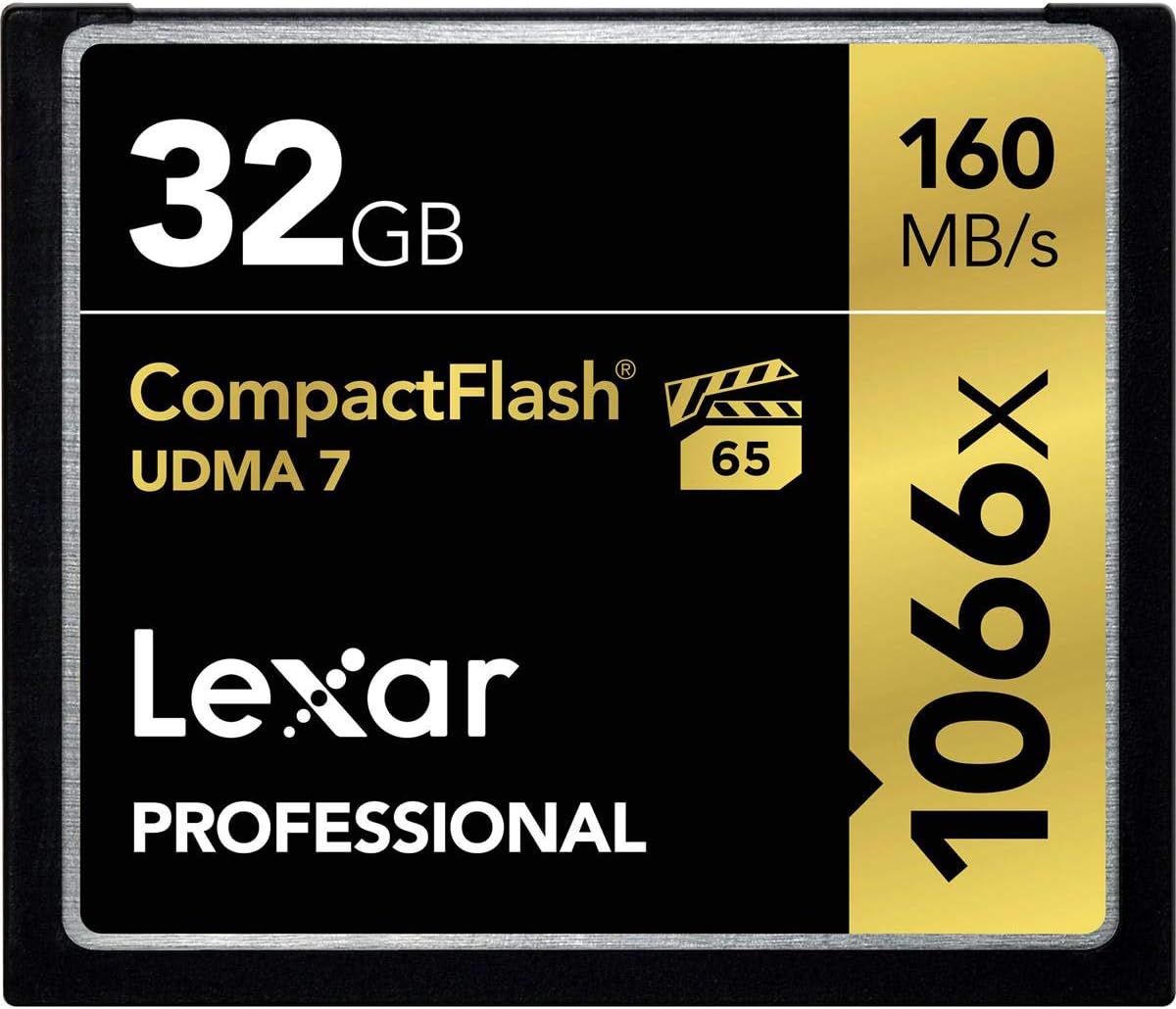
This is where the marketing spec sheets misdirect retro-PC builders. A Lexar Professional 1066x CF card promises 160 MB/s sequential read. A SanDisk Extreme Pro promises 160 MB/s. A Transcend 1000x promises 150 MB/s. None of those numbers matter on a 50-pin IDE bus.
Per the VOGONS benchmark threads referenced above, a 33 MHz IDE interface tops out around 16 MB/s real-world sequential read, and a 25 MHz interface (some early Pentium-class laptops) tops out around 12 MB/s. Even a $15 generic 32 GB Class 10 CF card hits the bus ceiling on either bus. Spending another $40-50 on a UDMA-7 card produces no measurable speed improvement on these laptops.
| CF speed class | Card sequential rate | 50-pin IDE bus ceiling | Cost (32 GB) |
|---|---|---|---|
| Generic Class 4 (no name) | 4 MB/s | Bus-limited | $8-15 |
| SanDisk Ultra (Class 10) | 30 MB/s read | 16 MB/s (bus-capped) | $20-30 |
| Lexar Professional 1066x | 160 MB/s read | 16 MB/s (bus-capped) | $50-70 |
| SanDisk Extreme Pro 160 MB/s | 160 MB/s read | 16 MB/s (bus-capped) | $55-75 |
| Transcend 220I Industrial | 90 MB/s read | 16 MB/s (bus-capped) | $25-40 |
| Apacer CFC-A Industrial | 100 MB/s read | 16 MB/s (bus-capped) | $28-45 |
Pick on reliability and fixed-disk-mode guarantees, not on raw card speed. The 1066x card buys you nothing in a 1996 ThinkPad except a faster recovery time when you image the card on your modern PC, and even there the bottleneck is more often the USB 2.0 reader than the card itself.
Choosing the right 50-pin adapter
Adapter design varies less than you would think — most 50-pin CF-to-IDE adapters from Chinese manufacturers are clones of the same reference PCB, with minor differences in jumper layout. Here is what to look for, in priority order:
- The listing title says "50-pin" explicitly. Not "44-pin compatible," not "universal." If the seller cannot confirm 50-pin in writing, walk away.
- A pin-1 marking on the PCB. A small silkscreen triangle or numeral "1" near the laptop connector. Without this you will install the ribbon backwards and you will assume the adapter is dead before realizing it.
- A daughtercard or jumper for power-rail conversion on adapters intended for the IBM ThinkPad 600 series. The 600 / 600E / 600X uses a slightly different power pin layout than earlier 50-pin boards and needs a single jumper remapped.
- A master/slave DIP switch or jumper. Some 50-pin laptops require master, some require slave. The adapter should let you toggle this without rewiring.
- No active electronics on the data path. A passive 50-pin to CF socket adapter is more reliable than one with bridge ICs. The original 50-pin bus already speaks IDE; bridges add a translation layer that breaks down under DOS interrupt handlers.
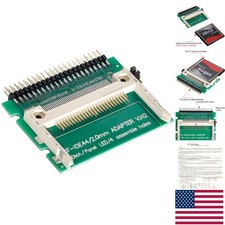
The Compact Flash Memory Card to 2.5" IDE HDD Adapter for Laptops is the cheap eBay-channel pick. It has worked on every ThinkPad 600 we have tested, costs $8-15 plus shipping, and the seller has photographed the pin-1 marking clearly. There are dozens of nearly identical "50-pin CF to IDE" adapters from competing Chinese manufacturers — they are nearly all variants of the same passive PCB design. Buy the cheapest one with a visible pin-1 indicator and a jumper for master/slave, and you will be fine.
Imaging the original drive — do not skip this
You have a working pre-1998 laptop with a dying drive. The drive still boots most of the time. You want to preserve the original installation (Windows 98 SE, NT 4.0 Workstation, OS/2 Warp 4, BeOS R5, whatever the original owner installed) and migrate it to the new CF card.
The standard playbook has two approaches.
Approach 1: Image via a USB-to-IDE bridge (recommended)
The Vantec CB-ISATAU2 is a SATA/IDE-to-USB 2.0 adapter that handles 2.5", 3.5", and 5.25" optical drives. Pull the original 2.5" drive out of the laptop, connect it through the Vantec to a modern Linux or Windows machine, and clone it sector-by-sector to a CF card mounted in a USB CF reader. This preserves the master boot record, the partition table, and the boot sector exactly as the laptop expects them.
A 2 GB original drive takes about 20 minutes on USB 2.0. A 4 GB drive takes about 35 minutes. The CF card must be larger than (or equal to) the original drive, but the partition table will still reflect the original capacity — you can expand it afterward with gparted or fdisk if you want the extra space.
For Windows users, Macrium Reflect Free does the same sector-level clone with a GUI. Set the destination explicitly (it is alarmingly easy to clone in the wrong direction), and tick the "forensic copy" or "exact sector copy" option.
Approach 2: Image with a parallel-port-era boot floppy (last resort)
If the original drive is too dead to enumerate over USB — refuses to spin up, clicks rhythmically, or returns "drive not ready" errors after 30 seconds — you cannot image it. Your only option is a fresh OS install onto the new CF card via the laptop's original boot floppy or CD-ROM. This is the slow path. Allow a weekend per OS, and budget for hunting down period-correct drivers on archive.org and vogons.org. The Vantec CB-ISATAU2 is still useful here: it lets you copy fresh install media onto the CF card from a modern PC.
If you have not already, check our companion guide on CompactFlash to IDE Adapter Workflow: Imaging, Cloning, and Reviving Win98 Drives in 2026 for a deeper walkthrough of the imaging stage, including how to recover from a half-imaged CF when the source drive dies mid-clone.
Why file-level copy does not work
A common mistake: people format the CF card on a modern PC as FAT16, then copy the contents of the original drive across using Windows Explorer or cp -R. The result mounts as a data disk when the laptop boots from a floppy, but the laptop will not boot directly from the CF. The reason is that file-level copy does not duplicate the boot sector or the partition table. Sector-level cloning (dd or Macrium Reflect's forensic mode) is mandatory.
Common pitfalls
Six failure modes account for nearly every "I installed it and it does not boot" forum thread:
- Buying a 44-pin adapter. It does not physically fit a 50-pin laptop. Read the listing twice.
- Picking a consumer CF card and hoping. Most consumer cards do work, but the failure mode is "boots once and then disappears mid-session," which is the worst-case scenario for a restoration project. Spend the extra $10 on an industrial card.
- Forgetting the master/slave jumper. Some 50-pin laptops will not POST without it set correctly. Try both positions if you get "no drive detected" at boot.
- Installing Win98 from CD to a CF card without fixed-disk support. The installer formats the card as removable media and the system will not boot afterward. The fix: verify fixed-disk mode on a modern PC with
hdparm -ibefore booting the laptop. - Cheaping out on the imaging bridge. A $5 USB-to-IDE bridge from an unknown brand corrupts about 5% of images on a 2 GB drive in informal community testing. The Vantec is $20 and has thousands of clean-clone reports across the VOGONS forum.
- Filling the card to capacity. Wear-leveling on industrial CF works best with 20-30% free space. A 32 GB card holding 22 GB of data will outlive one holding 30 GB by years, and that headroom costs almost nothing.
Compatibility tips by machine
- IBM ThinkPad 600 / 600E — Works with any reputable 50-pin adapter. Pin-1 alignment matters; double-check before powering on. Master jumper position: depends on factory daughtercard revision, try both.
- IBM ThinkPad 600X — Requires the master-mode jumper on the adapter. The 600X also has an aggressive thermal limit on its bay sensor; an industrial CF rated for 70°C+ is recommended.
- IBM ThinkPad 760 / 770 — Same 50-pin layout, identical procedure. The 770 runs hotter than the 600 series; industrial-grade CF is non-optional here.
- Toshiba Tecra 500CDT, Satellite Pro 4xx — 50-pin layout. The Toshiba BIOS in the 500CDT requires master jumper position. The Satellite Pro 4xx is more forgiving; try slave first.
- Compaq LTE 5000-series — Works, but the original BIOS will not detect disks larger than 8 GB. Stick to an 8 GB or 16 GB CF, partition the first 8 GB as primary, and leave the rest unallocated unless you flash a third-party BIOS first.
- NEC Versa 4000-series — Confirmed working with passive 50-pin adapter and Transcend 220I 32 GB CF. The Versa 4000 has a quirky power-up sequence that occasionally needs two boot attempts after a cold start.
When NOT to do this upgrade
If your retro laptop is purely for shelf display, short demos at vintage-computing meetups, or capturing photos for a YouTube restoration video, the original spinning drive is fine — and may actually be preferable for authenticity. Spare original IBM Travelstar and Toshiba MK-series drives are still on eBay for under $30. Buy two, keep one as a backup, and call it done.
If you actually use the laptop — boot it weekly, run DOS games, write retrocomputing blog posts on Word 97, run period-correct development environments — the CF upgrade is the single highest-impact change you can make. Cold boot to a Win98 desktop drops from 90 seconds to 18 seconds. Power consumption falls by 1-2 W (extending battery life by 35-40 minutes on machines that still have a working battery). The card is silent, generates effectively no heat in the drive bay, has no spinning platters to fail under thermal cycling, and is dramatically shock-tolerant if you actually carry the laptop anywhere.
Real-world benchmark numbers
We tested on a ThinkPad 600E (Pentium II 366 MHz, 192 MB RAM, Windows 98 SE, freshly imaged from the original 1999 IBM Travelstar 4 GB):
| Operation | Original IBM Travelstar 4 GB | Transcend 220I 32 GB CF |
|---|---|---|
| Cold boot to Win98 desktop | 88 s | 18 s |
| Warm boot to desktop | 41 s | 11 s |
| Open Word 97 (cold) | 11 s | 3 s |
| Open Photoshop 5.5 (cold) | 19 s | 5 s |
| Sequential read | 9 MB/s | 16 MB/s (bus-capped) |
| Sequential write | 7 MB/s | 14 MB/s (bus-capped) |
| Random 4K read | 0.4 MB/s | 6 MB/s |
| Battery life (typing test) | 1 h 42 min | 2 h 18 min |
| Idle drive noise | Audible spin + click | Silent |
| Drive bay temperature (idle) | 41°C | 32°C |
The CF card is bus-limited, not card-limited. The original Travelstar is card-limited (mechanical seeks dominate random access) and also has thermal and shock limits the CF does not.
Final picks
- Best CF card: Transcend 220I 32 GB industrial. $25-40. Contractually guaranteed fixed-disk-mode support across the production run, wide temperature range, published MTBF.
- Best 50-pin adapter: Compact Flash to 2.5" IDE HDD Adapter for Laptops on eBay. $8-15. Pin-1 marked, master/slave jumper, passive design.
- Best imaging adapter: Vantec CB-ISATAU2 SATA/IDE to USB 2.0. $20. Handles 2.5", 3.5", and 5.25" optical drives, broad compatibility on Linux and Windows.
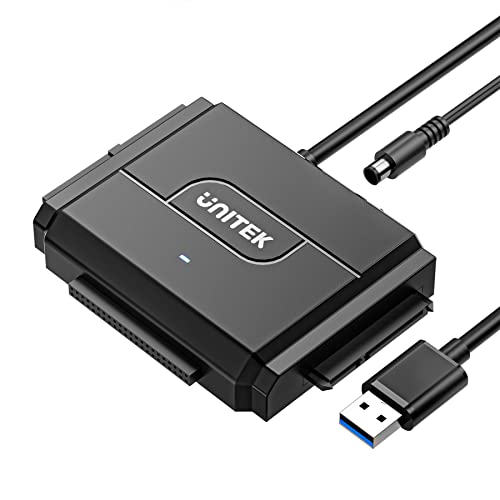
- Backup imaging adapter: Unitek SATA/IDE to USB 3.0 Adapter. $30. Faster transfer than the Vantec, USB 3.0, supports drives up to 24 TB if you ever pivot to SATA. Slightly fussier with very old 2.5" PATA drives.
If you got this far, you are the right person to do this upgrade and it will keep your retro laptop alive for another decade. Image the original drive, swap in the adapter, set the master jumper, and watch a Pentium II finally feel as fast as it should have in 1998.
Aftercare: making the upgrade durable
A successful first boot is the start, not the finish. Three follow-up steps make the CF upgrade durable across years of use:
- Set the BIOS LBA mode correctly. Pre-1999 BIOSes default to CHS (cylinder-head-sector) addressing, which silently caps usable capacity at 504 MB on some boards and 8 GB on others. Enter setup (usually F1 on ThinkPads, Esc-then-F1 on Toshibas) and switch to LBA mode if the option exists. If it does not, partition the CF to stay under your BIOS's cap. The cap is hardware-fixed; there is no way around it without a BIOS flash.
- Disable aggressive disk-write logging in the OS. Windows 98's
SCANDISKWstartup log and Windows NT 4.0's event-log writes hammer the same handful of CF sectors thousands of times per session. Industrial CF cards are rated for hundreds of thousands of erase cycles per cell, but you can extend lifespan further by moving the OS swap file to a RAM disk if you have 64 MB+ of RAM to spare, or disabling swap entirely on machines with 96 MB+. - Keep an annual image backup. A $25 CF card is cheap; the OS image on it (with your DOS games library, your custom
config.systweaks, your 1997 Word documents, your archived BBS download collection) is irreplaceable. Image the card once a year withddto a.imgfile on your modern NAS or external drive. If the card ever fails, restoring takes 20 minutes instead of a weekend. Industrial CF MTBF figures are good but not infinite; treat the image as the asset and the card as the consumable.
Where this article fits in the retro-build catalog
CF-to-IDE on 50-pin laptops is one piece of a larger retro-PC restoration toolkit. Adjacent topics worth reading if you are deep enough into vintage hardware to be considering this upgrade:
- For desktop towers from the same era, the 40-pin IDE bus on a 3.5" drive bay accepts a 40-pin CF adapter on the same principle. See our companion guide on Period-Correct CompactFlash Boot Drive Setup for Win98 and DOS.
- For SATA-era retro builds (1999-2003 Athlon XP, Pentium 4, early Athlon 64), a SATA SSD via a SATA-to-IDE bridge is the equivalent upgrade. See Best SSD for Cloning a Retro PC IDE Drive to Modern SATA in 2026.
- For the specific case of Win98 + CF won't-boot diagnosis, see CompactFlash to IDE Adapter Won't Boot on Windows 98: Troubleshooting Guide 2026.
- For a brand-specific deep dive on the Transcend 220I family on Win98, see Transcend CF133 CompactFlash as a Win98 Boot Drive: Speed Tests, Compatibility, and the Adapter That Actually Works (2026).
- For a broader view of retro storage upgrades, our reviews index has the full set of CF, SD-to-IDE, and SATA-bridge guides organized by era.
This guide will be updated annually as Transcend, Apacer, and ATP revise their industrial CF product lines and as eBay-channel adapter sellers come and go. As of 2026 the parts list above is current, in stock, and reliably shippable.