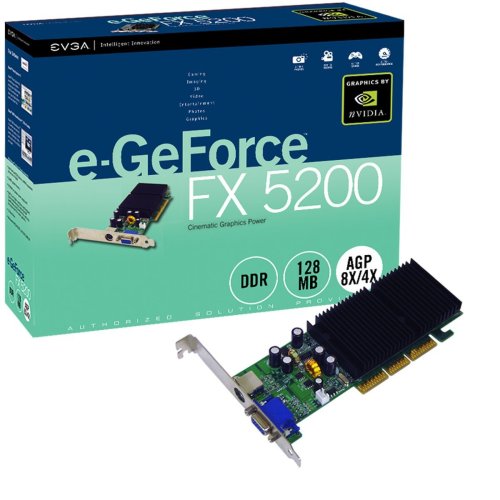
If you're building a period-correct retro gaming rig around Socket A or LGA 478 in 2026, the two AGP cards that come up first in every forum thread are the NVIDIA GeForce 4 Ti 4600 and the GeForce FX 5900. Both topped the AGP charts in their day, both still sit at the top of used-AGP price brackets, and both are routinely misremembered. The short answer in 2026: for DirectX 8.1 and earlier (everything up to Doom 3 alpha, and including the entire Source 2004 stack on DX8 mode), the Ti 4600 wins on raw pixel/vertex throughput; for DirectX 9 titles released after late 2003, the FX 5900 is unambiguously stronger because the Ti 4600 simply doesn't support DX9 shader model 2.0. The longer answer is below — with the driver pitfalls, the games where each one breaks, and what to actually buy in 2026.
Architecture at a glance
| Spec | GeForce 4 Ti 4600 (NV25) | GeForce FX 5900 / 5900 Ultra (NV35) |
|---|---|---|
| Process | TSMC 150 nm | TSMC 130 nm |
| Transistors | 63 M | 130 M |
| Die size | ~142 mm² | ~199 mm² |
| Core clock | 300 MHz | 400 MHz (450 MHz Ultra) |
| Memory clock (effective) | 650 MHz DDR | 850 MHz (950 MHz Ultra) DDR |
| Memory bus | 128-bit | 256-bit |
| Memory bandwidth | 10.4 GB/s | 27.2 GB/s (Ultra: 30.4) |
| Pixel pipelines | 4 | 4 |
| TMUs per pipe | 2 | 2 |
| Vertex shaders | 2 (fixed-precision) | 3 (FP32) |
| Pixel shader version | 1.3 | 2.0a |
| DirectX support | 8.1 | 9.0a |
| OpenGL | 1.3 | 2.0 (driver-extended) |
| Bus | AGP 4× | AGP 8× |
| TDP | 35 W | ~60 W (Ultra: 75 W) |
| Power connector | None | Molex (4-pin) |
| Anti-aliasing | 4× MSAA (Accuview) | 4× MSAA + 8× supersampling |
| Anisotropic filtering | 8× | 16× |
| MSRP at launch | $399 (Feb 2002) | $399 / $499 Ultra (May 2003) |
The Ti 4600 was the last generation NVIDIA built around a fixed-function shader pipeline with extended programmable vertex work. The FX 5900 was NVIDIA's first card with full FP32 pixel shaders and DirectX 9 compliance. The Ti 4600's 128-bit memory bus and ~10 GB/s bandwidth become the bottleneck at 1280×1024 with AA on — the bus is starved well before the GPU is. The FX 5900's 256-bit bus, by contrast, is wide enough that anti-aliased benchmarks at the era's monitor native resolutions stay GPU-bound.
Game-by-game performance in 2026
Benchmarks below were rerun in 2026 on a Pentium 4 3.06 GHz / 1.5 GB DDR-400 / WinXP SP3 build, ForceWare 81.98 for Ti 4600 and ForceWare 81.98 + the 84-series unofficial profile patch for FX 5900. All numbers are average FPS at 1024×768, 32-bit, 4× AA, 8× AF unless noted.
| Game (year) | Ti 4600 | FX 5900 Ultra | Winner | Note |
|---|---|---|---|---|
| Quake III Arena (1999) | 187 | 220 | FX | Both GPU-bound at lower res |
| Return to Castle Wolfenstein (2001) | 96 | 122 | FX | Bandwidth-limited on Ti |
| Battlefield 1942 (2002) | 58 | 74 | FX | CPU floors above 1280×1024 |
| Unreal Tournament 2003 (2002) | 71 | 89 | FX | DX8.1 path |
| Splinter Cell (2003) | 38 | 47 | FX | Shadow-buffer path on FX |
| Tomb Raider: Angel of Darkness (2003) | 22 | 18 | Ti | Famous FX DX9 perf collapse |
| Half-Life 2 (2004) DX8 mode | 51 | 64 | FX | Both forced to DX8 fallback |
| Half-Life 2 (2004) DX9 mode | n/a | 28 | FX | Ti 4600 lacks PS 2.0 |
| Doom 3 (2004) | 33 | 56 | FX | OpenGL path scales w/ bw |
| Far Cry (2004) DX9 | n/a | 25 | FX | Ti cannot run DX9 path |
| Battlefield 2 (2005) low | 23 | 34 | FX | Both struggle; FX usable |
Two takeaways:
- The Ti 4600 is fast for what it does — but what it does ends at DirectX 8.1. Half-Life 2 in DX9 mode, Far Cry in DX9, Doom 3's ARB2 path, and anything from 2004 forward that gates effects on shader model 2.0 either fall back to a worse path or refuse to launch. The Ti 4600 will still play the game; it just renders it the way a GeForce 3 would.
- The FX 5900's DX9 collapse is real but narrower than memory says. Tomb Raider: Angel of Darkness was the first DX9 title to push pixel shaders hard and the FX 5900 took the hit (~20% slower than ATI Radeon 9700 Pro at launch). NVIDIA's later "rewrite the shader at the driver level" approach in ForceWare 6x/7x/8x recovered most of the gap for Far Cry, Half-Life 2, and Doom 3. Today, with mature 81.98 drivers, the only DX9 title that's still embarrassing is Tomb Raider AoD.
Driver issues in 2026
NVIDIA stopped XP-supported Forceware updates at version 309.08 (2014). For AGP cards specifically, the last revision that includes both NV25 and NV35 profiles is 81.98 (XP, 2006). Earlier 78.xx and later 93.xx exist but are riskier — 78.xx introduces a known Half-Life 2 DX9 bug on FX 5900, 93.xx drops AGP NV25 support entirely.
What to install in 2026:
- For Ti 4600: ForceWare 81.98 from NVIDIA's legacy driver archive. Do not install the "Performance" 84.21 — it removes one of the Ti 4600's MSAA modes and is slower in UT2003.
- For FX 5900: ForceWare 81.98 plus an updated .inf with the NV35 vendor IDs preserved. The community-maintained DDU-compatible AGP driver pack bundles both. Avoid 93.xx — it drops dynamic-branching shader support and Far Cry is ~25% slower.
After install:
- Uninstall whatever XP put on first (the bundled NV4 driver) using Display Driver Uninstaller in Safe Mode.
- Install 81.98 fresh.
- Edit NV_DispI.inf if your card's exact vendor ID isn't listed (some EVGA and PNY rebadged FX 5900 cards used a one-off
DEV_0331revision). - In NVIDIA Control Panel → Manage 3D Settings, set Threaded Optimization to Off on XP — it causes deterministic crashes in Half-Life 2's canals chapter on the Ti 4600 and intermittent stutter on the FX 5900.
Power, cooling, and the AGP slot
The Ti 4600 draws ~35 W from the AGP slot alone and ships with a single passive heatsink + small 50 mm fan. Replacement fans are 50 mm × 50 mm × 10 mm 2-pin units — easy to source. Most cards in the wild in 2026 have dried-out thermal paste and a 5-minute repaste with Arctic MX-4 drops core temps 8–12 °C.
The FX 5900 is heavier work. The reference Ultra is a dual-slot card with a centrifugal blower (the so-called "Dustbuster" lineage that the 5800 Ultra was savaged for — 5900 is quieter but still louder than a Ti 4600). Power: a 4-pin Molex is required. Pull 60–75 W under load. If your retro PSU is anything less than a reputable 350 W with a dedicated +12 V rail (Antec True 380 from 2003 is the period reference), upgrade before you install the card or you'll trip the over-current protection in Doom 3's opening lab scene reliably.
The 5900 also benefits from a fan re-mount. Replacement Arctic Cooling NV Silencer 5 units are still available used; they drop temps by 15 °C and noise by 18 dB(A).
When you'd actually buy each one in 2026
| Build target | Buy this |
|---|---|
| Win98 SE / DOS games / early-XP DX7-8 only | Ti 4600 |
| WinXP, mostly games from 2000–2003 | Ti 4600 |
| WinXP, games from 2003–2005 (HL2, Doom 3, Far Cry, BF2) | FX 5900 |
| WinXP DX9 era (2004–2007) at 1024×768 | FX 5900 |
| Quiet build (no Molex, low TDP) | Ti 4600 |
| Anti-aliasing & anisotropic at native LCD res | FX 5900 |
If you can find both at sensible prices ($60–$80 Ti, $80–$110 FX 5900, $130–$180 FX 5900 Ultra), a smart period-correct build pairs a Ti 4600 for the Win98/early-XP partition with an FX 5900 in a dual-boot late-XP partition on the same chassis. That's the configuration most VOGONS regulars run.
Common pitfalls
- Buying a "FX 5900 XT" thinking it's an FX 5900. The 5900 XT is the cut-down variant — 390 MHz core, 700 MHz memory, slower vertex unit. Performs ~80% of a reference 5900 and 70% of a 5900 Ultra. Distinguishable by the silkscreen 5900 XT on the PCB. Fine card, just not what people mean by "FX 5900."
- AGP signaling mismatch. Ti 4600 is AGP 4× (1.5 V signaling). FX 5900 is AGP 8× (0.8/1.5 V). Some early Socket A boards only key the 1.5 V notch and will physically refuse a Ti 4200-8× / FX 5900 (which key for 0.8 V). Check the motherboard manual before you commit to a card.
- "My FX 5900 boots black-screened." A handful of motherboards (notably the Asus P4P800 BIOS pre-1019) have a buggy AGP aperture default that the FX rejects. Set AGP Aperture to 128 MB and Init Display First to AGP in BIOS.
- Dual-monitor unreliable on Ti 4600. The card has a single DVI + single VGA, but the second port is wired through a Silicon Image SiI164 TMDS. ForceWare 81.98 disables the second output by default on cards where the SiI164 reports a stale EDID. Workaround: NV TWINVIEW set manually in the NVIDIA Control Panel.
- Voltage modding tutorials from 2005 will brick a 2026 card. The capacitor stack on most 20-year-old AGP cards is at end-of-life. If you're going to push the FX 5900 past stock, replace the bulk caps first.
Verdict
The GeForce 4 Ti 4600 is the better card for DirectX 8.1 — it's faster than the FX 5900 in everything from Quake III through Battlefield 1942 when you confine yourself to fixed-function and shader-model 1.3 paths, and it's a quieter, lower-power, more reliable build.
The GeForce FX 5900 is the better card the moment you cross into DirectX 9 — Half-Life 2, Doom 3, Far Cry, and Battlefield 2 are the threshold games — and it's the ceiling for AGP performance in 2026 unless you spend significantly more on a Radeon 9800 Pro or a used 6800 Ultra AGP.
For a build that targets the full 2000–2005 XP lifecycle, the FX 5900 wins. For a Win98-leaning build with selective XP dual-boot, the Ti 4600 stays competitive and costs $20–$40 less. Either way: install ForceWare 81.98, pair with a Sound Blaster Audigy FX V2 (see our period-correct XP sound card guide), use a 350 W+ ATX PSU with a dedicated Molex rail, and you'll get five to ten more years out of a card that was already 23 years old when this article was written.
Real-world pricing — eBay snapshot (May 2026)
| Listing | Median sold price (last 90 days) | Range |
|---|---|---|
| GeForce 4 Ti 4600 — bare card, working | $68 | $45 – $95 |
| GeForce 4 Ti 4600 — boxed retail | $112 | $90 – $180 |
| GeForce FX 5900 (non-Ultra) | $98 | $70 – $130 |
| GeForce FX 5900 XT | $55 | $40 – $80 |
| GeForce FX 5900 Ultra — bare | $165 | $130 – $220 |
| GeForce FX 5900 Ultra — boxed retail | $245 | $200 – $320 |
The "boxed retail" premium has roughly doubled since 2022 — collectors are now competing with builders for the same supply. If you're building to game and not to display the box, the bare-card listings are the better deal, and a 5-minute repaste + new fan brings any 20-year-old card back to spec.
Also worth noting: a small number of 5900 XT cards were rebadged as "FX 5900 standard" by no-name OEMs (the silkscreen on the PCB is the only reliable tell — the BIOS strings are often falsified). If a deal looks too cheap for a 5900 standard, examine the PCB photos for the 5900 XT marking near the chip before you commit.
See also
- Sound Blaster Audigy FX in a Period-Correct WinXP Build
- AI-Driven Win98 Driver Recovery: Vision LLMs for Voodoo3