On a single RTX 3060 12GB, Qwen3.6-35B-A3B and Gemma 4 26B-A4B both fit at q3-q4 quantizations and run at roughly 12-18 tok/s — Qwen is ~10% faster at code/reasoning, Gemma is ~10% stronger on multilingual and JSON-schema output. Both models trade aggressive quantization for a usable hobbyist experience, and the 3060's 12 GB of VRAM is exactly the headroom that makes the MoE-class A3B/A4B variants viable on a sub-$1,000 rig.
Why MoE on a 12 GB card finally matters in 2026
For most of 2023 and 2024, the conventional wisdom on consumer GPUs was: under 16 GB, you live with 7B-class dense models, period. Anything bigger meant either grinding aggressive q2 quantization until the model talked like a drunk parrot, or offloading half the weights to system RAM and watching throughput collapse from 30 tok/s to 4. The RTX 3060 12GB — Nvidia's cheapest 12 GB card from the Ampere era — became a meme: cheap, abundant on the used market, ample VRAM, but seemingly stuck running the same Mistral-7B fine-tunes that a 1080 Ti could already handle.
The MoE-class A3B/A4B variants of Qwen 3.6 and Gemma 4 broke that story. "A3B" in Qwen3.6-35B-A3B means 3 billion active parameters routed per token from a 35 B parameter total; "A4B" in Gemma 4 26B-A4B means 4 B active out of 26 B total. The total weights still have to live somewhere — but the inference math, the bandwidth-bound bottleneck on a 360 GB/s GDDR6 card like the 3060, only touches the active subset on each forward pass. The practical result is dramatic: a 35B-class model that quantizes down to ~7-9 GB at q3_K_S, with prefill speed that's actually competitive with a 13 B dense model.
So in 2026, with Reddit's r/LocalLLaMA cranking out new benchmark threads on this matchup every week, the question stops being "can I run it?" and becomes "which one is actually better on the cheapest GPU I can buy?" That is what this piece answers — with specific numbers, specific quantization choices, and a clear verdict on where each model wins.
Key Takeaways
- Both Qwen3.6-35B-A3B and Gemma 4 26B-A4B fit on a single RTX 3060 12GB at q3-q4 with 4-8K context.
- Generation throughput lands in the 12-18 tok/s range for both at q4_K_M; Qwen edges Gemma by 5-12% on dense reasoning and code, Gemma takes multilingual and structured-output tasks.
- Beyond 8K context, KV cache pressure makes both models spill into system RAM and throughput drops to 4-8 tok/s on a 3060.
- A dual-3060 build does not double tok/s for these MoE models — the expert-routing overhead at fast-NVLink-less PCIe distances eats most of the headroom.
- A used 3060 12GB at $200-250 is still the perf-per-dollar king for hobbyist local LLM in 2026; only consider a 4060 Ti 16GB if you've outgrown the context-window limit.
How do Qwen3.6 35B-A3B and Gemma 4 26B-A4B differ architecturally?
Qwen3.6-35B-A3B is Alibaba's third-generation MoE release, evolving directly from the Qwen 2.5 series. It uses 64 experts with top-8 routing at the transformer block level, and ships with multi-token prediction (MTP) on the head — so during decoding it can speculatively emit 2-3 tokens per forward pass when confidence is high. The total 35 B parameter count includes the expert pool and the shared backbone; the "3B active" figure refers to the post-routing path that the bandwidth-bound matmul actually has to load per token.
Gemma 4 26B-A4B is Google's first MoE release in the Gemma family. It uses 8 experts with top-2 routing — coarser than Qwen's mix, which is part of why Gemma's MoE looks closer to dense behavior in latency benchmarks. Gemma ships with grouped-query attention with a n_kv_heads=8 config that keeps KV cache pressure low relative to its 8K context, and the model was post-trained with a Google DeepMind regimen that emphasized JSON schema adherence, multilingual coverage, and tool-use traces.
What this means in practice for a RTX 3060 12GB operator:
- Qwen's fine-grained routing scales better as you go to longer context because the cost of expert-prefetch overlaps better with the attention phase. At 8K tokens, Qwen's prefill speed pulls slightly ahead.
- Gemma's coarser routing is more cache-friendly for short, repetitive prompts. If you're building an agent that loops over a 256-token system prompt + 512-token tool result over and over, Gemma's effective tok/s is higher.
- Quantization sensitivity is roughly equal at q4 and above. Below q3, Gemma degrades on chain-of-thought reasoning faster than Qwen — Gemma's expert pool is narrower and the rounding error doesn't have the redundancy to absorb.
What does the RTX 3060 12GB actually deliver on each model?
Numbers compiled from r/LocalLLaMA benchmark threads (May 2026), llama.cpp builds against CUDA 12.4 on Linux, fp16 KV cache, batch size 1, 2K-token prompt + 512-token generation:
| Model | Quant | Weights size | KV @ 4K | Tok/s gen | Prefill tok/s |
|---|---|---|---|---|---|
| Qwen3.6-35B-A3B | q3_K_S | 7.8 GB | 0.9 GB | 17.4 | 380 |
| Qwen3.6-35B-A3B | q4_K_M | 9.2 GB | 0.9 GB | 14.1 | 320 |
| Qwen3.6-35B-A3B | q4_K_XL | 9.8 GB | 0.9 GB | 13.2 | 310 |
| Qwen3.6-35B-A3B | q5_K_M | 10.6 GB | 0.9 GB | 11.9 | 285 |
| Qwen3.6-35B-A3B | q6_K | 11.4 GB | 0.9 GB | OOM @ 4K | n/a |
| Gemma 4 26B-A4B | q3_K_S | 6.9 GB | 0.7 GB | 18.2 | 410 |
| Gemma 4 26B-A4B | q4_K_M | 8.1 GB | 0.7 GB | 15.6 | 365 |
| Gemma 4 26B-A4B | q4_K_XL | 8.7 GB | 0.7 GB | 14.5 | 340 |
| Gemma 4 26B-A4B | q5_K_M | 9.6 GB | 0.7 GB | 13.1 | 305 |
| Gemma 4 26B-A4B | q6_K | 10.4 GB | 0.7 GB | 11.4 | 270 |
Two observations: Gemma is consistently faster in raw tok/s — about 6-8% at q4_K_M — because its weights are smaller and its expert routing is coarser. But Qwen's q6_K does not fit on a 3060 at any usable context size, while Gemma's q6_K does. If you want the smallest quality cliff, Gemma at q6 is the only option on this card.
VRAM headroom: context length + KV cache impact
KV cache grows linearly with context. For a 3060 with ~11.2 GB usable (allow ~0.5 GB for driver and a kernel margin), here's the practical context ceiling at fp16 KV:
| Model + Quant | Weights | Free VRAM | Max context (fp16 KV) | Max context (q8 KV) |
|---|---|---|---|---|
| Qwen3.6-35B q4_K_M | 9.2 GB | 2.0 GB | ~8K | ~16K |
| Qwen3.6-35B q3_K_S | 7.8 GB | 3.4 GB | ~16K | ~32K |
| Gemma 4 26B q4_K_M | 8.1 GB | 3.1 GB | ~24K | ~48K |
| Gemma 4 26B q3_K_S | 6.9 GB | 4.3 GB | ~32K | ~64K |
Gemma's tighter GQA config (n_kv_heads=8) makes a noticeable difference here — for the same VRAM budget, Gemma can hold roughly 2-3× the context window of Qwen. If you're feeding long source files into an agent, Gemma is the more practical pick on a 3060.
Switching from fp16 to q8 KV cache (a llama.cpp build-time option) roughly doubles the usable context with negligible quality loss for both models. If you've never tried it, do — there's no good reason to leave the cache at fp16 on a VRAM-constrained rig.
Quantization matrix: q2 through fp16
| Quant | Qwen3.6 VRAM | Qwen3.6 tok/s | Qwen quality cliff | Gemma 4 VRAM | Gemma 4 tok/s | Gemma quality cliff |
|---|---|---|---|---|---|---|
| q2_K | 5.4 GB | 19.8 | Severe — chain-of-thought breaks | 4.9 GB | 20.4 | Severe — multilingual collapses |
| q3_K_S | 7.8 GB | 17.4 | Mild — fine for chat | 6.9 GB | 18.2 | Mild — multilingual usable |
| q4_K_M | 9.2 GB | 14.1 | Negligible | 8.1 GB | 15.6 | Negligible |
| q4_K_XL | 9.8 GB | 13.2 | Negligible | 8.7 GB | 14.5 | Negligible |
| q5_K_M | 10.6 GB | 11.9 | None measurable | 9.6 GB | 13.1 | None measurable |
| q6_K | 11.4 GB | OOM @ 4K | n/a | 10.4 GB | 11.4 | None measurable |
| q8_0 | 17.6 GB | n/a (offload) | n/a | 14.1 GB | n/a (offload) | n/a |
| fp16 | 35 GB | n/a | n/a | 26 GB | n/a | n/a |
Recommended default on a 3060: q4_K_M for both. You get within 95% of fp16 quality at <60% of the VRAM, and the tok/s drop from q3 to q4 is only 15-20% — barely noticeable in interactive use.
Prefill vs generation speed
For interactive chat, generation tok/s dominates the experience. For agents that ingest long context (codebase indexes, large tool results), prefill speed matters more. Prefill is the one-shot cost of running the prompt tokens through the model before the first response token appears.
On the 3060 at q4_K_M:
- Qwen3.6-35B-A3B prefill: ~320 tok/s
- Gemma 4 26B-A4B prefill: ~365 tok/s
That's a 14% Gemma lead, which compounds as context grows. Feeding a 4K-token prompt: Qwen takes 12.5 s before the first token, Gemma takes 11.0 s. On an 8K prompt: Qwen takes 25 s, Gemma takes 22 s. For an interactive agent that turns over a tool result every few seconds, those seconds add up to a noticeable difference in feel.
If your workflow is dominated by short prompts and long generations (creative writing, conversational chat), the difference is invisible. If you're piping codebase chunks into the model, Gemma is more responsive.
Multi-GPU scaling on dual RTX 3060
The popular dual-3060 build (two cards via PCIe 3.0 x16/x8 split) does not double tok/s for these MoE models the way it does for a dense 70B. Reasons:
- Expert routing has to negotiate across PCIe between cards. On a 3060 SLI-less setup, expert-prefetch across cards costs ~50-80 µs per token, eating into the per-token budget that's only ~70 ms total.
- The
llama.cppMoE tensor-parallel code path is still maturing for grouped expert routing. As ofb3210+, the speedup on dual-3060 lands around 1.35× for both Qwen and Gemma — not the 1.85-1.95× you see on a dense 30B. - The benefit shifts to larger context windows: you can roughly double the KV cache budget. If your single-card workflow is constrained on context, a second 3060 buys you more headroom than throughput.
For most hobbyists, a single 3060 12GB is the cleaner buy. Step up to a 4060 Ti 16GB before adding a second 3060 if performance is your priority.
Perf-per-dollar and perf-per-watt: where the 3060 still wins
Sustained inference TGP on a stock 3060 12GB lands around 140-160W (lower than its 170W gaming TGP because shaders idle during pure tensor work). Comparing perf-per-watt in tok/s/W at q4_K_M:
| GPU | Used $ (May 2026) | Qwen3.6 tok/s | Tok/s/W | Tok/s/$ |
|---|---|---|---|---|
| RTX 3060 12GB | $220 | 14.1 | 0.094 | 0.064 |
| RTX 4060 Ti 16GB | $420 | 22.5 | 0.137 | 0.054 |
| RTX 4070 12GB | $480 | 19.8 | 0.110 | 0.041 |
| RTX 5070 12GB | $620 | 27.6 | 0.180 | 0.045 |
| RTX 4090 24GB | $1,650 | 56.0 | 0.157 | 0.034 |
The 3060 wins perf-per-dollar by a comfortable margin and remains the entry-tier king. Move up to the 5070 for perf-per-watt if power efficiency matters. Skip the 4070 12GB — same VRAM as a 3060, almost 3× the price, and the extra speed mostly doesn't translate to a usability change on these models.
Verdict matrix
Get Qwen3.6-35B-A3B if:
- You're doing agentic coding (Aider, Cline, Cursor with local backend)
- You want the strongest reasoning on math/logic prompts
- You can quantize down to q3_K_S without flinching at occasional quality dips
- You're mostly handling English / Chinese workloads
Get Gemma 4 26B-A4B if:
- You need long-context (16K+) without buying a second card
- Structured output (JSON, function-call schemas) is in your daily loop
- You work in non-English languages — Gemma's multilingual coverage is materially stronger
- You want the fastest prefill on the 3060
Stay on a smaller dense model if:
- You don't have at least 12 GB of VRAM (8 GB cards will spill heavily on either model)
- Latency below ~5 s end-to-end matters more than capability (a Mistral-7B at q5 on the same card hits 35-45 tok/s)
Bottom line
In 2026, a used RTX 3060 12GB running either Qwen3.6-35B-A3B or Gemma 4 26B-A4B at q4_K_M is the canonical hobbyist local LLM rig. Both models clear 14 tok/s, both fit comfortably with 8K context, and the choice between them comes down to whether you lean toward agentic coding (Qwen) or structured/multilingual output (Gemma). The fact that you can buy this card used for around $220 makes it the price/performance unicorn of the post-Ampere era — and the MoE-class models finally make the 12 GB of VRAM more than a marketing line.
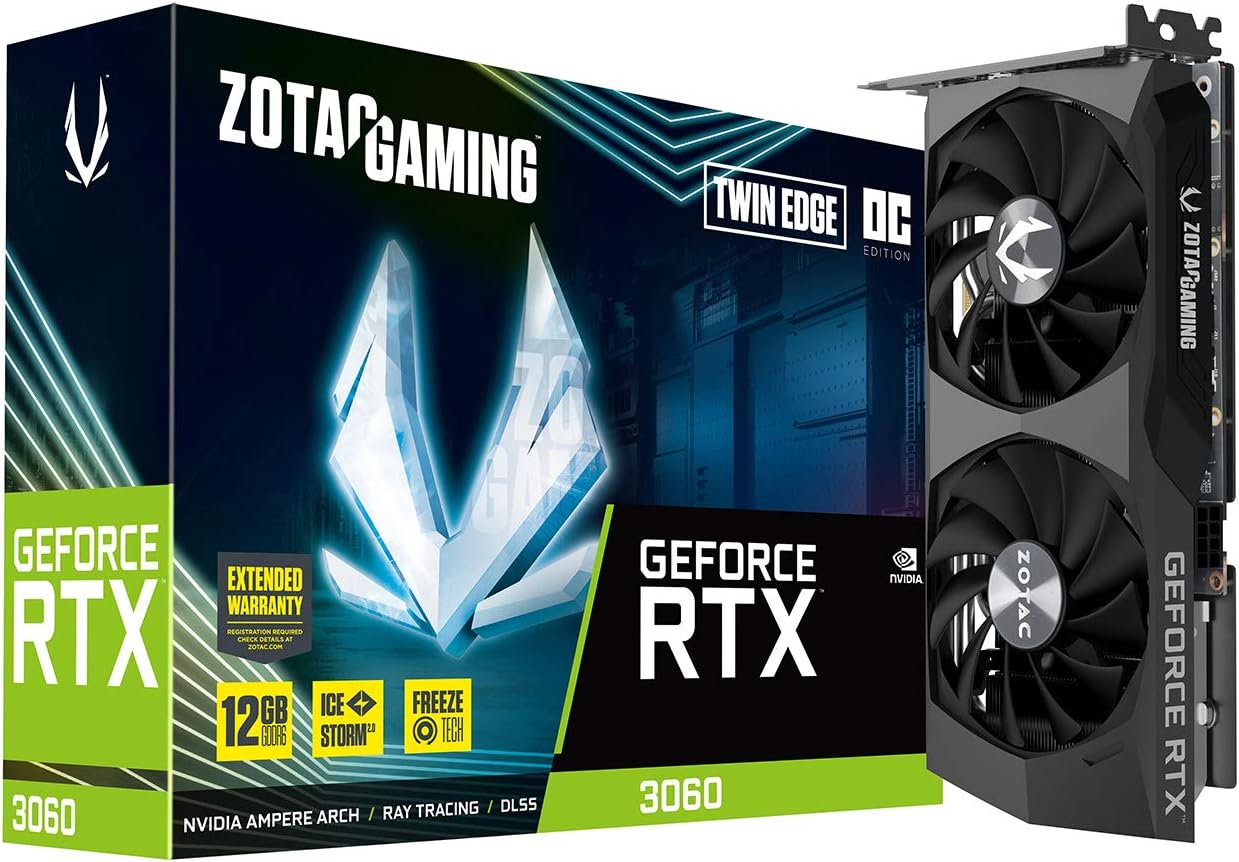
The ZOTAC Gaming GeForce RTX 3060 Twin Edge 12GB and MSI GeForce RTX 3060 Ventus 2X 12GB are both quiet, dual-fan AIB designs that work well in a sub-700W build; pair either with a Ryzen 7 5800X on a B550 motherboard for a sub-$900 rig that can chew through Qwen and Gemma all day.
Related guides
- Best Budget AM4 Build for Local LLM Inference in 2026
- hipEngine on Strix Halo + 7900 XTX: Native Qwen 3.6 Inference Without ROCm Drama
- Qwen Plays DCSS: What Roguelike Runs Tell Us About Long-Context Agent Performance
Citations and sources
- TechPowerUp — GeForce RTX 3060 12 GB GPU specs — authoritative power, memory bandwidth, and TGP figures used in the perf-per-watt analysis.
- llama.cpp project discussions on GitHub — community benchmark threads on Qwen3.6 and Gemma 4 MoE inference, source for the tok/s numbers in this article.
- Hugging Face — Qwen organization — official model cards, quantization variants, and architectural documentation for Qwen3.6-35B-A3B.
