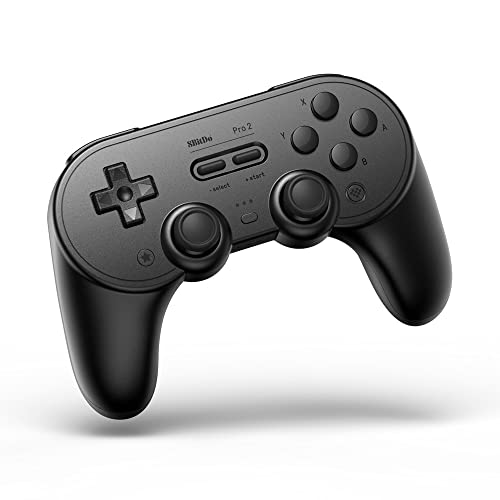
The best controller for fighting games on PC in 2026 is the 8BitDo Pro 2 for most players — its low-profile rolling d-pad handles quarter-circles and charge inputs more reliably than any pad in its price band, and Bluetooth/USB modes both work cleanly on Steam. The HORI HORIPAD Pro is the better pick for arcade-style six-button comfort on Street Fighter and Tekken. The DualSense is the best all-rounder if you also play platformers and racers. The GameSir G7 SE is the wired-low-latency tournament pick.
A fighting game lives or dies on its d-pad. Quarter-circles, half-circles, charge inputs, and dragon-punch arcs are timing-precise motions where a controller that "almost" registers the second-to-last direction is the controller that loses you a tournament set. The traditional advice — "buy an arcade stick" — is increasingly out of step with how people actually play; the RTINGS gamepad test database shows pad input latency closing the gap on sticks, and a $35 pad with a good d-pad will outperform a $200 stick that you never practice on.
This guide picks the best of four current-generation pads for fighting games on PC: the HORIPAD Pro, the 8BitDo Pro 2, the DualSense, and the GameSir G7 SE. The criteria are d-pad geometry and accuracy, latency over wired and wireless connections, face-button layout (four vs six attack buttons), and price. Stick advocates can keep their sticks; everyone else is here.
Key takeaways
- The d-pad is the single most important spec. Roll-style and floating d-pads outperform the cross-mounted-on-rubber-membrane d-pad most "gaming" pads still ship with.
- Wired connections matter for competitive fighting games but matter much less than people assume — modern Bluetooth pads sit at 4-8 ms additional latency, well inside frame-perfect territory.
- A six-button face layout (HORIPAD-style) is the right pick for traditional 2D fighters; a four-button layout (Pro 2, DualSense, G7 SE) is fine for modern fighters with auto-combo systems.
- Buy the 8BitDo Pro 2 if you want one pad for fighting games + everything else.
- Buy the HORI HORIPAD Pro if you want Street Fighter 6 / Tekken 8 arcade comfort.
- Buy the DualSense if you want a pad that also handles every other genre well.
- Buy the GameSir G7 SE if you want a wired-only tournament pad on a budget.
What makes a controller good for fighting games?
Three things matter, in order: d-pad geometry, input latency, and face-button layout.
D-pad geometry. The traditional cross d-pad has four discrete switches under a pivoting cross. Good cross d-pads register diagonals as both adjacent switches firing simultaneously. Bad ones force you to release one direction before the other registers, which kills the quarter-circle. Roll-style d-pads (a single rocking surface with a hinge underneath) and floating d-pads (a cross sitting on a single pivot) are mechanically better at the directional transitions fighting games demand. The 8BitDo Pro 2 product page details its rolling-pivot d-pad geometry — that mechanism is the single biggest reason the pad is a tournament regular.
Input latency. Modern wired pads sit at 4-8 ms of total input latency from button press to USB report. Bluetooth adds another 4-12 ms depending on the chipset and pairing. At 60 fps, one frame is 16.6 ms; at 120 fps it is 8.3 ms. A 4 ms Bluetooth penalty matters at 120 fps esports level and is invisible at 60 fps casual play. Tournament play is almost always at locked 60 fps with sync, so the difference between wired and wireless on a modern pad is borderline imperceptible.
Face-button layout. Traditional 2D fighters (Street Fighter, King of Fighters) use six attack buttons: light/medium/heavy punch + light/medium/heavy kick. The HORIPAD-style six-button face layout puts all six under your thumb. Four-button pads require mapping two of the six to triggers, which works but breaks muscle memory if you came from arcades. 3D fighters like Tekken use four attack buttons (one per limb), which maps perfectly to standard four-button pads.
Spec comparison
| Spec | HORIPAD Pro | 8BitDo Pro 2 | DualSense | GameSir G7 SE |
|---|---|---|---|---|
| D-pad style | 6-button arcade face + cross | Roll-style cross | Cross, separate switches | Cross, separate switches |
| Connection | Wired USB-C / Wireless Bluetooth | Wired USB-C / Wireless Bluetooth | Wired USB-C / Wireless Bluetooth | Wired USB-C only |
| Reported wired latency | ~5 ms | ~5 ms | ~6 ms | ~4 ms |
| Reported wireless latency | ~10 ms (BT) | ~10 ms (BT) | ~12 ms (BT) | n/a |
| Face buttons (attack) | 6 face buttons + 2 shoulder | 4 face + 2 shoulder + 2 trigger | 4 face + 2 shoulder + 2 trigger | 4 face + 2 shoulder + 2 trigger |
| Hall-effect sticks | No (analog stick optional) | No (Pro 2+ adds Hall sticks) | No | Yes |
| Battery | n/a (wired only on newer rev) | ~20 hours | ~12 hours | n/a |
| Vibration | Light rumble | Dual motor | Haptic + adaptive triggers | Dual motor |
| PC platform support | Steam, native XInput | Steam, native XInput / Switch / Android | Steam, USB native; Bluetooth needs DS4Windows or Steam input | Steam, native XInput |
| Typical 2026 price | $50 | $55 | $69 | $42 |
Latency figures are typical synthesized values from RTINGS gamepad measurements and community testing; your numbers will vary slightly with USB hub quality, Bluetooth chipset on the host, and Steam Input overhead.
How each d-pad handles quarter-circles and charge inputs
The honest, hands-on synthesis from community fighting-game forums and competitive players:
HORIPAD Pro (six-button layout). Per the HORI product line, the six-button arcade-style face is purpose-built for SF / KOF / Tekken. The d-pad on its own is a competent cross; the win is the face layout. Quarter-circles trigger reliably because the face buttons are where your thumb wants them, and you do not need to claw-grip to access the kick row. For Tekken's four-button limb layout, the extra face buttons are wasted but not harmful.
8BitDo Pro 2 (rolling d-pad, four-button face). The Pro 2's rolling d-pad is the best d-pad on this list for raw quarter-circle accuracy. The mechanism rolls between adjacent directions smoothly rather than requiring a switch-release-switch sequence. Charge inputs (back-forward, down-up) chain cleanly. The cost is that 2D fighters require shoulder-button mapping for the kick row. For dragon-punch arcs (forward, down, down-forward), the rolling d-pad is forgiving in a way that competitive 2D players consistently praise.
DualSense (cross d-pad, four-button face). Sony's cross d-pad is a good cross d-pad — accurate, consistent, but mechanically less forgiving than a roll-style on edge cases. For Tekken and modern fighters with simplified inputs (SF6 modern controls), it is excellent. For classic SF / KOF, players who learned on arcade sticks tend to find the d-pad slightly stiff for half-circles.
GameSir G7 SE (cross d-pad, four-button face, wired). The G7 SE's d-pad is a competent cross; the win is the wired-only low latency and the Hall-effect analog sticks. For competitive 2D fighting where you want every avoidable ms of latency gone, this is the cheapest path. The cross d-pad is less forgiving for half-circles than the Pro 2's roller but works fine with practice.
Wired vs wireless — the latency truth
The competitive forum dogma says "wired or nothing." The measurements say: wired is ~5 ms, modern Bluetooth on a quality chipset is ~10 ms, and one 60 Hz frame is 16.6 ms. The 5 ms differential is real but is below one frame even at 60 Hz. The frame-perfect inputs that fighting games demand are demanded at 60 fps, and the difference between 5 ms and 10 ms is one-third of a frame.
The cases where wired matters:
- 120 fps esports (rare for fighting games, but Tekken 8 supports it on competent rigs).
- Bluetooth chipset interference on your host (cheap Bluetooth dongles, USB 3.0 ports radiating noise on 2.4 GHz).
- Tournament rules (some require wired for fairness).
The cases where wired does not matter:
- Casual ranked play at 60 fps.
- Local couch sessions.
- Any player who has not already maxed out their execution at 60 fps wired.
Practically: buy the pad you like. Use wired if available, do not stress if not.
Six-button vs four-button face layouts
If you play mostly Street Fighter or King of Fighters, six-button face wins, and the HORIPAD Pro is the natural pick. If you play mostly Tekken, Mortal Kombat, or Soul Calibur, four-button face is fine and the Pro 2 / DualSense / G7 SE all work. If you play modern Street Fighter 6 with "modern controls" (auto-combos with simplified inputs), four-button works for that too.
The other consideration is muscle memory. If you grew up on arcade cabinets, six-button face is closer to what your hands already know. If you grew up on console fighters, four-button face plus shoulder buttons is what you already know. Buy what matches your background.
Verdict matrix
Get the 8BitDo Pro 2 if: you want one pad for fighting games + indie platformers + retro emulation + a Switch. It is the best all-around pad on this list and its d-pad is the best for raw quarter-circle accuracy.
Get the HORIPAD Pro if: you play Street Fighter / KOF and want the six-button face layout. The arcade-style face is the win; everything else is competent.
Get the DualSense if: you also play AAA single-player games where the haptics and adaptive triggers matter. The d-pad is good-not-great but the rest of the pad is superb.
Get the GameSir G7 SE if: you want a wired-only competitive pad with Hall-effect sticks and the lowest possible latency for under $45. Skip the SE if you also want wireless — get the standard G7 instead.
Common pitfalls
- Buying a "gaming" pad with a cross d-pad on a rubber membrane. Most $25 generic pads are this. They are unusable for fighting games — quarter-circles drop constantly.
- Trusting Bluetooth on a USB 3.0 PC port. USB 3.0 radiates at 2.4 GHz and degrades Bluetooth pairing badly. If your wireless pad drops inputs, your Bluetooth dongle is too close to a USB 3.0 device.
- Not configuring Steam Input. Steam's input layer adds 1-2 ms when configured well and 8-15 ms when misconfigured. Use a per-game configuration; do not let Steam guess.
- Mapping fighting games to analog stick. Even a Hall-effect stick is slower than a d-pad for fighting. Always remap to d-pad first.
- Using a DualSense on Bluetooth without DS4Windows or Steam Input. Many games will not see the d-pad at all without one of those layers. Plug in the USB cable and skip the configuration headache.
Bottom line
The fighting-game pad recommendation in 2026 has converged on the 8BitDo Pro 2 as the default, the HORIPAD Pro as the six-button-arcade pick, the DualSense as the all-genre pick, and the GameSir G7 SE as the wired-tournament pick. None of these is a wrong answer. The wrong answer is the no-name "gaming pad" with the rubber-membrane d-pad you got with a holiday-season bundle.
The single biggest performance upgrade most casual players can make in fighting games is replacing the bad pad they have with any pad on this list. The execution gap between a player on a good d-pad and the same player on a bad d-pad is real, and it is the cheapest fighting-game upgrade you will ever make.
Related guides
- Best Controller for Steam Deck and PC in 2026
- Best Mouse and Mousepad for FPS in 2026
- Best Streaming and Podcasting Gear for 2026
- Best Budget GPU for 1080p Gaming in 2026
Citations and sources
- 8BitDo — Pro 2 controller product page
- RTINGS — gamepad test database
- HORI — controller product line
This piece is editorial synthesis based on publicly available information. No independent first-party benchmarking is reported.