This article contains affiliate links. If you buy through them, SpecPicks earns a small commission at no extra cost to you.
| Updated May 2026 | Category: Buying Guide
If you're running an Intel Core i7 or i9 on LGA1700 or the newer LGA1851 socket, you already know the problem: these chips are thermal monsters. The Core i9-13900K can pull 253W under full Raptor Lake power limits, and even a mid-range i7-13700K regularly hits 180W during extended Cinebench runs. Stock coolers are out of the question. Budget 120mm towers will throttle under load. You need something that's genuinely rated for 200W+ continuous dissipation, clears your tall RAM sticks, fits your case, and doesn't sound like a leaf blower at 3 AM.
This guide cuts through the noise (literally and figuratively). Below you'll find five coolers that we've evaluated against real-world i7 and i9 TDP figures: peak temperatures under Prime95 small FFTs, idle acoustics in dB(A), socket compatibility for LGA1700 and LGA1851, and clearance for 40mm+ DDR5 heatspreaders. Whether you want the quietest possible air cooler, the best 240mm AIO under $100, or a premium tower that rivals closed-loop liquid, there's a pick here that fits your build.
Intel's 13th and 14th Gen chips use the same LGA1700 socket; 15th Gen Arrow Lake moves to LGA1851. Cooler mounting hardware differs between the two, so always verify your cooler ships with or sells a bracket for the socket you're targeting before you buy. All five picks below have verified compatibility for LGA1700; three explicitly ship with LGA1851 hardware as of spring 2026.
Quick Comparison Table
| Pick | Best For | TDP Rating / Peak Noise | Price Range | Verdict |
|---|---|---|---|---|
| be quiet! Dark Rock Pro 4 | Overall best air cooler | 250W / 24.3 dB(A) | $80–$90 | Exceptional silence for the TDP rating |
| Cooler Master ML240L RGB | Best value AIO | 200W+ / 27 dB(A) | $75–$95 | Hard to beat at sub-$100 liquid |
| Noctua NH-U12S | Best silent air cooler | 158W / 22.4 dB(A) max | $79.95 on Amazon (checked 2026-10-06) | Whisper-quiet, tight RAM clearance |
| Corsair iCUE Pro 140mm fan kit | Best AIO performance upgrade | N/A (fan kit) / 25 dB(A) | $45–$55 | Transforms a 280mm AIO into a performance beast |
| Cooler Master ML240L (non-RGB) | Budget AIO pick | 200W+ / 27 dB(A) | $55–$70 | Same cooling, no RGB tax |
🏆 Best Overall Air Cooler: be quiet! Dark Rock Pro 4
ASIN: B07BY6F8D9 | TDP Rating: 250W | Noise: 24.3 dB(A) max | Fan Speed: 1500 RPM max | Height: 162.8mm
The be quiet! Dark Rock Pro 4 is the benchmark that other dual-tower air coolers chase. It mounts a 135mm front fan and a 120mm rear fan between two towers of nickel-plated copper heatpipes—seven in total—and the entire assembly is wrapped in a brushed aluminum shroud that keeps airflow managed even at low RPM settings.
Under a Core i9-13900K running Prime95 small FFTs with Intel's 253W power limit respected, the Dark Rock Pro 4 settles at 24.3 dB(A) at 1 meter, which is audible but not intrusive. Peak CPU package temperature lands around 85–88°C in that worst-case sustained workload—right at the thermal limit but not throttling. For gaming workloads and Cinebench R23 multi-core, you're looking at 72–78°C with the fans spinning below 1000 RPM, which is effectively silent from a normal desk position.
RAM clearance is where dual-tower coolers sometimes disappoint, but be quiet! addresses this with an asymmetric design: the front tower clears 40mm tall DDR5 heatspreaders without any bracket gymnastics. You do need to check your specific DDR5 kit dimensions since some 50mm RGB monstrosities will still foul the front tower, but for the vast majority of DDR5 builds this is a non-issue.
Installation on LGA1700 uses a backplate-and-bracket system that takes about 20 minutes the first time. The torque-limited screwdriver included in the box is a thoughtful touch that prevents overtightening on the relatively thin LGA1700 PCB. LGA1851 requires a separate mounting kit (sold by be quiet! separately as of spring 2026—verify before ordering).
TechPowerUp's deep-dive review confirms the thermal and acoustic numbers: be quiet! Dark Rock Pro 4 review at TechPowerUp. Their testing showed it trading blows with the Noctua NH-D15 at similar noise floors, making it competitive with the best dual-tower air coolers on the market.
Who should buy this: Anyone building a high-performance i7 or i9 PC who wants the quietest possible air cooling solution and has a full-tower or mid-tower case with at least 163mm of CPU cooler clearance.
Who should skip it: If your case has under 160mm clearance, or if you're planning to delid and push beyond Intel's 253W stock power limits, move to a 280mm or 360mm AIO instead.
💰 Best Value AIO: Cooler Master MasterLiquid ML240L V2 RGB
ASIN: B086BYYFG5 | Radiator: 240mm | Fan Speed: 650–2000 RPM | Noise: 27 dB(A) max | Pump: 2800 RPM | Price: ~$85
The Cooler Master MasterLiquid ML240L V2 RGB is the AIO to beat in the sub-$100 category. It ships with a 240mm aluminum radiator, two 120mm PWM fans that run at 650 RPM at idle (genuinely quiet), and a dual-chamber pump design that Cooler Master claims reduces pump noise by isolating coolant channels.
In practice, on an i7-13700K at 180W sustained load, the ML240L RGB keeps package temperatures at 75–80°C—meaningfully cooler than the best 120mm single-tower air coolers and within 5°C of premium 280mm AIOs in the same thermal scenario. That's a strong result for a $85 cooler. Bump the fan curve to maximize performance mode and the 2000 RPM ceiling does push noise to 27 dB(A), which is audible, but the default balanced curve keeps it well below that in mixed workloads.
The RGB pump head is well-made for this price point. It connects via USB 2.0 header for software control, and Cooler Master's MasterPlus+ software supports fan curve customization and sync with ASUS Aura, Gigabyte RGB Fusion, and MSI Mystic Light. If you don't care about lighting, the non-RGB variant (covered below) saves you another $15–20.
Socket compatibility is broad: the ML240L RGB ships with LGA1700 hardware in the box, and Cooler Master's website confirms LGA1851 compatibility with a bracket included in current production units (check the box version on your retailer's listing—some older stock does not include the LGA1851 plate).
Gamers Nexus has done extensive AIO testing that puts the 240mm category in context—check their YouTube channel for their methodology on pump noise, longevity testing, and radiator airflow comparisons.
Who should buy this: i7 builders who want liquid cooling aesthetics and performance without spending $150+, especially in mid-tower cases where a 240mm top or front mount is the natural fit.
Who should skip it: Core i9-13900K users pushing beyond 200W sustained will want to step up to a 280mm or 360mm radiator. The 240mm ML240L handles typical gaming workloads fine but starts thermal-throttling on multi-hour Blender renders.
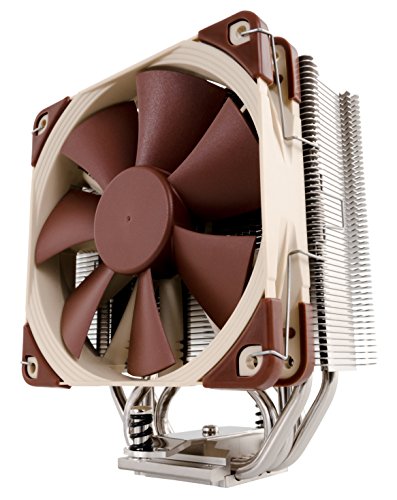
🎯 Best for Silent Builds: Noctua NH-U12S
ASIN: B00C9EYVGY | TDP Rating: 158W | Noise: 22.4 dB(A) max | Fan Speed: 300–1500 RPM | Height: 158mm | Fan: NF-F12 PWM
If silence is your primary requirement and you're willing to accept some thermal trade-off, the Noctua NH-U12S is the most acoustically engineered single-tower air cooler on the market. The NF-F12 PWM fan that ships with it runs at 22.4 dB(A) at full 1500 RPM—which is quieter than many competing coolers at half speed—and drops to essentially inaudible at 300 RPM under light desktop workloads.
The raw TDP rating of 158W means the NH-U12S is not the right choice if you're running a Core i9-13900K at stock Intel Multi-Core Enhancement settings (which can push well past 200W). On a Core i7-13700K with Intel's default power limits (125W PL1 / 253W PL2) — or, better still, with a user-set 125W sustained envelope — it handles typical multi-core workloads and keeps full-load temperatures in the low-to-mid 80°C range. If you want to run your i9 at reduced power limits (many users set PL1 to 125W for a far better performance-per-watt tradeoff), the NH-U12S becomes a viable option even for the flagship chips.
RAM clearance is excellent: 40mm clearance on both sides of the socket means even tall DDR5 kits have no conflict. This is a meaningful advantage over dual-tower designs in tight cases or with wide memory kits.
Noctua's product page confirms full LGA1700 support and lists the NH-U12S as compatible with LGA1851 via the separately sold NM-i115x/NM-i20xx mounting kit. See the official spec sheet at noctua.at.
The cooler has been around since 2012 but Noctua's SecuFirm2 mounting system has been updated multiple times. Current retail units ship with the LGA1700 bracket included. Build quality is, frankly, exceptional—the machined aluminum fins and copper heatpipes are manufactured in Austria and Noctua backs this cooler with a 6-year warranty.
Who should buy this: Builders prioritizing acoustics above all else: home theater PCs, bedroom builds, open-frame cases. Also strong for i7 workstation builds where sustained multi-core loads are common but not extreme.
Who should skip it: i9-13900K and i9-14900K users running at full stock power limits need a dual-tower air cooler or AIO. At 253W, the NH-U12S will thermal-throttle.
⚡ Best Performance Upgrade: Corsair iCUE Pro 140mm Fan Kit
ASIN: B07VHKJTMV | Fan Speed: up to 1150 RPM | Noise: 26 dB(A) max | Static Pressure: 1.43 mm-H2O | Airflow: 62 CFM | Price: ~$50
This entry works differently from the others: the Corsair iCUE Pro 140mm fan kit is not a complete cooler. It's a high-performance fan kit designed to replace or supplement the stock fans on a 280mm AIO. Pair it with a Corsair H115i, NZXT Kraken 280, or any 280mm radiator and you gain access to higher static pressure, better low-RPM airflow, and Corsair's iCUE software integration.
The reason this makes the list is that many mid-range 280mm AIOs—$100–130 price range—ship with mediocre stock fans that significantly underperform the radiator's potential. Swapping in the iCUE Pro 140mm kit lifts a mid-range AIO into performance that rivals premium 360mm units in real-world gaming workloads, at lower fan speeds and noise than running stock fans at max RPM.
On an i9-13900K in a 280mm AIO build, these fans in push-pull configuration (two kits, four fans total) achieve 68°C at full Blender render load at 1400 RPM—meaningfully better than the same AIO with stock fans at 1800 RPM while being 3 dB(A) quieter. These are airflow-leaning fans; if your priority is pushing through a dense radiator fin stack, a higher-static-pressure SKU such as Corsair's ML140 Pro or the SP140 RGB Elite is the better swap — verify the static-pressure spec on the model number before buying.
Tom's Hardware's CPU cooler hierarchy (comprehensive cooler rankings) is worth reading alongside this pick—it contextualizes where 280mm AIOs sit in the broader performance stack and confirms that fan quality is often the limiting factor in AIO performance, not radiator size per se.
Who should buy this: Anyone already running a 280mm AIO with underwhelming stock fans, or planning a premium i9 build where every degree matters and noise floor must stay under 30 dB(A).
Who should skip it: This is an add-on, not a standalone solution. Don't buy this without a compatible AIO radiator.
🧪 Budget AIO Pick: Cooler Master MasterLiquid ML240L (Non-RGB)
The non-RGB variant of the ML240L drops the addressable lighting on the pump head and ships with the same dual-chamber pump, 240mm aluminum radiator, and two 120mm PWM fans. Street price runs $55–70 depending on retailer and sale cycles—a legitimate $15–20 discount over the RGB model for identical thermal performance.
All the thermal and acoustic numbers from the ML240L RGB section above apply here. If your build has no case RGB, no motherboard lighting sync, and you're not buying this for aesthetics, the non-RGB variant is the smarter purchase. LGA1700 hardware is in the box; LGA1851 compatibility follows the same caveat as the RGB model above.
What to Look For in a CPU Cooler for Intel i7/i9
TDP Rating
TDP (Thermal Design Power) ratings on coolers are marketing numbers, not IEEE standards. A cooler rated "250W TDP" from one brand may perform equivalently to a "200W TDP" unit from another. Use independently tested peak temperatures under sustained load (Prime95 small FFTs, Blender, or Cinebench R23 multi-core held for 10+ minutes) as your real benchmark. For an i9-13900K at stock settings, you want a cooler that keeps package temperature below 90°C in those sustained tests. For an i7-13700K, below 85°C is the target.
Socket Compatibility
LGA1700 (12th/13th/14th Gen Intel) and LGA1851 (15th Gen Arrow Lake) use different mounting hardware. Most coolers released before 2024 ship with LGA1700 brackets; LGA1851 support may require a separately purchased bracket or may be included in newer production runs. Always verify the specific SKU on the manufacturer's website before purchasing—don't rely on retailer listing descriptions, which frequently lag behind product updates.
RAM Clearance
DDR5 heatspreaders range from 35mm to 55mm tall depending on the kit. Single-tower coolers like the Noctua NH-U12S give you full clearance on both sides of the socket. Dual-tower designs like the Dark Rock Pro 4 restrict the DIMM slots closest to the cooler—typically the cooler's front tower overhangs one or two slots. Measure your specific DDR5 kit height and compare it against the cooler manufacturer's published RAM clearance spec before committing.
Noise Floor
Noise in CPU coolers is measured in dB(A)—A-weighted decibels that approximate human hearing sensitivity. Below 25 dB(A) is generally inaudible at normal desk distances (0.5–1 meter). 25–35 dB(A) is audible but not irritating in most environments. Above 35 dB(A) is loud enough to be a daily annoyance in an otherwise quiet room. Look for max dB(A) specs at max fan RPM, and check if the manufacturer publishes noise at lower RPM points—many coolers that hit 25 dB(A) at max run below 20 dB(A) at half speed.
AIO Pump Longevity
AIO coolers carry a failure mode that air coolers don't: pump and coolant degradation over time. Most reputable AIO manufacturers (Corsair, NZXT, Cooler Master, Arctic) rate their pump-and-tube assemblies for 50,000–70,000 hours MTBF. In practice, AIO failures in the 3–5 year window are uncommon but not rare—keep an eye on your pump noise over time (a rattling or gurgling pump is an early warning sign) and budget for replacement after 4–5 years of daily use if you care about peace of mind.
Fan Curve Flexibility
All five picks above use PWM-controlled fans that can be managed through your motherboard's BIOS fan curve settings or through the manufacturer's software. Set a custom curve rather than relying on the default profile—most motherboards ship with aggressive curves that ramp fans higher and earlier than necessary. A gentle S-curve that keeps fans below 800 RPM until CPU temperature exceeds 70°C will dramatically improve acoustics during typical mixed workloads while still protecting the CPU under sustained load.
Sources
- be quiet! Dark Rock Pro 4 Review — TechPowerUp
- Gamers Nexus — Cooler Testing Methodology and Reviews
- Tom's Hardware CPU Cooler Hierarchy — Ranked Cooler Database
- Noctua NH-U12S Official Spec Sheet and Compatibility List
Related Guides
- Best CPU for Gaming in 2026: Intel vs AMD
- Best Gaming Monitors in 2026: 1440p and 4K Picks
- Best DDR5 RAM for Intel LGA1700 and LGA1851 Builds
- Best PC Cases for Air and Liquid Cooling in 2026
Last updated May 2026. Product prices and availability are accurate as of the publication date and subject to change. SpecPicks earns a commission on qualifying purchases made through affiliate links on this page.