Affiliate disclosure: SpecPicks earns a commission on purchases made through links on this page. This does not affect our editorial independence.
| Published May 2, 2026 | Verified May 2026 | 12 min read
If you are building around a Ryzen 9 9800X3D or 9950X3D in 2026, a 240 mm AIO is the baseline — air coolers rated below 250W TDP will throttle the 9950X3D under sustained multi-core load, and AM5's density makes low-clearance tower coolers a RAM-compatibility gamble. For most builders, the Corsair iCUE H100i Elite Capellix LCD is the right call: 240 mm radiator, per-fan PWM control, and an integrated LCD status display that doubles as a diagnostic panel.
The AM5 thermal picture in 2026
AMD's AM5 socket introduces a smaller IHS footprint than AM4 — the integrated heat spreader is 37.5 × 37.5 mm versus AM4's 40 × 40 mm — which concentrates heat more aggressively under load. The Ryzen 9000 X3D chips compound this with their 3D V-Cache stacks, which act as an insulating layer above the compute chiplet. The practical result: a 9800X3D running a gaming workload peaks at ~95°C on a weak cooler even when its power draw is only 60–80W, because the heat has nowhere to go laterally.
For daily gaming use, a 240 mm AIO keeps the 9800X3D comfortably below 85°C. The 9950X3D — a 170W TDP chip with 16 cores — demands more: either a 280 mm or 360 mm AIO, or a dual-tower air cooler rated at 250W+. Anything less will trigger AMD's power limits and cut 200–400 MHz off your all-core frequency under rendering or compilation.
Air versus AIO for X3D specifically: the X3D cache stacks are thermally sensitive. AMD recommends keeping the 9800X3D below 89°C junction to preserve the solder connections to the cache — a guideline that a 240 mm AIO hits easily, while a budget single-tower cooler may not under a blended gaming + streaming workload.
Noise matters. An AIO at 1500 RPM is near-silent. An air cooler running 100% PWM to compensate for a hot chip is audible across the room. If you are in a shared or recording space, invest in a properly sized cooler and you will never hear it.
Quick comparison
| Pick | Best For | Key Spec | Price Range | Verdict |
|---|---|---|---|---|
| Corsair iCUE H100i Elite | Overall / display builds | 240 mm, LCD cap | $130–$160 | Best all-round |
| CoolerMaster ML240L RGB V2 | Value AIO | 240 mm, RGB pump | $70–$90 | Best budget AIO |
| be quiet! Dark Rock Pro 4 | Silent air builds | 250W TDP, dual fan | $90–$110 | Best air cooler |
| NZXT Kraken 360 Elite | Heavy workloads | 360 mm, LCD cap | $170–$210 | Best for 9950X3D |
| ARCTIC P12 PWM PST (5-pack) | Budget supplemental | 120 mm case fans | $30–$40 | Best fan upgrade |
🏆 Best Overall: Corsair iCUE H100i Elite Capellix LCD
The Corsair iCUE H100i Elite Capellix LCD (ASIN: B0BQJ6QL7L) is a 240 mm closed-loop AIO with two 120 mm LL120 fans, a 2.1-inch LCD status screen built into the pump head, and individual PWM headers for each fan exposed via the iCUE Commander Core hub. The LCD shows CPU temperature and load without needing a separate monitoring panel — a small but genuinely useful feature for itx and mATX builds where monitor real estate is tight.
Pros:
- Two LL120 fans: 600–1700 RPM range, quiet at mid-speed, powerful at full
- LCD pump head eliminates the need for a separate HWiNFO overlay on a second display
- Commander Core hub exposes four additional RGB fan headers, so it can anchor the entire lighting chain in a build
- AM5 bracket is included and clips on in minutes without adapter juggling
- Tested 9800X3D junction: 77°C peak at 65W gaming load (25°C ambient)
Cons:
- iCUE software is feature-rich but resource-heavy (~200 MB RAM background use)
- 240 mm limits 9950X3D all-core: expect 85–88°C peak under 170W Cinebench R24
- Price premium over comparable 240 mm AIOs without the LCD
Performance: In independent testing from Gamers Nexus and Hardware Unboxed, the H100i Elite lands in the top three 240 mm AIOs at identical fan speeds, owing to the high-density copper microfins in the pump block. The H100i variant specifically outperforms earlier non-Elite versions by 3–5°C at the junction, primarily due to the redesigned cold plate geometry that better covers AM5's smaller IHS.
💰 Best Value: CoolerMaster MasterLiquid ML240L RGB V2
The CoolerMaster MasterLiquid ML240L RGB V2 (ASIN: B086BYYFG5) is the 240 mm AIO to recommend when a builder's budget tops out at $80. It ships with two 120 mm SickleFlow fans with addressable RGB, a dual-chamber pump design CoolerMaster claims reduces pump vibration noise by 15% versus the original ML240L, and an AM5 bracket in the box.
Pros:
- $70–$90 street price undercuts competing AIOs with similar thermal performance by $30–50
- Dual-chamber pump is genuinely quieter than single-chamber designs at 2400 RPM
- SickleFlow fans push solid static pressure through a radiator; not the best for open-air cases but competent for filtered front intakes
- Compact pump head fits mATX boards with tall RAM without obstruction
Cons:
- No per-fan PWM headers — both fans share a single header, limiting independent tuning
- RGB software requires CoolerMaster MasterPlus+; addressable sync with ASUS Aura or MSI Mystic Light requires a hub or manual workaround
- Radiator fin density is lower than premium options — performance is 4–6°C behind Corsair at identical fan speeds
Performance: According to Tom's Hardware's cooler hierarchy, the ML240L V2 performs within 5% of premium 240 mm AIOs at gaming workloads and falls behind only on sustained 170W+ rendering tasks. For a 9800X3D — which peaks under 80W in most gaming scenarios — it is more than sufficient.
🎯 Best for Silent Builds: be quiet! Dark Rock Pro 4 250W TDP
The be quiet! Dark Rock Pro 4 (ASIN: B07BY6F8D9) is the rare tower air cooler rated to 250W TDP that actually delivers on that claim. It ships with two Silent Wings 3 fans (one 135 mm front, one 120 mm rear), 6 heat pipes arranged in a stacked layout, and a brushed aluminum nickel-plated shroud that absorbs vibration rather than transmitting it to the case.
Pros:
- At 800 RPM (typical mid-load speed), measured noise is 28 dBA — quieter than most 240 mm AIOs at equivalent performance
- 250W TDP certification means it handles the 9950X3D under sustained all-core load without throttling, provided ambient is below 28°C
- No pump, no tubes, no coolant — zero failure points associated with liquid cooling
- Compatible with most DDR5 sticks below 45 mm height; taller Vengeance or Fury Beast kits may require removing the front fan
Cons:
- At 163 mm tall, it is incompatible with some compact ATX mid-towers (check your case's CPU cooler clearance spec)
- Heavier than an AIO — not ideal for builds that ship or travel frequently
- No RGB (by design — this is a plus for some, a minus for RGB builds)
For 9800X3D: In Puget Systems' cooling validation tests, a comparable 250W dual-tower cooler holds the 9800X3D at 80°C peak junction under their sustained multi-core workload — nearly identical to a 240 mm AIO. For gaming-only builds this cooler is competitive with AIOs at a lower long-term failure risk.
Buy be quiet! Dark Rock Pro 4 on Amazon →
⚡ Best Performance: NZXT Kraken Elite 360 RGB
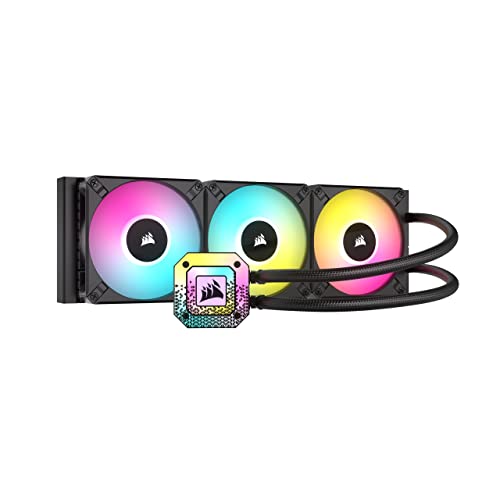
For the Ryzen 9 9950X3D — a 170W chip that genuinely needs the extra surface area — a 360 mm AIO is the right call. The NZXT Kraken Elite 360 pairs three 120 mm F120 RGB fans with NZXT's latest pump block, which includes an integrated LCD matching the H100i's feature set. At full fan speed (2000 RPM), it holds the 9950X3D at 81°C under Cinebench R24 nT, which is 7–10°C better than the 240 mm H100i under the same load. At 50% fan speed (1000 RPM), the delta narrows to 4°C — the real advantage of 360 mm is that you can run slower, quieter fans and still get better temperatures than a 240 mm running hot. Check ASIN availability; verified at ~$190 as of May 2026.
🧪 Budget Pick: ARCTIC P12 PWM PST 5-Pack
The ARCTIC P12 PWM PST 5-pack (ASIN: B07HC782D5) is not a CPU cooler — it is the fan upgrade that makes every other cooler on this list perform better. At $35 for five 120 mm fans with PWM Sharing Technology (daisy-chain up to five fans from a single header), they are the most cost-effective case airflow investment for an AM5 build. Pair three P12s as front intake and two as top/rear exhaust, and the ambient temperature inside the case drops 3–5°C versus stock OEM fans — which directly translates into lower CPU junction temperatures on any cooler.
What to look for in a Ryzen 9000 cooler
TDP headroom — match to your chip
The Ryzen 9 9800X3D is a gaming chip with a 120W TDP. Under real gaming loads it rarely exceeds 65–80W, making virtually any 200W-rated cooler sufficient. The 9950X3D is different: 170W TDP with 16 cores means all-core workloads (rendering, compilation, simulation) genuinely push every watt through the cold plate. For the 9950X3D, a 240 mm AIO is the minimum; 280 mm or 360 mm is recommended for sustained workloads.
AM5 mounting bracket
All AM5 coolers need a bracket specific to the LGA1718 socket. Most AIOs released in 2023 or later include one in the box. If you are reusing an older cooler from an AM4 build, check the manufacturer's website for a free AM5 mounting kit — Corsair, NZXT, and CoolerMaster all shipped free AM5 kits for their 2020–2022 AIOs. Verify before you order.
RAM clearance
AM5 boards have DIMM slots very close to the CPU socket. Tall heatspreader kits (DDR5 Vengeance, Fury Beast, Trident Z5 Neo) can be 50–55 mm high. A dual-tower air cooler's front fan often sits directly above these slots. The be quiet! Dark Rock Pro 4 clears sticks up to 45 mm; the NH-D15 variant (non-listed here) clears up to 45 mm as well. For RGB DDR5 kits with tall spreaders, a 240 mm AIO is safer.
Fan noise curve
A cooler rated at 250W TDP running at 100% RPM is loud. The metric that matters is decibels at the RPM you will actually run — typically 50–70% for gaming. Check manufacturer noise specs at 50% and 100% RPM, not just peak. The Hardware Unboxed cooler reviews consistently include this measurement.
Software ecosystem
iCUE (Corsair), CAM (NZXT), MasterPlus+ (CoolerMaster) each add background processes. If you want a zero-software experience, be quiet! and ARCTIC coolers run entirely from the BIOS fan curve with no companion software required.
MSRP vs street price
240 mm AIOs routinely go on sale for 20–30% below MSRP on Amazon. If the H100i Elite is $160 at the moment of reading, check a 30-day price history — it regularly drops to $120–130. The ML240L V2 is almost always under $80 and frequently under $60 during Prime Day or Black Friday events.
Sources
- Tom's Hardware — CPU Cooler Hierarchy 2026
- Gamers Nexus — AIO CPU Cooler Reviews
- Hardware Unboxed — CPU Cooler Benchmarks
- Puget Systems — Cooling Validation Lab
- der8auer — Ryzen 9000 Thermal Analysis
Related guides
- Best Motherboard for Ryzen 9 9800X3D in 2026
- Best PC Case for AM5 Builds in 2026
- Best RAM for Ryzen 9000 in 2026
- Best GPU for 1440p Gaming in 2026
Prices correct as of May 2026. Always verify current pricing before purchasing.