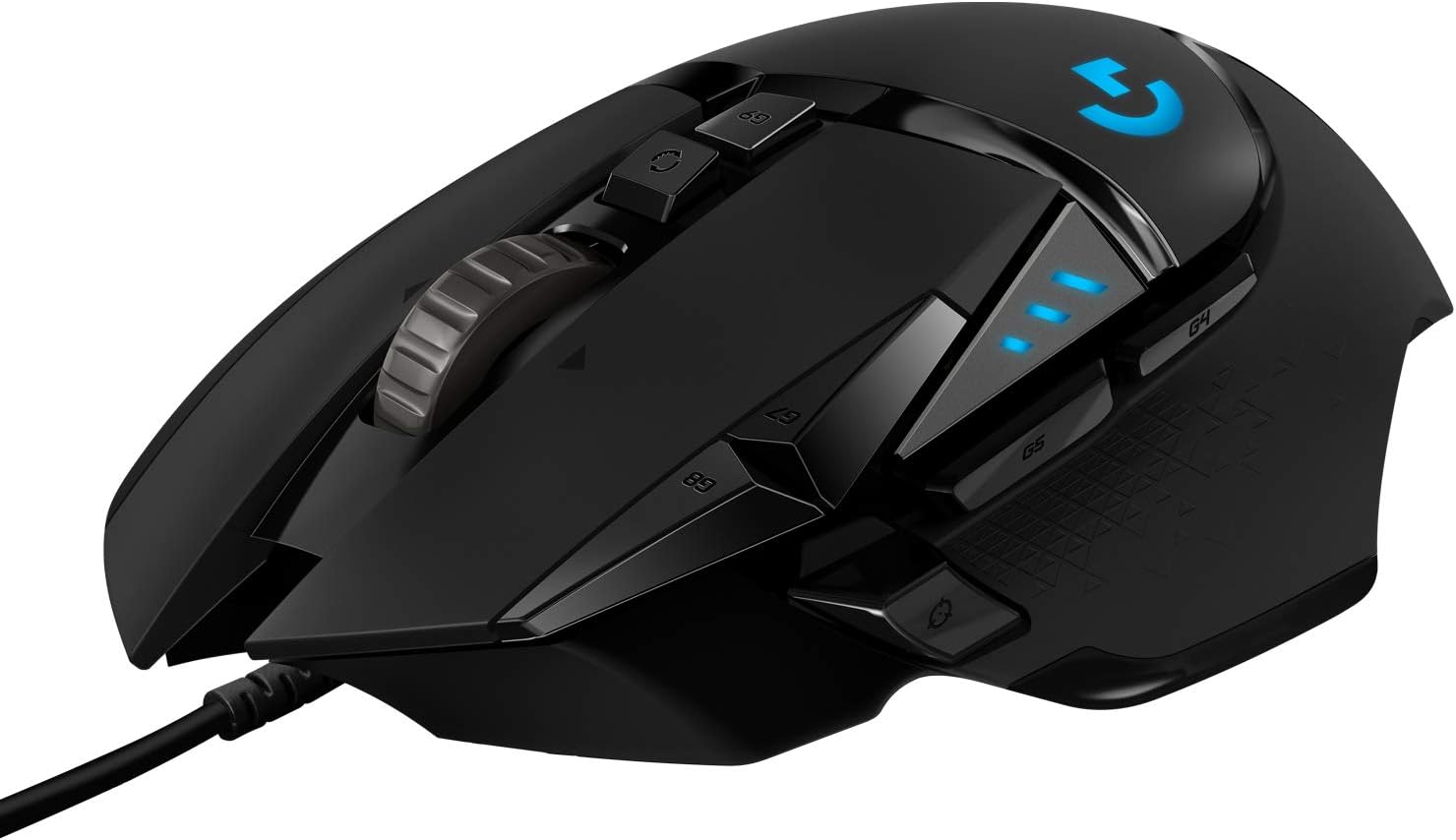
The best Logitech G gaming peripheral lineup in 2026: the G502 Hero is the best sub-$60 wired gaming mouse, the G920 Driving Force is the best entry sim-racing wheel under $300, and the Blue Yeti remains the standard for USB streaming microphones under $100. Across categories, Logitech's hardware-to-price ratio is unmatched.
Affiliate disclosure: SpecPicks earns a commission on qualifying purchases. Prices reflect May 2026 Amazon listings.
Why a brand guide helps here
Logitech G spans a wider range of product categories than any other peripheral brand — mice, keyboards, racing wheels, microphones, headsets, gamepads, and webcams. That breadth is useful when you're building a full setup (one brand, one software stack, one warranty department), but it also creates a problem: which product is actually worth buying versus which exists to fill a shelf slot?
This guide cuts through the full Logitech catalog by focusing on four featured SKUs that SpecPicks has tracked: the G502 Hero, the K270 (productivity crossover), the G920 and G29 racing wheels, and the Blue Yeti USB microphone. These are the Logitech products with enough review volume, community testing, and long-term owner feedback to give honest assessments.
Quick-pick comparison table
| Pick | Best For | Key Spec | Price Range | Verdict |
|---|---|---|---|---|
| G502 Hero | Best Overall Mouse | Hero 25K sensor, 121g | $40-55 | Top value wired mouse |
| K270 Wireless | Productivity / Office | 24-mo battery, 2.4 GHz | $20-28 | Best cheap wireless keyboard |
| G920 Driving Force | Sim Racing (Xbox/PC) | Dual FFB motor, 900° | $220-260 | Entry sim-racing standard |
| Blue Yeti | Streaming / Podcasting | 4 polar patterns, USB | $80-110 | Budget USB mic benchmark |
| G29 Driving Force | Sim Racing (PS/PC) | Same FFB, PS5 compatible | $180-220 | G920 equivalent for PlayStation |
Best Overall: Logitech G502 Hero
The G502 Hero is Logitech's best-selling wired gaming mouse and one of the most-reviewed peripherals on Amazon with over 90,000 ratings. The Hero 25K sensor is accurate to sub-1% tracking error at any speed you can physically move a mouse — the tracking spec has not been the limiting factor in competitive play for years. At $40-55 in 2026, it sits at a price point where alternatives cost significantly more for marginal improvements.
Key specs:
- Sensor: Hero 25K (25,600 DPI max, 400+ IPS, 40G acceleration)
- Weight: 121g (with 5 removable weights, 16g adjustment range)
- Buttons: 11 programmable
- Cable: 7.2-foot braided
- DPI steps: 100-25,600 in 50 DPI increments
- Onboard memory: 5 profiles
Sensor reality: The Hero 25K is the same optical sensor platform as the 25,600-DPI units in Logitech's $150+ Superlight 2 line. The difference between the G502 Hero and premium mice is entirely construction — lighter weight, wireless, more refined cable, premium feet. The sensor itself is category-leading at any price.
The weight debate: At 121g the G502 Hero is heavier than modern "ultralight" mice (60-80g). Independent studies and community testing from hardware forums (Mousepad-review.com, BattleNonsense) consistently show that lighter mice improve average-level players' aim but that the effect plateaus above about 70g and that the G502's adjustable weights let you tune down to 105g by removing all inserts. For MMO/MOBA where you're clicking dozens of buttons per minute, 121g is a non-issue. For CS2/Valorant competitive FPS, consider the G Pro X Superlight 2 if budget allows.
Software: G HUB lets you set DPI per profile, configure macro bindings, set lighting, and read battery (wireless versions). Onboard memory stores up to five profiles independently — once configured you don't need G HUB running.
When NOT to pick it: If you're primarily playing competitive FPS and care about every gram. If you need wireless. If your hand size is small (the G502's ergonomic grip favors medium-large right hands).
Best Productivity Crossover: Logitech K270 Wireless Keyboard
Logitech markets the K270 as a general desktop keyboard rather than a gaming peripheral, but it earns a spot in any Logitech brand guide because it's paired with Logitech mice on more desks than any other keyboard in the product line. The Unifying Receiver pairs with the K270, any Logitech Unifying mouse, and up to four more devices — one USB port covers the entire desktop.
Key specs: Full-size with numpad, 2.4 GHz Unifying Receiver, 24-month battery (2x AA), membrane switches ~46 dB, 920g.
Why it's here: The K270 is Logitech's best-selling keyboard globally. At $20-28 it's the correct default for users who want wireless without paying for features they won't use (backlight, Bluetooth multi-host, mechanical switches). If your main machine is a desktop and you use one device at a time, this is the right keyboard.
For a full review, see our Best Wireless Keyboards for Home Office in 2026 guide.
Best for Sim Racing: Logitech G920 Driving Force
The G920 is Logitech's entry sim-racing wheel for Xbox and PC and has been the best value in its category since its 2015 launch. In 2026 it remains the right answer for anyone spending $200-260 on their first racing wheel — the Driving Force dual-motor force-feedback system delivers accurate road texture, curb impacts, and understeer/oversteer feedback at a level that makes sim racing actually educational rather than just steering-wheel-shaped.
Key specs:
- Platform: Xbox One/Series X|S, PC (Windows 10/11)
- Steering angle: 900° lock-to-lock
- Force feedback: Dual-motor, up to 2.2 Nm torque
- Pedals: Included 3-pedal floor unit (gas, brake, clutch)
- Shifter: NOT included (sold separately as G Driving Force Shifter)
Force feedback depth: The G920 uses Logitech's Hall Effect sensor for steering — no potentiometer drift, more accurate angle reading. The dual-motor FFB is noticeably better than the single-motor options at this price tier. In iRacing, Assetto Corsa Competizione, and Gran Turismo 7 (via PC streaming), the wheel correctly communicates understeer onset, tire load transfer, and ABS intervention.
Platform note: The G920 is Xbox/PC only. PlayStation users need the G29, which shares identical hardware but has PS4/PS5 button layout. Both use the same Driving Force FFB system.
What's missing: The G920 does not include a gear shifter (sequential or H-pattern). For games with manual shifting — any serious sim title — add the Logitech G Driving Force Shifter ($40-55) or pair with a third-party sequential. The 3-pedal set included has a clutch but uses non-load-cell brake hardware; upgrading to load-cell brake mods is a common first modification at ~$50-80.
Alternatives: The Thrustmaster T248 ($230-260) and Moza R3 ($180-200) compete at this price. The T248 has a screen on the hub for telemetry display; the Moza uses a direct-drive motor. The G920's advantage is software support breadth and 10-year parts availability from Logitech's service program.
Best Performance/Streaming: Blue Yeti USB Microphone
The Blue Yeti is the USB microphone that set the category standard for home streaming in 2014, and the 2025 updated version remains the correct pick for anyone spending $80-110 on USB audio. Logitech acquired Blue in 2018; the Yeti is now sold under "Logitech Creators Blue Yeti" branding but is otherwise unchanged.
Key specs:
- Pattern: Cardioid, bidirectional, omnidirectional, stereo (switch on body)
- Sample rate: 16-bit/48 kHz
- Polar pattern control: Physical switch (not software-only)
- Connection: USB-A to device, no driver required
- Gain control: Rotary dial on body, headphone pass-through with zero latency
Four patterns, one mic: The Yeti's differentiator is four selectable polar patterns on the physical body. Cardioid (front-facing) is correct for single-speaker streaming. Stereo picks up left and right simultaneously — useful for recording two sources side-by-side. Omnidirectional picks up all directions equally, best for room ambience or round-table podcasts. Bidirectional (figure-eight) captures front and back — interview pattern. No other USB mic at this price offers this flexibility.
Room noise warning: The Yeti's large-diaphragm condenser capsule is sensitive enough to pick up keyboard clatter, HVAC hum, and street traffic that cheaper mics miss. In a softly-furnished dedicated office or treated recording space, this is its strength. In an untreated room with parallel hard walls, you'll hear the room. The fix is a pop filter, a short boom arm (keeps the mic 6-8 inches from your mouth), and basic acoustic panels on the wall behind you.
For streamers who move: The Yeti's 1.2-pound body sits on a desktop stand but clamps onto most boom arms via a standard 5/8-inch thread. USB-C variant (Yeti X) is preferred if your PC has only USB-C available.
Budget Pick: Logitech G29 Driving Force (Used/Older Platform)
The G29 is the PlayStation-compatible version of the G920 and carries identical Driving Force force-feedback hardware. In 2026 new G29 prices have dropped to $180-220 as Logitech transitions attention to the G923 line, and used units regularly appear for $100-140 in tested condition — making it the best value entry into sim racing if you play on PS4/PS5.
Platform: PlayStation 4, PlayStation 5, PC (requires toggle switch on wheel)
What's the same as G920: 900° steering, dual-motor FFB, Hall Effect steering sensor, 3-pedal floor unit with clutch, same shifter-optional setup.
What's different: Button layout (PS triangle/circle/X/square vs Xbox A/B/X/Y), PS4-era LED display on the hub (shows current gear if game supports it), slightly different hub grip texture.
Used-market recommendation: The G29/G920 Driving Force motor is one of the most-tested FFB mechanisms in consumer sim racing. Units with 50,000+ hours of use still pass basic force-feedback self-diagnostics. When buying used: plug in, run the wheel calibration (it self-centers and sweeps full lock), and verify FFB strength in any supported title. Grease on the gear train occasionally thickens in storage — a 10-minute warm-up usually resolves this.
What to look for in Logitech G peripherals
Lightspeed wireless vs wired
Logitech's Lightspeed wireless (available on G Pro X Superlight 2, G903, G733 headset) delivers ~1 ms report rate equivalent to wired. Independent click-to-photon testing (Optimum Tech, Hardware Unboxed) consistently shows no measurable difference from wired in FPS performance. The caveat: Lightspeed mice cost $100-160 vs $40-55 for the wired G502 Hero. Unless wireless is a hard requirement (cluttered desk, cable management, shared setup), wired remains the better value.
Hero sensor generations
The original Hero sensor (2017) introduced 100-16,000 DPI with HERO power management that extended battery life dramatically. Hero 25K (2019+) raised the ceiling to 25,600 DPI and improved accuracy at high tracking speeds. In practice there is no perceptible performance difference between Hero and Hero 25K for any real-world use case — both are accurate beyond the limits of human movement.
G HUB software
G HUB handles DPI adjustment, macro programming, RGB lighting, and onboard memory management for all current Logitech G mice and keyboards. It's required for initial setup of complex configurations but optional for day-to-day use if profiles are saved to onboard memory. The 2025.x builds are stable on Windows 11 after years of occasional instability complaints.
Warranty
Logitech G products carry a 2-year limited warranty. Logitech's service program is well-regarded — defective units within the warranty window receive replacements promptly. Extended to 3 years with Logitech+ subscription, which also adds cloud profile sync.
Sources
- Logitech G502 Hero product page
- RTINGS.com G502 Hero review
- Tom's Hardware G920 Driving Force review
Related guides
- Best Wireless Keyboards for Home Office in 2026
- Best Budget SATA SSDs Under $80 in 2026
- Best Cooler for Ryzen 7 5800X Overclocking
Prices and availability as of May 2026. All Amazon links include affiliate tracking.


