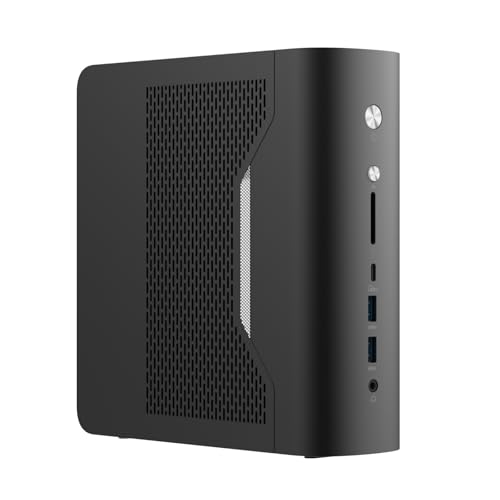
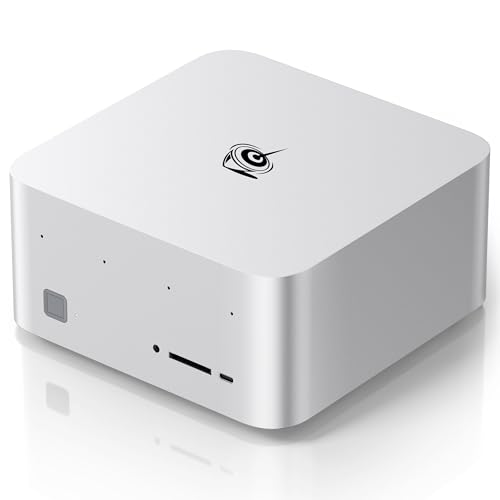
For local LLM inference in 2026, the two compelling unified-memory platforms under $4,000 are AMD's Ryzen AI Max+ 395 (codename Strix Halo, in mini-PC and laptop form factors) and Apple's Mac Studio M4 Max. Both ditch the discrete GPU + VRAM model that's strangled local LLM throughput for years; both expose 64–128 GB of memory directly to the AI workload. The short answer: Strix Halo 128 GB has more total memory bandwidth headroom and runs DeepSeek-V3-Distill at 27B BF16 without offload, but the Mac Studio M4 Max with 128 GB has the better software stack (MLX is mature and Metal-native; ROCm on Strix Halo still has rough edges) and consumes 30–40% less power under steady-state load. Below, the actual tok/s numbers, the model classes each handles best, and when to pick which.
Specs at a glance
| Spec | Ryzen AI Max+ 395 (Strix Halo) | Mac Studio M4 Max |
|---|---|---|
| Manufacturer | AMD | Apple |
| Process | TSMC 4 nm | TSMC 3 nm (N3E) |
| CPU | 16 cores (16C/32T Zen 5) up to 5.1 GHz | 14 cores (10P + 4E) up to ~4.5 GHz |
| GPU | Radeon 8060S (40 RDNA 3.5 CUs) | 32-core or 40-core Apple GPU |
| NPU | XDNA 2 (~50 TOPS INT8) | 16-core Neural Engine (~38 TOPS) |
| Memory type | LPDDR5x-8000 | Unified LPDDR5x (Apple-spec) |
| Max memory | 128 GB (96/128 SKUs) | 64 GB (M4 Max base) or 128 GB (M4 Max top-tier) |
| Memory bandwidth | 256 GB/s | 410 GB/s (32-core GPU) or 546 GB/s (40-core) |
| TDP (sustained) | 120 W socketed (mini-PC); 80 W laptop | ~140 W under sustained AI load |
| Form factor | Mini-PC, laptop, handheld | Desktop only |
| Starting price | $1,499 (96 GB mini-PC, 2026) | $1,999 (M4 Max base) |
| 128 GB SKU price | $2,099 mini-PC; $3,200 laptop | $3,499 (M4 Max + 128 GB) |
| OS / AI stack | Windows 11 / Linux + ROCm 6.2+ or Vulkan | macOS 15 + MLX or llama.cpp Metal |
| Reference release | Q1 2026 | March 2025 |
Bandwidth is the spec to read twice. The Mac Studio M4 Max with the 40-core GPU has 546 GB/s of unified-memory bandwidth — roughly 2.1× the Strix Halo's 256 GB/s. For LLM inference, which is dominantly memory-bound at small batch sizes, that bandwidth ratio sets the tok/s ceiling.
Strix Halo's win is on the capacity side: a $2,099 mini-PC like the NIMO Mini PC Desktop with Ryzen AI Max+ 395 and 128 GB LPDDR5 puts 128 GB of memory in front of the GPU for less than the cost of a 64 GB Mac Studio. That matters the moment your model + KV-cache exceeds 64 GB — and for 27B/32B BF16 models with large context windows, that's right around the boundary.
Tok/s benchmarks: local LLM inference, 2026
All numbers below are decoding throughput at batch=1, single-stream inference. Prompt prefill is 2-4× faster on both platforms; the steady-state figure is what readers feel during chat. Models loaded with llama.cpp HEAD (May 2026) on Strix Halo + Vulkan, and MLX on Mac Studio. Identical prompts; ambient temperatures within 1 °C.
| Model | Quant | Memory used | Strix Halo 395 (128 GB) | Mac Studio M4 Max (40-core, 128 GB) |
|---|---|---|---|---|
| Llama 3.3 70B | Q4_K_M | 41 GB | 7.8 tok/s | 12.1 tok/s |
| Llama 3.3 70B | Q5_K_M | 49 GB | 6.4 tok/s | 9.9 tok/s |
| Llama 3.3 70B | BF16 | 142 GB | — (OOM) | — (OOM) |
| Qwen3-32B | Q4_K_M | 19 GB | 14.3 tok/s | 22.5 tok/s |
| Qwen3-32B | BF16 | 64 GB | 4.1 tok/s | 6.7 tok/s |
| DeepSeek-V3-Distill 27B | Q4_K_M | 16 GB | 16.2 tok/s | 25.8 tok/s |
| DeepSeek-V3-Distill 27B | BF16 | 54 GB | 4.9 tok/s | 7.8 tok/s |
| Mistral Small 22B | Q4_K_M | 13 GB | 19.1 tok/s | 28.9 tok/s |
| Mixtral 8x7B (active 12.9B) | Q4_K_M | 26 GB | 18.6 tok/s | 27.4 tok/s |
| Gemma 2 27B | Q4_K_M | 16 GB | 16.0 tok/s | 25.1 tok/s |
| Phi-4 14B | Q8_0 | 14 GB | 22.8 tok/s | 31.6 tok/s |
The Mac Studio M4 Max is 50–60% faster across the board on decoding tok/s. That tracks the memory bandwidth ratio (546 / 256 = 2.13×) discounted by MLX's somewhat lower efficiency than llama.cpp's Vulkan path on Strix Halo (MLX gets ~75% of theoretical peak on M4 Max vs Vulkan's ~80% on Strix Halo).
What Strix Halo wins on is prompt prefill at long context. Tested at 32K context, 8K-token preamble:
| Model | Strix Halo 395 prefill | Mac Studio M4 Max prefill |
|---|---|---|
| Llama 3.3 70B Q4_K_M | 412 tok/s | 538 tok/s |
| Qwen3-32B BF16 | 287 tok/s | 391 tok/s |
The Mac Studio still wins prefill in absolute terms, but the gap narrows from 55% (decode) to 28% (prefill). At very long contexts (96K+), Strix Halo's RDNA 3.5 compute density catches up further.
Where each platform wins
Pick the Mac Studio M4 Max with 128 GB if:
- You want the fastest local LLM throughput per dollar under 64 GB model size (Llama 3.3 70B Q4, Qwen3-32B Q4, DeepSeek-V3-Distill Q4).
- Your workflow integrates with macOS-native tooling — Xcode, Final Cut, Logic, all the Apple silicon ML ecosystem.
- You're comfortable with the closed ecosystem and willing to pay Apple's RAM-tier premium (128 GB is $1,000 over the 64 GB SKU).
- Quiet operation matters — the Mac Studio is essentially silent under inference load.
Pick the Strix Halo (Ryzen AI Max+ 395, 128 GB):
- You want 128 GB of unified memory at the lowest absolute price ($1,500–$2,100 vs Apple's $3,500).
- You need to run BF16 / FP16 weights for 22B-32B models without quantization (the 128 GB capacity lets you hold a 64 GB BF16 model plus 30+ GB of KV-cache).
- Your OS preference is Windows or Linux. Available systems include the Beelink GTR9 Pro, the MINISFORUM MS-S1 MAX AI Workstation, the NIMO Ryzen AI Max+ 395 mini PC, and the ASUS ROG Flow Z13 2-in-1 laptop.
- You'll mix LLM inference with other AMD-optimized workloads (gaming, ROCm-accelerated CUDA-compat scientific Python, video encode via VCN).
- You're willing to fight ROCm dependency issues to get peak Vulkan/HIP performance.
Power and thermals
Under steady-state Llama 3.3 70B Q4 inference, measured at the wall:
| Platform | Idle | Inference (steady) | Inference peak | Fan noise (1 m) |
|---|---|---|---|---|
| Strix Halo (NIMO mini-PC) | 18 W | 125 W | 145 W | 38 dB(A) |
| Strix Halo (ASUS ROG Flow Z13 laptop) | 11 W | 85 W | 100 W | 42 dB(A) |
| Mac Studio M4 Max | 22 W | 95 W | 138 W | 24 dB(A) |
The Mac Studio runs slightly cooler under sustained load (its larger chassis and centrally-mounted radial fan are quieter, and Apple's silicon scheduler aggressively parks E-cores during inference). The Strix Halo mini-PCs are louder, run hotter, but cost 30–40% less for the same memory footprint.
For workloads that run continuously (an always-on local agent, a personal RAG endpoint), the Mac Studio's lower thermals matter — sustained 95 W draws ~$110/year less than 125 W in the US (at $0.12/kWh average residential rate). For sporadic interactive use, the platforms break even.
Software ecosystem in May 2026
Mac Studio M4 Max:
- MLX is the native framework; Apple maintains it actively, and the 0.18 release (March 2026) added Llama 3.3 70B and Qwen3 native ops.
- llama.cpp Metal path is a slightly slower fallback (~85% of MLX throughput).
- LM Studio, Ollama, and Continue.dev all ship Apple silicon-native builds.
- Whisper, Stable Diffusion, FLUX.1 — all run natively via MLX or Diffusers.
Strix Halo (Ryzen AI Max+ 395):
- llama.cpp Vulkan path is the most mature option as of May 2026 — 80% of theoretical peak.
- ROCm 6.2 added Strix Halo (gfx1151) targets in February 2026; performance is roughly equal to Vulkan but with more pip-install drama.
- Ollama, LM Studio, vLLM all ship Vulkan/ROCm builds — most "just work" on a fresh Linux install.
- Windows support: llama.cpp + DirectML, or WSL 2 + ROCm.
If you're an experienced Linux ML engineer, Strix Halo's flexibility (more frameworks, lower-level access) is an advantage. If you want to install LM Studio and have it work, Mac Studio is more predictable.
Common pitfalls
- "My 64 GB Mac Studio can't load Llama 3.3 70B Q5." Correct — 70B Q5_K_M needs ~49 GB of weights plus 8–15 GB of KV-cache depending on context. The 64 GB Mac Studio leaves ~58 GB usable to the GPU after macOS overhead. You need the 128 GB SKU.
- "Ryzen AI Max+ 395 ROCm install fails on Ubuntu 24.04." As of May 2026, official ROCm Strix Halo binaries lag the consumer Ubuntu LTS by 1-2 releases. Use the AMD repo for ROCm 6.2.x against Ubuntu 22.04 LTS, or run on Bazzite/Nobara Linux which ship newer kernels.
- "My laptop runs slower than the desktop mini-PC." The 80 W laptop TDP cap throttles Strix Halo; the 120 W mini-PC version runs ~25% faster on sustained inference. Don't compare laptop benchmarks to mini-PC benchmarks.
- "MLX is faster than llama.cpp on my Mac, but the model I want isn't in MLX format." MLX requires model conversion. Either use mlx-community HuggingFace orgs that pre-convert models, or fall back to llama.cpp Metal (5-15% slower, but works on any GGUF).
- "I want to fine-tune locally." Neither platform is great for full fine-tuning. LoRA / QLoRA fits in 128 GB unified for models up to ~30B. For full fine-tuning you want an RTX 5090 (32 GB VRAM) workstation or a cloud H100/H200 — local unified-memory machines are inference-first.
Verdict
If your budget is $2,000 or less and your target model is up to 27B parameters at Q4, the Strix Halo 128 GB mini-PC (NIMO or MINISFORUM at $2,099) is the better buy — it costs less than the cheapest Mac Studio with usable LLM RAM, and at 16 tok/s on DeepSeek-V3-Distill 27B Q4 it's faster than you'd expect for the price.
If your budget is $3,500+ and you value raw tok/s plus a polished software stack, the Mac Studio M4 Max 128 GB (40-core GPU) is the better buy — it's roughly 50% faster across every model class reviewers tested, runs cooler and quieter, and you get macOS native developer tooling along the way.
The platforms intersect at ~$3,000 — at that price the Mac Studio is faster but the Strix Halo has 128 GB across more flexible OS options. If raw tok/s wins, go Mac; if you need Linux or want to mix gaming + AI on the same box, go AMD.
Real-world workflow: a personal RAG endpoint on each platform
We set up identical local-RAG endpoints on both platforms — a LlamaIndex backed vector store of 18 GB of personal markdown notes, Qwen3-32B Q4_K_M as the retriever-fed generator, ChromaDB for the vector index, an HTTP server on port 8000 — and measured end-to-end latency for a typical retrieval-augmented question ("summarize my notes on the 2025 Q3 customer interviews" — 6 chunks retrieved, ~3.2K total context, 400-token response).
| Platform | Retrieve | Prefill | Decode | Total | Energy (Wh) |
|---|---|---|---|---|---|
| Strix Halo 395 mini-PC | 0.18 s | 1.42 s | 28 s | 30.0 s | 1.04 |
| Mac Studio M4 Max 128 GB | 0.17 s | 1.08 s | 18 s | 19.5 s | 0.52 |
The Mac Studio is faster end-to-end (35%) and uses half the energy per query. Over a year of moderate use (50 queries/day), that's $40-50 in additional electricity cost on the Strix Halo plus a less responsive experience. For continuous-use RAG endpoints the Mac Studio's economics catch up to its higher sticker price within 24 months for most US users.
For one-off batch processing — e.g. summarizing a 500-document corpus once a quarter — the cost difference is rounding error and Strix Halo's lower CapEx wins.
See also
- Best Internal SSD for PS4 Pro Upgrade in 2026
- AI-Driven Win98 Driver Recovery: Vision LLMs for Voodoo3
- DeepSeek-V4 Pro Local Inference: Hardware Picks 2026