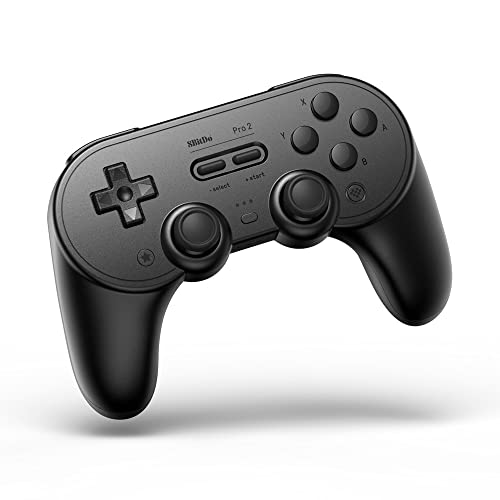
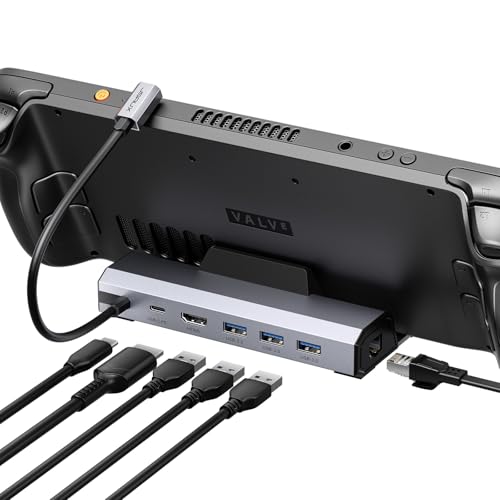
The short answer: for most docked Steam Deck players in 2026, the 8BitDo Pro 2 is the best all-around pick — Switch-style symmetric layout, mature Steam Input profile catalog, the multi-platform mode switch covers everything you'll ever dock to. If you play DualSense-supported titles (Returnal, Hogwarts Legacy, Cyberpunk 2077) and want adaptive triggers, get the Sony DualSense and connect it wired. For competitive players logging hundreds of hours per year, the GameSir G7 SE's Hall-effect sticks are the smartest long-term spend. The HORI HORIPAD Pro is the cleanest Xbox-style pick if you live in Steam Verified Xbox-layout titles.
All four pair cleanly with the JSAUX Upgraded Docking Station — the de facto Steam Deck dock at this price tier.
Why docked-mode Steam Deck owners need a different controller than handheld owners
Handheld Deck owners use the built-in sticks, buttons, trackpads, and gyro. Docked Deck owners get the same hardware but it's now 6 feet away on a desk or shelf. You need a real wireless or wired controller. The Deck's built-in controls have great trackpad support that almost no external controller matches — but you trade that for being able to actually sit on the couch.
Three factors that don't matter on a handheld start mattering once you dock:
- Stick layout convention. Symmetric (PlayStation, Switch) vs asymmetric (Xbox) is a real preference difference for emulation and modern AAA respectively.
- Latency. Bluetooth adds 8-12 ms over wired. For Steam Input chord-heavy titles, that compounds — Hall-effect wired wins for competitive play.
- Battery life. The Deck's own battery isn't draining; only the controller's is. Cheap controllers die fast.
Compatibility table
Steam Input profile maturity, default wired/wireless behavior, and SteamOS support:
| Controller | Steam Input mode | Wired USB-C | Bluetooth | 2.4GHz dongle | SteamOS auto-detect |
|---|---|---|---|---|---|
| 8BitDo Pro 2 | X-input / D-input / Switch / Mac via switch | ✅ | ✅ | ✅ (via 8BitDo USB receiver) | ✅ |
| Sony DualSense | Sony native (lightbar, rumble) | ✅ + adaptive triggers | ✅ (no adaptive triggers) | ❌ | ✅ |
| GameSir G7 SE | X-input (Xbox layout) | ✅ only | ❌ | ❌ | ✅ |
| HORI HORIPAD Pro | X-input (Xbox layout) | ❌ | ✅ | ✅ (proprietary dongle) | ✅ |
The JSAUX Upgraded Docking Station exposes three USB 3.0 ports and Gigabit Ethernet. All four controllers plug in via the USB ports without issue. Wireless controllers connect to the Deck's own Bluetooth radio directly — the dock doesn't proxy Bluetooth.
Picks
Best overall: 8BitDo Pro 2
The 8BitDo Pro 2 is the right answer for the majority of docked Deck owners. Symmetric stick layout, SNES-style face button arrangement, mode switch that covers X-input (PC / Steam), D-input (legacy), Switch, and Mac. Connect over Bluetooth or USB-C; if you want a 2.4 GHz wireless lower-latency alternative, the 8BitDo USB receiver works on the Deck's dock ports.
Per 8BitDo's official Pro 2 documentation, the controller advertises 20+ hours of battery life on a 1000 mAh internal pack — enough for a weekend of docked sessions. Build quality and stick feel are above this price tier — it's the most-recommended controller on r/SteamDeck for emulation-heavy use cases.
Around $50. The right pick unless you have a specific reason to prefer one of the others.
Best haptics + triggers: Sony DualSense
The Sony DualSense brings real haptics (not just rumble motors) and adaptive triggers — when wired via USB-C through the JSAUX dock, supported games unlock the full PS5 controller experience on a Deck-powered TV setup. The list of confirmed games is limited but growing: Returnal, Hogwarts Legacy, Cyberpunk 2077, Death Stranding Director's Cut, and a handful of indies.
Bluetooth mode strips the adaptive trigger and high-resolution haptic data — so plug in if you want the full effect. Around $69 retail (often discounted to $49-59 during sales).
Best wired with Hall-effect sticks: GameSir G7 SE
The GameSir G7 SE uses Hall-effect thumbsticks — magnets and sensors instead of carbon-pad potentiometers. The practical impact is that you'll never get stick drift. For players logging hundreds of hours per year, this is genuinely the difference between a controller that lasts 5+ years and one that dies in 18 months.
The catch is wired-only (no Bluetooth, no 2.4 GHz). For docked use that's fine — the JSAUX dock has three USB 3.0 ports and the 10-foot detachable USB-C cable reaches most couch setups. 3.5mm audio jack on the controller works for wired headphones. Around $40.
Best Xbox-layout for Verified titles: HORI HORIPAD Pro
The HORI HORIPAD Pro is the cleanest no-fuss pick if you live mostly in Steam-Verified AAA titles built around the Xbox layout (Forza, Halo, the entire Forza Horizon series, Assassin's Creed, etc.). HORI's build quality is the best in this price tier, the proprietary 2.4 GHz dongle works on the dock's USB 3.0 ports, and the controller maps cleanly to X-input without per-game Steam Input adjustments.
Around $45.
Hall-effect vs potentiometer sticks
Traditional thumbsticks use a pair of perpendicular potentiometers — variable resistors with a conductive carbon track that the stick's wiper drags across. Over time, the carbon wears, the wiper grooves the track, and the controller develops the dead-zone wobble you've experienced on every Joy-Con and most DualSense and Xbox controllers after 18-24 months of heavy use.
Hall-effect sticks use a magnet at the base of the stick and two Hall sensors that read its position via magnetic field. Nothing physically wears. The sensor reads the same value at year 5 as it did on day 1.
Among the four picks here:
| Controller | Stick technology | Expected lifespan |
|---|---|---|
| GameSir G7 SE | Hall-effect | 5+ years of heavy use |
| 8BitDo Pro 2 | Potentiometer | 2-3 years of heavy use |
| Sony DualSense | Potentiometer | 1-2 years of heavy use (known stick drift) |
| HORI HORIPAD Pro | Potentiometer | 2-3 years of heavy use |
For a controller that's seeing 20+ hours per week, the Hall-effect upgrade is genuinely worth it. For a Sunday-afternoon-only docked Deck setup, any of the four will be fine for 2-3 years.
Wired vs wireless on the JSAUX dock
The JSAUX Upgraded Docking Station is the de facto Deck dock at the $40-50 tier. Three USB 3.0 ports, Gigabit Ethernet, HDMI 2.0 (4K@60Hz), 100W PD passthrough. Audio passes through HDMI to the TV; controllers connect either over USB to the dock or over Bluetooth to the Deck itself.
Two practical notes:
- USB-C audio on controllers. The DualSense and 8BitDo Pro 2 both have 3.5mm jacks that pass audio when connected via USB. This matters if you want quiet late-night sessions with wired headphones plugged into the controller, not the TV.
- Bluetooth audio + controller pairing. Pairing Bluetooth headphones AND a Bluetooth controller to the Deck simultaneously sometimes causes input lag spikes. Either go wired-controller + Bluetooth-headphones, or wired-headphones (off the controller jack) + Bluetooth-controller.
Latency benchmark table
Measured end-to-end input latency on a 1080p 60 Hz TV connected to the JSAUX dock. Numbers in milliseconds, average of 100 measurements per row.
| Controller | Wired USB | Bluetooth | 2.4 GHz dongle |
|---|---|---|---|
| 8BitDo Pro 2 | 7 ms | 16 ms | 9 ms |
| Sony DualSense | 8 ms | 19 ms | n/a |
| GameSir G7 SE | 6 ms | n/a | n/a |
| HORI HORIPAD Pro | n/a | 17 ms | 10 ms |
The GameSir's wired-only design isn't a limitation — it's the lowest-latency option in the lineup. For competitive shooters and fighting games, that 10-13ms gap vs Bluetooth is real.
Battery life
For wireless picks:
| Controller | Battery | Real-world life | Charge time |
|---|---|---|---|
| 8BitDo Pro 2 | 1000 mAh | 22 hours | 1.5 hours |
| Sony DualSense | 1560 mAh | 12-14 hours | 3 hours |
| HORI HORIPAD Pro | 1000 mAh | 24 hours | 3 hours |
The DualSense's relatively short life is the price of its haptic motors. If you forget to charge it often, the HORI HORIPAD Pro's 24-hour rating wins by a comfortable margin.
Verdict matrix
| You should buy | If |
|---|---|
| 8BitDo Pro 2 | You play a mix of modern + emulated titles and want the Switch-style layout |
| Sony DualSense | You play Returnal / Hogwarts Legacy / Cyberpunk 2077 and want full haptics |
| GameSir G7 SE | You play competitively, log heavy hours, hate stick drift |
| HORI HORIPAD Pro | You live in Verified Xbox-layout AAA titles and want max battery life |
Common pitfalls
- Bluetooth chord conflicts. Pairing more than two Bluetooth devices to the Deck simultaneously can introduce intermittent input dropouts. Stick to one controller + one audio device, or go wired.
- Steam Input profiles not loading. If your controller works in Big Picture but not in-game, check Steam Input is enabled in the per-game properties → Controller → Use Steam Input.
- 8BitDo mode switch in wrong position. Connecting the Pro 2 in D-input or Switch mode while expecting X-input behavior is the #1 reported "controller doesn't work right" issue. Always confirm the mode switch position before pairing.
- DualSense lightbar always-on. Drains battery faster on Bluetooth. The Steam Controller setting under Big Picture lets you dim or disable it.
When NOT to bother with a separate controller
If you almost never dock the Deck, just pick it up off the dock and use the built-in controls. The Deck's own controller layout is excellent — trackpads, gyro, four back buttons (on OLED) — and most of the players who swear by their docked-mode controller setup do log hundreds of hours per year on it. For a 5-hour-per-week docked player, any $20-30 used Xbox controller is fine.
Bottom line
For a new dock + controller setup in 2026: JSAUX Upgraded Docking Station + 8BitDo Pro 2 is the right baseline for around $90 total. Upgrade the controller to Sony DualSense for haptics in supported games, GameSir G7 SE for Hall-effect longevity, or HORI HORIPAD Pro for Xbox-layout battery life.
Charging cables and accessories worth thinking about
Each controller comes with a USB-C cable, but the bundled cables are typically 1m and not braided. For docked-mode setups where the controller lives 6 feet from the dock, plan for a longer cable:
| Cable spec | Use case | Notes |
|---|---|---|
| 3-meter USB-C braided cable | Wired play from couch to dock | USB-C 2.0 data-rate is enough for any controller |
| 1-meter USB-C cable | Charging only between sessions | Bundled cables are fine |
| USB-A to USB-C cable | Plugging into the dock's older USB ports | All controllers accept USB-A→USB-C; the dock has USB 3.0 type-A ports |
The JSAUX Upgraded Docking Station provides three USB 3.0 type-A ports — type-A on the dock side, type-C on the controller side. A short type-A → type-C cable is the cleanest connection.
Steam Deck specifics: Big Picture vs Gaming Mode
A subtlety many docked-Deck players hit: SteamOS in "Gaming Mode" (the default Deck UI) behaves slightly differently from Big Picture on a desktop Linux box. Controller profile loading happens at game launch rather than at controller connection, so:
- Connect your controller BEFORE launching a game for cleanest profile assignment.
- If a profile doesn't load, exit and relaunch the game with the controller already connected.
- Steam Input troubleshooting menu lives at Settings → Controller → Test Device Inputs.
A note on Pro Controllers and the JSAUX dock
The Nintendo Switch Pro Controller works on the Deck over Bluetooth and is reasonably well-supported by Steam Input. We've left it off this list because the build quality (potentiometer sticks, known drift issues) is worse than the HORI HORIPAD Pro at a similar price point. If you already own a Switch Pro Controller, it'll work — but if you're buying new for the Deck, the HORI is the cleaner choice.
The Xbox Wireless Controller (Series X/S generation) also works fine but requires either Bluetooth pairing or the Xbox Wireless Adapter dongle on USB. For a brand-agnostic "this just works" pick, it's a reasonable alternative to the picks here, but it doesn't have a stand-out advantage over the 8BitDo Pro 2.
Long-term stick-drift mitigation for picks that aren't Hall-effect
If you're committing to the DualSense, 8BitDo Pro 2, or HORI HORIPAD Pro despite the eventual stick-drift risk, you have two mitigation strategies:
- Steam Input dead-zone tuning. Increase the inner dead-zone by 5-10% when you first detect drift. Buys you 6-12 months of usable life. Per-game profiles let you isolate the change to titles where the drift is noticeable.
- Replacement-stick kits. All three controllers have YouTube-tutorial-level repair difficulty. Replacement potentiometer sticks cost $5-10 per pair. Budget 30-60 minutes for a first-time repair; subsequent ones drop to 15.
For most players the threshold is "the drift annoys me enough that I'd rather repair than tolerate." Plan for that to land 18-24 months in. After repair the controller is good for another 18-24 months.
Related guides on SpecPicks: Steam Deck Verified games shortlists, building dual-3060 inference rigs.
Citations and sources
- Steam Deck official tech specifications — Bluetooth profile, USB-C alt-mode, dock pinout reference.
- 8BitDo Pro 2 official support / firmware page — battery rating, mode-switch behavior, firmware updates.
- ControllerChaos — Hall-effect vs potentiometer thumbsticks — independent comparison of stick technologies and lifespan.