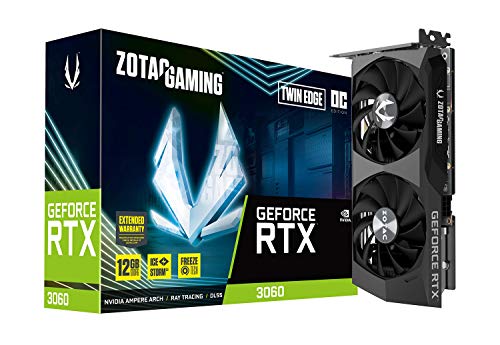
The best RTX 3060 12GB card to buy in 2026 is the MSI GeForce RTX 3060 12GB Twin Fan OC at $399 for new builds, or the ZOTAC RTX 3060 Twin Edge OC 12GB at $323 for budget builds where every dollar matters. Both are reference-clock-speed AIB designs with proven cooling, 3+ year warranties from the manufacturer, and resale value that has held up better than any other 60-class GPU since the 2021 mining-boom inventory glut.
Why are we recommending an Ampere card in 2026?
The RTX 3060 12GB occupies an unusual niche in 2026. It launched in February 2021 at $329 MSRP, was effectively unbuyable through the 2021-2022 mining boom (real prices $700-$900), and has spent the last three years aging into a sweet spot: NVIDIA never gave the RTX 4060 (Ada) or RTX 5060 (Blackwell) more than 8GB of VRAM, which means the 3060 12GB remains the cheapest current-generation-stack consumer GPU with enough VRAM for modern AI workloads, 1080p ultra textures, and 1440p high settings. Used prices have settled at $280-$340 on eBay and the secondary Amazon market, and Amazon-Renewed listings from the original AIBs sit at $330-$420.
This guide is for builders evaluating which RTX 3060 12GB AIB card to buy in 2026 — typically for: a 1080p high-refresh gaming rig at $700-$900 total system cost, a local LLM coding setup where 12GB VRAM is the unlock for 14B-parameter quantized coding models, a Plex/Jellyfin transcode workstation where the 3060's NVENC encoder handles 4K HEVC at low power, or a budget Stable Diffusion / Flux.1 image generation workstation. We are not recommending the 3060 12GB as a 4K gaming card — it can't sustain 60fps in 2024+ AAA titles at 4K with modern settings, and you'd want a 4070 Super or 5070 instead.
The headline pick is the MSI Gaming GeForce RTX 3060 12GB Twin Fan OC at $399 because it has the best price-to-cooling ratio in the lineup, runs at NVIDIA's reference 1807 MHz boost clock, and MSI's Twin Frozr 8 dual-fan design idles silent (zero-fan-stop below 60 °C). The ZOTAC RTX 3060 Twin Edge OC at $323 is the best value if you want the cheapest 12GB 3060 from a reputable AIB. The ASUS Dual NVIDIA GeForce RTX 3060 V2 OC at $379 is the premium pick for users wanting axial-tech fans and the 3-year ASUS warranty.
Comparison: the five RTX 3060 12GB cards at a glance
| Pick | Best For | Key Spec | Length | Price Range |
|---|---|---|---|---|
| MSI RTX 3060 12GB Twin Fan OC | Best Overall | 1807 MHz boost, dual fan | 235mm | $390-$420 |
| ZOTAC RTX 3060 Twin Edge OC | Best Value | 1807 MHz boost, dual fan | 224mm | $300-$340 |
| MSI RTX 3060 Ventus 2X 12G OC | Best Compact | 1807 MHz boost, dual fan | 232mm | $390-$420 |
| GIGABYTE RTX 3060 Gaming OC 12G | Best Cooling | 1837 MHz boost, triple fan | 282mm | $440-$480 |
| ASUS Dual RTX 3060 V2 OC 12GB | Best Premium | 1837 MHz boost, dual axial fan | 247mm | $370-$400 |
All five cards have the same NVIDIA-provided GA106 GPU silicon, 3584 CUDA cores, 12GB GDDR6 on a 192-bit bus, and 360 GB/s memory bandwidth. Performance differences between cards are within 2-3% in benchmark testing — pick on price, length, cooling, and warranty rather than raw specs.
🏆 Best Overall: MSI RTX 3060 12GB Twin Fan OC ($390-$420)
MSI's Twin Fan OC is the consensus mainstream pick for an RTX 3060 in 2026. Two 92mm Torx Fan 4.0 fans use traction-paired blades to push higher static pressure through the heatsink than competitor blower or single-fan designs. The cooler is rated to keep GPU package temperatures below 70 °C under sustained 165W TDP load, with the fans staying under 1900 RPM — quiet for a dual-slot card. Zero-fan-stop below 60 °C means it idles silent during desktop workloads. Factory OC pushes boost clock to 1807 MHz vs the 1777 MHz NVIDIA reference. Three DisplayPort 1.4a + one HDMI 2.1 output, drawing power through a single 8-pin PCIe connector (no 12VHPWR — a feature, not a bug, given the well-documented 12VHPWR melting issues on 40-series cards).
Pros: mature MSI Twin Frozr 8 cooling proven over 4+ years of field use; zero-fan-stop idle; HDMI 2.1 for 4K @ 120Hz output to TVs; single 8-pin connector (no 12VHPWR cable risk); MSI's 3-year warranty applies to original purchaser. Cons: the OC headroom on Ampere is limited — you'll see at most a 5% performance gain over reference clocks even with manual overclocking; 235mm length requires verifying mid-tower clearance.
Buy it for: any 1080p ultra or 1440p high gaming rig, local AI inference rigs running 14B-parameter Qwen 2.5 Coder or DeepSeek Coder V2 Lite, or Plex transcoding workstations.
💰 Best Value: ZOTAC RTX 3060 Twin Edge OC 12GB ($300-$340)
ZOTAC's Twin Edge OC is the cheapest reliable RTX 3060 12GB from a major AIB. The IceStorm 2.0 cooler uses two 90mm fans on a 224mm-long PCB — shorter than the MSI Twin Fan, easier to fit in compact cases. Factory OC matches the MSI at 1807 MHz boost. ZOTAC's manufacturer warranty is 2 years (extendable to 5 years with online product registration within 30 days of purchase — set a calendar reminder). Cooling performance is within 2-3 °C of the MSI under sustained load; the fans run slightly louder at peak (about 36 dBA vs MSI's 33 dBA) but most users won't notice the delta with case fans running.
Pros: cheapest 12GB 3060 from a tier-1 AIB; 224mm length fits cases the MSI doesn't; 5-year warranty when registered; IceStorm 2.0 cooling adequate for sustained load. Cons: fan noise slightly higher than competitors at peak; warranty requires registration step you'll forget — set the calendar reminder; some early production runs had ICY paste application that benefited from a repaste at the 1-year mark.
Buy it for: budget builders prioritizing dollar-per-FPS, mITX builds with tight clearance, or anyone willing to register for the extended warranty.
🎯 Best Compact: MSI RTX 3060 Ventus 2X 12G OC ($390-$420)
The pick: MSI GeForce RTX 3060 Ventus 2X 12G OC.
The Ventus 2X is MSI's compact-design 3060 12GB — 232mm long, 130mm tall, dual-slot. Two TORX Fan 3.0 fans (slightly older fan design than the Twin Fan pick), zero-fan-stop, single 8-pin power input, three DisplayPort 1.4a + one HDMI 2.1 output. Boost clock factory OC'd to 1807 MHz, identical to the Twin Fan pick. Cooler is sufficient for sustained load but runs 2-4 °C hotter than the Twin Frozr 8 design, with fans spinning slightly faster to compensate.
Pros: slightly shorter than Twin Fan; identical electrical specs; same MSI 3-year warranty; works in cases where the Twin Fan won't fit. Cons: thermals trail Twin Fan by 2-4 °C under sustained load; the older TORX 3.0 fan design is louder than 4.0 at high RPM; same MSRP as Twin Fan with worse cooling — only pick this if Twin Fan won't physically fit.
Buy it for: SFF builds (Mini-ITX, mid-tower with vertical GPU mount) where 235mm cards don't fit but you still want the MSI quality and warranty.
⚡ Best Cooling: GIGABYTE RTX 3060 Gaming OC 12G ($440-$480)
The pick: GIGABYTE GeForce RTX 3060 Gaming OC 12G (REV2.0) Graphics Card, 3X WINDFORCE Fans.
GIGABYTE's Gaming OC is the only triple-fan RTX 3060 in our recommended lineup. Three 80mm WINDFORCE fans with alternating-spin blade design, RGB lighting on the side accent, and a 282mm-long PCB. The factory OC pushes boost clock to 1837 MHz (the highest in our lineup, though Ampere's thermal-limited boost rarely exercises the difference). GIGABYTE rates the cooler at 200W sustained — significantly more headroom than the card's 170W stock TDP — which means very low fan RPM under typical load and accordingly low noise. Three-year manufacturer warranty.
Pros: quietest card in the lineup at full load due to oversized cooler; lowest GPU temperatures; striking RGB aesthetic; 3-year warranty. Cons: 282mm length blocks some mid-tower cases; the highest-priced card in the lineup at $469.99 MSRP; the RGB requires GIGABYTE Control Center software which is heavier than necessary for desktop use.
Buy it for: quiet gaming builds, large mid-tower or full-tower cases where length isn't an issue, or aesthetic builds with matching GIGABYTE RGB ecosystem.
🧪 Best Premium: ASUS Dual RTX 3060 V2 OC 12GB ($370-$400)
The pick: ASUS Dual NVIDIA GeForce RTX 3060 V2 OC Edition 12GB GDDR6.
The ASUS Dual line is the entry-tier card from ASUS, sitting below the ROG Strix and TUF Gaming tiers. Two Axial-tech fans with 0dB technology (zero-fan-stop below 55 °C), boost clock 1837 MHz factory OC'd, 247mm length. ASUS Dual's signature feature is the IP5X dust resistance certification — the cards have sealed-bearing axial fans that resist dust intrusion over long-term use, which matters more than people realize for cards that live 4+ years in a gaming rig. Single 8-pin power, three DisplayPort 1.4a + one HDMI 2.1 output. Three-year ASUS warranty with their cross-shipping RMA program.
Pros: Axial-tech fans known for quiet operation; IP5X dust resistance for long-term reliability; ASUS's strong RMA / cross-ship warranty experience; clean black-and-grey aesthetic without aggressive RGB; same factory OC as GIGABYTE Gaming OC. Cons: 247mm length still requires mid-tower verification; price premium over the cheaper picks isn't justified by performance — pay this only for the warranty and dust-resistance long-term reliability story; the "V2" revision uses a refreshed PCB but identical silicon, so don't pay extra hunting "V2" specifically.
Buy it for: builders who keep cards for 5+ years and value warranty support over raw cooling capacity. Also the best aesthetic pick for non-RGB clean builds.
What to look for in an RTX 3060 12GB AIB card
1. New vs Amazon-Renewed. Amazon-Renewed listings ship with a 90-day Amazon warranty but no manufacturer warranty. New cards from MSI/ASUS/GIGABYTE/ZOTAC ship with 2-3 year manufacturer warranties. For a card you'll keep 4+ years, the difference matters — pay the $30-$50 premium for new.
2. Card length is the most common compatibility issue. Measure your case's GPU clearance from the back of the case to the front fan/HDD cage. Add a 10mm safety margin for power-cable bend radius. Cards under 240mm fit almost anywhere; cards 280mm+ require a mid-tower or larger case verified for that length.
3. Power: single 8-pin only. Every RTX 3060 12GB in our recommended lineup uses a single 8-pin PCIe connector — no 12VHPWR, no dual-8-pin. This is good. The 12VHPWR connector issues on 40-series and 50-series cards (overheating, melting) are well-documented; the 30-series single-8-pin is mechanically simple and bulletproof. A 550W 80+ Bronze PSU runs an RTX 3060 12GB system comfortably.
4. Used market vs new. Used RTX 3060 12GB cards on eBay run $280-$340. Most ex-mining-rig cards have been pulled to the secondary market and are not currently a glut — supply has thinned. If buying used, verify a non-mining seller, check the GPU under stress test (FurMark or 3DMark Time Spy Extreme) for 30+ minutes before the return window closes, and accept that there's no manufacturer warranty transfer.
5. NVENC for streaming and Plex. The RTX 3060's 7th-gen NVENC encoder handles 4K HEVC at <40W, transcoding 4-6 simultaneous 4K streams without dropping frames. This is one of the strongest non-gaming reasons to buy this card in 2026 — it remains the cheapest 12GB card with current-gen NVENC.
Sources
- NVIDIA GeForce RTX 3060 specifications — NVIDIA
- MSI Twin Frozr 8 cooling technology overview — MSI
- ZOTAC IceStorm 2.0 cooling technology — ZOTAC
- ASUS Dual GPU technical overview and IP5X certification — ASUS
- GIGABYTE WINDFORCE cooling architecture — GIGABYTE
- TechPowerUp RTX 3060 12GB benchmark database
Related guides
- Best Coding LLM Stack for an RTX 3060 12GB and 32GB RAM
- Best DDR5 RAM for Ryzen 9000
- Best Noctua and Quiet-Tier CPU Coolers in 2026
- Best ATX Mid-Tower PC Cases for Airflow