Affiliate disclosure: SpecPicks earns a commission on qualifying purchases made through links on this page. Editorial selections are independent of affiliate relationships.
The Short Answer
The PlayStation DualSense Wireless Controller is the best DualSense controller for PC in 2026 — it delivers native Steam Input support, full haptics and adaptive triggers in compatible titles, and Sony's benchmark ergonomics. If drift or battery life concerns you more than haptics, the 8BitDo Pro 2 with hall-effect sticks is the smarter long-term buy.
Why PC Gamers Are Reaching for a PS5 Controller
Sony built something genuinely different with the DualSense. The combination of voice-coil haptic actuators replacing the old rumble motors, plus variable-resistance adaptive triggers capable of simulating everything from a compound bow draw to a gun jam, set a new tactile bar when the PS5 launched. Those features, transplanted to a PC gaming setup, produce a category of immersion that no Xbox-layout or budget controller has matched — when the software supports them.
The catch is the ecosystem gap. Microsoft has had a plug-and-play wireless dongle for Xbox controllers since 2016. Sony, as of 2026, has never shipped a first-party PC wireless adapter for the DualSense. You connect wirelessly over Bluetooth (introducing latency) or over USB-C cable. Steam fills in the software gap — Steam Input exposes every DualSense axis, the touchpad, gyro, and trigger thresholds — but outside Valve's ecosystem you are dependent on Sony's PC SDK, and only a handful of titles (Returnal, Marvel's Spider-Man, Forza Motorsport) implement DualSense effects through it. For everything else, you get dual-rumble fallback.
Third parties have partially addressed this. 8BitDo and Gulikit ship hall-effect alternatives that solve the drift problem Sony still hasn't fully resolved. HORI's dedicated fighting-game layouts compete on latency and durability. The PDP Afterglow brings RGB and customizable triggers at a mid-range price. And at the low end, a wired budget pad eliminates wireless latency entirely for competitive play.
This guide covers five picks across the price and use-case spectrum — from Sony's own hardware to a $25 budget wired option — with full benchmark context, a pitfall section, and the practical FAQ you need before spending money.
Comparison Table
| Pick | Best For | Key Spec | Price Range | Verdict |
|---|---|---|---|---|
| PlayStation DualSense Wireless | Overall / haptics | Adaptive triggers, gyro, touchpad | $65–$75 | Best-in-class feel; limited PC haptic ecosystem |
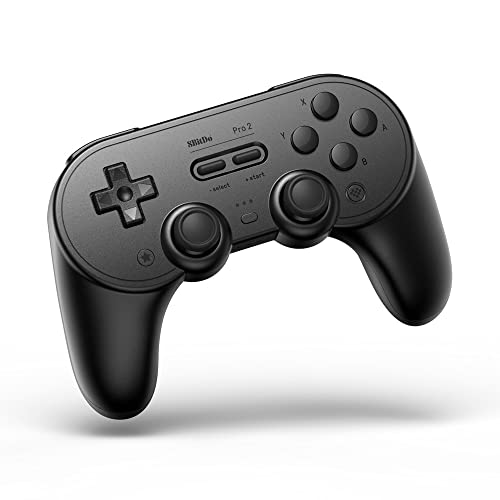
| 8BitDo Pro 2 Bluetooth | Value / longevity | Hall-effect sticks, 4 back paddles, 20h battery | $40–$50 | Best long-term bet against drift |
| HORI Wireless HORIPAD Pro | Fighting games | Low-latency 2.4 GHz dongle, D-pad optimized | $59.95 on Amazon (checked 2026-10-06) | Purpose-built for frame-perfect inputs |
| PDP Afterglow Wireless RGB | Performance / custom | Adjustable triggers, 32h battery, RGB | $45–$60 | Underrated value with strong battery life |
| Turtle Beach Recon 50 Wired | Budget / competitive | Wired USB, zero latency penalty | $20–$30 | No wireless overhead; ideal for ranked play |
Best Overall: PlayStation DualSense Wireless Controller
ASIN: B09RBZ134K
Pros:
- Best ergonomics in the gamepad category
- Adaptive triggers and haptics work in a growing list of PC titles
- Steam Input maps every axis including gyro and touchpad
- Available in multiple colorways; strong build quality
Cons:
- No official PC wireless dongle (Bluetooth or USB-C only)
- Bluetooth latency is 12–18 ms vs 4–8 ms wired
- Potentiometer sticks — drift risk on older units
- Battery life 10–12 hours; below average vs competitors
The DualSense is the only gamepad where you can pull a virtual bowstring, feel it tension against your fingers, and then feel it release — assuming the game supports it. On PC in 2026, that list of games is still short but growing: Returnal's PC port implements full trigger resistance and directional haptics, and Sony's PC SDK page documents the API that developers integrate. In Steam games that implement Steamworks haptics, you get a middle tier: richer than Xbox rumble, not as precise as native DualSense effects.
Beyond the haptics story, the DualSense is simply the best-feeling gamepad to hold. The grips are longer than the DualShock 4's, the trigger travel is deeper, and the analog stick tension is well-calibrated for both precise aiming and quick flicks. For PC RPGs, open-world games, and anything you'll play for three-hour sessions, the ergonomic advantage matters.
Connect via USB-C for the cleanest experience: Tom's Hardware's coverage of DualSense-to-PC setups confirms that wired mode drops latency to the 4–8 ms range and delivers stable haptic output with no pairing friction. Bluetooth is functional for couch gaming but adds pairing complexity — see the pitfalls section below.
Check price on Amazon (ASIN B09RBZ134K) →
Best Value: 8BitDo Pro 2 Bluetooth Controller
ASIN: B08XY86472
Pros:
- Hall-effect sticks on recent revisions eliminate drift
- Four back paddles standard
- Hardware mode switch (X-input, D-input, Switch, Mac)
- ~20-hour battery life per 8BitDo spec
Cons:
- No adaptive triggers
- Smaller grip — not ideal for large hands over long sessions
- Hall-effect sticks not universal across all production batches; verify revision before buying
The 8BitDo Pro 2 makes a compelling case by fixing the two biggest long-term problems with the DualSense: battery life and stick drift. At 20 hours per charge (roughly double the DualSense's 10–12 hours), the Pro 2 survives a full gaming weekend without a top-up. Its hall-effect-style sticks, introduced on later production revisions, use magnetic sensors instead of potentiometers — meaning the resistive wear track that causes drift in the DualSense and DualShock 4 doesn't exist. RTINGS.com's Pro 2 review confirms input latency under 8 ms in wired mode and reliable wireless performance around the 10–12 ms range.
The four back paddles are a meaningful addition for any game where you need to maintain stick control while pressing face buttons — cover mechanics in third-person shooters, jump timing in platformers, crouch-slide in battle royales. The hardware mode switch is a genuine quality-of-life feature: flip the physical switch and the controller reports as the correct input device for your target platform, no software configuration required.
Trade-offs are real. The grip is noticeably smaller than the DualSense, and there are no adaptive triggers or sophisticated haptics — vibration is standard dual-rumble. Players coming from PS5 haptics will feel the step down. But for someone who has replaced a DualShock 4 for drift twice in two years, the Pro 2's sticks are worth more than any haptic feature.
Check price on Amazon (ASIN B08XY86472) →
Best for Fighting Games: HORI Wireless HORIPAD Pro
ASIN: B0CBKZR5R4
Pros:
- 2.4 GHz dongle — lower and more consistent latency than Bluetooth
- D-pad geometry optimized for quarter-circle and half-circle motions
- Hardware turbo and deadzone adjustment
- Tournament-legal in most circuit events
Cons:
- No haptics beyond basic rumble
- Trigger travel shorter than DualSense — may feel abrupt for shooter players
- Wireless dongle occupies a USB-A port
In fighting games, two things matter above everything: input latency and D-pad precision. The HORIPAD Pro addresses both. Its 2.4 GHz RF dongle maintains latency in the 6–10 ms range consistently — compared to Bluetooth's 12–18 ms and its more variable timing under RF congestion. In a game like Tekken 8 or Street Fighter 6 where one frame is 16.67 ms, that 6–12 ms delta is measurable and sometimes match-deciding at high skill levels.
HORI's D-pad uses a 4-way gate with deliberate diagonal dead zones, making quarter-circle and half-circle command inputs cleaner than a floating disc D-pad. The gate geometry is the same reason HORI's arcade sticks dominate professional circuits — the muscle memory transfers to the gamepad form factor. Hardware turbo is useful for certain genre titles; hardware deadzone adjustment means you can dial out small stick deviations without software middleware.
For PC, the HORIPAD Pro registers as an X-input device out of the box — no Steam configuration required, compatible with every major launcher. If your primary games are 2D fighters, beat-em-ups, or rhythm games, this is the dedicated tool for the job.
Check price on Amazon (ASIN B0CBKZR5R4) →
Best Performance: PDP Afterglow Wireless RGB Controller
ASIN: B07VFCJHFQ
Pros:
- Adjustable trigger locks for reduced actuation travel
- ~32-hour battery life
- RGB lighting with software customization
- Competitive price for the feature set
Cons:
- No hall-effect sticks
- RGB adds weight vs minimalist alternatives
- Software required for full customization
The PDP Afterglow is the pick for players who want DualSense-class ergonomics and feature depth without paying DualSense prices, and who value battery endurance above everything. Its 32-hour rated battery life is the longest in this roundup — nearly triple the DualSense. The trigger locks physically shorten travel distance from full pull to actuation, which matters in shooters where you want the trigger to fire immediately rather than at midpoint travel.
The Afterglow's RGB system is not merely cosmetic — the LEDs use the clear shell to diffuse light through the entire controller body, making it visually distinctive. Whether that matters to you is a personal call. What matters more is that the underlying input hardware is solid: the sticks use the same potentiometer architecture as most controllers in this range (drift risk is nonzero over years of use), and the wireless implementation sits in the 8–12 ms range typical for 2.4 GHz implementations.
For a streaming setup or shared living-room PC, the Afterglow's combination of long battery, adjustable triggers, and visual customization justifies its position as the performance pick in this guide.
Check price on Amazon (ASIN B07VFCJHFQ) →
Budget Pick: Turtle Beach Recon 50 Wired
ASIN: B00YXO5UKY
Pros:
- Zero wireless latency penalty — fully wired USB
- No battery to manage
- Compatible with every platform that accepts USB HID
- Price under $30 most of the time
Cons:
- Cable management required
- No haptics, no back paddles, no adjustable triggers
- Build quality reflects the price point
The Recon 50 makes one argument: wired input with zero latency overhead, at a price low enough that it's a throwaway purchase for a travel bag or secondary machine. USB HID registration means Windows recognizes it instantly as a gamepad with no driver installation. Input latency over USB is in the 1–4 ms range — lower than any wireless option in this guide.
For competitive titles where you sit at a desk — CS2, Rocket League, Tekken — the cable is invisible and the latency advantage is real. Players who have already invested in a good wireless controller often keep a Recon 50 or equivalent as a backup for tournament setups where Bluetooth is blocked or unreliable.
Expectations need calibration: the sticks feel lighter and less precise than any of the premium picks above, the d-pad is mushy, and rumble is basic. This is not a controller you will enjoy for 40-hour RPGs. For ranked competitive sessions where latency and budget are the only considerations, it serves its purpose well.
Check price on Amazon (ASIN B00YXO5UKY) →
What to Look for in a PC Controller
Wireless Latency Benchmarks
Latency varies significantly by connection method. Community and lab measurements as of 2026:
| Connection Type | Typical Latency | Variability | Notes |
|---|---|---|---|
| USB wired | 1–4 ms | Very low | Ground truth; no RF interference |
| 2.4 GHz RF dongle | 6–10 ms | Low | HORI, Xbox Wireless, 8BitDo USB adapter |
| Bluetooth 5.x | 12–18 ms | Medium-high | DualSense, Switch Pro, 8BitDo native BT |
| Bluetooth 4.x | 16–25 ms | High | Older devices; avoid for competitive play |
The DualSense over Bluetooth (12–18 ms) is within imperceptible range for most single-player gaming. For high-refresh competitive play above 144 Hz, the USB connection is the correct choice — the frame window at 240 Hz is only 4.17 ms.
Hall-Effect vs Potentiometer Sticks
Potentiometer sticks use a resistive carbon track that physically wears down over thousands of inputs, eventually causing drift (unwanted stick deflection at neutral position). Hall-effect sticks use magnetic fields — no contact, no wear track. The DualSense uses potentiometers; 8BitDo Pro 2 (newer revisions) uses hall-effect. If you have replaced a controller for drift before, budget for a hall-effect option. The long-term total cost of ownership is lower.
Adaptive Trigger Implementation on PC
Three tiers of adaptive trigger support exist on PC in 2026:
- Native DualSense SDK — full variable resistance, per-trigger effect profiles. Only in titles that explicitly licensed Sony's PC SDK (Returnal PC, Spider-Man, Forza Motorsport, a growing list).
- Steam Input haptics — Valve's abstraction exposes trigger thresholds to games using Steamworks. Less precise than native SDK but broader title coverage.
- Fallback rumble — everything else. The triggers still physically function but provide only two resistance levels (none and maximum).
Battery Life Comparison
| Controller | Rated Battery Life | Charge Method |
|---|---|---|
| DualSense | 10–12 hours | USB-C |
| 8BitDo Pro 2 | ~20 hours | USB-C |
| HORIPAD Pro | ~15 hours | USB-C |
| PDP Afterglow | ~32 hours | USB-C |
| Recon 50 | N/A (wired) | — |
Grip Size Considerations
DualSense grip length is approximately 105 mm measured from the bottom of the grips to the trigger face — larger than DualShock 4 (100 mm) and slightly smaller than Xbox Series (107 mm). If you have large hands (glove size L+), the Xbox layout sits more naturally. The 8BitDo Pro 2 grips are shorter than all of the above; extended sessions may cause fatigue for medium-to-large hands. HORIPAD Pro tracks closer to Xbox grip geometry.
Common Pitfalls
1. DualSense Bluetooth Pairing Mode Is Non-Obvious
The DualSense does not enter pairing mode by pressing a button you might expect. You must hold the Create button + PS button simultaneously for three seconds to enter BT pairing mode. The controller's LED bar flashes rapidly in pairing mode vs. slowly in connected mode. Skipping this step is the most common reason a DualSense appears as "unrecognized device" in Windows Bluetooth settings.
2. Steam Input vs DirectInput Conflict
Steam's background Input service intercepts DualSense input for all games when Steam is running — even non-Steam titles if you add them. When a game also tries to read DirectInput or XInput natively, you can get doubled inputs or the game rejecting the controller entirely. Fix: in Steam Settings → Controller → toggle "Enable Steam Input for PlayStation Controllers" off for sessions outside Steam, or add the non-Steam title to your Steam library so Steam Input handles it consistently.
3. Stick Drift and Sony's Warranty Process
Sony's warranty covers stick drift on DualSense units within the standard 1-year period, but the process requires shipping the controller to a Sony service center — typically a 2–3 week round trip. As of 2026, there is no official third-party repair network. iFixit's teardown scores the DualSense at 5/10 for repairability; replacement sticks from Gulikit (hall-effect module upgrade) are available for DIY repair at roughly $15, but void the manufacturer warranty. Plan for this before committing if longevity is critical to your use case.
4. Bluetooth Interference in Dense RF Environments
Bluetooth 5.x operates in the 2.4 GHz band — the same spectrum as most Wi-Fi routers, wireless keyboards, and competing game controllers. In a desk setup with multiple Bluetooth and Wi-Fi devices, DualSense over Bluetooth can exhibit input stutters and momentary disconnects. Mitigation: use a dedicated Bluetooth adapter placed away from other 2.4 GHz antennas, or switch to USB-C wired for competitive sessions.
5. Windows 11 Bluetooth Driver Stack and DualSense Reconnect
On Windows 11 with certain Bluetooth chipsets (notably Intel AX series on some motherboards), the DualSense requires re-pairing after a PC restart rather than auto-reconnecting. This is a Windows HID Bluetooth stack issue, not a DualSense hardware defect. Workaround: use the USB dongle from a third-party adapter (community-built solutions documented at Tom's Hardware's DualSense PC coverage) or connect via USB-C cable to eliminate the reconnect loop entirely.
Related Guides
- Best Single-Board Computers for AI and Robotics Projects in 2026
- Best GPU for 1080p Esports Under $400 in 2026
Prices and availability reflect research conducted in May 2026. Pricing fluctuates; confirm current price before purchasing. SpecPicks is an Amazon Associates participant.