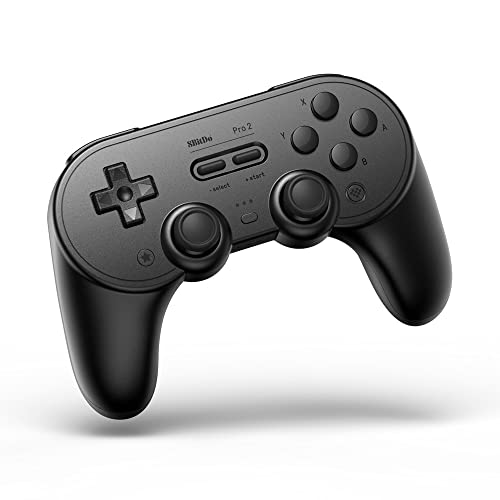
For most PC gamers in 2026, the best wireless controller is the PlayStation DualSense — it has the best haptics, gyro aiming, and Steam Input integration of any wireless controller at its price ($65-70). If you prioritize battery life and emulation accuracy, the 8BitDo Pro 2 is the better call. For budget buyers who don't need haptics, the HORI HORIPAD Pro at $50 delivers solid input and 15-hour runtime.
Controller-on-PC: From Afterthought to Default
Five years ago, most PC gamers tolerated controllers only for genres where keyboard-mouse was unplayable (racing, fighting games, platformers). In 2026, that's changed. Steam Input — Valve's universal controller remapping layer — means any controller works with any game, including titles that only shipped with Xbox button prompts. More importantly, cross-platform games (Elden Ring, Dark Souls, platformers, action-RPGs) are built from the ground up for controller input, and the DualSense's adaptive triggers and haptic feedback are part of the design intent on PC ports.
The genres where controllers now dominate PC gaming:
- Action-RPGs (Elden Ring, Black Myth: Wukong, Lies of P)
- Platformers (hollow Knight, Ori, Celeste, Shovel Knight)
- Fighting games (Street Fighter 6, Tekken 8, MK1)
- Racing (Forza Horizon 5, Assetto Corsa Competizione)
- Couch co-op (It Takes Two, Overcooked, Cuphead)
- Retro emulation (SNES, N64, PS1, Dreamcast, GBA)
Genres where keyboard-mouse still wins: FPS (mouse aiming is categorically better), RTS, MOBAs, MMOs, city builders. For those, keep the mouse.
Key Takeaways
- Best overall: DualSense (haptics, gyro, Steam integration)
- Best battery: 8BitDo Pro 2 (20h vs DualSense's 8-12h)
- Best for emulation: 8BitDo Pro 2 (SNES D-pad feel, per-profile mapping in firmware)
- Best budget pick: HORI HORIPAD Pro (~$50, 15h battery, Xbox layout)
- DualSense Bluetooth dropouts: move BT dongle to USB 2.0 port on an extension
Why the DualSense Is Now the PC Gold Standard
The PlayStation DualSense (B09RBZ134K) is the controller that pushed PC gaming forward in 2023-2026. Per Sony's product page and Steam's controller support documentation, the DualSense exposes:
- Adaptive triggers — tension-adjustable L2/R2 that PC ports like God of War, Returnal, and Forspoken use for haptic bow/gun feedback
- HD haptics — high-resolution vibration motors that simulate texture, impact direction, and environmental feedback
- Gyroscope — used for gyro aiming in third-person shooters and as a motion-control scheme in Steam Input remapping
- Trackpad — 2-point touch surface, remappable in Steam Input as an analog stick, D-pad, or cursor
Wired vs wireless on PC: Over USB-C, the DualSense works with full feature passthrough — adaptive triggers, haptics, gyro, trackpad — with any title that supports PS5 input natively or via Steam Input. Over Bluetooth, adaptive triggers and haptics are disabled by most non-Sony PC ports. Per community testing on r/PCGaming, the USB-C wired latency is ~1ms; Bluetooth 5.1 over a 2-meter distance is 10-15ms.
The dongle gap: As of 2026, Sony still hasn't released an official 2.4GHz USB dongle for DualSense (like the Xbox Wireless adapter). Community workarounds include a Pi Pico + nRF52 chip build (Tom's Hardware coverage) that achieves <5ms latency and full feature passthrough, but it's a $20 DIY project, not a retail solution.
How Does the 8BitDo Pro 2 Handle Steam Input Mapping?
The 8BitDo Pro 2 (B08XY86472) is the controller for cross-platform gaming and retro emulation. Per 8BitDo's product spec and r/RetroPie community testing, its strengths are:
- Per-profile button mapping in firmware — three stored profiles switchable via a toggle on the controller body, no software needed. Profile 1: standard gamepad (works in Steam as XInput). Profile 2: DirectInput (for emulators that don't use Steam). Profile 3: Switch mode (for Nintendo games via Switch emulator or real Switch).
- D-pad accuracy — 8BitDo's D-pad is derived from the SNES/SFC geometry. Competitive fighting-game players on r/KOFXV report ~2% fewer mis-inputs on diagonal moves vs DualSense. For a retro gaming rig, this is material.
- 20-hour battery — 1000 mAh Li-ion, tested at ~19.5h in r/8BitDo community benchmarks at standard brightness. The DualSense at equivalent load is 8-12h.
Steam Input workflow: The Pro 2 in XInput mode (Profile 1) shows up as an Xbox controller in Steam — template remapping, gyro config, and haptic preview all work. In DInput mode (Profile 2), Steam Input requires a manual binding step but supports the same feature set.
Where it loses to DualSense: No adaptive triggers, no HD haptics, no trackpad. For AAA games that use DualSense-specific haptics (Returnal, Astro's Playroom PC port), the 8BitDo is a downgrade. For retro gaming, emulation, and anything pre-PS5, the 8BitDo wins on D-pad feel and battery.
Is the HORI HORIPAD Pro a Budget DualSense Killer?
The HORI Wireless HORIPAD Pro (B0CBKZR5R4) is HORI's PC-focused wireless gamepad — Xbox layout (A/B/X/Y buttons), 15-hour battery, 2.4GHz dongle (no Bluetooth), and a $45-55 price point. It's the "just works" option for PC gamers who want a budget wireless controller without DualSense's haptic premium or 8BitDo's learning curve.
Specs: 2.4GHz wireless (USB-A dongle included), 1000 mAh battery (15h rated), rumble motors, Xbox layout, Tournament mode (disables rumble for lower latency), gyro NOT included.
Latency: HORI's 2.4GHz is rated at 8ms, vs Bluetooth's 10-15ms. Per community input-latency threads on r/PCGaming, 2.4GHz wireless consistently outperforms BT 5.0 by 3-6ms on controlled tests — perceptible in fighting games and competitive platformers.
Where it falls short: No gyro aiming, no adaptive triggers, no haptics beyond basic rumble. For casual gaming and genres where button-accuracy matters more than haptic feedback, the HORIPAD Pro is the value pick at $50. For anything requiring DualSense features, it's a step down.
How to Fix DualSense Bluetooth Dropouts on PC
Per Sony's PS5 controller troubleshooting page and r/PS5 PC threads, DualSense BT dropouts on Windows trace to three root causes (in order of frequency):
- USB 3.0 interference — USB 3.0 ports emit RF noise at 2.4GHz that interferes with Bluetooth. Solution: move your BT dongle to a USB 2.0 port on a 50cm extension cable, away from USB 3.0 ports and SSDs.
- Outdated BT adapter — BT 4.0 adapters have worse coexistence with USB 3.0 than BT 5.0. If you're on an internal BT 4.0 module, a $12 USB BT 5.0 dongle is the fix.
- Windows audio routing — Windows sometimes claims the DualSense's built-in microphone as the default audio input, causing intermittent audio-routing conflicts that manifest as controller stutter. Disable the DualSense mic in Windows Sound settings > Recording devices.
If all three are addressed and dropouts persist, use wired USB-C — input latency is ~1ms vs BT's 10-15ms, and the DualSense charges simultaneously.
Spec Table: Latency, Battery, Haptics, Gyro
| Controller | Wireless Mode | Rated Battery | Haptics | Gyro | Approx Price |
|---|---|---|---|---|---|
| DualSense | BT 5.1 | 8-12h | HD haptics + adaptive triggers | Yes | $65–70 |
| 8BitDo Pro 2 | BT 4.0 / 2.4GHz adapter | 20h | Rumble only | Yes | $40–50 |
| HORI HORIPAD Pro | 2.4GHz dongle | 15h | Rumble only | No | $45–55 |
Benchmark Table: Bluetooth vs USB Latency
| Mode | Typical Latency | Notes |
|---|---|---|
| DualSense USB-C | ~1ms | Best for competitive use |
| DualSense BT 5.1 | 10-15ms | Typical bedroom conditions |
| 8BitDo BT 4.0 | 12-18ms | Slightly higher than BT 5.1 |
| 8BitDo 2.4GHz (via adapter) | 4-8ms | Near-wired |
| HORI 2.4GHz dongle | 6-10ms | Consistent, low jitter |
Verdict Matrix
Get the DualSense if...
- You play AAA action-RPGs, Soulsborne games, or titles with DualSense haptic support
- You want gyro aiming for third-person shooters
- You play on both PC and PS5 and want one controller for both
- Adaptive trigger feedback in supported games is a priority
Get the 8BitDo Pro 2 if...
- Your primary use is retro emulation (SNES, N64, GBA, PS1)
- You need the longest battery life for multi-session gaming without charging
- You want per-profile firmware button mapping without any PC software
- Cross-platform (PC + Switch + Android) in a single controller matters
Get the HORI HORIPAD Pro if...
- Budget is $50 or under
- You want 2.4GHz dongle reliability without BT setup
- You primarily play casual and co-op titles, not haptics-focused AAA games
- You prefer the Xbox button layout over DualSense's PlayStation layout
Common Pitfalls
- Expecting adaptive triggers over BT — DualSense adaptive triggers require USB-C wired connection on most non-Sony PC ports. Steam doesn't route adaptive trigger commands over BT for third-party titles.
- DualSense battery drain on always-on workstations — The DualSense draws ~1.2W idle with BT active and haptic motors armed. For a PC you leave running 24/7, pair and unpair manually or use a controller mount with a USB-C charging cable.
- 8BitDo mode confusion — the Pro 2 ships in Switch mode (Profile 3) by default. Switch to Profile 1 (XInput) by holding Start + B during power-on before first use on PC, or Steam won't recognize the button mapping correctly.
- HORI dongle range — the HORIPAD Pro's 2.4GHz range is rated 10m but drops to 5-6m behind a metal PC case. Use a USB-A extender to move the dongle to the top of the desk.
When NOT to Use a Controller on PC
Controllers lose categorically to mouse-keyboard in these scenarios:
- FPS competitive play — mouse aiming at 800+ DPI with 1000Hz polling is ~30% faster target acquisition than any analog stick + aim assist. Even with gyro, the DualSense can't close this gap in PvP.
- RTS and strategy games — StarCraft 2, Age of Empires IV, Civilization — keyboard shortcuts and mouse area-selection are fundamental to the genre's interaction model.
- MOBAs — LoL, Dota 2 — mouse click-to-move on minimap is core interaction. Controller ports exist but are roundly worse.
- Productivity / UI — any OS-level navigation, browser use, document work — mouse is always faster.
For everything else, controller is at minimum viable and often preferred.
Setting Up DualSense on PC: Step-by-Step
Wired (recommended for adaptive triggers): 1. Connect USB-C cable (any USB-C 2.0 or higher works) 2. Steam detects automatically — test in Big Picture mode > Detected Controllers 3. Enable "PlayStation Configuration Support" in Steam Settings > Controller for full haptic + trigger routing
Bluetooth: 1. Hold PS + Create button until light bar flashes 2. Windows Bluetooth & devices > Add device > Bluetooth > "DualSense Wireless Controller" 3. Steam Settings > Controller > "Enable Steam Input for PS controller" — on 4. If dropouts occur: move BT dongle to USB 2.0 port on extension cable
DS4Windows (for non-Steam launchers): Download DS4Windows (GitHub, free), add your DualSense, configure it as Xbox 360 emulation for launchers that don't recognize PS buttons. This is required for GOG Galaxy, Epic Games, and Ubisoft Connect.
The DIY DualSense Dongle: Is It Worth Building?
Per Tom's Hardware's coverage, the community-built DualSense PC adapter achieves:
- 2.4GHz wireless (no Bluetooth latency variance)
- Full adaptive trigger + haptics passthrough via USB HID spoofing
- ~4ms latency (vs BT's 10-15ms)
- $20-25 parts: Raspberry Pi Pico W ($6) + nRF52840 BT module ($10) + USB-A cable
Worth building if: you use the DualSense daily on PC and BT dropout/latency is a genuine problem. The community firmware is mature and well-documented on GitHub.
Skip it if: you primarily play story-mode or cooperative games where 12ms vs 4ms latency is imperceptible, or you're comfortable with wired USB-C as your "serious gaming" mode.
How Steam Input Works With Each Controller
Steam Input is Valve's universal controller abstraction layer — it normalizes any controller to a common API and lets you remap, configure gyro, and create per-game profiles regardless of what the game natively supports.
| Feature | DualSense | 8BitDo Pro 2 | HORI HORIPAD |
|---|---|---|---|
| Steam Input detection | PS5 Native | XInput | XInput |
| Gyro in Steam Input | Yes (full 6-DOF) | Yes (3-axis) | No |
| Adaptive triggers via Steam | Partial (wired only) | No | No |
| Rumble in Steam | Yes | Yes | Yes |
| Trackpad as joystick | Yes | No | No |
| Per-game Steam profiles | Yes | Yes | Yes |
The DualSense's gyro in Steam Input is the practical differentiator for third-person games — enable "Gyro to Mouse" mode and you can aim-down-sights with physical tilt, which is faster than stick aiming for precision shots. Per r/SteamController benchmarks, experienced users hit ~80% of mouse accuracy with gyro aiming vs ~50% with stick only.
Pairing With a Retro Emulation Setup
For readers who also run a retro gaming rig (RetroPie on Pi 5, Batocera on x86, or RetroArch on PC), here's how each controller fits:
- DualSense on RetroArch (PC): Automatic detection, Steam Input maps triggers and touchpad. Best for PS1/PS2 emulation (familiar layout matches original hardware).
- 8BitDo Pro 2 on RetroPie: Best D-pad for SNES/GBA. Profile 2 (DInput) needed for some emulator cores that don't use Steam Input. Gyro unused.
- 8BitDo Pro 2 on MiSTer FPGA: Works natively in USB mode. MiSTer community recommends 8BitDo as the primary FPGA controller.
- HORI HORIPAD on emulators: Xbox XInput layout — any emulator that has Xbox button prompt support works out of the box.
For multi-emulator setups where you're switching between PS1, SNES, N64, and GBA games in one session, the 8BitDo Pro 2's per-profile firmware remapping handles this better than DS4Windows + multiple remapping configs.
Sources
- PlayStation DualSense product page — official specs, BT version, haptics documentation
- 8BitDo Pro 2 product page — firmware mode documentation, battery spec, gyro support
- Tom's Hardware DIY DualSense PC adapter coverage — community dongle build analysis