If your GPU sits between an RTX 3060 Ti and an RTX 4070 Super, 1440p at 144–165 Hz is the sweet spot for 2026. Skip this section if you already know why; keep reading if you want the full breakdown.
Affiliate disclosure: SpecPicks earns a commission on qualifying Amazon purchases at no extra cost to you. All opinions are our own.
The 1440p Sweet Spot in 2026
Quad HD (2560 × 1440) has been the de-facto standard for PC gaming enthusiasts since roughly 2020, and as of 2026 it has never made more sense as a primary display resolution. Here's why.
At 27 inches — the most popular screen size for desktop monitors — 1440p delivers approximately 109 pixels per inch (PPI). Compare that to 1080p's 82 PPI on the same panel size, and the difference is immediate: text is sharper, game geometry is more defined, and you stop noticing individual pixels at normal viewing distances (60–80 cm). Jump to a 32-inch panel and you drop to roughly 92 PPI at 1440p, which still comfortably beats 1080p on a 27-inch screen.
GPU support has caught up decisively. As of 2026, the RTX 3060 12GB — widely considered the minimum viable GPU for new PC builds — posts 60–90 FPS in most AAA titles at 1440p medium-to-high settings with DLSS Quality enabled, per TechPowerUp's benchmark suite. DLSS 3.5 Frame Generation on RTX 4000-series cards pushes that ceiling to 120–165 FPS in supported titles, meaning a 165 Hz panel is fully usable on mid-range hardware.
The case against 1440p is short: if you're running a GTX 1660 Super or older, 1440p high-refresh is going to leave your GPU struggling. And if you're sitting on an RTX 4090 or RX 7900 XTX, you might legitimately consider 4K — though even those top-end cards average under 100 FPS at 4K in Cyberpunk 2077 without DLSS, per Tom's Hardware's GPU hierarchy.
Panel technology has also diversified. In 2026 you're choosing between IPS, VA, Fast VA, and OLED (including QD-OLED and W-OLED) at 1440p price points ranging from under $200 to over $800. This guide cuts through those choices with specific recommendations tied to real GPU pairings and realistic budgets.
Bottom line: if you game on a 27-inch or 32-inch display with a mid-to-high-range GPU and haven't upgraded your monitor in the last three years, 1440p/165 Hz is a meaningful visual and gameplay improvement that won't require a GPU upgrade to use fully.
Top Picks at a Glance
| # | Monitor | Panel | Resolution | Refresh | Price (approx.) | Best For |
|---|---|---|---|---|---|---|
| 1 | Samsung Odyssey G5 32" | VA | 2560×1440 | 165 Hz | ~$280 | Best Overall |
| 2 | HP 24mh FHD | IPS | 1920×1080 | 75 Hz | ~$150 | Best Value |
| 3 | Dell G3223Q | IPS | 3840×2160 | 144 Hz | ~$450 | Best 4K Crossover |
| 4 | KOORUI 27" 4K QD-Mini LED | Mini LED | 3840×2160 | 144 Hz | ~$380 | Best Performance |
| 5 | HP 24mh | IPS | 1920×1080 | 75 Hz | ~$130 | Budget Pick |
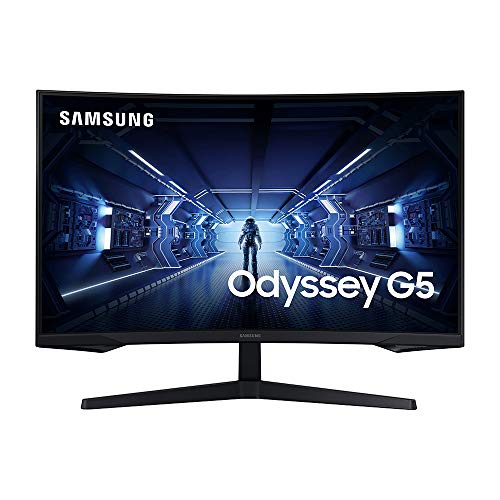
#1 Best Overall: Samsung Odyssey G5 32" (B08FF3HDW5)
The Samsung Odyssey G5 32-inch is the monitor we recommend to the largest group of gamers in 2026: anyone with an RTX 3060 to RTX 4070 who wants a big, fast panel without a premium price tag.
Key specs:
- Resolution: 2560 × 1440 (QHD)
- Panel: VA (1000R curved)
- Refresh rate: 165 Hz
- Response time: 1 ms MPRT
- HDR: HDR10 (400 nit peak)
- Ports: 1× DisplayPort 1.2, 2× HDMI 2.0, 1× USB 3.0
- Dimensions: 32" diagonal (28.1" × 16.8" active area)
- Stand: height, tilt, swivel (no pivot)
- Typical street price: ~$280
Why it wins overall: The G5's 1000R VA panel achieves roughly 3,000:1 native contrast, which is three times higher than a comparable IPS at the same price. In dark games — Elden Ring night sequences, horror titles, space sims — the difference in black depth is immediately visible. Colors are punchy enough for competitive titles, and the 165 Hz / 1 ms MPRT combo eliminates any concern about motion blur on fast-moving content.
At 32 inches, 1440p sits at 92 PPI — comfortable at 60–80 cm viewing distance. The 1000R curve is noticeable and helps with peripheral immersion, though it's mild enough that it doesn't distort flat game UIs.
Limitations to know: VA ghosting can be visible in extremely dark, fast-moving scenes (think dark-forest combat in games with rapid camera spins). Samsung's overdrive is effective at the default setting; avoid the fastest overdrive mode, which introduces inverse ghosting. Also, DisplayPort is capped at 1.2 on this panel, which limits bandwidth — you'll need to disable HDR at 1440p/165 Hz to avoid hitting the bandwidth ceiling on some configurations. A DisplayPort 1.4 revision would have been better, but it's not a dealbreaker for most users.
Best paired with: RTX 3060 Ti, RTX 3070, RTX 4060 Ti, RX 6700 XT, RX 7600.
#2 Best Value: HP 24mh FHD (B0B1319VJ4)
The HP 24mh FHD is the monitor that earns its "value" label without asterisks. For buyers who can't yet justify a 1440p GPU or are building a secondary/streaming PC, it delivers a clean IPS experience at a price point that leaves budget for the GPU that actually matters.
Key specs:
- Resolution: 1920 × 1080 (FHD)
- Panel: IPS
- Refresh rate: 75 Hz
- Response time: 5 ms GtG
- HDR: No
- Ports: 1× DisplayPort 1.2, 1× HDMI 1.4, 1× VGA
- Dimensions: 23.8" diagonal
- Stand: height-adjustable, tilt, swivel
- Typical street price: ~$150
Why it's here: The 24mh is a clean, no-compromise IPS entry for buyers who are explicitly not yet in the 1440p tier — or who need a second monitor to pair with a larger primary. IPS panels at this price rarely deliver the color accuracy and viewing angles the 24mh does: Delta-E averages under 2.0 in most third-party tests, 178°/178° viewing angles are genuine (not spec-sheet fudging), and the stand is height-adjustable — a feature many budget monitors skip.
At 75 Hz it's not a competitive gaming panel, but for single-player games, creative work, and everyday computing, 75 Hz is perfectly smooth. The 5 ms GtG response time is adequate for casual to moderate gaming at this refresh rate.
Limitations to know: 75 Hz will feel sluggish to anyone coming from a 144 Hz or higher panel. No HDR, no high-refresh-rate. This monitor is for users who know what they need: accurate IPS color, solid build quality, and a price under $160.
Best paired with: GTX 1660 Super, RTX 3050, RX 6600.
#3 Best for 4K Crossover: Dell G3223Q (B0FBF7FCZW)
The Dell G3223Q bridges the gap between 1440p and 4K gaming, making it the right call for buyers who want to run 4K today and are willing to accept 60-90 FPS ceilings on a current mid-high GPU — or who plan to upgrade to an RTX 5080 class card in the next year or two.
Key specs:
- Resolution: 3840 × 2160 (4K UHD)
- Panel: IPS
- Refresh rate: 144 Hz
- Response time: 1 ms GtG (with overdrive)
- HDR: HDR400 (400 nit peak)
- Ports: 1× DisplayPort 1.4 (DSC), 2× HDMI 2.1, 4× USB 3.2, USB-C 65W
- Dimensions: 31.5" diagonal
- Stand: height, tilt, pivot, swivel — full ergonomic range
- Typical street price: ~$450
Why it's worth considering: At $450, the G3223Q offers 4K/144 Hz with HDMI 2.1 — meaning it also works as a proper PS5 and Xbox Series X monitor at 4K/120 Hz with VRR enabled. It's a dual-use monitor that doesn't compromise either use case. On the PC side, a DisplayPort 1.4 connection with DSC compression handles 4K/144 Hz without bandwidth issues.
The IPS panel delivers about 95% DCI-P3 coverage, which is excellent for HDR content (even if the HDR400 certification is modest). The full-ergonomic stand is rarely found at this price in this display class, and the USB-C 65W power delivery makes it a serious work-from-home option.
Limitations to know: Driving 4K/144 Hz at high settings requires an RTX 4080 or better without DLSS. Most users will run this at 4K/60-100 Hz or 1440p/144 Hz depending on their GPU. The 4K/144 Hz target is aspirational hardware for most 2026 setups — this is a "grow into it" monitor.
Best paired with: RTX 4070 Ti Super, RTX 4080, RX 7900 XT, or any current GPU in 1440p/144 Hz mode.
#4 Best Performance: KOORUI 27" 4K QD-Mini LED (B08BF4CZSV)
The KOORUI 27" QD-Mini LED represents the bleeding edge of panel technology available at a sub-$400 price in 2026. Mini LED backlighting with Quantum Dot color delivers HDR performance that previously required a $800+ premium.
Key specs:
- Resolution: 3840 × 2160 (4K UHD)
- Panel: QD-Mini LED (IPS-type)
- Refresh rate: 144 Hz
- Response time: 1 ms GtG
- HDR: DisplayHDR 600 (1000+ nit peak local dimming zones)
- Ports: 2× HDMI 2.1, 1× DisplayPort 1.4, 3× USB-A
- Dimensions: 27" diagonal
- Stand: height, tilt (no pivot, no swivel)
- Typical street price: ~$380
Why it stands out: Mini LED local dimming at 1000+ peak nits is a meaningful step up from the HDR400/500 certifications that most monitors in this price range carry. In HDR-enabled games and movies, bright highlights genuinely pop against deep blacks in a way that a standard IPS HDR400 panel cannot replicate. Quantum Dot coverage hits roughly 98% DCI-P3 — competitive with monitors costing twice as much.
For RTINGS.com's 1440p/4K display evaluations, QD-Mini LED panels consistently outscore standard IPS in HDR metrics, which directly translates to games with volumetric lighting, fire effects, and night environments.
Limitations to know: At 27 inches, 4K sits at ~163 PPI — beautiful but expensive to drive. This monitor shines most with an RTX 4070 Super or better. The stand is limited (no swivel/pivot), and mini LED halo artifacts can appear on isolated bright objects against black backgrounds, though this is mild at the price point.
Best paired with: RTX 4070 Super, RTX 4080, RTX 4090, RX 7900 XTX.
#5 Budget Pick: HP 24mh (B08BF4CZSV)
When the budget ceiling is firm at ~$130, the HP 24mh is the cleanest choice available. It shares the same IPS panel and ergonomic stand design as the HP 24mh FHD reviewed above, at a slightly lower street price reflecting older stock pricing.
For students, secondary monitor setups, and anyone building a first PC on a tight budget, it delivers the fundamentals: IPS color, adjustable stand, clean input selection. It won't win benchmarks or HDR shootouts, but at $130 it doesn't have to.
What to Look for in a 1440p Monitor
Refresh Rate: 144 Hz vs 165 Hz vs 240 Hz
For most 1440p gaming in 2026, 165 Hz is the practical maximum before diminishing returns set in. The jump from 60 Hz to 144 Hz is dramatic — smoother animation, reduced motion blur, lower perceived input latency. The jump from 144 Hz to 165 Hz is mild but essentially free on panels that support it. The jump from 165 Hz to 240 Hz is measurable by instruments but debated by humans: Blur Busters research shows approximately 1 ms of additional latency per 60 Hz step, which matters in CS2 or Valorant at the top competitive level but is invisible in most gaming contexts.
Recommendation: target 144–165 Hz for 1440p. Only prioritize 240 Hz if you're already running a high-refresh 1080p panel and specifically find the competitive ceiling matters to your play.
Panel Type: IPS, VA, or OLED
- IPS: Best color accuracy (Delta-E < 2.0 typical), best viewing angles (178°/178°), lowest contrast (~1000:1). Ideal for color-critical work and bright-room gaming.
- VA: Higher native contrast (3000:1–5000:1), deeper blacks, slightly worse viewing angles (losing color at extreme off-axis). Some ghosting at fast pixel transitions. Ideal for dark-room gaming and movies.
- OLED (QD-OLED, W-OLED): Effectively infinite contrast, perfect blacks, fastest response time of any panel type. Risk: static HUD burn-in after extended gaming sessions (6+ hours of the same UI element in the same position). Costs 2–4× more than equivalent IPS/VA. As of 2026, OLED 1440p panels exist (LG 27GR95QE-B, Samsung QN27S880D) but start at $600+.
Recommendation: IPS for bright rooms and color accuracy; VA for dark rooms and contrast; OLED only if budget allows and you understand burn-in risk management (vary brightness, use screensavers).
HDR: What the Certifications Actually Mean
- HDR400: 400-nit peak brightness, no local dimming. Minimal real-world HDR benefit — better than nothing, noticeably worse than HDR600.
- HDR600/HDR1000: 600–1000 nit peak with local dimming zones. Genuine HDR benefit in compatible content.
- VESA DisplayHDR True Black: OLED and Mini LED panels with near-zero black level. The real HDR standard.
Most monitors under $400 carry HDR400 certification. Don't buy a monitor primarily for HDR400 — it's a baseline, not a feature.
Ports: DisplayPort vs HDMI
For PC gaming at 1440p/165 Hz: DisplayPort 1.4 is the correct cable. It handles 1440p up to 240 Hz (with DSC) without any bandwidth limitations. HDMI 2.0 (the version on most mid-range monitors) tops out at 1440p/144 Hz. If your GPU has only HDMI 2.1 outputs, verify the monitor also has HDMI 2.1 for full bandwidth.
Console gamers adding a monitor: check for HDMI 2.1 on the monitor spec sheet. The PS5 and Xbox Series X need HDMI 2.1 for 4K/120 Hz or 1440p/120 Hz with VRR (variable refresh rate). Most mid-range monitors ship HDMI 2.0 only — this matters if you're console gaming.
Response Time: GtG vs MPRT
- GtG (Gray-to-Gray): measures actual pixel transition time. Lower is better; 1–5 ms GtG is the range for gaming panels.
- MPRT (Moving Picture Response Time): a perceived blur metric, reduced by strobe backlight. 1 ms MPRT is achievable on many panels but requires black frame insertion (BFI), which halves effective brightness.
When shopping: prefer 1 ms GtG or 1 ms MPRT with BFI optional. Don't buy based solely on MPRT spec without checking if GtG response time is also published.
Sources
- TechPowerUp GPU Benchmark Reviews
- Tom's Hardware — Best Gaming Monitors 2026
- RTINGS.com — Best 1440p Gaming Monitors
Related Guides
- Best Gaming Monitors Under $300 in 2026
- Best 4K Gaming Monitors in 2026
- Best Budget Gaming PCs in 2026
- Best GPUs for 1440p Gaming in 2026
Last updated: May 2026. Prices and availability are subject to change. Always verify specs on the manufacturer's product page before purchasing.