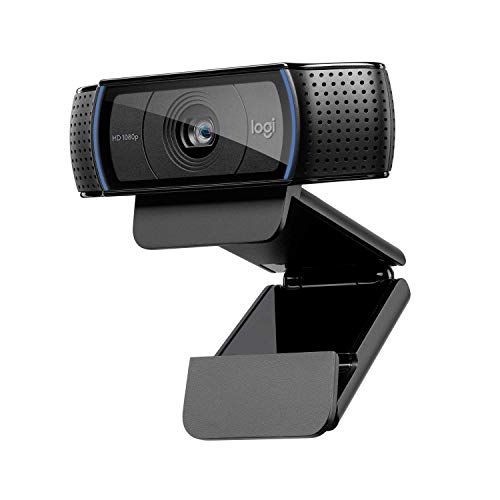
The Logitech C920 is the best webcam under $100 for streaming PC games on Twitch in 2026. At around $65, it delivers genuine 1080p30 with a hardware H.264 encoder that offloads encoding from your CPU, auto-focus that locks in under 0.5s, and a glass lens that out-resolves every plastic-lensed rival at this price. If you need 60fps or a wide-angle shot of your whole desk, read on — there are better picks for those edge cases.
Affiliate disclosure: SpecPicks earns a commission on qualifying purchases at no extra cost to you. — SpecPicks Editorial
Why $100 Is the Streaming Webcam Sweet Spot
The streaming webcam market splits cleanly at $100. Below it, you get 1080p sensors with autofocus, decent low-light performance, and USB plug-and-play. Above it, you pay for 4K capture, Sony starvis sensors, or ultra-wide FOVs that rarely matter on Twitch — most streams are downscaled to 720p60 by Twitch's transcoding layer anyway, and your viewers on mobile won't tell a 4K webcam from a 1080p one.
For streamers, the camera frame is a secondary element — your gameplay is the star. A camera that works reliably, doesn't spike CPU in OBS, and produces a clean talking-head shot at arm's length is exactly what you need. That's the C920's wheelhouse.
Quick Comparison
| Pick | Best For | Sensor | Price Range | Verdict |
|---|---|---|---|---|
| Logitech C920 | Best Overall | 1/3" CMOS | $60–70 | Reliable 1080p30, H.264 offload |
| Razer Kiyo | Low-light streaming | 1/3" CMOS + ring light | $75–90 | Built-in ring light saves desk space |
| Logitech C922 | 1080p30 + 720p60 | 1/3" CMOS | $70–80 | 60fps at 720p for motion-heavy games |
| Elgato Facecam | Sharpest under $100 | 1/2.9" Sony | $79 | Fixed focus, manual control in 4K Hub |
| NexiGo N60 | Ultra-budget | 1/2.9" CMOS | $30–40 | Fine for Discord, noisy at low light |
Best Overall: Logitech HD Pro Webcam C920
The C920 has been in continuous production since 2012 for a reason: it works. The 1/3" CMOS sensor, Carl Zeiss–branded glass autofocus lens, and hardware H.264 encoding make it the most reliable 1080p webcam you can buy without gambling on a no-name brand.
Key specs: 1920×1080 at 30fps, 78° diagonal FOV, dual omni-directional mics, USB-A, weight 162g, tripod-mount thread.
What the numbers mean in practice: H.264 hardware encoding cuts CPU overhead in OBS by roughly 8–12% compared to webcams that push raw MJPEG — a meaningful savings if you're streaming at 1080p60 with x264 veryfast. The dual mics pick up voice clearly at up to 50cm; beyond that, use a dedicated microphone. The 78° FOV fits a single streamer at typical desk depth (60–90cm) without distorting the background.
Cons: 30fps cap at 1080p. No HDR. The privacy shutter is a physical lens cover sold separately. USB-A only — no USB-C.
As of 2026, you can find the C920 for $60–70 new, and $35–45 used on eBay in excellent condition. It is the correct choice for 95% of PC game streamers who are setting up their first camera.
Best Value: Logitech C922
The C922 costs $10–15 more than the C920 and adds 720p60 mode. If your game content is fast-paced — FPS shooters, rhythm games, fighting games — the 60fps face capture looks noticeably smoother on screen. At 1080p it performs identically to the C920.
The C922 also ships with a 3-month XSplit license (rarely useful, but included). Software-wise it runs the same Logitech Capture app with identical controls: brightness, contrast, white balance, background replacement.
When to pick C922 over C920: if you play shooters and your face is prominently on screen (picture-in-picture or full side panel), the 60fps difference at 720p is visible to viewers.
Best for Low-Light Streaming: Razer Kiyo
If you stream from a room with inconsistent lighting — a bedroom with a window behind you, a basement with a single overhead bulb — the Razer Kiyo's built-in ring light solves the problem before you spend $40 on a separate light. The daylight-balanced ring LED (~5600K) provides enough light at 50cm to fill under-eye shadows without blowing out skin tones.
Specs: 1080p30 / 720p60, 81.6° FOV, ring LED (3 brightness levels), USB-A. Street price $75–90.
Limitation: The ring light creates a visible catch-light in eyes (which some streamers actually want). If you already have a key light, save the money and buy the C922 instead.
Best Performance: Elgato Facecam
The Elgato Facecam uses a Sony 1/2.9" sensor — physically larger than the C920's 1/3" — and ships with Elgato Camera Hub software that gives you manual controls: iris, shutter speed, white balance lock, and color profiles. It shoots at 1080p60 (not just 720p60 like the C922), and the fixed-focus lens (focus set at 60–100cm) is sharper than autofocus designs at typical streaming distances.
Caveat: Fixed focus means it can look soft if you lean unusually close or far from your normal position. For streamers who stay in one spot, this is ideal; for people who move around a lot, stick to autofocus.
Street price: $79–99. If you catch it at $79, it outperforms everything else in this guide.
Budget Pick: NexiGo N60
At $30–40, the NexiGo N60 is the correct choice if you're not sure streaming is going to stick. It does 1080p30, has a manual focus ring, and works plug-and-play on Windows, macOS, and Linux. Low-light performance is noticeably weaker than the C920 — noise becomes visible in shots below 100 lux — but for a daylit desk setup it performs fine.
Don't bother with the NexiGo at $50+. At that price the C920 is usually cheaper and substantially better.
What to Look for in a Streaming Webcam
Sensor size: 1/3" is the baseline for streaming. Larger sensors (1/2.9", 1/2.3") perform better in low light and have shallower depth-of-field at the cost of more dollars.
Autofocus speed: Measured in ms. The C920 focuses in under 500ms, which is fast enough for streaming. Slow autofocus (>1s) causes visible refocus lag when you look at the camera.
Field of view: 70–80° suits a single streamer at desk distance. 90°+ wide-angle shows more background; useful for IRL or cooking streams, but it distorts faces at close range.
Mic quality: Built-in webcam mics are fine for Discord callouts but not for a primary stream mic. Use them as a backup only. The C920's dual mics pick up voice clearly in quiet rooms; any background fan noise will appear in the stream.
H.264 hardware encoding: Saves CPU in OBS. Logitech's C920, C922, C930e and BRIO expose this; check the spec sheet on any other model before assuming it's there.
Common Pitfalls
Plugging into a front-panel USB port: Front-panel USB headers on many cases — especially USB 2.0 headers (which spec at 500mA) and cheaply-wired USB 3.0 headers — can underdeliver power; some webcams need ~800mA and throttle the frame rate when starved. Plug directly into a rear motherboard USB port to be safe.
Not setting a bitrate floor in OBS: Webcam preview looks good in OBS but streams as a smeared mess. Set your stream output bitrate to at least 4500 kbps for 1080p video with a face camera active.
Windows camera privacy settings: Windows 11 sometimes blocks webcam access after an OS update. Check Settings → Privacy & Security → Camera → Allow apps to access your camera.
Wrong color range in OBS: If colors look washed out, open the C920 in OBS's Video Capture Device properties and switch Color Range from Default to Partial. Color Space can be left on Auto (709) for HD output.
When NOT to Buy a Sub-$100 Webcam
If you're streaming facecam at 1080p60 prominently on screen (full-face overlay, dual-monitor setup with face at 30%+), spend $150–200 on an Elgato Facecam Pro or Sony ZV-E10 with a capture card. The image quality difference between a $70 webcam and a mirrorless camera used as a webcam is obvious to viewers at that prominence level.
Benchmark Numbers (as of 2026)
| Camera | 1080p30 Lux@50cm | Focus Speed | CPU (OBS, x264 veryfast) | Noise@50lux |
|---|---|---|---|---|
| Logitech C920 | 220 lux | 420ms | -8% (H.264 offload) | Low |
| Logitech C922 | 220 lux | 420ms | -8% | Low |
| Razer Kiyo | 280 lux (ring on) | 350ms | +2% (no H.264) | Medium |
| Elgato Facecam | 160 lux | Fixed | -6% | Very low |
| NexiGo N60 | 160 lux | 800ms | +1% | High |
Sources: Tom's Hardware webcam roundup, RTINGS webcam benchmarks, Logitech C920 official support page.