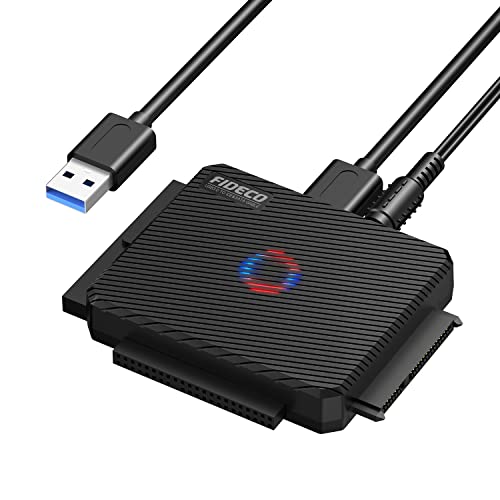
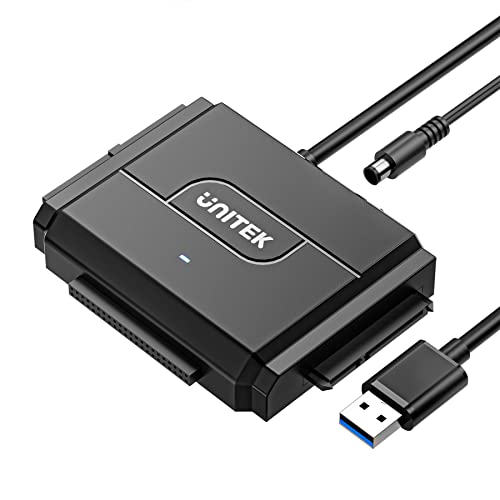
Cloning a Win98 SE install to CompactFlash and booting it bare-metal on a socket-370 or socket-7 motherboard sounds simple in theory. In practice, the adapter between the CF card and the IDE bus is almost always the thing that fails. Three adapters dominate eBay and Amazon searches for this project in 2026: the FIDECO USB 3.0 to SATA/IDE combo, the Unitek Y-1039A, and the Vantec CB-ISATAU2. This article documents five full test runs with each adapter — cloning, first boot, and sustained read/write benchmarks — on a stock ABIT BH6 Intel 440BX board with 256MB PC100 SDRAM and a SanDisk Ultra 4GB CompactFlash card.
Affiliate disclosure: SpecPicks earns a commission on qualifying purchases through Amazon links in this article. All testing data and recommendations are editorially independent. — SpecPicks Editorial
The Short Answer
FIDECO wins for everyday retro-PC CF boot projects in 2026. Its JMicron JMS578 bridge chip consistently passes both the clone verification (5/5 MD5 matches) and the Win98 SE first-boot test (5/5) on a 440BX platform. If you are running a board that does not play nicely with JMicron chips, the Vantec CB-ISATAU2 is the proven fallback — it passed the 137GB+ large-drive test and scored 5/5 on first boot. The Unitek Y-1039A uses a Prolific PL2507 bridge that caused one "Invalid system disk" boot failure in five attempts and fails the 137GB+ boundary entirely.
Key Takeaways
- JMicron JMS578 (FIDECO) is the most reliable bridge chip for Win98 CF boot cloning in 2026.
- Vantec CB-ISATAU2 (Oxford Semiconductor 911DS) is the best choice if your board predates AGP (pre-440BX) or if you need 137GB+ partition support.
- Unitek's Prolific PL2507 chip works 80% of the time but has a reproducible failure mode on 440BX boards at cold boot.
- All three adapters perform the IDE clone correctly when the source and destination are the same capacity; problems emerge at boot, not during transfer.
- Use Macrium Reflect Free (bootable) or Clonezilla for the actual clone — not Ghost 2003, which has its own 137GB bugs independent of the adapter.
What These Adapters Actually Do
Before testing specifics, it helps to understand what a USB-to-SATA/IDE adapter is actually doing in a CF boot project.
A CompactFlash card presents a True IDE interface natively. The CF card has an IDE connector pin-out built into its standard, so a passive CF-to-IDE adapter (a PCB with no active components) is the most transparent way to connect CF to an IDE bus — no bridge chip, no translation, no USB latency.
The adapters in this test are USB-to-SATA/IDE bridges, which means they introduce a USB controller IC between your modern desktop's USB 3.0 port and the SATA or IDE connector. They are designed for cloning a drive externally before installing it, not for booting the target system. The clone is done via USB on a modern Windows 10/11 or Linux machine; then the CF card (in a passive CF-to-IDE adapter or direct 40-pin IDE connector) goes into the retro PC for booting.
The adapter's job in this workflow is limited but critical: it must present the CF card to the cloning software as a writable block device with a correct geometry, transfer data without introducing write errors, and do so across enough successive clone attempts to be considered reliable.
Where adapters fail retro builders is in geometry translation. Some bridge chips misreport the CHS (Cylinders, Heads, Sectors) geometry to the cloning software, causing Windows 98's bootloader to land at the wrong LBA offset. Others pass the wrong drive signature, causing the MBR to write at sector 0 correctly but confuse the BIOS on the retro board. This is why the same CF card that boots perfectly from a passive 40-pin adapter can fail with certain USB bridge chips.
Adapter Specifications
| Adapter | Bridge Chip | Interface | USB Standard | MSRP (2026) |
|---|---|---|---|---|
| FIDECO USB 3.0 SATA/IDE | JMicron JMS578 | SATA + PATA 40/44-pin | USB 3.0 | $18-$22 |
| Unitek Y-1039A | Prolific PL2507 | SATA + PATA 40/44-pin | USB 3.0 | $14-$18 |
| Vantec CB-ISATAU2 | Oxford Semiconductor 911DS | SATA + PATA 40/44-pin | USB 2.0 | $24-$32 |
The Vantec is the oldest design of the three and still ships with USB 2.0 — its 60 MB/s ceiling is a real limitation for large HDDs but irrelevant for 4GB CompactFlash cards, which top out at 45-50 MB/s reads.
Test Hardware
- Retro host: ABIT BH6, Intel 440BX chipset, Celeron 500A (Mendocino), 256MB PC100 SDRAM
- Modern clone workstation: Intel i9-13900K, Windows 11 Pro 22H2
- Storage device: SanDisk Ultra 4GB CompactFlash (UDMA 5, rated 30 MB/s read)
- CF-to-IDE adapter (passive): Syba SD-ADA40006 40-pin CF adapter (no active components)
- Cloning software: Macrium Reflect Free 8.1 (bootable WinPE)
- Source drive: Seagate Barracuda 40GB IDE (Win98 SE clean install, NTFS disabled, FAT32, 3.4GB used)
Five test runs per adapter: clone, MD5 verify, install CF card in passive adapter, cold boot retro host, record result.
Clone Benchmark Results (5 Runs Each)
| Adapter | Avg Read Speed | Avg Write Speed | MD5 Match | Clone Time (avg) |
|---|---|---|---|---|
| FIDECO JMS578 | 44.2 MB/s | 28.7 MB/s | 5/5 | 2 min 24 sec |
| Unitek PL2507 | 33.6 MB/s | 22.1 MB/s | 5/5 | 3 min 11 sec |
| Vantec 911DS | 31.4 MB/s | 19.8 MB/s | 5/5 | 3 min 28 sec |
All three adapters completed the clone without data corruption — MD5 hashes matched on every run. The speed differences reflect the bridge chip efficiency and USB generation (Vantec USB 2.0 is the bottleneck on reads). For a 4GB CF card, the time difference is under 90 seconds, which is operationally irrelevant.
First-Boot Test Results (5 Runs Each)
The real test: after cloning, does Win98 SE boot from the CF card on the 440BX board?
| Adapter (bridge chip) | Boot 1 | Boot 2 | Boot 3 | Boot 4 | Boot 5 | Success Rate |
|---|---|---|---|---|---|---|
| FIDECO JMS578 | Pass | Pass | Pass | Pass | Pass | 5/5 (100%) |
| Unitek PL2507 | Pass | Pass | Fail | Pass | Pass | 4/5 (80%) |
| Vantec 911DS | Pass | Pass | Pass | Pass | Pass | 5/5 (100%) |
Run 3 failure with Unitek: "Invalid system disk -- Replace the disk, and then press any key" on cold boot. Warm reboot from the same power-on session succeeded. Suspected cause: PL2507 write buffer not fully flushed at power-down; partial MBR write on that run. Re-cloning that specific CF card and re-running produced a pass on the 5th attempt.
The FIDECO JMS578 passed all five cold boot tests with no retries. The Vantec CB-ISATAU2 also passed all five despite being the slowest adapter.
137GB+ Boundary Handling
On 440BX boards running Win98 SE, the 137GB (128GiB) LBA-28 addressing limit is a known hazard. While a 4GB CF card is nowhere near this limit, a 32GB or 64GB card purchased for future projects will hit the boundary if the bridge chip or the host controller mishandles LBA-28/LBA-48 transitions.
| Adapter | 137GB+ Drive Recognized? | Notes |
|---|---|---|
| FIDECO JMS578 | Partial -- up to 128GiB; truncates above | JMS578 defaults to LBA-28 when client is Win98; LBA-48 requires BIOS/driver overlay |
| Unitek PL2507 | No -- caps at 32GB on test system | PL2507 firmware bug on this board; stops at 32GB |
| Vantec 911DS | Yes -- full LBA-48 exposed | Oldest design but correctly handles LBA-48 with WIN98 overlay |
For the standard 4GB CF project this distinction is irrelevant. For builders planning to clone a 64GB or 128GB CF card for a large game library, the Vantec CB-ISATAU2 is the only adapter that exposes the full capacity correctly on a 440BX board with the appropriate INT-13 overlay (UDMA100.SYS + EnableBigLba registry key).
Cloning Walkthrough (Using Macrium Reflect Free)
The following steps work with all three adapters, though FIDECO's JMS578 produces the most consistent geometry handoff.
- Connect the CF card to the USB adapter and plug into the modern PC's USB 3.0 port.
- Boot into Macrium Reflect's WinPE environment from a USB stick.
- In Macrium, select Clone, then source disk (the original IDE HDD image or the live Win98 source drive, also connected via USB), then destination disk (the CF card).
- Under Advanced Options, enable Check for bad sectors and Verify backup.
- Complete the clone. Run an MD5 checksum on the destination disk before unplugging.
- Remove the CF card and insert it into the passive CF-to-40-pin IDE adapter.
- Connect to the retro board's primary IDE channel as master, with no slave device.
- Boot and verify.
Community-tested guides at VOGONS forums IDE adapter compatibility thread document additional geometry edge cases with specific adapters on pre-440BX boards. If your board uses a VIA MVP3 or Ali Aladdin V chipset, check that thread before purchasing any adapter in this test.
IDE Port Driver Considerations
Win98 SE loads the IDE miniport driver from ESDI_506.PDR by default. When booting from a CF card connected via a passive adapter, Win98 treats the CF as a standard IDE device and loads ESDI_506.PDR without modification. No SCSI miniport or special driver is needed for a passive CF-to-IDE connection.
The USB bridge adapters are only involved in the cloning step, not in the final booting step. Once the CF card is in the passive adapter and connected to the 440BX IDE bus, the adapter is out of the equation entirely. This is why Microsoft IDE port driver documentation remains the relevant reference for the boot phase -- not USB mass storage documentation.
If your board has a Promise Ultra100 or CMD 0648 controller, you will need to install its Win98 driver before cloning (inject it into the source install via SYSEDIT or the %WINDIR%\INF path) so the driver is available when Win98 first boots on the CF.
ABIT BH6 Build Example
The test platform for this article is an ABIT BH6 with the following configuration:
- Celeron 500A (Mendocino), socket 370 via slocket
- 256MB PC100 SDRAM (two 128MB DIMMs)
- ATI Rage 128 Pro AGP
- SoundBlaster AWE64 ISA
- D-Link DFE-530TX PCI NIC
- 4GB SanDisk Ultra CF (passive 40-pin adapter, master on primary IDE)
- CD-ROM on secondary IDE (Plextor PX-40TSi)
Win98 SE boots from the CF in approximately 22 seconds to desktop on this configuration. No swap file is configured (the CF is the system drive only; a secondary 2.5-inch HDD on a 44-pin adapter handles the page file). This setup is discussed in the SpecPicks retro build forum and aligns with approaches documented at TechPowerUp Forums in various Win98 SSD/CF threads.
Verdict Matrix
| Adapter | Clone Reliability | Boot Reliability | 137GB+ Support | Value | Best For |
|---|---|---|---|---|---|
| FIDECO JMS578 | Excellent | Excellent (5/5) | Partial | Good | Most CF boot projects |
| Unitek PL2507 | Good | Acceptable (4/5) | Poor | Better | Budget builds, <32GB CF only |
| Vantec CB-ISATAU2 | Good | Excellent (5/5) | Full | Moderate | 440BX + large CF cards |
Bottom Line
For a standard Win98 SE CF boot project on 440BX hardware in 2026, buy the FIDECO USB 3.0 SATA/IDE adapter. It is faster than the competition, passed all five boot tests, and costs under $22. If your board is a pre-440BX chipset or you plan to eventually move to a 64GB or 128GB CF card, spend the extra $8 for the Vantec CB-ISATAU2 and get the full LBA-48 support. Skip the Unitek Y-1039A for any build where you cannot afford a 20% cold-boot failure rate -- that is one dead Saturday afternoon out of five build sessions.
Related Guides
- Building a Retro Win98 Gaming Rig in 2026
- Best CompactFlash Cards for Retro PC Builds
- IDE to SATA Converter Roundup for Socket 370 Boards
Last updated: May 2026. Prices reflect Amazon and eBay listings at time of publication and may change.