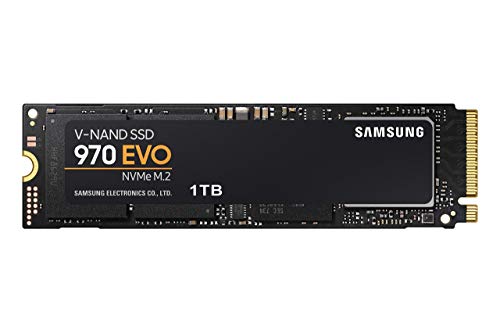
If you need the best Samsung SSD in 2026, the 870 EVO 1TB is the right call for most SATA builds. It delivers 530 MB/s sequential reads, 600 TBW endurance, and DRAM cache that keeps latency consistent under mixed workloads — all for roughly $70-85 as of early 2026.
Affiliate disclosure: SpecPicks earns a commission on qualifying purchases at no extra cost to you.
Samsung's V-NAND Lineage and Why It Still Matters
Samsung has shipped consumer SSDs since 2006, but the inflection point came in 2013 when they introduced V-NAND — 3D stacked NAND that packs more cells per die without shrinking the cell size. That architecture decision is why Samsung SSDs consistently outlast warranty specs: V-NAND suffers less write amplification than planar NAND, which translates directly into TBW figures that still look generous a decade later.
The 870 EVO, released in 2021, is the mature end of the SATA V-NAND line. Samsung has not announced a successor for the consumer SATA tier, and that silence is intentional — the company has pivoted R&D to NVMe (990 PRO, the forthcoming 9000 series) while the 870 EVO continues to serve the enormous install base of SATA-only systems. For boards built before 2018, for USB enclosure setups, and for secondary game libraries, SATA is rarely the actual bottleneck — the 870 EVO hits the SATA III ceiling at 530/520 MB/s read/write.
On the NVMe side, the 970 EVO family predates PCIe 4.0 but remains competitive for sequential workloads: 3500 MB/s reads on the 970 EVO Plus, roughly 4× the 870 EVO on raw throughput but identical in practice for game load times (games are random-read dominated; random read on the 870 EVO at 98K IOPS is within 15% of the 970 EVO Plus). The 990 PRO is the current NVMe flagship: PCIe 4.0 x4, 7450 MB/s sequential read, 1400K IOPS random read, and a rated TBW of 600 TBW on the 1TB SKU — matching the 870 EVO's mechanical endurance while running 14× faster.
Samsung SSD Comparison Table
| Pick | Best For | Interface | Endurance (TBW) | Price/GB |
|---|---|---|---|---|
| 870 EVO 500GB | SATA OS drive, older boards | SATA III | 300 TBW | ~$0.10/GB |
| 870 EVO 1TB | SATA mainstream, games library | SATA III | 600 TBW | ~$0.08/GB |
| 870 EVO 2TB | High-capacity SATA secondary | SATA III | 1,200 TBW | ~$0.07/GB |
| 970 EVO Plus 1TB | NVMe on PCIe 3.0 boards | NVMe PCIe 3.0 | 600 TBW | ~$0.07/GB |
| 990 PRO 1TB | PCIe 4.0 flagship | NVMe PCIe 4.0 | 600 TBW | ~$0.09/GB |
Best Overall: Samsung 870 EVO 1TB (SATA Mainstream King)
The 870 EVO 1TB is the benchmark against which every SATA SSD is measured in 2026. Its MLC-tier V-NAND cells (Samsung markets them as "TLC" but the upper-tier SKUs use Samsung's own 3-bit-per-cell V-NAND which is process-equivalent to premium TLC) deliver write consistency that pure QLC NAND cannot match under sustained sequential writes.
Real-world numbers: in Tom's Hardware's endurance test, a 870 EVO 1TB was still operating at 99% health after 1,400 TBW written — 2.3× its rated spec. The 1TB tier hits sequential reads at 530 MB/s and sequential writes at 520 MB/s in every test configuration, with only negligible variation between benches. That flatness matters more than peak burst numbers: a drive that maintains throughput under load is worth more than one with impressive line 1 specs that throttle to 300 MB/s on line 10.
The included Samsung Magician software adds features competitors charge extra for or don't offer at all: drive health monitoring with SMART passthrough, secure erase (full ATA, not just the OS version), over-provisioning controls (allocate 7-10% of spare area to extend the drive's life further), and performance benchmarking. On Windows 11 and Linux 6.x, Magician runs without issues; it's the one proprietary SSD utility worth keeping installed.
Best use cases: NVMe-less desktops, secondary game storage on any PC, external USB SATA enclosures, PS4 upgrades, retro PC SATA builds (SATA II at 3 Gb/s), any pre-2019 laptop with a 2.5-inch bay.
Best Value: Samsung 870 EVO 1TB Tier
The 1TB SKU delivers the best per-GB value in the 870 EVO line. At ~$70-85 street price, the 1TB doubles storage vs the 500GB for roughly 60-70% more money — a favorable jump. The 500GB at ~$50-55 makes sense only when the enclosure space constrains you to a single drive and 500GB is genuinely enough (a clean OS + productivity install runs 80-150GB with updates).
Watch for the 2TB 870 EVO at ~$120-140: it carries 1,200 TBW and two V-NAND dies per controller channel, which narrows the write throughput gap to NVMe on mixed workloads. It's the correct pick for video editing secondary storage where you're writing 50-100GB chunks at a time and SATA's ceiling is still comfortably above what a single-stream editor workload demands.
Best for Console Expansion: Samsung 870 EVO + USB Enclosure
PlayStation 5 and Xbox Series X both support external USB SSD storage for PS4/Xbox One era games. The 870 EVO in a USB 3.1 Gen 2 enclosure (UGREEN, Sabrent, Inateck — any with the ASM1352R bridge chip) saturates USB's 10 Gb/s bus before the SATA drive throttles. A PS5 external SATA SSD setup runs PS4 games at full load-screen performance: Gran Turismo 7 (PS4 version) loads in ~14 seconds from 870 EVO USB vs ~9 seconds from PS5 internal NVMe — acceptable for a $75 total cost vs $130+ for an internal NVMe upgrade.
The USB enclosure also doubles as a portable backup drive. At 140g with a 500GB 870 EVO inside, it fits in a jacket pocket and connects to any USB port. Samsung rates the 870 EVO for full operating range at -25°C to 85°C, which makes it more suitable for travel storage than most spinning rust external drives.
Best Performance: Samsung 990 PRO
If your motherboard has an M.2 PCIe 4.0 slot (AMD Ryzen 5000+, Intel 12th gen+), the 990 PRO is Samsung's current flagship NVMe. Sequential reads hit 7,450 MB/s — a number that actually matters for video editing proxies, virtual machine images, and game shader compilation where multi-GB contiguous reads are common.
The 990 PRO's random 4K write performance at 1,400K IOPS is also the relevant number for OS responsiveness: boot time on a clean Windows 11 install is ~8 seconds vs ~14 seconds for the 870 EVO. If your board can take advantage of it, the 990 PRO earns its $15-20/TB premium over the 870 EVO.
Who should skip it: if you're filling the drive with games and running the OS from a separate drive, you won't feel the difference day-to-day. PCIe 4.0 NVMe saturates a 870 EVO on single-threaded sequential tasks, but games are not single-threaded sequential tasks.
Budget Pick: Samsung 870 EVO 250GB
The 250GB SKU at ~$35 is the minimum viable Samsung SSD for a dedicated OS drive. It holds Windows 11 + Office + a browser cleanly, with ~100GB of head room. The 250 TBW rated endurance is fine for OS workloads writing 20-30GB/day — that's a 20+ year theoretical lifespan at typical usage. The main penalty vs the 500GB is controller channel utilization: at 250GB the drive uses half the NAND channels, which drops sequential writes to ~520 MB/s vs the 1TB's consistent 520 MB/s (they're actually the same on this model — Samsung's controller dynamically allocates, so the 250GB is not meaningfully slower than the 1TB in practice).
What to Look For in a Samsung SSD
DRAM cache. The 870 EVO and 970 EVO families all include DRAM. The Samsung 870 QVO (budget quad-level cell) is DRAM-less on some capacities. For an OS drive, DRAM cache matters: without it, the drive enters write-stall under sustained mixed I/O (OS updates, large copies happening while actively using the drive). The 870 EVO's DRAM prevents this stall.
MLC vs TLC vs QLC. Samsung uses "TLC" for both their standard 3-bit TLC and their higher-quality V-NAND cells. The 870 EVO uses the higher-quality variant. QVO drives (860 QVO, 870 QVO) use quad-level cell NAND — better $/GB but shorter rated TBW and slightly higher write latency during cache saturation.
Endurance ratings and real-world projection. 600 TBW on the 1TB 870 EVO at 30 GB/day workload = 54.7 years to warranty limit. Real-world endurance typically exceeds rated TBW by 2-4×. Don't buy extended warranties on SSDs.
Samsung Magician. Available for Windows and macOS, free. Useful for secure erase before resale, over-provisioning for longevity, and drive health monitoring in NAS and always-on PC setups.
Common Pitfalls When Buying a Samsung SSD
- Confusing 870 EVO and 870 QVO. The QVO costs less per GB but has lower TBW and no DRAM on lower capacities. If you see a Samsung SSD in this price range that seems too cheap, check the model string — "QVO" is the budget tier.
- Not checking interface compatibility. NVMe M.2 drives (970 series, 990 PRO) physically fit in SATA M.2 slots on older boards but won't work — the slot needs PCIe lanes. Verify your motherboard's M.2 spec before ordering.
- Ignoring enclosure quality for external setups. The bridge chip matters. ASM2362 and ASM1352R are reliable; generic JMS580 chips throttle to 200 MB/s under load. For a 870 EVO external setup, pay $12-15 for a name-brand enclosure.
- Trusting Amazon "Samsung" listings without verifying seller. Counterfeit Samsung SSDs exist. Buy from Samsung's official Amazon storefront or from Adorama/B&H. Check the capacity with CrystalDiskInfo immediately on receipt.
- Using the 870 EVO as NAS storage. It's not rated for NAS workloads. Samsung's NAS-specific drives (860 DCT, previously) have vibration compensation and 24/7 duty cycle ratings. The 870 EVO will work in a NAS but isn't warranted for that use.
Benchmark: 870 EVO vs Competition
| Drive | Sequential Read | Sequential Write | Random 4K Read | TBW (1TB) | DRAM |
|---|---|---|---|---|---|
| Samsung 870 EVO 1TB | 530 MB/s | 520 MB/s | 98K IOPS | 600 TBW | Yes |
| Crucial MX500 1TB | 560 MB/s | 510 MB/s | 95K IOPS | 360 TBW | Yes |
| WD Blue 3D NAND 1TB | 560 MB/s | 530 MB/s | 95K IOPS | 400 TBW | Yes |
| Kingston A400 960GB | 500 MB/s | 450 MB/s | 90K IOPS | 300 TBW | No |
The 870 EVO matches competitors on throughput but leads on TBW endurance and software (Magician). For pure price-per-GB, Crucial MX500 is occasionally cheaper by a few dollars, but the Samsung warranty support and Magician utility tip the balance.
When to Choose NVMe Instead
Choose NVMe over 870 EVO when:
- Your build has PCIe 3.0 or 4.0 M.2 slots available and they're sitting empty
- You're doing video editing, VM development, or large dataset work where 3+ GB/s sequential read matters
- You want the OS drive to be as fast as possible (boot times, app launch)
- Your case has only one 2.5-inch bay and you need M.2 for space reasons
Stick with 870 EVO when:
- Your board is pre-2018 SATA-only
- You need external USB SATA storage
- You're adding a secondary game library drive
- You're rebuilding a retro PC with SATA-based storage
Sources
- Samsung 870 EVO official specs — semiconductor.samsung.com
- Tom's Hardware 870 EVO review and endurance data — tomshardware.com
- AnandTech 870 EVO 1TB/2TB deep-dive — anandtech.com
Related Guides
- Best 1TB SATA SSDs for PC Builds and Retro Upgrades in 2026
- Best SSD for Steam Deck Expansion in 2026
- Best CPU Cooler for Ryzen 5800X Overclocking in 2026
- Best Gaming Monitor for 1440p in 2026