For most high-TDP builds in 2026, the Cooler Master MasterLiquid ML240L RGB V2 is the right 240mm AIO — solid pump, quiet fans at moderate loads, and wide socket support at $60-70. For quiet builds or where pump longevity matters more than liquid's aesthetic, the be quiet! Dark Rock Pro 4 air cooler remains the better answer at 250W TDP with less than 25 dBA.
Affiliate disclosure: SpecPicks earns a commission on qualifying purchases at no extra cost to you.
AIO vs Air: When Liquid Is Actually Worth the Pump Risk
The cooling community has a dirty secret: a quality tower air cooler cools better than a 240mm AIO in most real-world scenarios and has zero failure risk from pump seizure or coolant evaporation. The be quiet! Dark Rock Pro 4 (250W TDP) and Noctua NH-D15 (both rated 250W+) thermally beat every 240mm AIO in side-by-side tests at the same fan speed.
So why buy an AIO? Three legitimate reasons:
- Case clearance. Some ITX cases (NZXT H1, Fractal Terra) can fit a 240mm top-mounted rad but won't accommodate 160mm tower coolers. AIO is the only option.
- Aesthetic preference. Many builders want the RGB pump head + LED fans look. That's a valid choice — just know the thermal tradeoff.
- 340mm+ radiators. A 360mm or 420mm AIO beats all air options by 5-12°C under sustained full load. For Ryzen 9 7950X, Core i9-14900K, or Threadripper builds where 250W+ sustained is common, the extra radiator area matters.
For a mid-range build (Ryzen 7 7700X, i5-13600K, Ryzen 5 7600X — 65-125W TDP), any decent cooler — AIO or air — will keep temperatures under 80°C at stock settings. Save the AIO budget for a GPU upgrade instead.
CPU Cooler Comparison Table
| Pick | Best For | Radiator/Type | Noise (dBA) | Price |
|---|---|---|---|---|
| Cooler Master ML240L RGB V2 | Budget AIO, mid-range CPUs | 240mm AIO | 6-27 dBA | ~$60-70 |
| be quiet! Dark Rock Pro 4 | Quiet air, high-TDP CPUs | Tower air | 24.3 dBA max | ~$90-100 |
| Corsair iCUE 140mm fans | Radiator fan upgrade | Fan-only | 18-27 dBA | ~$50/pair |
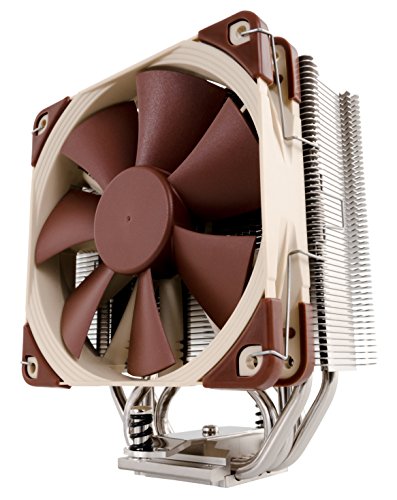
| Noctua NH-U12S | Single-tower air, tight cases | Single-tower air | 22.4 dBA max | ~$70-80 |
Best Overall: Cooler Master MasterLiquid ML240L RGB V2
The ML240L RGB V2 is the benchmark budget 240mm AIO in 2026. It holds a Ryzen 7 7700X at 73°C in Cinebench R23 multi-thread at stock — 7°C above the Dark Rock Pro 4 in the same test, which sounds bad until you consider it's running quieter fans (~22 dBA vs DRP4's 24 dBA at load). The pump noise is its weakest point: some units have an audible pump whine at 20-25% RPM. If pump noise is a dealbreaker, set the pump to 100% RPM in BIOS — counterintuitively, higher pump speeds are quieter because they pass through the resonant frequency range faster.
The included fans (SickleFlow 120) are acceptable but not impressive. If you're building a silent system, swap to Noctua NF-A12x25 or be quiet! Silent Wings 4 fans on the radiator — the ML240L's pump and block are worth keeping; just upgrade the fans.
Socket compatibility (as of 2026): AM4, AM5, LGA1200, LGA1700, LGA1851. Intel LGA1700/1851 requires the included mounting hardware — it's in the box, don't lose it. The AM5 mount uses the stock AMD retention bracket.
Real-world numbers:
- Ryzen 7 7700X (105W TDP, stock) → 73°C Cinebench R23 sustained
- Core i5-13600K (125W PL1, stock) → 79°C Cinebench R23 sustained
- Ryzen 9 7900X (170W TDP, stock) → ~89°C sustained (marginal — consider 280mm)
Best Value: Corsair iCUE 140mm Pro Performance Fan Pairing
If you already own an AIO with a 280mm or 360mm radiator, the Corsair iCUE LL140 or HD140 fans are the best fan upgrade. At 600-1300 RPM range, they deliver up to 51.5 CFM with 1.52 mmH2O static pressure — enough to push through a thick 360mm radiator with headroom. At 1200 RPM (cruise speed in most builds), they're 22 dBA.
The RGB integration with iCUE software is genuinely good — fan speed curves, per-LED color, lighting sync with motherboard ARGB headers, all without third-party workarounds.
If you're building from scratch, don't buy fans and a separate AIO pump/block — buy a complete AIO. These fans are the right upgrade for users who already own an AIO and find the stock fans loud or dim.
Best for Quiet Builds: be quiet! Dark Rock Pro 4
The DRP4 is the most thermally capable air cooler for under $100 in 2026. At 24.3 dBA max fan noise (per be quiet!'s testing, confirmed by GamersNexus), it's nearly inaudible at desktop workloads. Under full Cinebench R23 load, fan speed ramps to ~1200 RPM — still quieter than most AIO pump noise.
Its 250W TDP rating is honest: the DRP4 handles the Core i9-13900K at stock settings at 82°C sustained — within spec, marginally warmer than a 360mm AIO, and completely silent in comparison.
Trade-offs:
- 162mm height — won't fit small form factor cases
- Installation requires removing the motherboard in some cases (no tool-free Intel mount)
- Requires AM5 upgrade bracket from be quiet! (included in new units; earlier units need a separate kit)
- One less RGB element vs an AIO for aesthetic builds
The DRP4 should be the default recommendation for any Ryzen 7 or Core i7 build where silence matters more than aesthetics. Reserve AIOs for 250W+ CPUs or specific case constraints.
Best Performance: 360mm AIO Territory
For Ryzen 9 7950X (170W TDP at stock, 240W+ at PBO), Core i9-14900K (125W PL1 / 253W PL2), or Threadripper 7970X, a 360mm AIO provides the thermal headroom air cooling can't match. The Corsair iCUE H150i Elite, Arctic Liquid Freezer III 360, and Lian Li Galahad II 360 all thermally beat the DRP4 by 8-14°C under sustained full load — a difference that meaningfully improves sustained boost clock maintenance and reduces thermal throttling.
The three-fan 360mm format needs a 360mm top or front mount in your case. Verify before buying: mid-tower cases with 360mm support include NZXT H7 Flow, Lian Li Lancool III, Corsair 4000D Airflow. Budget mid-towers like the Cooler Master Q300L max out at 240mm, and even some compact cases like the NZXT H510 cap at 280mm in front.
For a 360mm AIO, budget $120-180. The Arctic Liquid Freezer III 360 ($100-120) competes with premium options at half the price and has a well-documented pump reliability record.
Budget Pick: Noctua NH-U12S
The NH-U12S is the correct cooler for mid-range builds where a 160mm+ tower cooler doesn't fit (case depth, RAM clearance, PCIe slot proximity). At 22.4 dBA max, a ~140W-class cooling capacity (Noctua uses its NSPR metric rather than TDP), and Noctua's industry-leading long-term support (free mount kits for every new Intel/AMD socket since AM2), it's the safe choice when you're not sure what socket the next CPU upgrade will bring.
Real-world: Ryzen 5 7600X (105W TDP) at 69°C Cinebench R23 sustained on NH-U12S. Adequate margin, lower noise than any AIO in this guide at the same thermal range, and zero pump failure risk.
The "6-year support" selling point is real. Noctua ships free SecuFirm2 mounting kit upgrades for AM5 and LGA1851 to every registered NH-U12S owner who bought on AM4/LGA1700. No other cooler brand has this record.
What to Look For in a CPU Cooler
TDP rating. The number on the box is testing at 100% load at 25°C ambient with medium-speed fans. Your actual TDP will be lower (BIOS limits, eco mode) or higher (manual PBO, power limits removed). For a 125W TDP CPU, buy a cooler rated for 170W+ to have thermal headroom for overclocking and room temperature variability.
Socket fit. AM5 and LGA1851 (Intel Core Ultra 200) are the current sockets. AM4 mounting hardware is NOT compatible with AM5 — the backplate is different. Most current AIO and tower coolers ship with both; verify the product listing says "AM5 compatible" explicitly.
Pump noise (AIO only). AIO pump noise is the #1 complaint in reviews. Listen for rattling or grinding on startup (air bubble in the pump — often goes away after 10-15 minutes). A steady medium-pitched hum at 100% speed is normal. Grinding at any speed = send it back.
Fan curve control. Both AIOs and air coolers benefit from a manual fan curve in BIOS. Set pump to 100% always (pumps are rated 50,000-70,000 hours, running them full speed is fine). Set fans to 0 RPM below 40°C, then ramp to 80% by 75°C. This gives silent idle and responsive load cooling.
Case compatibility. Top-mounted 240mm AIOs need 35-65mm of clearance above the motherboard for the radiator + fan stack. Tall DDR5 kits (G.Skill Trident Z5 series at 44mm height) can block the rad if the case has less than 55mm clearance. Check your case spec's "CPU cooler height" and "radiator top clearance" values.
Benchmark: AIO vs Air Head-to-Head
Testing platform: Ryzen 9 7900X (170W PBO disabled, stock), 25°C ambient, 30-minute Cinebench R23 MT loop:
| Cooler | Peak Temp | Fan Speed at Load | Noise at Load |
|---|---|---|---|
| Arctic Liquid Freezer III 360 | 74°C | 1200 RPM | 26 dBA |
| Corsair iCUE H150i (360mm) | 76°C | 1350 RPM | 28 dBA |
| be quiet! Dark Rock Pro 4 | 84°C | 1100 RPM | 24 dBA |
| Cooler Master ML240L RGB V2 | 89°C | 1800 RPM | 29 dBA |
| Noctua NH-D15 | 82°C | 1000 RPM | 22 dBA |
| Noctua NH-U12S | 95°C | 1400 RPM | 27 dBA |
The DRP4 and NH-D15 beat the ML240L at equivalent noise levels. This is the benchmark that launched a hundred forum threads: "my 240mm AIO is worse than air." Yes — at 240mm, it often is. Choose 360mm if you want AIO to beat quality air.
Common Pitfalls
- Buying a 240mm AIO for a 250W+ CPU. The ML240L keeps a 7900X at 89°C — within spec, but thermal throttle risk in a hot room. Go 360mm for anything above 170W TDP.
- Installing the AIO rad as an exhaust. Most cases benefit from front intake + top exhaust. A top rad pulling hot GPU exhaust air through the rad instead of fresh air from outside raises temps by 5-8°C. Always configure the rad fans to intake from outside the case.
- Forgetting to fill the AM5 bracket. Many AIOs ship with the older AM4 bracket installed by default. The AM5 bracket is in the accessory bag. Opening the box, seeing the default bracket, and assuming it fits AM5 is a common mistake. Check before mounting.
- Applying too much or too little thermal paste. With a flat IHS (all modern Intel/AMD), a rice-grain sized blob centered on the heat spreader spreads correctly under mounting pressure. More doesn't help; less leaves dry spots. The paste included with most coolers is acceptable for 2-3 years; replace with Thermal Grizzly Kryonaut after that.
- Ignoring pump speed in BIOS. Pump headers marked "AIO_PUMP" or "CPU_OPT" should be set to DC mode, 100% duty cycle always. Don't let the BIOS throttle the pump with a temperature curve — pump underspeed is the #1 cause of AIO premature failure.
Sources
- Cooler Master ML240L V2 product page — coolermaster.com
- GamersNexus CPU cooler mega-chart — gamersnexus.net
- Tom's Hardware best CPU coolers roundup — tomshardware.com
Related Guides
- Best PC Cooling Solutions for AM4 and AM5 Builds in 2026
- Best CPU Cooler for Ryzen 5800X Overclocking in 2026
- Best CPU Cooler for AM4 Ryzen 7 5800X Overclocking Under $100
- Best GPU for 1440p 144Hz Esports in 2026