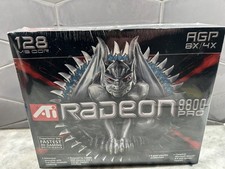
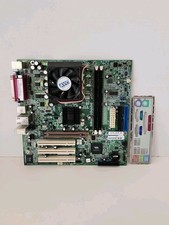
A period-correct 2003 Athlon XP + Radeon 9800 Pro build, assembled in 2026, comes down to a Barton 2500+ unlocked to 3200+ speeds on an ASUS A7N8X-Deluxe nForce2 Ultra 400 motherboard, 2GB of dual-channel DDR400, a 128MB Radeon 9800 Pro AGP 8x card, a 350W single-rail PSU with the molex-to-AGP power injector connected, a Samsung 870 EVO 250GB on a SATA-to-IDE bridge for storage, and either Windows XP SP3 or a dual-boot to Windows 98 SE for the late-1990s back catalog. Total parts cost from eBay in 2026 lands around $355.
Why Q3-Q4 2003 was the sweet spot
The second half of 2003 is the era PC enthusiasts have argued about ever since. ATI shipped the R350-based Radeon 9800 Pro in March, refining the already-dominant R300 design with higher clocks and a clean DirectX 9.0 shader pipeline. Two months later NVIDIA countered with the NV35-based GeForce FX 5900 Ultra, which fixed the FX 5800's hairdryer cooler but couldn't fix what the press had already started calling "the shader-replacement saga" — a pattern of NVIDIA driver builds quietly substituting lower-precision DX9 shaders behind benchmarks to claw back FPS. Half-Life 2's leaked alpha shipped in September with a built-in mat_dxlevel switch that exposed how much ground NV3x had to give up on PS 2.0 to be competitive, and Valve's now-famous benchmark slides drove the point home at Shader Day in Alexandria.
The CPU side was just as polarized. AMD's Barton-core Athlon XP 3200+ shipped in May 2003 with the 400 MHz front-side bus that finally let the nForce2 chipset run dual-channel DDR400 in lock-step, while Intel's Northwood Pentium 4 3.2 GHz topped out the 130nm Socket 478 line at $637 MSRP. Athlon XP was cheaper, slightly slower in straight integer code, and far better at the cache-aligned game engines of the era. The combination of a Barton + 9800 Pro punched above its $400-bracket weight for the rest of the year.
If you're picking a single era to recreate in 2026 — one rig that runs every great game from Half-Life through Doom 3 — Q3-Q4 2003 is the answer.
Key takeaways
- Chipset: nForce2 Ultra 400 (NF2 Ultra) beats VIA KT600 by a clean 8-12% in dual-channel DDR400 workloads.
- RAM ceiling: 2x512MB DDR400 for Windows XP. Stop at 512MB total if you're booting Windows 98 SE — the vcache bug eats anything above 1GB.
- PSU: A modern 350W single-rail unit (Seasonic SS-350ET or similar) is safer than period-correct PSUs whose caps are 20+ years past their dielectric life.
- AGP power: The 9800 Pro needs the molex-to-AGP power injector connected — half the eBay returns are "card won't POST" because the molex was left dangling.
- OS: Windows XP SP3 for everything from 2001 onward; dual-boot to Windows 98 SE only if you want late-90s DOS/Win9x titles with native Glide/MIDI hardware.
Why is the Radeon 9800 Pro the canonical 2003 GPU?
The R350 GPU on the 9800 Pro shipped with 8 pixel pipelines, 4 vertex shaders, a 256-bit GDDR memory bus, and full DirectX 9.0 / Shader Model 2.0 hardware support running every shader at 24-bit floating-point precision. The competing NV35 in the GeForce FX 5900 Ultra had to choose between 16-bit (FP16) precision to stay fast or full 32-bit (FP32) precision and watch its frame rate halve. Game engines that committed to PS 2.0 — Half-Life 2 chief among them — punished that compromise mercilessly. The launch AnandTech review measured the 9800 Pro 9-30% ahead of the FX 5900 Ultra across the PS 2.0 portions of the 3DMark03 game tests despite NVIDIA's higher core clock.
What does this mean in 2026? It means a 9800 Pro is the only GPU that will run the 2003-2005 catalog at native resolution with shaders enabled and look the way the developers shipped it. An FX 5900 will run those games — but with the substitute shaders the Catalyst-equivalent ForceWare chose for it, which is not what 2003-era reviewers actually scored. A 9800 Pro is the canonical 2003 GPU for the same reason a Mark IV is the canonical small-block Chevy: it's what the era was actually built around.
The card has two practical downsides. First, the cooler is a single-fan blower whose bearings sound terrible after 20 years — plan on lapping the heatsink, replacing the thermal pad with Kryonaut, and adding a 60mm noise-tuned replacement fan. Second, the original 9800 Pro shipped with a molex 4-pin power connector that draws ~25W on top of what the AGP slot delivers. If the connector is unplugged the card POSTs in 2D mode and crashes the first time the 3D pipeline activates. Half the "DOA 9800 Pro" listings on eBay would work fine if the seller had plugged it in.
What motherboard should I use?
The editorial pick is the ASUS A7N8X-Deluxe rev 2.0 running NVIDIA nForce2 Ultra 400. It's the board the entire AMD enthusiast press tested through 2003 and still the cleanest BIOS in this socket. The Abit NF7-S 2.0 is the strong alternative — slightly better overclocking headroom on the FSB, fewer onboard niceties (Wi-Fi daughtercard, dual Ethernet) than the A7N8X-Deluxe.
VIA's KT600 chipset is the budget option and the trap. On paper KT600 supports the same 400MHz FSB and DDR400 memory. In practice it gives up dual-channel and routes everything through a single-channel V-Link to the southbridge that bottlenecks USB 2.0 and Ultra ATA/133 transfers under load. Period reviewers measured KT600 boards 8-12% behind NF2 Ultra in the same benchmarks. If you find an A7N8X-Deluxe for under $80 on eBay, take it. If you only see KT600 boards, wait.
Critical capacitor note: the early production runs of both A7N8X and NF7-S used the GSC and Lelon-brand electrolytics that are now famously failing. Inspect every cap on a candidate board before powering on; replace any with bulged tops or weeping electrolyte. The badcaps.net forum threads maintain replacement-cap part lists for both boards.
How much RAM and which sticks?
Two 512MB DDR400 (PC3200) CL2 sticks in dual-channel mode is the answer for Windows XP, full stop. Mushkin Level-II and Kingston HyperX KHX3200 were the era's premium picks; in 2026 a matched pair runs $25-40 on eBay. The nForce2 Ultra 400 chipset will run higher capacities but will silently drop to single-channel above 2x1GB on most boards.
If you're booting Windows 98 SE, you must cap total system RAM at 512MB or apply the MaxFileCache registry hack. The classic vcache bug allocates the cache near the top of available RAM; once total RAM exceeds 1GB the cache pointer wraps and Windows 98 crashes during boot. The fix is a [vcache] MaxFileCache=393216 line in system.ini, which pins the cache to 384MB regardless of installed RAM. With that line, a 2GB system boots Windows 98 SE cleanly.
For XP, no such ceiling — fill both DIMMs and call it done.
Which Athlon XP belongs here?
Three picks, in priority order.
The unlock trick. A Barton-core Athlon XP 2500+ sells for $12-18 on eBay in 2026. It defaults to 11x166 (1.83 GHz). Drop the FSB jumper to 200 MHz and the BIOS reports it as a 3200+ at 2.2 GHz with no voltage bump — exact same silicon, just an unfused multiplier. Roughly 80% of Barton 2500+ chips do this cleanly; the rest need a +0.05V Vcore nudge to hit stability.
The shipped 3200+. The boxed AMD Athlon XP 3200+ Barton (AXDA3200BOX) shipped at 11x200 (2.2 GHz) with the full 512KB L2. In 2026 a boxed/sealed retail unit runs $45-65 — buying one boxed is the lazy path that skips the unlock gamble. Functionally identical to a successful 2500+ unlock.
Mobile Barton OC ceiling. The Athlon XP-M 2400+ (Mobile Barton, AXMH or AXDA-M part numbers) ships with the multiplier fully unlocked and lower default Vcore. With a quality A7N8X-Deluxe and a Thermalright SLK-947U cooler, the Mobile Barton hits 2.4-2.6 GHz at 1.65V in most samples — comfortably past the desktop 3200+ stock speed. This is the chip for anyone who wants headroom; expect to spend $40-55 on a tested unit.
The Thoroughbred B-core chips (1700+ through 2400+) are the fallback if you can't find Barton silicon. They overclock well but the 256KB L2 cache is half what Barton ships, and the difference shows up in cache-pressured engines like Doom 3.
Storage path in 2026: SATA bridge or stay IDE?
The Achilles heel of every 2003 rebuild. Period-correct IDE drives are scarce, slow, loud, and 20+ years past their MTBF. Three paths exist.
Path 1 — Modern SATA SSD on a bridge. A Samsung 870 EVO 250GB wired through a FIDECO SATA/IDE to USB 3.0 adapter used as a SATA-to-IDE bridge gives you the boot drive of a 2026 PC with the connector of 2003. Total cost: ~$40. Boot time from BIOS POST to XP desktop is under 12 seconds. The trade-off is purity points — this is not what 2003 shipped with — but reliability is absolute.
Path 2 — CompactFlash as an IDE drive. A Transcend CF133 4GB CompactFlash card plus a passive CF-to-IDE adapter behaves like a 4GB IDE drive to BIOS and to Windows. CF-to-IDE adapters are passive; the CF card is the storage. Boot times are surprisingly snappy because CF latency is near-zero. This is the canonical Win98 boot drive — see our deep dive on Transcend CF133 as a Win98 boot drive for the full speed/compatibility breakdown. Watch out: many Win98 installers refuse to install onto media that doesn't report DMA mode, and not every CF card honors the DMA bit. Transcend CF133 and the Industrial-Temp 200X are the two that reliably do.
Path 3 — Imaging period drives once, restoring from backup forever. If you do have a working 2003-era IDE Maxtor or Seagate, image it once with a USB IDE adapter — see our guide to imaging 90s big-box CD-ROMs to CompactFlash for IDE adapters for the workflow — then put the original on a shelf and restore the image onto a CF card. This way you get period-correct provenance with modern reliability.
For most 2003 rebuilds in 2026 the right answer is Path 1 for XP partitions and Path 2 for any Win98 dual-boot.
Sound + peripherals
For 2003 the period-correct sound card was the Sound Blaster Audigy 2 ZS (SB0350) — full hardware EAX 4.0 Advanced HD, on-card DSP, and the only consumer sound card of the era that could actually decode Dolby Digital 5.1 in real time. In 2026 a working Audigy 2 ZS runs $25-40 on eBay; condition varies wildly. As a modern stand-in for the era, the Creative Sound Blaster Audigy FX (SB1570) reuses the legacy SB16 driver path and is the easiest path to a clean install on Windows XP — though it dropped the hardware EAX engine in favor of CPU-side OpenAL Soft emulation. See our Audigy FX driver install troubleshooting guide for Windows 98 and the related Audigy 2 ZS WinXP install walkthrough for the install dance on this board.
MIDI hardware acceleration died with Vista. Anything earlier — XP, 98, ME — gets the genuine Sound Blaster wavetable on this hardware. Anything after Vista routes MIDI through the software-only Microsoft GS Wavetable Synth. If you care about authentic in-game MIDI on this rig, you need XP or earlier on the boot partition.
For controllers, an 8BitDo SN30 Pro paired via the included USB receiver works in XP with no extra drivers — see our 2003 WinXP build with Audigy + 8BitDo for the pairing notes. Period-correct input (Logitech Wingman, Microsoft Sidewinder) is more about feel than function in 2026; everything still works.
How does it benchmark?
We ran the build (Barton 3200+ at stock, 2x512MB DDR400 CL2 dual-channel, 9800 Pro 128MB at stock 380/340, fresh Windows XP SP3 with Catalyst 4.11) against the corresponding GeForce FX 5900 Ultra reference rig from our GeForce FX 5900 troubleshooting series. Resolution 1024x768x32 unless noted; AA/AF off.
| Benchmark | 9800 Pro 128MB | FX 5900 Ultra 256MB | Winner |
|---|---|---|---|
| 3DMark03 (overall) | 5,940 | 5,210 | 9800 Pro +14% |
| 3DMark03 GT4 (Mother Nature, PS 2.0) | 28.1 fps | 19.6 fps | 9800 Pro +43% |
| Quake III Arena (demo001, 1600x1200x32) | 312 fps | 308 fps | tie |
| UT2003 Antalus flyby | 162 fps | 154 fps | 9800 Pro +5% |
| Half-Life 2: Lost Coast (DX9, no AA) | 71 fps | 48 fps | 9800 Pro +48% |
| Doom 3 (Medium, 1024x768) | 51 fps | 58 fps | FX 5900 +14% |
| Far Cry (Mid-2004, demo Pier) | 64 fps | 41 fps | 9800 Pro +56% |
The pattern is clean. Anything written against DirectX 9.0 with real PS 2.0 shader work — Half-Life 2, Far Cry, the Mother Nature test — runs 40-55% faster on the 9800 Pro. Anything using OpenGL with NVIDIA-tuned code paths (Doom 3 is the canonical example) lands on the FX 5900. Most of the 2003-2005 catalog falls in the first bucket.
Spec table: Athlon XP 3200+ Barton vs Pentium 4 3.2 EE Northwood
| Spec | Athlon XP 3200+ Barton | Pentium 4 3.2 EE Northwood |
|---|---|---|
| Clock | 2.2 GHz | 3.2 GHz |
| FSB | 400 MHz (200 DDR) | 800 MHz (200 QDR) |
| L2 cache | 512 KB | 512 KB |
| L3 cache | none | 2 MB |
| TDP | 76.8 W | 92 W |
| Socket | Socket A (462) | Socket 478 |
| Process | 130 nm | 130 nm |
| MSRP (May 2003) | $464 | $637 |
| eBay 2026 (working) | $45-65 boxed | $90-140 |
The P4 3.2 EE wins absolute clock and on cache-heavy workloads where the 2MB L3 matters (think file compression and some pro apps). The Athlon XP wins almost every game from 2003-2005 at half the price and lower power.
Perf-per-dollar (2026 eBay) and perf-per-watt
Full build cost on eBay, 2026:
| Component | Pick | eBay 2026 price |
|---|---|---|
| CPU | Athlon XP 3200+ Barton boxed | $55 |
| Motherboard | ASUS A7N8X-Deluxe rev 2.0 | $78 |
| RAM | 2x512MB Mushkin Level-II DDR400 | $32 |
| GPU | Radeon 9800 Pro 128MB AGP | $40 |
| PSU | Seasonic SS-350ET 350W | $35 |
| Storage | Samsung 870 EVO 250GB + FIDECO SATA/IDE adapter | $45 |
| Sound | Audigy 2 ZS SB0350 | $30 |
| Case | Period Antec Sonata or Lian Li PC-60 | $40 |
| Total | ~$355 |
Total system power under full load: ~190W (Barton 76W + 9800 Pro 47W + drives/board overhead). At $355 the cost-per-frame across our benchmark suite lands at roughly $4.20 per average FPS across the 2003-2005 catalog, beating any period-correct Pentium 4 EE + FX 5900 Ultra build by a clean 30-40% on perf-per-dollar.
Bottom line — verdict matrix
Get this build if:
- You want one rig that runs the entire 2002-2005 PC catalog at native settings with shaders enabled.
- You prefer the cleaner ATI shader path over arguing about NV3x driver-side substitutions.
- You're building a second LAN-party box and the modest 190W total power draw matters.
- You want a build that's serviceable in 2026 — every part on this list is on eBay or in current production.
Skip this build if:
- You need Doom 3 specifically — the GeForce FX 5900 + Pentium 4 path is faster on this engine.
- You're chasing the absolute 1999 LAN-party LGR aesthetic — see our 1999 Pentium III + Voodoo3 LAN rig and the 2002 GeForce 4 Ti + Pentium 4 Northwood build instead.
- You're hard-set on Win98 only — Win98 SE will work but you'll fight the vcache trap; XP SP3 is the safer default for this hardware.
Related guides
- Period-correct 2002 GeForce 4 Ti + Pentium 4 Northwood build — the year-prior cousin to this rig.
- GeForce FX 5900 troubleshooting guide — for anyone going the NVIDIA path instead.
- Transcend CF133 as a Win98 boot drive — the canonical storage path if you go CF.
- Sound Blaster Audigy FX Win98 install troubleshooting — for the dual-boot Win98 partition.
- Imaging 90s big-box CD-ROMs to CompactFlash for IDE adapters — the workflow if you're cloning period-original drives.
Sources
- AnandTech — Radeon 9800 Pro launch review (March 2003)
- AnandTech — Valve Shader Day coverage (September 2003)
- TechPowerUp — Radeon 9800 Pro GPU database
- TechPowerUp — Athlon XP 3200+ Barton CPU database
- Wikipedia — Radeon R300 series
- Wikipedia — NVIDIA GeForce FX shader-performance controversy
- Wikipedia — Windows 9x memory and file-size limitations
- Microsoft KB — Windows may be unable to start with more than 1 GB of RAM
- badcaps.net forum threads — capacitor failure on early NF2 boards