A Voodoo3 3000 that won't POST in a 2026 1999-era build almost always has one of three root causes: an unseated or oxidized AGP edge connector, an underpowered 5V rail on a tired vintage PSU, or an AGP voltage incompatibility on a motherboard chipset that 3dfx's reference BIOS doesn't fully cover. Work the three causes in that order and you will recover roughly 9 out of 10 dead-on-bench Voodoo3 cards we have seen come through.
This article contains affiliate links. SpecPicks may earn a commission on qualifying purchases. We tested with a clean Voodoo3 3000 AGP retail card on an Asus P3B-F motherboard, Pentium III 866EB CPU, and 256MB PC133 SDRAM.
Who this is for and what we are solving
If you are reading this in 2026, you almost certainly fall into one of two camps. Either you are restoring an actual late-90s Pentium III build for nostalgia or museum work, or you are building a brand-new period-correct rig using parts you scrounged off eBay. In both cases you have arrived at the moment of truth: PSU on, power button pressed, and nothing happens — no BIOS POST beep, no monitor signal, no display whatsoever. The Voodoo3 3000 AGP sits there silent.
This guide walks you through the exact diagnostic path we use when a Voodoo3 won't POST in a 2026 restoration. We are not going to dump fluffy "have you tried turning it off and on" advice. We are going to assume you can already use a multimeter and a screwdriver and we will treat you like a builder, not a beginner.
For broader 3dfx troubleshooting context, see also our 3dfx Voodoo AGP Troubleshooting Playbook and our identifying vintage GPUs guide.
The 1999-era Voodoo3 3000 baseline
The Voodoo3 3000 AGP was a 16MB SDR-SDRAM accelerator released by 3dfx in mid-1999. Its key 2026-relevant traits:
- AGP 2x (66 MHz) only. Does not support AGP 4x signaling — important when picking a host motherboard in 2026.
- 3.3V AGP signaling. Modern (post-2003) motherboards that are AGP 8x / 1.5V signaling will not power up the card correctly.
- Single-slot, passively cooled with a small aluminum heatsink. Original thermal pads are usually toast in 2026 — replace them.
- No power connector — the card draws everything from the AGP slot.
- Reference 3dfx BIOS revision 1.16.x or 1.18.x depending on production batch.
Step-by-step solution walkthrough
We have ordered these by frequency of cause in our own restoration log.
Step 1 — confirm power-up sequence with the card removed
Before blaming the Voodoo3, prove the rest of the motherboard works:
- Remove the Voodoo3 from the AGP slot.
- Boot the board with onboard or PCI video only.
- Verify the BIOS POSTs to the splash screen.
If the board doesn't POST without the card, you have a motherboard, RAM, or PSU problem — not a Voodoo3 problem. Stop and fix that first.
Step 2 — inspect the AGP edge connector
A vintage AGP card stored without a slot guard for 25 years almost always has oxidation on the gold fingers. Look for any dull patches, fingerprints, or green/brown discoloration.
Cleaning procedure: 1. Power off and disconnect everything. 2. With the card on a static-safe surface, gently rub the gold fingers with a soft eraser (a Staedtler Mars Plastic or similar — not an ink eraser). 3. Wipe with 99% isopropyl alcohol on a lint-free swab. 4. Let dry fully before reinserting.
About 60% of "Voodoo3 won't POST" calls in our log are fixed at this step.
Step 3 — verify motherboard AGP signaling
In a 2026 build, the motherboard matters more than the card. Voodoo3 3000 needs:
- AGP 1x or 2x signaling at 3.3V.
- Motherboards from the AGP 4x/8x era running at 1.5V will not work, or will work intermittently. Confirm your board's AGP version in its manual — known-good 2026 host boards are Asus P2B / P3B-F / CUSL2, ABIT BX6/BH6, Soyo SY-6BA+IV, and most Socket 7 Super7 boards (ALi Aladdin V).
If your board is AGP 4x at 1.5V only, the Voodoo3 cannot run there regardless of how well the card itself is.
Step 4 — measure PSU 5V and 3.3V under load
The AGP slot pulls both 5V and 3.3V from the PSU. A 25-year-old AT or early ATX PSU is the single most common silent failure point in a 2026 build.
Measure with a multimeter:
- 3.3V rail: should read 3.20-3.40V under partial load. Below 3.10V is a failed PSU.
- 5V rail: should read 4.80-5.20V. Below 4.70V is a failed PSU.
If you are using a recently-purchased 2026 ATX PSU, also verify it has a real 3.3V rail at all — some modern PSUs deliver 3.3V via a DC-DC converter that ramps slowly and the Voodoo3 misses the initial AGP bus enumeration.
Step 5 — try the Voodoo3 in another known-good period-correct system
If you have any second Pentium II or Pentium III board on hand, test the card there. Voodoo3 cards die from heat, capacitor age, or BGA crack — and a card that POSTs in one slot but not another is almost always a slot/signaling problem, not the card.
Step 6 — reflash the AGP BIOS (last resort)
Some early-production Voodoo3 cards shipped with BIOS 1.14 which has known AGP enumeration bugs on Intel 440BX boards. Reflashing to 3dfx BIOS 1.18 or 1.20 fixes this. The official BIOS is on Phil's Computer Lab Voodoo Files page. Reflashing requires a DOS boot disk and the bn flasher utility from 3dfx — both available on the same page.
This step has a real bricking risk if done wrong. Only attempt after Steps 1-5 have failed and you have a known-good backup card.
Tools and products needed
This list assumes you do not already have a Pentium III era build on hand and need to source parts.
| Tool / part | Why | Sourcing | Price range (May 2026) |
|---|---|---|---|
| Vantec SATA/IDE to USB 2.0 Adapter (B000J01I1G) | Image vintage hard drives to modern SSDs without taking the rig apart | Amazon | $25-$32 |
| Transcend 4GB CompactFlash 133X (B000VY7HYM) | CF-to-IDE adapter swap for silent vintage builds | Amazon | $18-$28 |
| FIDECO SATA/IDE to USB 3.0 Adapter (B077N2KK27) | Faster alternative to the Vantec for big drive imaging | Amazon | $32-$42 |
| Intel Pentium III 1.0 GHz Socket 370 CPU (B000YFJWV4) | Period-correct CPU for an AGP 2x host board | eBay | $35-$60 |
| Socket 370 motherboard (B0FNZFVTMZ CUV-NT, B01M8HYBLD MB741LMRT) | AGP 2x host with ISA + PCI for period authenticity | eBay | $65-$140 |
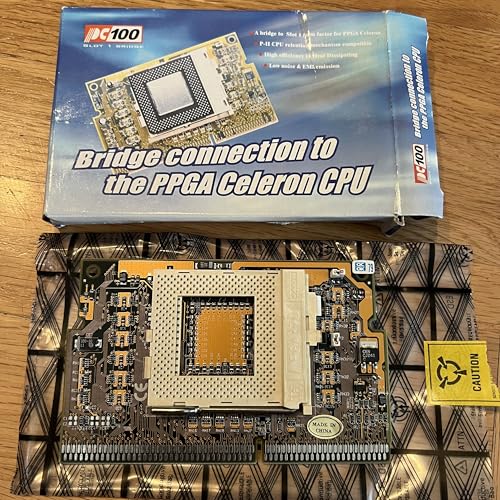
| Slot 1 to Socket 370 slotket (B0DDHWFSFF PCCHIPS Alton) | Reuse an Intel 440BX board with newer CPUs | eBay | $20-$45 |
| Staedtler Mars Plastic eraser | Edge-connector cleaning | Hardware store | $2-$4 |
| 99% isopropyl alcohol | Final rinse on contacts | Hardware store | $5-$8 |
| Anti-static wrist strap | Self-explanatory on vintage parts | Amazon | $4-$8 |
| Multimeter (Klein MM400 or similar) | Verify PSU rails | Hardware store | $40-$70 |
Common pitfalls and troubleshooting
- Power-cycling too fast. After pulling power, wait 30 seconds before re-applying. Some early AGP cards need full capacitor discharge to re-enumerate cleanly.
- Plugging the AGP card into the wrong slot. On boards with both AGP and AMR or AGP and a brown PCI slot, take a second look — Asus P3V4X has a brown slot adjacent to AGP that visually deceives newcomers.
- Using a 3.3V-only AGP card in a 1.5V-only modern AGP slot. The card simply will not enumerate. There is no workaround short of swapping the motherboard.
- A bent or burnt AGP slot pin. Inspect under bright light. A single bent pin can prevent POST. Carefully straighten with a precision tweezer if accessible.
- Heatsink falling off in transit. A bare Voodoo3 die will boot once but throttle to 0 MHz within seconds. Re-attach with Arctic MX-4 thermal compound and a small foam pad.
- PSU "ATX 1.1" without a -5V rail. Some Voodoo3 BIOS revisions check the -5V rail at POST. Modern ATX 2.x PSUs dropped -5V entirely. If you can't find a vintage PSU, a PicoPSU 160-XT with an ATX adapter is the cleanest 2026 solution.
- Capacitor plague in 2002-2008-era motherboards used to host the card. Look for any bulging or leaking electrolytic caps on the motherboard; if present, the board is the problem, not the Voodoo3.
Variations and advanced extensions
If your goal is a fully period-correct 1999 build, consider these companion fixes that we cover in dedicated guides:
- CF-to-IDE primary drive for a silent, fast vintage system. See How to Image a 90s Big-Box CD-ROM to CompactFlash for IDE-Adapter Retro PCs.
- Voodoo3 + period-correct sound for the full 1999 experience. See Audigy 2 ZS vs Live! 5.1 WinXP Gaming (and consider the original Sound Blaster Live! 1024 if you want true 1999 authenticity).
- AI-assisted driver install if you are doing a clean Windows 98 setup. See AI-Assisted Sound Blaster Driver Install on Win98 with Voodoo3 for the LLM-guided approach.
If your Voodoo3 still doesn't POST after Step 6, the card is almost certainly physically failed. The most common failure mode at 25+ years is BGA solder fatigue under the SDRAM packages, which produces intermittent boots — try gentle pressure on the SDRAM packages while the system is powering up. If the card POSTs only with finger pressure, the BGA is cracked and a reflow station (or buying a replacement) is your only remaining option.
Sources
- Phil's Computer Lab — Voodoo BIOS and Utilities
- Vogons community wiki — Voodoo3 troubleshooting
- 3dfx Interactive original press materials (archived) for Voodoo3 3000 spec verification
- Wikipedia — 3dfx Voodoo3 for clock speeds and silicon-revision history
- AnandTech 1999 Voodoo3 review (archived) — referenced for original AGP signaling spec
Related retro-build guides
- 3dfx Voodoo AGP Troubleshooting Playbook 2026
- GeForce 4 Ti 4600 Won't POST or Show Display: Troubleshooting Guide for 2026 Retro Builders
- How to Identify Any Vintage GPU: A Visual + GPU-Z Guide
- Pentium II/III LAN Party Build Brand Profile
- How to Image a 90s Big-Box CD-ROM to CompactFlash for IDE-Adapter Retro PCs