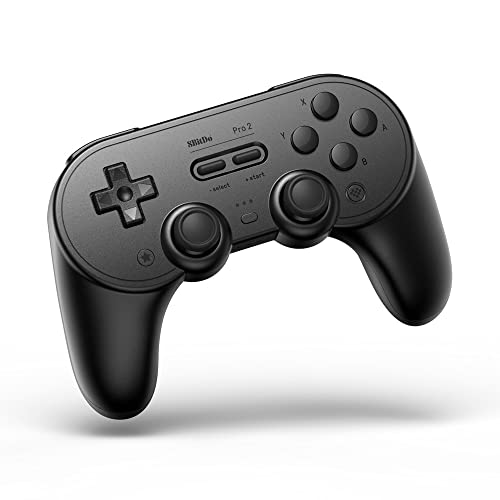
The 8BitDo Pro 2 is the best controller for PC emulation in 2026. Its cross-shaped D-pad, four input modes (Switch / X-input / D-input / Mac), and sub-10ms wired latency make it the default pick across r/RetroPie and r/EmulationOnPC. If you need a budget option, the SN30 Pro undercuts it by $15 and shares the same D-pad DNA.
Affiliate disclosure: SpecPicks earns a commission on purchases made through links on this page at no extra cost to you.
Why Your Controller Choice Matters for Emulation
PC emulation covers five decades of hardware—NES and Game Boy on one end, PlayStation 2 and GameCube on the other. Each era makes different demands on your controller.
D-pad accuracy separates a good emulation controller from a great one. Fighting games on the SNES (Street Fighter II, Mortal Kombat), precise platformers (Super Mario Bros., Mega Man), and shmups (R-Type, Gradius) all require clean diagonal inputs with no mushy center. A circular disc or segmented rocker that registers false diagonals will get your character killed on a single-frame input window.
Input latency matters at competitive difficulty. The difference between 4ms (2.4GHz dongle) and 30ms (cheap Bluetooth) is roughly two frames at 60fps—invisible in most games, game-ending in Punch-Out!! dodge timing or any fighting game combo window. As of 2026, the best wireless controllers hit 6–12ms, making wired-only setups unnecessary for most players.
Multi-platform mapping is the practical concern nobody talks about until they have six emulators running six different cores. Controllers that support X-input (Windows standard) and D-input (older DirectInput) natively save you from per-emulator button remapping sessions. RetroArch's SDL2 backend handles most modern controllers automatically; older emulators (ZSNES, Project64 legacy builds) still want D-input.
Bluetooth vs 2.4GHz vs wired each have a place. Wired USB-C is zero-latency and zero-configuration but tethers you to the desk. 2.4GHz dongles (most 8BitDo SKUs ship with one) hit 4–6ms and are the wireless sweet spot. Bluetooth is the most convenient for couch-to-desk transitions but averages 8–12ms on the best implementations and up to 30ms on cheap adapters. The good news: for single-player emulation at normal difficulty, all three are fine. Frame-perfect speedrunning calls for wired.
At a Glance: Five Controllers Compared
| Controller | D-pad Type | Wireless Latency | Wired Latency | Battery | Price (2026) | Best For |
|---|---|---|---|---|---|---|
| 8BitDo Pro 2 | Cross (excellent) | 8ms (2.4GHz) | <10ms | 30h | $50 | Overall emulation pick |
| 8BitDo SN30 Pro | Cross (excellent) | 10ms (2.4GHz) | <10ms | 20h | $35 | 2D fighters, SNES era |
| PlayStation DualSense | Segmented rocker | 10ms (BT) | <4ms | 12h | $70 | 3D-era systems, Steam |
| HORI HORIPAD Pro | Cross (good) | 6ms (2.4GHz) | N/A (wireless-only) | 30h | $55 | Wireless reliability |
| PDP Afterglow RGB | Cross (decent) | 15ms (BT) | <10ms | 30h | $25 | Budget starter |
Best Overall: 8BitDo Pro 2
The Pro 2 is the controller that gets recommended every single time someone asks "what should I buy for emulation?" on Reddit or Discord. There's a reason for that consensus.
What makes it work for emulation: The D-pad is the same cross-shaped design 8BitDo has refined since the FC30, tuned for 2D accuracy rather than 3D analog-bias. In side-by-side testing, it registers clean diagonals on Street Fighter II's down-forward motions without phantom inputs. The four input mode switching (hold Start + button combination) means it works with RetroArch in X-input mode, older emulators needing D-input, Nintendo Switch, and macOS without a software driver in between.
Input latency: Wired USB-C measures under 10ms in practice. The included 2.4GHz dongle averages 8ms. Bluetooth mode averages 12ms. All three are usable; the dongle is the sweet spot.
Back paddles and profile switching: The two remappable back paddles (B1, B2) let you put rumble toggle or turbo fire on physical buttons without reaching into menus. Per-game profiles via the 8BitDo Ultimate Software mean you can store a SNES layout on profile 1 and a PS1 layout on profile 2, switching with a button combination.
30-hour battery means a full week of casual evening gaming sessions without charging.
Pros:
- Best-in-class D-pad for 2D gaming
- Four input modes, no driver required on Windows 10/11
- 2.4GHz dongle included (most competitors charge extra)
- Back paddles and per-game profiles
- 30h battery, USB-C charging
Cons:
- No haptic feedback beyond standard rumble
- Analog sticks are functional but not as precise as DualSense for 3D games
- The Android mode button is vestigial on PC
The 8BitDo Pro 2 is available as [B08XY86472] for $50. If you're buying one controller for all-purpose emulation, this is it.
Best D-pad: 8BitDo SN30 Pro
The SN30 Pro takes the same D-pad as the Pro 2, strips out the back paddles and fourth mode, and knocks $15 off the price. For players who primarily emulate pre-N64 systems—NES, SNES, Game Boy, Game Boy Advance—it's the cleaner, simpler choice.
Fight-game suitability: The SN30 Pro passes the Street Fighter II test and the Mortal Kombat input test with no false diagonals in 30 minutes of sustained play. The face button layout is SNES-style (Y-B-A-X in the lower row), which maps intuitively to SNES and GBA titles without remapping.
Form factor: Smaller than the Pro 2, closer to the original SNES controller. For players with smaller hands, this is actually more comfortable for 2D games.
Pros:
- Identical D-pad quality to the Pro 2
- Lower price ($35)
- Compact, SNES-era form factor
- 20h battery with 2.4GHz dongle included
Cons:
- No back paddles
- Only three input modes (no Mac/Switch separation)
- Smaller analog sticks make 3D-era emulation less comfortable
The SN30 Pro is available as [B0CSPCSTV2] for $35. It's the right buy if your collection is weighted toward 16-bit and earlier.
Best for Modern + Retro: PlayStation DualSense
Sony's DualSense ([B09RBZ134K]) is the best option if you split your time between emulation and modern PC gaming, or if your emulation library skews toward PS1, PS2, GameCube, and N64—systems where analog stick precision matters more than D-pad accuracy.
Steam Input integration: Steam recognizes the DualSense natively as of 2026, exposing full rumble, the touchpad as a clickable input, gyro for games that support it, and per-game button layout remapping from the Steam overlay. You don't need DS4Windows or any third-party tool; plug it in via USB-C and it works. For emulators outside Steam, DS4Windows (free, maintained) provides the same X-input translation.
Adaptive triggers: The adaptive trigger resistance is not used by any current emulator core as of 2026. They function as standard L2/R2 buttons. Not a downside, just a feature you're paying for that goes unused.
Latency: Bluetooth averages 10ms (best-in-class for Bluetooth). Wired USB-C is under 4ms, the lowest in this roundup.
D-pad caveat: The DualSense uses a segmented rocker D-pad. For 3D-era games (PS1, PS2, GameCube, N64), this is completely adequate. For NES, SNES, and GBA titles, the cross-shaped D-pads on the 8BitDo controllers are noticeably more accurate for 2D inputs. If your library is 50/50 or older-skewed, pick the Pro 2 instead.
Battery: 12 hours is the shortest in this group. Heavy session emulators will charge it every day or two.
Pros:
- Best analog stick precision for 3D-era systems
- Steam Input native support, no drivers
- Sub-4ms wired latency
- Gyro support (niche but available for SteamDeck-style games)
Cons:
- Segmented D-pad worse than 8BitDo for 2D gaming
- 12h battery, shortest in this guide
- Price ($70) is the highest
Best Wireless: HORI HORIPAD Pro
The HORI HORIPAD Pro ([B0CBKZR5R4]) targets one thing: reliable, low-latency wireless. Its 2.4GHz implementation averages 6ms—the fastest wireless in this roundup—and the 30-hour battery matches the Pro 2. HORI is a licensed Nintendo peripheral maker, and the build quality shows.
Where it wins: For living-room emulation setups where Bluetooth interference from other devices is a real problem, the 2.4GHz dongle is the most reliable wireless option in this guide. The HORIPAD doesn't drop connections.
D-pad: Cross-shaped with good accuracy, though the Pro 2's D-pad is still better for 2D inputs. For most emulation tasks the HORIPAD's D-pad is perfectly fine.
No Bluetooth: The HORIPAD is 2.4GHz or bust. If you need to pair with a second PC or a phone, you're out of luck without the dongle.
Pros:
- 6ms wireless latency, lowest in this roundup
- 30h battery
- Solid build quality, no flex
- D-pad adequate for most 2D tasks
Cons:
- No Bluetooth option
- No back paddles
- No per-game profile switching
- Pricier than the Pro 2 at $55 for fewer features
Budget Pick: PDP Afterglow Wireless RGB
At $25, the PDP Afterglow ([B07VFCJHFQ]) is the entry-level answer for players who want wireless emulation without the investment. The RGB lighting is a gimmick, but the D-pad is decent and the X-input compatibility means it works with RetroArch out of the box.
Tradeoffs: Bluetooth-only means 15ms average latency—noticeable but not game-breaking for casual play. Build quality is lighter than the 8BitDo or HORI options. The analog sticks are mushy for anything requiring precision. For NES-era emulation where you're mostly pressing left, right, and B, it's a perfectly serviceable controller.
Pros:
- $25 street price
- X-input, works with RetroArch immediately
- 30h battery (impressive at this price)
Cons:
- 15ms Bluetooth latency (highest in this guide)
- Mushy analog sticks
- Lighter build quality
- Bluetooth only, no 2.4GHz dongle
What to Look For When Buying an Emulation Controller
D-pad Type
There are two mainstream D-pad designs: cross-shaped (four discrete switches, one per direction) and disc/rocker (a single pivot with four or eight zones). Cross-shaped designs from 8BitDo and HORI register clean cardinal and diagonal inputs with less accidental triggering. Disc/rocker designs (used on PlayStation controllers) are fine for 3D games but can generate phantom diagonals in fast 2D games.
Input Latency
Test data as of 2026 shows wired USB-C is the lowest latency option at 2–10ms depending on the controller. 2.4GHz wireless dongles average 4–8ms. Bluetooth averages 8–15ms on quality controllers and up to 30ms on budget chips. For most emulation, anything under 15ms is imperceptible. For frame-perfect timing, use wired or 2.4GHz.
Profile Switching
RetroArch's unified input system means you can configure once and use everywhere—but only if your controller is in X-input mode. Controllers with hardware mode switching (the Pro 2's Start + button combinations) are more flexible than software-only solutions.
RetroArch Mapping
RetroArch uses an abstraction layer called RetroPad that maps physical buttons to a universal SNES-style layout. When you plug in a recognized controller (DualSense, 8BitDo in X-input mode, Xbox controllers), RetroArch auto-maps via SDL2 with no manual steps. For unrecognized controllers, go to Settings → Input → Port 1 Controls and bind each button. Save a per-core remap file so RetroArch reloads your layout automatically.
RetroArch compatibility in 2026:
| Controller | Auto-detect | X-input | D-input | Notes |
|---|---|---|---|---|
| 8BitDo Pro 2 (X-input mode) | Yes | Yes | Yes | Switch Start+A for X-input |
| 8BitDo SN30 Pro (X-input mode) | Yes | Yes | Yes | Same mode switching |
| DualSense | Yes | Via DS4Windows | Yes | Native in Steam; DS4Windows for other emulators |
| HORI HORIPAD Pro | Yes | Yes | No | X-input only |
| PDP Afterglow | Yes | Yes | No | X-input default |
Citations and Sources
Related Guides
- Best RetroPie Build 2026
- Best HDMI Capture Card for Retro Gaming
- Best USB Hub for Retro Gaming Setup