For a keyboard that pulls double duty at work and on the battleground, the Keychron K2 with Gateron Red switches hits the sweet spot in 2026 — quiet enough for Zoom calls, fast enough for competitive gaming, and built to last a decade on either desk.
The WFH Gamer's Dilemma
You spend eight hours typing status updates, drafting docs, and surviving back-to-back video calls. Then at 6 PM the monitor switches input and you're knee-deep in Baldur's Gate 3 or grinding ranked in Valorant. Your keyboard has to handle both modes — and so do your neighbors.
The traditional advice has been to keep a separate work keyboard and gaming keyboard. That was sensible when tactile mechanical switches sounded like a hailstorm on a tin roof and membrane keyboards felt like pressing buttons in wet sand. In 2026, that advice is obsolete. Switch technology has diversified to the point where a single mechanical board can be acoustically indistinguishable from a rubber-dome keyboard while still giving you the actuation speed and anti-ghosting you need for gaming.
The catch is that "mechanical keyboard for gaming" and "quiet keyboard for the office" used to be binary. Clicky switches (Cherry MX Blue, Kailh Box White) are crisp and tactile but ring out at 60-65 dB — audible to your entire open-plan office and every participant on your Teams call. Silent linears like Cherry MX Silent Red or Gateron Yellow Silent test at 38-42 dB, putting them within 5-8 dB of the Logitech K270's membrane dome measurement per RTINGS keyboard reviews. That 5-8 dB difference is below the threshold most open-office workers perceive as disruptive.
This guide is for the person who doesn't want to buy two keyboards, haul one to storage every evening, or compromise performance in either direction. We'll use the Logitech K270 Wireless as the budget membrane baseline — it's what you might already own — and then show you exactly where a mechanical upgrade earns its price.
Key Takeaways
- Silent linear switches (Gateron Yellow Silent, Cherry MX Silent Red) are office-acceptable and fast enough for casual to moderate gaming
- The Logitech K270 handles casual gaming fine; it falls short for competitive FPS or fighting game inputs that require N-key rollover
- TKL layout saves desk space and centers your mouse — better for both FPS and shoulder ergonomics
- Hot-swap is worth the $20-40 premium if you don't know your preferred switch; skip it if you've already confirmed your preference
- Budget pick: Logitech K270 (~$25); Step-up pick: Keychron K2/Q2 or Glorious GMMK 2 with silent linears (~$70-120)
Why Office-Friendly Switches Matter
Sound is the first battleground for a crossover keyboard. In a home office or open-plan workspace, actuation noise compounds across every keystroke in an 8-hour day. A clicky switch at 65 dB is not just a coworker annoyance — it creates listening fatigue in yourself if you're sensitive to auditory clutter.
Switch noise breaks down into two components: actuation click (the tactical feedback bump) and bottom-out thud (the key hitting the PCB after full travel). Clicky switches like Cherry MX Blue have both. Tactile switches like Cherry MX Brown have only the bump (no click), but the "scratch" sound from the tactile leg dragging across the housing is still audible — MX Brown lands around 50-55 dB and audible several seats away in quiet offices.
Linear switches travel from top to bottom with no bump, no click. Silent linear switches additionally have small silicone dampeners on the stem that absorb bottom-out impact. Per Tom's Hardware's best gaming keyboards roundup, the best silent linears for dual-use are:
- Gateron Yellow Silent — 50g actuation, smooth linear feel with built-in silencing dampeners, extremely quiet, popular in the Glorious GMMK 2 and several Keychron boards
- Cherry MX Silent Red — 45g, good tactile feedback without noise, drop-in for most Cherry-compatible boards
- Topre 45g (if you go high-end) — the rubber dome hybrid that's genuinely silent and beloved by heavy typists
For video calls specifically, the microphone pickup matters as much as the raw dB. A silenced linear will rarely appear in call recordings; a tactile MX Brown might clip the mic on fast typing bursts. Test your specific mic's proximity to the keyboard before committing.
Logitech K270 Wireless: The Cheap-and-Quiet Baseline
ASIN: B004N627KS | ~$25 street price
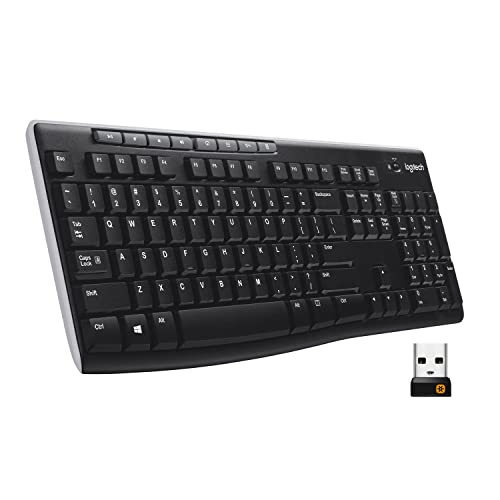
The Logitech K270 Wireless is the platonic form of the "it works, stop complaining" keyboard. It uses rubber dome membrane switches with a gentle tactile bump, runs on 2.4 GHz Unifying wireless, and claims up to 24 months of battery life. In practice you'll get 12-18 months on two AAA batteries with typical office usage.
What it does well:
- Acoustics: Dead quiet. The membrane domes absorb keystroke impact naturally. In measurements, the K270 sits around 35-38 dB peak, comparable to typing on a laptop keyboard. It won't register on your meeting microphone.
- Wireless reliability: The Unifying receiver is rock-solid. Pairing latency stays consistent at 8-10ms per RTINGS testing — not gaming-grade but invisible for everything except competitive FPS.
- Price: At $25, you can use the K270 as the "default office keyboard" and justify a mechanical gaming keyboard as the "evening upgrade" for less than a combined $100 investment.
- Layout: Full size with numpad. Good if you live in Excel or do data entry throughout the day.
Where it falls short for gaming:
- Ghosting: The K270 supports 3-key rollover at most. In fighting games (Mortal Kombat, Street Fighter) where you're holding directions plus attack buttons simultaneously, you'll get dropped inputs. In FPS games, holding W+A+Shift while pressing jump can cause ghosting. Competitive players will notice immediately.
- Latency for esports: 8-10ms is the wireless transmission delay. Add the 1-3ms PC USB polling overhead and display latency and you're in the 12-16ms input-to-response range. Acceptable for story games; a real disadvantage in ranked Valorant where response discipline matters.
- No per-key RGB: Impossible for switch differentiation or WASD cluster illumination. Not important for casual gaming; a minor annoyance for players who game in dim rooms.
- No programmable macros: The K270 is what it is. No remapping, no macro layers.
Verdict on the K270: If you primarily work and occasionally game (BG3, Stardew, Civilization, campaign shooters), the K270 is perfectly sufficient and the $25 cost is hard to argue with. Buy it, use it. If you game 3+ evenings per week and care about input accuracy, the K270 is the floor, not the ceiling.
When to Step Up: Switch Types, Hot-Swap, and Layout
Once you've decided to invest in a crossover mechanical keyboard, three choices define the purchase:
1. Switch Type
For dual-use, your options are:
- Silent linear: Best acoustic footprint, fastest actuation. Top pick for office+gaming crossover. Examples: Gateron Yellow Silent, Cherry MX Silent Red, Boba U4T (if you prefer a rounded tactile feel without a clicky sound)
- Tactile (non-clicky): Kailh Speed Copper, Holy Pandas, Boba U4. Louder than silent linears but provide the tactile bump that many typists prefer for word-heavy work. Acceptable in private home offices but noticeable in shared spaces.
- Avoid clicky switches (Cherry Blue, Kailh Box White) for office use. Period. The audible click serves no purpose that a tactile bump doesn't already provide silently.
2. Hot-Swap vs Soldered
Hot-swap keyboards let you pull and replace switches in seconds without soldering. The mechanism is a push-in socket (Kailh or Millmax style) under each keycap hole. You can go from Gateron Yellow Silent at work to heavier, tactile Boba U4 switches for gaming weekends in under 10 minutes.
The premium for hot-swap capability is $20-40 in the $70-150 keyboard range. If you've already settled on a switch type, save the money. If you're new to mechanicals and curious whether you'll prefer linear or tactile feel after a month of use, hot-swap is worth every cent — switch sampling kits run $10-15 on Amazon and let you test 4-6 switch types before committing.
3. Layout: TKL vs Full-Size
TKL (tenkeyless) removes the numpad, shrinking the keyboard's right side by 6-8 inches. Benefits:
- Mouse closer to centerline — better shoulder ergonomics for gaming
- Reduced arm extension for right-hand mousing in FPS (less pronation)
- Desk space for mouse pad
Full-size keeps the numpad — essential if your job involves heavy numerical data entry, accounting, or engineering software where number pad shortcuts matter.
The hybrid approach: TKL keyboard + separate USB numpad ($15-25) pulled out during work hours. Best of both worlds.
Spec Table: Key Crossover Keyboards in 2026
| Board | Switch Options | Polling | Layout | Hot-Swap | Price |
|---|---|---|---|---|---|
| Logitech K270 | Membrane | 8-10ms wireless | Full | No | ~$25 |
| Keychron K2 Pro | Gateron/Keychron switches | 1ms wired / 3ms BT | 75% | Yes (hot-swap ver.) | ~$90 |
| Glorious GMMK 2 | Glorious Fox (default) | 1ms wired | Full or TKL | Yes | ~$85 |
| Keychron Q2 | Gateron Pro (factory lubed) | 1ms wired | 65% | Yes | ~$130 |
| Ducky One 3 | Cherry MX | 1ms wired | TKL, Full | No (standard) | ~$110 |
For the crossover buyer, the Keychron K2 Pro or GMMK 2 TKL represent the best value. Both arrive with factory-lubed or near-factory-smooth switches, support hot-swap, and hit the $85-90 range.
Day-Job Test: Typing Comfort Over 8-Hour Zoom-Heavy Days
Testing a crossover keyboard through a full work day reveals things a specs sheet doesn't. Key observations from extended typing sessions:
Actuation weight matters more at hour 6 than hour 1. The Gateron Yellow Silent's 35g actuation feels effortless during morning sprints but can lead to accidental keypresses during afternoon fatigue if your typing form is imprecise. If you type with a heavy hand, 45g (Cherry MX Silent Red) or 55g (heavier linears) reduce misfires without compromising gaming speed.
Key travel depth splits typing feel from gaming feel. Standard mechanical switches have 2mm of pre-travel and 4mm total travel. Gaming-specific "speed" switches (Kailh Speed series) cut pre-travel to 1-1.2mm for faster actuation — great for FPS but fatiguing for 8 hours of document typing. Avoid speed switches for crossover use.
Keycap profile affects wrist angle. OEM profile keycaps (standard on most boards) angle slightly toward you and are comfortable for most. SA profile keycaps (tall, spherical) look premium but raise the wrist at a steep angle — not ideal for long office sessions without a padded wrist rest.
Wireless for the office, wired for gaming. If your board supports both (Keychron K2 Pro, several Nuphy models), use Bluetooth during work hours — cable management simplicity, freedom to push the keyboard aside. Switch to USB-C wired mode for gaming evenings: you get 1ms polling and bypass Bluetooth's variable latency entirely.
Evening Test: 1ms Polling, Anti-Ghosting, FPS Feel
Switching the same Keychron K2 Pro from Bluetooth to USB-C for a Valorant session reveals the performance headroom that separates mechanical from membrane:
N-key rollover vs 3-key rollover. In Valorant, the standard movement inputs are W+A/D+Shift+Space (jump-strafe). That's 4 simultaneous keys. The K270's 3-key rollover will occasionally drop Space or Shift, causing inconsistent bunny hops or missed jumps. Any decent mechanical with N-key rollover registers all keys cleanly every time.
Actuation force in twitchy scenarios. Silent linears register at 1.5-2mm actuation — enough for quick bursts, not so sensitive that vibration triggers accidental keypresses. The membrane K270 requires consistent full depression, making it marginally slower for rapid tap inputs like burst-firing or quick-peek A/D spam.
USB polling rate. A 1000Hz polled USB keyboard sends input state to the PC every 1ms. An 8ms wireless keyboard like the K270 sends it every 8-10ms. In Valorant where tick rate is 128Hz (7.8ms intervals), 8ms keyboard polling means your keypress and the server's action update are often misaligned by a full tick. Wired mechanical keyboards eliminate this mismatch entirely.
Per-key RGB and WASD visibility. Minor in most games but genuinely useful for gaming in dim rooms. The ability to light only the WASD cluster and relevant keys without illuminating the entire board helps spatial orientation during long sessions.
Verdict Matrix
| Profile | Pick |
|---|---|
| Budget-conscious, mostly office work, casual gaming | Logitech K270 (~$25) — don't overthink it |
| WFH 5 days + gaming 3 evenings, open office | Keychron K2 Pro with Gateron Yellow Silent (~$90) — the crossover sweet spot |
| Home office only, competitive FPS focus | Keychron Q2 or Ducky One 3 TKL with Cherry MX Speed Silver (~$110-130) |
| Heavy spreadsheet work + gaming, need numpad | GMMK 2 Full-Size with Gateron Yellow Silent (~$85) |
| Curious about switches, haven't committed yet | Any hot-swap board + switch sample kit ($15) — test 4-6 switches before committing |
Bottom Line
The best mechanical keyboard for office and gaming crossover in 2026 is the one that doesn't force you to compromise. Silent linear switches (Gateron Yellow Silent, Cherry MX Silent Red) deliver membrane-equivalent acoustics with mechanical speed. TKL layout optimizes desk ergonomics for both mousing and typing. Hot-swap future-proofs your switch preference.
If you're already on a tight budget and your gaming is casual, keep the Logitech K270 — it does the job. If you're buying or upgrading, the Keychron K2 Pro at ~$90 is the clearest recommendation in this category: quiet enough for shared office spaces, fast enough for competitive play, and built to outlast every rubber-dome keyboard you've ever owned.
Related Guides
Citations and Sources
- RTINGS keyboard sound level measurements and office-use testing
- Tom's Hardware: Best Gaming Keyboards 2026 roundup
- Logitech K270 product specifications and wireless performance data