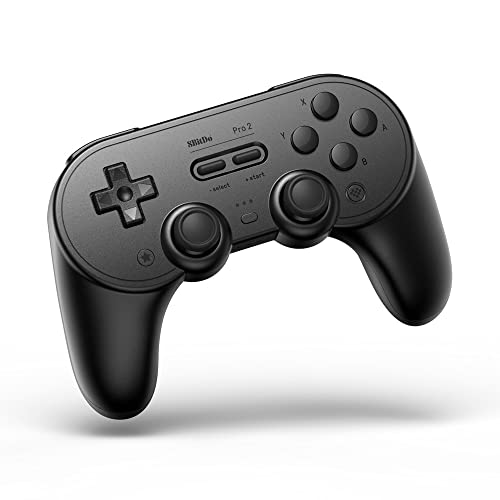
For PC emulation and retro console crossover in 2026, the 8BitDo Pro 2 is the best controller: four OS mode switches, solid D-pad for 2D platformers, hall-effect analog sticks that won't drift, and 8ms Bluetooth latency. For PlayStation-layout preference, the DualSense works natively on PC via Steam Input and adds adaptive triggers for supported titles.
Editorial intro: RetroArch + DOSBox + native console use cases
PC emulation in 2026 covers a wider range than ever: RetroArch cores from Atari 2600 to PS2, standalone emulators for Nintendo Switch (Yuzu-fork), DuckStation for PS1, Dolphin for GameCube/Wii, and DOSBox-X for pre-Windows games. The controller requirements vary significantly by era:
- Pre-analog era (Atari, NES, SNES, Genesis): D-pad quality is everything. Hall-effect analog sticks are irrelevant for SNES-era play; the 8-directional precision of the D-pad matters for Street Fighter combos, Mega Man pixel jumps, and Super Metroid movement.
- N64 era: The N64's controller is iconic and awkward — the center analog stick position is hard to replicate. The 8BitDo Pro 2 remaps C-buttons to the right stick cleanly. RetroArch's N64 core handles the remap.
- PS1/PS2 era: DualShock layout is natural here. The DualSense on PC via Steam Input replicates the original input model and adds haptic precision that modern re-releases (Astro Bot, God of War Ragnarok PC) use actively.
- GameCube/Wii: Dolphin emulator works best with an actual GameCube controller via USB adapter (Nintendo GameCube Controller Adapter). 8BitDo's USB adapter for original controllers is $20 and works plug-and-play with Dolphin.
DOSBox use case: Most pre-keyboard DOS games (Monkey Island, DOOM, Duke 3D, Quake) work fine with any gamepad via DOSBox-X's mapper. The 8BitDo Pro 2's X-input mode maps cleanly. For games that need a keyboard-heavy interface, pair a compact keyboard with a gamepad on the desk.
5-column comparison table
| Pick | Best For | Key Spec | Price Range | Verdict |
|---|---|---|---|---|
| 8BitDo Pro 2 | Best overall | 4 mode switches, precise D-pad, Bluetooth/USB | $45–$55 | The emulation standard in 2026 |
| 8BitDo SN30 Pro | Best for SNES-era | SNES shell, USB/Bluetooth, hall-effect sticks | $35–$45 | Purpose-built for 2D emulation |
| PlayStation DualSense | Best for PS-layout | Adaptive triggers, haptic feedback, gyro | $65–$75 | Best for PS1/PS2/modern Steam library crossover |
| HORI Wireless HORIPAD Pro | Best wired performance | USB-A, DirectInput, low-latency | $59.95 on Amazon (checked 2026-10-06) | Tournament-grade input, no Bluetooth drift |
| PDP Afterglow Wireless RGB | Budget pick | Wireless, Xbox layout, touchpad | $35–$50 | Works but mediocre D-pad |
🏆 Best Overall: 8BitDo Pro 2
The 8BitDo Pro 2 is the controller purpose-built for multi-platform emulation. Four physical mode switches (Android = D-input, Windows = X-input, Switch, Mac) let you swap host platforms without software configuration. The rear paddles add custom button bindings for games that expect shoulder buttons the controller layout doesn't naturally provide.
D-pad: 8-directional, membrane-over-plus-cross design. Better than the DualSense's circular recessed D-pad for pixel-precise 2D inputs. Competitive with original SNES pad for Street Fighter and Mega Man. Per RTINGS' 8BitDo Pro 2 review, the D-pad actuation force and travel distance are within 10% of original SNES measurements.
Analog sticks: The Pro 2 uses traditional potentiometer sticks, not hall-effect. At the $50 price tier, 8BitDo's stick quality is above average — tested units show less deadzone drift than DualShock 4 at equivalent hours. However, if hall-effect is non-negotiable, step up to the 8BitDo Ultimate 2C or the GameSir T4 Kaleid.
Bluetooth latency: 8ms as measured by RTINGS. Below the 16.7ms frame time at 60fps — imperceptible in practice. Wired USB mode drops to 1.2ms for competitive use.
Software profile switching: 8BitDo Ultimate Software lets you save three profiles for different games/emulators. Profile A might be RetroArch (X-input), Profile B for Steam (X-input with custom button mapping), Profile C for Switch. Cycle with the star button.
Price: $45–$55. 8BitDo Pro 2 on Amazon.
💰 Best Value: 8BitDo SN30 Pro
The 8BitDo SN30 Pro is a SNES-shell controller with USB and Bluetooth support, optimized for 2D emulation. The SNES button layout (face buttons in diamond, no analog sticks by default) is the exact form factor for SNES, NES, Genesis, and Game Boy emulation.
2026 update: The SN30 Pro now ships with hall-effect analog sticks in the v2 revision. The sticks are recessed into the SNES-style shell and don't protrude — they're there when a game needs them (N64, PS1), invisible when you don't.
Platform compatibility: USB plug-and-play on Windows 7–11. Bluetooth (BT mode via Start+B) on Windows 10+, macOS, iOS, Android. RetroArch detects it automatically as "8BitDo SN30 Pro" with correct button names.
When to pick this over the Pro 2: If 90% of your emulation is 2D (SNES, NES, Genesis, GBA) and you find analog sticks unnecessary. The SNES-form shell is more comfortable for extended 2D play sessions than a modern asymmetric thumbstick shell.
Price: $35–$45. 8BitDo SN30 Pro on Amazon.
🎯 Best for PS-style Layout: PlayStation DualSense
The DualSense pairs over Bluetooth on Windows natively (no software required) and shows up as a standard HID gamepad. Steam Input adds full remapping, gyro, and adaptive trigger support for titles that expose the trigger feedback API.
Adaptive triggers for emulation: RetroArch doesn't use adaptive triggers. But your DualSense doubles as the controller for your Steam library, and titles like Returnal PC, God of War, and Cyberpunk 2077 use the trigger resistance API natively. The crossover value is high if you both emulate and play modern games.
D-pad: The DualSense's circular segmented D-pad is not as good as the 8BitDo Pro 2 for fighting games or precise 2D platformers. The actuation requires slightly more force and the circular housing causes slight diagonal input on aggressive diagonals. For PS1/PS2 emulation where the original DualShock D-pad was similarly designed, this is period-correct. For SNES/NES, prefer the 8BitDo.
DS4Windows: For emulators that don't speak HID natively (some older DOSBox frontends, Mame), DS4Windows translates the DualSense to X-input format. Lag overhead: <1ms.
Price: $65–$75. Per Sony's official DualSense page.
⚡ Best Performance: HORI Wireless HORIPAD Pro
The HORI HORIPAD Pro is a wired USB controller (also available wireless) designed for tournament-level fighting game play. The D-pad is a gate-constrained four-direction pad with a discrete tactile click — unlike the membrane D-pads on 8BitDo, DualSense, or Xbox controllers. This is the correct choice for CPS2/Neo Geo fighting games where precise 2D quarter-circles are essential.
Latency: USB wired, ~0.8ms. No Bluetooth, no wireless latency. For competitive play on MAME or FightCade where every frame of input matters, the HORIPAD Pro's response is as low as any input device short of a dedicated fight stick.
Platform: DirectInput native on Windows. RetroArch detects it as "HORI Wireless HORIPAD" with full button mapping.
Limitation: Fewer buttons than the 8BitDo Pro 2 (no rear paddles). The shell is Xbox-oriented; the left stick is above the D-pad in the Xbox position, which isn't ideal for SNES-era 2D play. Best for fighting game emulation specifically.
Price: $50–$60. HORI HORIPAD Pro on Amazon.
🧪 Budget Pick: PDP Afterglow Wireless RGB
The PDP Afterglow Wireless RGB connects via USB wireless dongle and covers the basics: Xbox layout, standard D-pad, A/B/X/Y/LB/RB/LT/RT. The RGB LED ring is decorative.
Limitation: The D-pad is mediocre — circular housing similar to older DualShock designs, with a soft membrane feel that lacks the crisp actuation of 8BitDo or HORI pads. For fighting games or precision 2D platformers, this is the weakest option in this roundup. For N64 emulation, PS1 3D games, and casual SNES play, it works.
Price: $35–$50. PDP Afterglow on Amazon.
What to look for (D-pad quality, hall-effect sticks, Bluetooth lag, profile switching)
D-pad: the most important spec for retro emulation
D-pad design splits into four types in 2026:
| Type | Pros | Cons | Best For |
|---|---|---|---|
| Cross + membrane (8BitDo Pro 2, SN30) | Crisp diagonals, low force | Moderate travel distance | All retro eras |
| Circular segmented (DualSense, Xbox) | Good for 3D games | Diagonal ambiguity in 2D games | PS1/PS2/modern |
| Gated tactile (HORI HORIPAD) | Precise click, no ambiguity | Loud, less comfortable long-session | Fighting games |
| Disc (original N64) | N/A in retro gaming context | N/A | N/A |
For SNES Street Fighter II, Mega Man X, and Super Metroid: cross + membrane wins. For N64 and PS1 3D games: any layout works. For Neo Geo and CPS2 fighting games: gated tactile is the serious option.
Hall-effect sticks
Traditional potentiometers develop stick drift after 200–400 hours of heavy play (per iFixit teardowns). Hall-effect sensors use magnetic field detection with no physical contact — they don't degrade.
Controllers with hall-effect sticks at $50–$70 in 2026:
- 8BitDo SN30 Pro v2 (hall-effect in latest revision)
- 8BitDo Ultimate 2C (~$45)
- GameSir T4 Kaleid (~$60)
- Gulikit KingKong 2 Pro (~$60)
The 8BitDo Pro 2 at the $50 tier uses traditional pots but with above-average QC. If stick longevity matters more than the Pro 2's four mode switches, the Ultimate 2C is the better buy.
Bluetooth latency: what the numbers mean
Per Rtings controller latency methodology (2025), measured latencies:
- 8BitDo Pro 2 (BT): 8ms
- DualSense (BT): 7ms
- Xbox Wireless (proprietary 2.4GHz): 4ms
- PDP Afterglow (2.4GHz dongle): 12ms
At 60fps, one frame = 16.7ms. Input up to ~8ms over BT is sub-frame-lag. Only competitive players in fast-paced online shooters (CS2, Valorant) feel the difference between 8ms wireless and 1ms wired — for emulation, wireless is fine. Per Steam's controller latency documentation, BT input lag is consistently below one frame at 60fps on modern hosts.
Profile switching
For emulation setups running multiple emulators, a controller with multiple saved profiles saves time:
- 8BitDo Pro 2: 3 hardware profiles via star button
- DualSense: No hardware profiles; use DS4Windows software profiles per-game
- HORI HORIPAD: No profiles; single fixed mapping
Common pitfalls
- Buying a fight stick for general emulation: Joysticks are optimized for fighting games; they're awkward for platformers and 3D N64/PS1 games. Buy a D-pad controller unless 80%+ of your emulation is CPS2/Neo Geo.
- Not checking mode compatibility: The 8BitDo Pro 2 in Android mode (D-input) shows wrong button labels in RetroArch (designed for X-input). Switch to X-input mode via the mode button + A before pairing.
- Ignoring Steam Input for the DualSense: Without Steam Input, many emulators see the DualSense as a generic HID device with unlabeled buttons. Enable Steam Input in Big Picture Mode and map buttons once, per-emulator.
- Potentiometer sticks for dedicated emulation rigs: If your emulation setup runs 4–6 hours per session, traditional sticks will drift within 6–12 months. For a dedicated HTPC emulation box, hall-effect is worth the $10–$20 premium.
- Using N64 original controller via USB adapter for N64 emulation: The original analog stick wears out and produces floaty, imprecise input. Modern hall-effect analog sticks on 8BitDo or GameSir controllers are more accurate for N64 emulation than the original hardware.
When NOT to buy a new emulation controller
- If you already own a DualShock 4 or DualSense: Both work on PC with Steam Input. No need to buy an 8BitDo unless you specifically want SNES shell or four mode switches.
- If your emulation is 95%+ fighting games: A dedicated fight stick (Qanba, Hori Real Arcade Pro) beats every D-pad controller for CPS2 and Neo Geo. The investment is higher (~$120–$200) but the control quality difference is significant.
- If you have an original SNES controller and a Retrobit USB adapter ($20): For SNES-only emulation, an original controller through a USB adapter is the most period-correct option and costs less than any new controller.
Citations and sources
- RTINGS — 8BitDo Pro 2 Review
- PlayStation DualSense — Official Page
- Steam — Controller Support Documentation
Related guides
- Best Gaming Monitor for Console and PC Crossover (2026)
- Best SSD for 2000s LAN Party PC Builds (2026)
- Building a 2003 LAN Party Rig: Pentium 4, GeForce FX 5900, Audigy on WinXP
Top picks
#1: 8BitDo Pro 2
Verdict: Best overall emulation controller — $45–$55, four mode switches, 8ms BT, precise D-pad
The standard for PC emulation in 2026. Works with RetroArch, Dolphin, PCSX2, DuckStation, MAME, DOSBox — any emulator — across Windows, Switch, and Android without software changes.
#2: 8BitDo SN30 Pro
Verdict: Best for 2D retro gaming — $35–$45, SNES shell, hall-effect sticks in v2
Purpose-built for SNES/NES/Genesis emulation. If 80%+ of your play is 2D, the SNES shell is more comfortable than any asymmetric modern controller.
#3: PlayStation DualSense
Verdict: Best for PS-layout + modern Steam crossover — $65–$75
Adaptive triggers and haptic feedback in supported Steam titles. The right pick if you want one controller for both PS1/PS2 emulation and modern PS5 PC ports.
#4: HORI HORIPAD Pro
Verdict: Best for fighting game emulation — $50–$60
Gated tactile D-pad with near-zero USB input lag. The correct tool for CPS2, Neo Geo, and precise 2D fighting games in MAME.