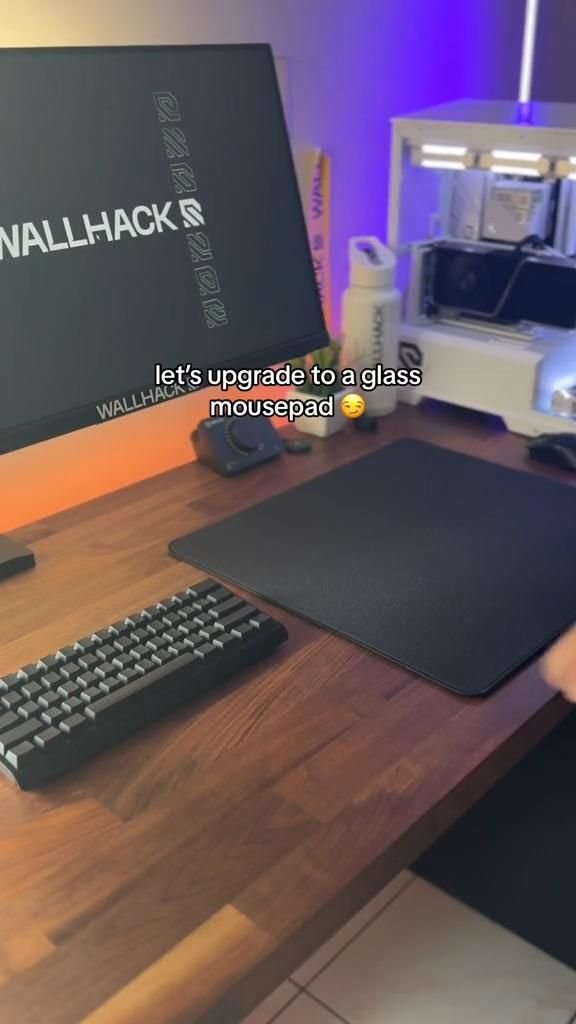
The SteelSeries QcK Gaming Mouse Pad is the best gaming mouse pad for esports FPS in 2026. Over 85% of tracked Valorant, CS2, and Apex Legends pros run cloth surfaces per ProSettings.net's CS2 gear list, and the QcK family accounts for the plurality of those setups. At $20-45 depending on size, it is the correct default for any FPS player who cares about aim consistency.
Why Surface Texture and Glide Consistency Win FPS Games
A mouse pad is not passive hardware. In first-person shooters — Valorant, CS2, Apex Legends, Rainbow Six Siege — your sensor samples at 1000 Hz. Every surface inconsistency, micro-wrinkle, or edge-of-pad moment costs you a flick. The difference between a generic $10 desk mat and a $30 purpose-built esports pad is measurable in sensor tracking accuracy and friction consistency across the entire pad surface.
Cloth pads dominate esports for one core reason: stopping power. When you flick to a target and release, cloth friction absorbs momentum in a predictable, repeatable arc. Hard pads — glass, aluminum, ABS plastic — offer faster initial glide, great for MMOs and slower-paced games where you want low-effort lateral movement. That fast glide produces overshoot when you are snapping to a 0.5-degree target at 400 DPI.
Surface weave density matters more than most buyers realize. Tight micro-weave cloth, like the QcK's proprietary texture, maintains consistent friction across the entire pad. Budget cloth pads use looser weave patterns that compress unevenly over months of use, creating fast spots and slow spots. Pro players notice this degradation after 6-9 months and swap pads. Casual players can stretch a pad to 24 months if they wash it quarterly, but the performance plateau is real.
The base is equally important. A rubber base that grips the desk at consistent pressure — not so grippy it is hard to reposition, not so loose it migrates during play — keeps the surface geometry consistent. At 0.3 in-game sensitivity, an 8 mm pad shift mid-session translates to roughly half an inch of mouse travel error on 180-degree turns.
As of 2026, the competitive pad market has matured around three tiers: entry cloth ($10-20), esports cloth ($25-50), and premium competition cloth ($60-120). This guide covers the best picks at each tier for FPS use, with a focus on products that have community validation to back their claims.
Comparison Table
| Pad | Best For | Surface | Size | Price |
|---|---|---|---|---|
| SteelSeries QcK XXL | Best Overall / Pro Standard | Micro-woven cloth | 900x400 mm | $35 |
| SteelSeries QcK Hard | Best Hard-Surface Option | Micro-textured ABS | 320x270 mm | $22 |
| Logitech G240 | Best Value Starter | Fine-weave cloth | 340x280 mm | $22 |
| Corsair MM300 Extended | Best for Wide Sweeps | Extended cloth | 930x300 mm | $38 |
| Artisan Hayate Otsu | Best Performance | High-speed control cloth | 490x420 mm | $68 |
Best Overall: SteelSeries QcK XXL
Pros: Pro-proven surface, consistent friction across the full pad, low-profile 2 mm build keeps the sensor close to the desk, 900x400 mm fits any sensitivity, washable Cons: Not the fastest surface — Artisan Hayate wins on raw glide speed; edges fray faster under machine-wash heat at high temperatures
The SteelSeries QcK is the default correct answer for most FPS players. The XXL format specifically — 900x400 mm — eliminates "ran off the edge" at any eDPI. The 2 mm thickness is the pro-circuit standard because it keeps the sensor close to the desk surface for a direct, predictable feel during fast swipes. Players who want extra rubber under the wrist can step up to the QcK Heavy line (6 mm). Per ProSettings.net's CS2 mousepad guide, the QcK family holds the top spot in pad citations across tracked esports titles.
The surface micro-weave sits in the middle of the speed/control spectrum — fast enough for wide flicks at 400-800 DPI, controlled enough that precision tracking at 800-1600 DPI does not consistently overshoot. For 90% of players, this balance is exactly right.
Companion pick: the Logitech G502 Hero. The HERO 25K sensor tracks accurately at 100+ inch-per-second velocities, and the G502 weight system lets you tune the feel for low-DPI sweeps on the QcK's micro-weave texture.
Bottom line: $35 for the XXL. Buy it once, use it for a year, wash it when the surface gets oily. The QcK is the baseline against which all other esports pads are measured.
Best Hard-Surface Option: SteelSeries QcK Hard
The SteelSeries QcK Hard at $22 is the correct pick for players who prefer hard surface glide — faster initial movement, no surface fiber degradation over time, and wipe-clean maintenance instead of quarterly washing. The micro-textured polyethylene surface offers the fastest mouse movement of any QcK variant, making it suited for players at 800-1600 DPI who want glide speed over stopping power.
The trade-off versus cloth: stopping power drops sharply at low DPI. Players at 400 DPI overshoot more consistently on the QcK Hard than on cloth variants. If your eDPI is above 800 and you want fast glide with easy cleaning, the QcK Hard earns its $22.
Check the RTINGS mouse tracking comparison tool for measured surface friction coefficients between hard and cloth options if you want objective data before buying.
Best Value Starter: Logitech G240
At $22, the Logitech G240 is the best entry-level cloth pad for players starting competitive FPS. The fine-weave surface offers slightly faster glide than the QcK micro-weave — appropriate for players at 800-1200 DPI who want more glide than stopping power. The 340x280 mm size fits 60 cm desks without overhang.
Weakness: edge stitching durability at its price tier — fraying appears at 8-12 months of daily use versus the QcK's 14-18 months. Washable, but edges need care after multiple machine cycles. If you are figuring out your sensitivity preference and cannot commit $35 to the QcK XXL, the G240 is the starting point.
Best for Wide Mouse Sweeps: Corsair MM300 Extended
Desk-mat style extended pads (930x300 mm) suit low-DPI players who perform 180-degree turns with 30-45 cm of mouse travel. The Corsair MM300 Extended at 930x300 mm covers full keyboard-and-mouse footprint, eliminating "ran off the edge" at any sensitivity setting. At $38 it is the cheapest route to an edge-free play area.
The MM300 Extended's surface is medium-speed cloth — not as consistent as the QcK micro-weave but uniform enough for serious competitive play. The rubber base runs the full length with no gap, preventing the center-lift that plagues some single-piece extended designs. If your eDPI is under 600 and you have ever run off a standard pad mid-game, the extended format solves the problem permanently.
Common failure mode: Extended pads at 3 mm compress toward 2.5 mm at the center during intensive sessions. If you notice glide inconsistency developing over 18-24 months, compression is the cause. Replace the pad.
Best Performance: Artisan Hayate Otsu
The Artisan Hayate Otsu ($68) is a Japanese-market pad built to split the speed/control dial precisely where high-level CS2 and Valorant players want it. The "soft medium" variant offers more stopping power than most control pads while maintaining the fast initial glide of a speed pad. Community benchmark testing documented in Tom's Hardware's best mouse pads roundup confirms the Hayate Otsu's friction coefficient is remarkably consistent across all DPI ranges from 400 through 3200.
At 490x420 mm it is generous without being a full desk mat. The base uses Artisan's high-density rubber compound — community consensus is 24+ months before any edge fraying appears, versus 14-18 months for the QcK cloth variants.
If you have gone through multiple QcK Heavys and want a pad you will not replace for three years, the Artisan Hayate Otsu is it. It costs more than twice the QcK and is worth it for players who have identified surface consistency as the bottleneck in their aim.
What to Look For
Surface Material
Cloth (micro-weave, fine-weave): Best for FPS. Predictable stopping power. Degrades slowly over 12-18 months. Machine-washable.
Hard (glass, aluminum, ABS): Best for RTS, MMO, or high-DPI FPS. Fastest glide, zero surface degradation. Not washable — wipe down with damp cloth. Overshoot risk at 400-600 DPI.
Hybrid (soft-top, hard base): Not recommended for competitive FPS — surface compression during fast swipes creates control variability.
Base Grip
Rubber base density matters more than thickness. A thin, high-density rubber base grips better than thick foam. Test: press a corner down and push laterally with moderate force — the pad should resist sliding until you intentionally lift and reposition. Pads that migrate during aggressive play break consistency.
Size Selection
Your eDPI (DPI x in-game sensitivity) dictates the minimum pad size:
- eDPI 800 or above: medium pad (320x270 mm minimum)
- eDPI 400-800: large pad (450x400 mm minimum)
- eDPI under 400: XL or extended (500x400 mm or 900x300 mm desk mat)
A 180-degree turn at 400 DPI with 0.5 sensitivity covers approximately 30 cm of mouse travel. The pad must accommodate the full arc without running off the edge during any in-game movement.
Edge Stitching
Heat-bonded or reinforced stitched edges separate 18-month pads from 36-month pads. Unstitched edges peel by month 6 under daily use. Look for tightly bound stitching that sits flush with the surface — raised stitching creates a tactile ridge that interrupts smooth return strokes on wide sweeps at low sensitivity.
Thickness
2-3 mm: Competitive standard. Direct sensor-to-desk feel. Preferred by most pros. 4-6 mm: Comfort tier. Wrist cushioning during long sessions, with slight spring-back effect on stopping power.
Sources
- ProSettings.net — CS2 Pro Player Setups
- RTINGS Mouse Tracking Comparison Tool
- Tom's Hardware — Best Mouse Pads Roundup


