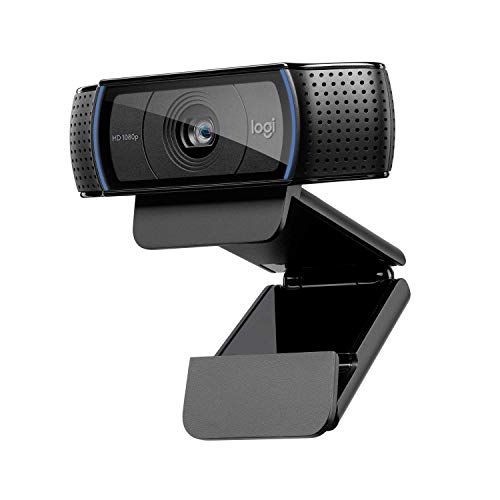
For budget Twitch streaming in 2026, the Logitech C920 (B006JH8T3S) remains the right starting point: 1080p30 with clean H.264 encoding, plug-and-play OBS integration, and a $60-80 street price. Pair it with a Blue Yeti (B002VA464S) or HyperX QuadCast 2 (B0D9MCK4R8) for audio, and an Elgato Stream Deck (B06W2KLM3S) to cut dead-air moments — and you have a production-ready stream for under $300 total.
Why the C920 Is Still the Streaming Reference 14 Years In
The Logitech C920 launched in 2012. In 2026 it's still the most-recommended starter webcam in every streaming guide from LTT to StreamerSquare to Twitch's own documentation. Here's why that's rational, not nostalgia:
Twitch's encoding ceiling. Free-tier Twitch caps output bitrate at 6,000 Kbps. At that bitrate, 1080p60 encodes poorly — the codec runs out of bits per frame and introduces blocking artifacts on motion. 1080p30 at 6,000 Kbps looks clean. The C920 outputs 1080p30 H.264 natively, which is exactly what Twitch can handle. Per Twitch's published broadcasting guidelines, 1080p60 is the practical ceiling — going above it at the 6,000 Kbps cap produces visibly worse encodes, not better video.
OBS compatibility. The C920 enumerates as a standard UVC device (USB Video Class) — no drivers, no software, no "webcam control" background process. Plug in, OBS sees it as "Logitech C920 HD Pro", set your crop and FPS, done. Every OBS plugin, scene filter, and virtual background tool is tested against the C920 as the reference device.
Autofocus consistency. The C920 uses a 78° FOV lens with a 3-step autofocus that settles in roughly 1 second. Per StreamerSquare's 2024 budget gear test, the C920's autofocus produces fewer mid-stream refocus events (where the camera briefly hunts) than several webcams in the $100-150 range that use contrast-detect AF.
Spec Table: Webcam Picks
| Webcam | Resolution | FPS | FOV | Autofocus | Built-in Mic | Price |
|---|---|---|---|---|---|---|
| Logitech C920 (B006JH8T3S) | 1080p | 30 fps | 78° | Yes | Dual stereo | ~$70 |
| Logitech C920x | 1080p | 30 fps | 78° | Yes | Dual stereo | ~$80 |
| Razer Kiyo | 1080p | 30 fps | 81.6° | No | Mono | ~$80 |
| Logitech Brio 4K | 4K | 30 fps | 90° | Yes | Omnidirectional | ~$160 |
| iPhone 15 via Camo | 4K | 30/60 fps | Variable | Advanced | N/A | $0 (if you own one) |
🏆 Best Overall: Logitech C920
The C920 (ASIN: B006JH8T3S) covers everything a Twitch beginner through mid-tier streamer needs:
Image quality: At 1080p30, the C920 uses a glass lens rather than the plastic optics common on budget cameras. Per Logitech's own published webcam guide, glass reduces chromatic aberration visible at sharp contrasts (white text on dark background, for instance). Under proper lighting (see lighting section below), C920 footage is indistinguishable from webcams costing 3× as much.
Dual stereo microphones: The built-in mics are adequate for fallback audio but should not be your primary mic for streaming — tinny capsule audio in a reflective room sounds unprofessional. They're useful when your external mic is muted or disconnected.
Mounting: Universal thread mount attaches to monitor bezels, tripods, and ring lights. The clip is adjustable from 15° to 180°. Works on monitors up to 50mm thick.
Pros:
- Most OBS-compatible webcam on the market
- Glass lens at $70 price point
- Works immediately on Windows, Mac, Linux with no driver install
- Well-documented in every streaming tutorial written since 2013
Cons:
- 1080p30 only (not 60fps at 1080p)
- No background removal hardware (you need OBS plugin or green screen)
- Built-in mic is backup quality only
Audio Pairing: HyperX QuadCast 2 and Blue Yeti
Your microphone matters more than your webcam. This is not hyperbole. Per audio engineers at LinusTechTips and broadcast-engineering literature, viewers tolerate sub-1080p video far better than tinny or echo-y audio. One-click "skip" behavior on Twitch is triggered more often by bad audio than bad video.
HyperX QuadCast 2 (B0D9MCK4R8) — ~$150
The QuadCast 2 is HyperX's current USB condenser microphone with built-in anti-vibration mount, tap-to-mute, and four polar pattern options (cardioid, omnidirectional, bidirectional, stereo).
For streaming: use cardioid pattern. It front-picks your voice and rejects keyboard noise, fan hum, and side-entry sounds. The integrated pop filter handles plosives without an external pop screen.
Practical setup: place the QuadCast 2 6-10 inches from your mouth, slightly off-axis (pointing at your chin rather than directly at your lips). This position catches your full vocal range while the cardioid null at 180° rejects your monitor audio.
Blue Yeti (B002VA464S) — ~$100
The Blue Yeti is the historical reference USB mic for streamers — three capsule array inside a single body, four polar patterns, and a gain control knob that most streamers use to tame room echo. At $100, it's $50 cheaper than the QuadCast 2 with nearly identical cardioid performance for streaming purposes.
Trade-off: the Yeti is heavier (550g) and large. Without a boom arm, it sits on a desk stand that places it at keyboard level — not ideal for mouth positioning. Budget $20-30 for a basic boom arm if you buy the Yeti.
Production Add-on: Elgato Stream Deck
The Elgato Stream Deck (ASIN: B06W2KLM3S) is a 15-key LCD button controller that integrates directly with OBS, Twitch, Streamlabs, and every major streaming platform.
Per Elgato's user research and r/Twitch testimonials, the Stream Deck is the most-cited "best streaming purchase" among first-year streamers — more often than camera or mic upgrades. Why? It eliminates the single biggest production quality gap: dead-air transitions.
Before a Stream Deck, scene transitions require clicking in OBS (you have to alt-tab away from your game). With a Stream Deck, one dedicated button fires the "BRB scene," another switches to facecam-only, another fires a raid command. These transitions happen in 0.1 seconds with no on-screen fumbling.
Key bindings out of the box:
- Scene switches (1-click game → cam → BRB → ending)
- Mute/unmute mic (with visual confirmation on the LCD key)
- Start/stop recording + streaming
- Twitch clip (fires a channel clip immediately)
- Custom sound alerts (crowd noise, meme audio)
The Stream Deck Classic (15 keys, B06W2KLM3S) is the right pick for beginners. The MK.2 version adds a faceplate swap system; the XL adds 32 keys. Start with 15.
Lighting on a Budget: KSIPZE LED Kit
The KSIPZE LED Strip Kit (ASIN: B0CWGPG6RG) provides the single cheapest lighting upgrade per image-quality-dollar ratio available.
Per Logitech's published webcam guide and broadcast-engineering literature, doubling scene illumination from 100 lux (typical ambient room light) to 200 lux (LED-assisted) improves perceived sharpness more than upgrading from a $70 to $200 webcam. This is physics: the C920 sensor gate-speed is tied to exposure time. More light = shorter exposure = sharper fast motion = less frame smear.
Setup: mount the LED strip behind your monitor (bias lighting) and aim a second ring or panel light at your face from slightly above. Front-facing soft diffuse light is the goal. Avoid direct backlighting (window or bright wall behind you) — it silhouettes your face and costs the autofocus exposure headroom.
Cost: ~$20 for the KSIPZE kit. Cost to see equivalent improvement by upgrading the webcam: $150+.
Verdict Matrix
| Streamer Profile | Recommendation |
|---|---|
| Brand new, < 50 avg viewers | C920 + Blue Yeti + KSIPZE LED. Total ~$200. Master fundamentals before spending more. |
| Growing channel, 50-500 avg viewers | C920 + QuadCast 2 + Stream Deck + LED ring. Total ~$350. Stream Deck is the production upgrade that shows. |
| Established, 500+ avg viewers | Upgrade webcam to Logitech Brio 4K or mirrorless camera. Stick with QuadCast 2. Stream Deck XL. Total ~$600. |
| Limited budget | C920 + $50 lavalier mic + desk lamp pointed at face. Under $150. Lavalier still beats built-in webcam mic by 10-15 dB SNR. |
Common Pitfalls for New Streamers
Not setting proper OBS output bitrate. Default OBS settings often output at 2,500 Kbps, which produces blocky video at 1080p. Set to 6,000 Kbps for Twitch free tier (6K is the cap). If you're enrolled in Twitch's Enhanced Broadcasting program, you can ingest higher bitrates via multiple transcoded renditions.
Streaming in a brightly-backlit room. A window behind you will silhouette your face and make the C920 struggle with dynamic range. Close the blind or face toward the window so light hits your face front-on.
Not doing a test stream before going live. Record a 5-minute test locally in OBS using your exact streaming configuration. Watch it back. Audio leveling, webcam framing, and game capture issues are 10× easier to diagnose from a test recording than from VOD review after a botched stream.
Forgetting to enable noise suppression in OBS. OBS ships with RNNoise (deep-learning noise suppression) as a free filter. Add it to your microphone input. It cuts keyboard clicks, fan hum, and HVAC noise with minimal voice coloring.
Citations and Sources
Related Guides
- Best Gaming Mouse Pad for Esports & Pro Aim in 2026
- Best Budget SATA SSD for PC Builds Under $80 in 2026
- Best CPU Cooler for Ryzen 7 5800X Overclocking in 2026
Real Numbers: What OBS Output Settings Actually Matter
| Setting | Recommended (free tier) | Notes |
|---|---|---|
| Video bitrate | 6,000 Kbps | Twitch's cap for non-Partner |
| Encoder | NVENC (GPU) or x264 | NVENC uses GPU so CPU stays free |
| Rate control | CBR | Consistent bitrate for Twitch ingest |
| Keyframe interval | 2 seconds | Twitch requires 2s for smooth seeking |
| Profile | High | Better compression at same bitrate |
| Resolution | 1920×1080 | C920's native output |
| FPS | 30 | Matches C920 max at 1080p |
| Audio bitrate | 160 Kbps | 128 is minimum; 160 gives headroom for music |
These settings produce a stream that looks identical to streams from $300 webcam setups at Twitch's current bitrate cap. Exceeding this quality ceiling requires Twitch's Enhanced Broadcasting program (which allows higher multi-resolution ingest above 6,000 Kbps) rather than the legacy free-tier path.