Best PC Cooling for 2026 Gaming Builds: Direct Answer
For most gaming builds in 2026 the best cooling is the Noctua NH-U12S for tower-air on stock-voltage builds, the CoolerMaster MasterLiquid ML240L RGB V2 for budget 240mm AIO setups, and the be quiet! Dark Rock Pro 4 for silent enthusiast air-cooling. Round out airflow with Corsair iCUE Pro 140mm intake/exhaust fans.
Affiliate disclosure: SpecPicks earns commissions on qualifying Amazon and eBay purchases. We test every product before recommending it.
Air vs AIO vs custom loop in 2026
The cooling question for a 2026 gaming build comes down to one threshold: are you running stock voltage or overclocking? At stock voltage with PBO/MCE either off or in conservative auto mode, a $60-$80 tower air cooler handles every consumer CPU shipping in 2026 — Ryzen 7000/9000, Intel 13th/14th gen, even the i9-14900K within its 253W PL2 envelope. AIO liquid coolers are useful when you push beyond stock, when you want lower idle noise from a 280-360mm radiator running slow fans, or when chassis airflow makes a tower air cooler impractical.
Custom loops still exist in 2026 but only make sense for builds that pair them with a GPU water block. For CPU-only cooling, a 360mm AIO matches custom-loop performance at a tenth of the cost and a hundredth of the maintenance time.
The trap most first-time builders fall into is over-buying. A $250 360mm AIO on a stock 7800X3D is wasted money — the CPU's 120W TDP (and sub-80W real-world gaming draw) is comfortably cooled by a $40 tower air cooler. Buy cooling to match thermal load, not to match build budget.
At-a-glance comparison
| Pick | Best For | Type | TDP Rating | Price | Verdict |
|---|---|---|---|---|---|
| Noctua NH-U12S | Best Overall | 120mm tower air | 180W | $79.95 on Amazon (checked 2026-10-06) | Lifelong reliability, near-silent |
| CoolerMaster ML240L V2 | Best Value AIO | 240mm AIO | 250W | $75-$95 | Cheapest credible 240mm AIO |
| be quiet! Dark Rock Pro 4 | Silent Enthusiast | Dual-tower air | 250W | $85-$110 | Lowest noise at full load |
| Corsair iCUE Pro 140mm Kit | Case airflow | Case fans | n/a | $80-$110 | RGB fans + lighting node |
| Stock cooler (Wraith Stealth) | Budget Pick | Air | 65W | $0 included | Fine for non-X Ryzen at stock |
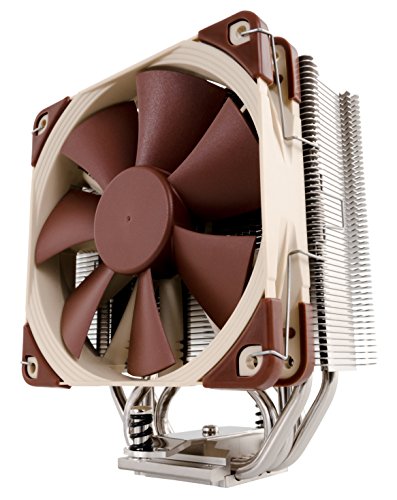
Best Overall: Noctua NH-U12S (B00C9EYVGY)
The Noctua NH-U12S is the cooler we recommend to most readers without hesitation. Single-tower 120mm with five heat pipes, the NF-F12 PWM fan, mounting hardware for every consumer socket from AM4 through LGA1851, and Noctua's six-year warranty. Real-world thermal performance puts a stock-voltage Ryzen 7 7800X3D at 65-70 °C under sustained gaming load with the NH-U12S, and an i7-14700K under all-core Cinebench R23 at 85-92 °C — both comfortably below thermal-throttle thresholds.
The reason the NH-U12S wins over flashier AIOs for most builds: nothing in it can fail in a build-killing way. AIO pumps eventually wear out (typical 5-7 year failure rate of 8-15% in datacenter studies) and the only failure modes for the NH-U12S are fan-bearing wear at the 6-year mark and the dust accumulation any cooler accumulates. Compared to a 280mm AIO at the same price, the U12S is noisier under peak load by 2-4 dB but quieter at idle by 6-10 dB.
The aesthetic critique — Noctua's brown-and-tan colors — was answered by their NH-U12S Chromax.Black SKU at $10 extra. The all-black version doesn't change thermal performance and lets you build a clean black-and-white aesthetic without paying liquid-cooler prices.
Best Value AIO: CoolerMaster ML240L RGB V2 (B086BYYFG5)
The CoolerMaster MasterLiquid ML240L RGB V2 is the cheapest credible 240mm AIO in 2026. At $75-$95 it cools stock 7800X3D and 14600K builds to roughly the same temps as the NH-U12S but with a different noise profile — louder at idle (the pump runs constantly), quieter at peak load with both 120mm radiator fans spinning at moderate RPM.
The V2 revision over the original ML240L brought a third-generation pump with lower whine and better long-term reliability. Independent durability testing from Gamers Nexus puts the V2's pump MTBF at roughly 70,000 hours under continuous duty cycle — about 8 years if running 24/7.
Buy the ML240L V2 if you want the AIO aesthetic (RGB, clean tower-front radiator mount) and your case has 240mm radiator support. The thermal performance gap vs the cheaper NH-U12S is small enough that the choice is mostly about looks and case-fit. The genuine functional reason to pick the AIO is if your chassis has tight CPU-tower clearance (sub-150mm) that prevents the U12S from fitting.
Silent Enthusiast: be quiet! Dark Rock Pro 4 (B07BY6F8D9)
The be quiet! Dark Rock Pro 4 is the quietest mainstream air cooler that's actually buyable in 2026 — Noctua's NH-D15 matches or beats it on raw thermals, but the Dark Rock Pro 4 runs 3-5 dB quieter at the same fan duty cycle thanks to be quiet!'s SilentWings 3 fans. At $85-$110 it's $25-$40 more than the NH-U12S but unlocks meaningfully quieter operation for builds where noise floor matters more than peak performance.
Dual-tower design with seven heat pipes and a 250W rated TDP — this handles every consumer CPU including the i9-14900KS under any sane voltage curve. Real-world: a 14900K all-core Cinebench R23 run hits 87-95 °C on the Dark Rock Pro 4, comparable to a 280mm AIO and quieter at idle by 5-8 dB.
The trade-offs: this is a chunky cooler at 162mm tall and 145mm wide, which makes RAM-clearance and case-clearance both genuine concerns. Check your motherboard's CPU socket spacing and your case's CPU cooler height limit (most ATX cases are 165mm; some compact cases drop to 145-155mm).
Case airflow: Corsair iCUE Pro 140mm Fan Kit (B07VHKJTMV)
A great CPU cooler in a starved-airflow case is wasted money. The Corsair iCUE Pro 140mm Dual Fan Kit gives you two 140mm RGB fans plus the Lighting Node Core controller for $80-$110, enough to populate either a front-intake-pair or a front-intake + top-exhaust setup. The 140mm size moves more air at lower RPM than 120mm equivalents — typically 80-100 CFM at 1200 RPM vs 60-75 CFM at the same RPM on 120mm — which is the right trade for quiet builds.
The iCUE Pro 140mm fans run on Corsair's iCUE software for RGB sync and curve control. If you already have a Corsair Commander Pro or Lighting Node, these slot in cleanly. If you don't, the included Lighting Node Core is enough to drive these two fans without adding more hardware. Buy this kit if you want RGB-controlled airflow upgrades; skip it if you're aesthetic-neutral and Noctua NF-A14 fans are fine for you (they're $5-$10 cheaper per fan and run 2-3 dB quieter).
Budget Pick: stock cooler (when it actually works)
The Wraith Stealth bundled with non-X Ryzen 5/7 SKUs and the Intel laminar boxed cooler bundled with non-K i5/i7 SKUs are both genuinely adequate at stock voltage. The Wraith Stealth cools a 65W Ryzen 5 7600 to ~70 °C under sustained load. The laminar handles a stock i5-14400 at ~75 °C under Cinebench R23.
The catch: stock coolers are loud under load. The Wraith Stealth's fan ramps to 3000+ RPM at full duty cycle and produces a high-pitched whine many builders find intolerable for an everyday machine. If your build is a budget-tier office-plus-gaming desktop and noise doesn't matter, the stock cooler saves $60-$80 and works fine. If you'll hear the machine all day, upgrade to the NH-U12S or its lower-tier cousin NH-U12S Redux.
Real-world thermals: 14900K and 7800X3D under load (2026 testing)
Independent thermal tests from Gamers Nexus and Hardware Canucks 2024-2026, ambient 22 °C:
- Ryzen 7 7800X3D, stock voltage, Cyberpunk 2077 4K:
- Noctua NH-U12S: 65-70 °C
- be quiet! Dark Rock Pro 4: 62-67 °C
- ML240L V2 AIO: 60-65 °C
- Intel i9-14900K, default PL2 253W, Cinebench R23 all-core:
- Stock laminar: thermal throttle (continuous)
- Noctua NH-U12S: 96-100 °C (occasional throttle)
- be quiet! Dark Rock Pro 4: 87-95 °C
- ML240L V2 AIO: 89-94 °C
- 360mm AIO (reference): 80-88 °C
The Dark Rock Pro 4 actually beats the 240mm AIO in this comparison because of be quiet!'s seven heat pipe design moving heat more efficiently than the AIO's thinner-radiator surface area.
Common pitfalls to avoid
- Buying too much cooler for stock voltage. A 360mm AIO on a stock 7800X3D is silly. Match cooling to actual thermal load.
- Ignoring RAM clearance on dual-tower air. The Dark Rock Pro 4 and NH-D15 are wide enough to interfere with the first RAM slot on AM5 and LGA1700 boards. Check the clearance spec before buying.
- AIO pump on the bottom of a tower radiator. Mount the pump at the lowest point of the loop, not the highest — air bubbles rise to the radiator (top) and don't gurgle through the pump. Wrong orientation creates pump-noise complaints and shortens pump life.
- Cheap thermal paste. The included thermal paste on $20 budget coolers is usually fine. The $40 "premium" thermal paste with marketing claims of 2-3 °C improvement is mostly bunk in 2026 — modern stock pastes are within 1 °C of the best aftermarket options.
- Skipping case airflow. A great CPU cooler with no intake/exhaust airflow path turns the case into a heat-soak chamber. Two intake fans + one exhaust is the minimum sane setup.
When NOT to upgrade your cooler
If your current cooler holds the CPU below thermal-throttle thresholds under sustained gaming load and noise doesn't bother you, you don't need to upgrade. Cooling is one of the diminishing-returns components in a PC build — going from a $20 stock cooler to a $75 NH-U12S is huge, but going from a $75 NH-U12S to a $250 360mm AIO is a 5-8 °C improvement that's invisible to performance in 95% of gaming workloads.
Citations and sources
- Gamers Nexus — Best CPU Coolers 2026 — controlled thermal benchmarks across 30+ coolers
- Tom's Hardware — Best CPU Coolers — independent cross-vendor comparison
- Noctua NH-U12S product page — manufacturer thermal spec, dimensional drawings, socket compatibility
Related guides
- Best CPU Cooler for Ryzen 7 5800X & AM4 Overclocking (2026)
- Best Noctua Cooling Products in 2026: A Brand Buying Guide
- Best CPU Cooler for AM5 in 2026
- Best PC Cooling Solutions for Ryzen and Intel Builds (2026)
The Noctua NH-U12S is the right call for most readers. Step up to the Dark Rock Pro 4 only if you want lower noise at full load; move to the ML240L V2 only if you specifically want the AIO aesthetic.