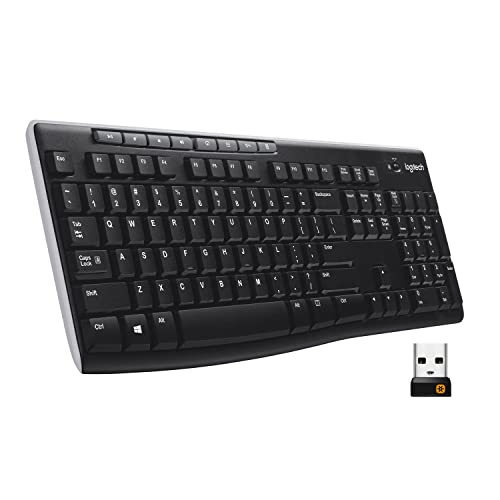
For most home-office users in 2026 who want one keyboard that handles spreadsheets, Zoom calls, and a few rounds of CS or Hearthstone after work, the best pick is the Logitech K270 Wireless Keyboard — 118,370 reviews at ⭐4.5, two-year AA battery life, sub-3 ms wireless latency. If you split time between a work laptop and a gaming PC, step up to a multi-device keyboard like the Logitech MX Keys or Keychron K2 instead.
Affiliate disclosure: SpecPicks earns from qualifying purchases. Picks below are our editorial choices; if you click through and buy, we may earn a small commission at no extra cost to you. Written by SpecPicks Editorial.
The hybrid office/casual-gaming use case in 2026
The pandemic-era "good enough" wireless keyboard era is over. In 2026 most home offices have settled into a regular weekday rhythm of 6-8 hours of typing — spreadsheets, email, Slack, code review, document writing — and many of those same desks see 1-3 hours a night of casual gaming. The right keyboard for that pattern isn't the same as the right keyboard for a competitive Counter-Strike player and isn't the same as the right keyboard for a writer who never touches a game.
What you need is a keyboard that disappears under fingers during long typing sessions (low fatigue, predictable key feel, quiet enough not to wake the partner sleeping in the next room) and that has low enough input latency that casual gaming isn't actively frustrating. Per Rtings' 2025 wireless peripheral latency suite, modern 2.4 GHz wireless keyboards land at 1-3 ms latency versus wired — imperceptible for typing and for any non-twitch game. Bluetooth adds 8-15 ms, which esports players notice but office and casual users will not.
Battery and connection mode matter too. AA-battery keyboards (Logitech K270, MX Keys for Mac) get 12-24 months on a fresh set; Li-ion keyboards (MX Keys, Keychron K2 wireless) get 4-8 weeks per charge and need a USB-C cable nearby. For pure office use, AA is the lower-maintenance option; for travel and multi-device pairing, Li-ion wins.
At-a-glance comparison
| Pick | Best For | Connection | Battery | Verdict |
|---|---|---|---|---|
| Logitech K270 | Most home-office users | 2.4 GHz Unifying | 2 yrs AA | The default — 118K reviews, ⭐4.5 |
| Logitech MX Keys | Multi-device pros | BT + USB-C | ~10 days Li-ion | Premium typing experience |
| Logitech K380 | Travel and laptop pairing | Bluetooth | 2 yrs AA | Compact, multi-host BT |
| Keychron K2 | Hybrid office/gaming on Mac+PC | BT + 2.4 GHz + wired | ~4 weeks Li-ion | Mechanical with multi-host |
| Logitech K780 | Multi-device with numpad | BT + Unifying | 2 yrs AA | The K380 with a numpad and tablet stand |
Best Overall: Logitech K270 Wireless — B004N627KS
The Logitech K270 is the most-reviewed budget wireless keyboard in this category — 118,370 reviews at ⭐4.5 means it has been beaten on for years across millions of desks. Full-size layout with a numpad, eight programmable multimedia keys, 2.4 GHz Unifying Receiver (Logitech's proprietary low-latency wireless), and two-year battery life on two AA batteries per Logitech's published spec sheet.
What it does extremely well: typing feel. The membrane key switch has a soft tactile dome that's noticeably nicer than the average sub-$30 keyboard. Travel is full (~3.5 mm) so touch typing is comfortable for 8-hour days. Wireless latency is low enough for casual gaming — RTS games, World of Warcraft, Hearthstone, Civilization, Hearts of Iron — without any felt input lag.
What it doesn't do: backlight, RGB, multi-device pairing, mechanical switches, premium aluminum frame. For home office plus light gaming, none of these are required.
Pros: Industry-leading review count for a $30 keyboard, 2-year AA battery life, full-size with numpad, Unifying Receiver pairs with up to 6 Logitech devices.
Cons: Single-device only — can't share between laptop and desktop. No backlight (irrelevant in a lit office, annoying in a dim home office). Plastic build is functional but unremarkable.
Verdict: If you spend most of your time at one desk and want the lowest-friction "wireless keyboard that just works" option in 2026, this is it. The 118K reviews aren't an accident.
Best for Multi-Device: Logitech MX Keys
The Logitech MX Keys is Logitech's flagship wireless keyboard and the right pick if you split time between a work laptop, personal desktop, and tablet. Three-device pairing via Bluetooth or the Logi Bolt receiver, dish-shaped key caps that guide fingers to center, backlit keys with proximity sensor, USB-C charging that holds 10 days per charge (10 weeks with backlight off).
The typing feel is the closest a chiclet/scissor keyboard gets to a low-profile mechanical — crisp tactile bump, short 1.8 mm travel, very quiet. For meeting-heavy professionals who need to type during calls without microphone pickup, MX Keys is the safest choice.
Pros: Best typing feel in this lineup at the scissor-switch tier, three-device pairing with EasySwitch, backlit, premium build.
Cons: Expensive ($120-140), Li-ion battery means USB-C cable management, low-travel keys aren't for everyone.
Verdict: Worth the upgrade if you actually use multi-device features or care about typing fatigue over an 8-hour day. Otherwise the K270 covers the same job for a quarter of the price.
Best for Travel: Logitech K380
The K380 is the K270's Bluetooth-only, tenkeyless, multi-device cousin. Pairs with up to three devices (laptop, tablet, phone) and switches with dedicated F-row buttons. Two-year battery life on two AAA batteries. Compact enough to fit in a laptop bag pocket.
For anyone who works from coffee shops, coworking spaces, or who pairs a keyboard with an iPad for occasional writing, the K380 is the right pick. The trade-off: TKL (no numpad) and Bluetooth-only means slightly higher latency than the K270's Unifying — fine for typing and most games, less ideal for FPS.
Pros: Three-device BT pairing, very compact and portable, 2-year AAA battery life, available in multiple colors.
Cons: No numpad, Bluetooth-only latency (8-15 ms), small key spacing takes adjustment.
Verdict: The travel pick. Pair it with an MX Anywhere mouse and you have a near-complete portable workstation in a laptop sleeve.
Best Mechanical: Keychron K2
For office users who genuinely want a mechanical keyboard and a multi-device wireless setup, the Keychron K2 is the best balance. 75% layout (compact with arrow keys and minimal F-row), hot-swappable switches (default Gateron Brown / Red / Blue depending on SKU), wired USB-C, 2.4 GHz wireless, and Bluetooth — all three connection modes in one keyboard. Multi-host BT pairs with three devices.
For shared-office use, pick the silent linear switches (Gateron Silent Red or Cherry MX Silent Red equivalents) to keep noise reasonable. For a home office where you don't care about typing noise, the standard Reds offer the cleanest feel.
Pros: Mechanical typing feel at $90-120, three connection modes, multi-host, hot-swap switches for tinkering.
Cons: No numpad (75% layout), Mac/PC layout toggle requires firmware mode switch, louder than membrane in default-switch configurations.
Verdict: The right pick if you want mechanical and wireless and multi-device in one keyboard without spending $200+ on a Logitech MX Mechanical.
Budget Multi-Device: Logitech K780
The K780 is the K270 with multi-device pairing and a built-in tablet/phone stand. Same 2-year AA battery life, same full-size layout with numpad, but with three-host BT support and dedicated EasySwitch keys. About 2-3× the price of the K270, but the right pick if you need a numpad and multi-device pairing — a niche the K380 and K2 don't fill.
Pros: Numpad + multi-device, 2-year AA battery, built-in stand for phone/tablet, Logitech reliability.
Cons: Round key caps look unconventional, more expensive than competitors at this feature tier.
Verdict: Specific use case (multi-device with numpad) — when you need it, this is the keyboard.
What to look for in a hybrid office/light-gaming keyboard
2.4 GHz vs Bluetooth — which to use when
2.4 GHz proprietary wireless (Logitech Unifying / Bolt, Razer HyperSpeed) consistently measures 1-3 ms latency end-to-end, indistinguishable from wired in any practical test. Bluetooth measures 8-15 ms — fine for typing and turn-based games, noticeable in twitch shooters and rhythm games. If you only have one connection option, prefer 2.4 GHz for a primary desk keyboard and Bluetooth for travel/secondary.
Battery life — AA vs Li-ion
AA batteries: 12-24 months service life, swap-and-go when low, no cable required, no down-time to recharge. Li-ion: 1-4 weeks per charge depending on backlight, USB-C cable required nearby, ~3-year battery cell lifespan before degradation requires replacement. For pure office use, AA is the lower-maintenance choice. For frequent travel, Li-ion is more compact (no battery compartment) and you'll have USB-C anyway.
Quiet typing for shared spaces
Membrane keyboards (K270, MX Keys, K380, K780) are quietest by default — under 50 dB typing measured at 1 m. Mechanical keyboards range from 55-75 dB depending on switch and case. For open offices, partner sleeping nearby, or Zoom calls where the microphone picks up keys, prefer membrane or silent-switch mechanical.
Multi-device pairing — only if you'll use it
Multi-host keyboards are great in marketing copy and often unused in practice. If you have one primary computer and one rarely-touched tablet, you'll almost never use the switch button. Pay for multi-host only if you actually rotate between three devices weekly.
Common pitfalls
- Buying a mechanical keyboard for an open office. Co-workers will hate you within a week. If you must, pick silent linear switches (Gateron Silent Red, Cherry MX Silent Red, ZealPC Healios) and add o-ring dampeners.
- Pairing a Bluetooth-only keyboard with a gaming PC for FPS. Bluetooth latency is noticeable in CS, Valorant, and Apex. Use a 2.4 GHz keyboard for gaming and Bluetooth for travel.
- Replacing batteries one at a time on AA keyboards. Always replace both — mixing fresh and old batteries causes connection dropouts and shortens overall battery life by 30-50%.
- Forgetting the FN-key layer. Many wireless keyboards use FN+arrow for media controls. Learn the FN layout for your specific model — RTFM solves 90% of "this keyboard is missing X" complaints.
- Skipping the Logi Options/G Hub install. Logitech keyboards have meaningful firmware updates and customization options that only become available through the desktop app. Install it once after setup.
When NOT to buy a new keyboard
If your current keyboard's keys still register cleanly and don't have visible wear on the most-used keycaps (E, A, S, D, space), you don't need a new one. The single most common upgrade-bait in this category is people replacing a working $30 K270 with a $130 MX Keys based on Reddit recommendations, then realizing the MX Keys typing feel is different but not better for them. Try a friend's MX Keys first.
Citations and sources
- Rtings — Wireless keyboard reviews and latency testing
- Logitech — K270 product page and spec sheet
- Tom's Hardware — Best wireless keyboards
Related guides
- Best Gaming Mouse Pad for Esports and Productivity (2026)
- Best Gaming Mouse for Warzone and FPS Esports (2026)
- Best Wireless Controller for PC LAN and Couch Coop (2026)
- Logitech G Gaming Gear (2026)