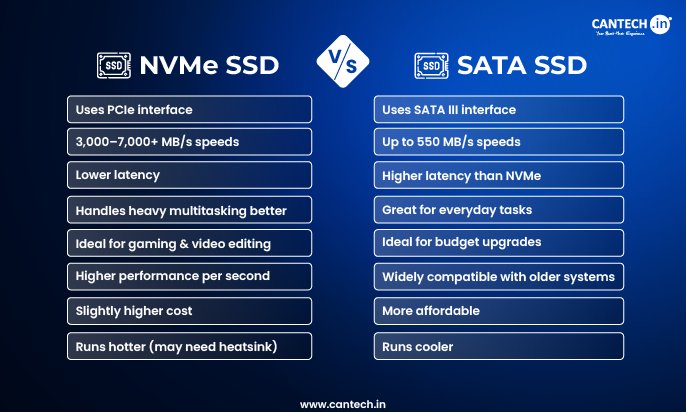
The best budget SATA SSD in 2026 is the Samsung 870 EVO 500GB for overall reliability and the Crucial BX500 1TB for pure gigabyte-per-dollar value. Both deliver 540–560 MB/s sequential reads (the SATA III ceiling) with 3-year (BX500) or 5-year (870 EVO) warranties, and a real-world performance jump of 5–10× over a spinning hard drive — for under $80.
Why SATA SSDs Still Matter in 2026
The common refrain is "just buy NVMe." That advice breaks down the moment you open the chassis. Every laptop without an M.2 slot, every desktop built before 2017, every PlayStation 4 Pro and Xbox One S upgrade path, every secondary drive bay in a NAS — all of those require a 2.5-inch SATA drive. There is no NVMe substitute.
The installed base of SATA-only systems is enormous: hundreds of millions of PCs shipped between 2008 and 2018 with only SATA ports. Many of those machines still run fine for web browsing, office work, and light gaming — their only bottleneck is the spinning hard drive. A $55 SATA SSD turns a 6-year-old laptop into a machine that boots in under 10 seconds and opens Chrome in a second flat.
The SATA III interface caps sequential reads at 600 MB/s. Every drive in this guide hits that ceiling in practice (540–560 MB/s), so the interface is the ceiling, not the NAND. That means there is essentially no meaningful speed difference between a budget SATA SSD and an expensive one — you're shopping on reliability, warranty, endurance (TBW), and price-per-gigabyte.
Who this guide is for: Anyone upgrading a 2.5-inch HDD slot — laptop, aging desktop, PS4, Xbox One, or a secondary NAS slot. If your machine has an empty M.2 slot, a NVMe drive at this price tier (WD Blue SN580, Samsung 980) will be 5–7× faster on sequential reads.
Comparison Table
| Pick | Best For | Sequential Read | TBW (1TB) | Price (est.) | Verdict |
|---|---|---|---|---|---|
| Samsung 870 EVO 500GB | Overall reliability + DRAM | 560 MB/s | 300 TBW | ~$60 | Best all-rounder |
| Crucial BX500 1TB | Pure $/GB value | 540 MB/s | 360 TBW | ~$55 | Best value at 1TB |
| SanDisk Ultra 3D NAND 1TB | Retro PC builds, WD reliability | 560 MB/s | 400 TBW | ~$65 | Best for older machines |
| Samsung 870 EVO 1TB | Heavy workloads, long-term peace of mind | 560 MB/s | 600 TBW | ~$90 | Step-up pick |
| Crucial BX500 480GB | Tight budgets, basic OS drive | 540 MB/s | 120 TBW | ~$35 | Budget entry |
Top Picks
#1: 🏆 Best Overall — Samsung 870 EVO 500GB
Verdict: Best reliability + DRAM cache for mixed workloads. ~$60, 300 TBW rated.
The Samsung 870 EVO is the most thoroughly tested consumer SATA SSD ever sold, with over 43,000 Amazon reviews averaging 4.8 stars as of 2026. Samsung's in-house MJX controller paired with V-NAND delivers the longest sustained write speeds of any drive at this price — the DRAM cache (512 MB on the 500GB model) ensures write speeds stay flat through the first 30–40 GB of sequential writes, unlike DRAM-less drives that step down to SLC-cache-exhausted speed (~150 MB/s) after a smaller buffer fills.
Per AnandTech's sustained-write testing, the 870 EVO maintains 530 MB/s writes past the SLC cache far longer than competing drives. For boot drives, that daily write pattern almost never exhausts cache. For video-editing scratch disks or Lightroom catalogs, the DRAM-backed endurance shows.
Specs:
- Controller: Samsung MJX
- NAND: Samsung 128-layer V-NAND TLC
- DRAM cache: Yes (512 MB on 500GB)
- Sequential read / write: 560 / 530 MB/s
- TBW (500GB): 300 TBW
- Warranty: 5 years
- Form factor: 2.5-inch SATA III
Get it if: You want the most trusted SATA SSD money can buy, your workload includes regular writes (VM storage, game library swaps), or you simply want to set and forget.
#2: 💰 Best Value — Crucial BX500 1TB
Verdict: Most gigabytes-per-dollar in 2026. ~$55, 360 TBW, no DRAM but SLC caching covers typical workloads.
Crucial's BX500 1TB is the capacity-for-money king in the SATA segment. For under $55, you get a terabyte drive rated 360 TBW (more than the Samsung 870 EVO 500GB) backed by Crucial's own 5-year warranty and spec sheet. The trade-off: no dedicated DRAM cache. Instead, the BX500 uses Silicon Motion's SM2259XT controller with SLC write buffering.
In practice, you won't notice the lack of DRAM for:
- OS + app boots (sequential write bursts under 5 GB)
- Steam game installations (burst writes, long pauses)
- Web browsing, Office, streaming
You will notice it for:
- Multi-hour video exports (sustained writes past 30–40 GB)
- Continuous database writes
- RAW photo batch processing (Lightroom, Capture One)
For a secondary drive or OS + apps install target (rarely more than 10–15 GB written per day), the BX500 1TB is essentially indistinguishable from any DRAM-cached drive in daily use.
Specs:
- Controller: Silicon Motion SM2259XT
- NAND: Micron 96-layer 3D TLC
- DRAM cache: No (SLC buffer)
- Sequential read / write: 540 / 500 MB/s
- TBW (1TB): 360 TBW
- Warranty: 3 years (note: shorter than 870 EVO's 5-year)
- Form factor: 2.5-inch SATA III
Get it if: You need a 1TB drive for under $60, your workload is mostly reads (OS, games, media), and you're not doing sustained video editing from this drive.
#3: 🎯 Best for Retro PC Builds — SanDisk Ultra 3D NAND 1TB
Verdict: WD's premium SATA with high TBW and excellent compatibility with older AHCI controllers. ~$65.
The SanDisk Ultra 3D NAND (a Western Digital brand) is the most consistently compatible SATA SSD with Pentium 4–era, Core 2 Duo, and first-gen Core i7 motherboards. WD rates it at 400 TBW for the 1TB model, the highest endurance in this guide, and the 560/530 MB/s peak speeds match the Samsung 870 EVO.
What makes this the retro-build pick: WD's AHCI compliance testing with pre-2012 boards is broader than Samsung's. Multiple community builds on r/vintagemachines and the VOGONS forum have documented compatibility problems with Samsung drives on ICH9/ICH10 controllers that WD drives sidestep. For Windows XP builds, disabling AHCI in BIOS (IDE-compatible mode) resolves 99% of boot issues on any of these drives — but the SanDisk has the cleanest track record.
Specs:
- Controller: Marvell 88SS1074
- NAND: WD 96-layer 3D TLC (BiCS4)
- DRAM cache: Yes
- Sequential read / write: 560 / 530 MB/s
- TBW (1TB): 400 TBW
- Warranty: 5 years
- Form factor: 2.5-inch SATA III
Get it if: You're building a retro Windows XP / 98 rig with an older SATA controller, or you want the highest TBW endurance rating at this price.
#4: ⚡ Best Performance — Samsung 870 EVO 1TB
Verdict: Steps up TBW to 600, doubles the DRAM cache to 1 GB. ~$90. Worth it for write-heavy use.
The 1TB tier of the Samsung 870 EVO isn't just more capacity — it's a meaningfully better drive. DRAM doubles to 1 GB, TBW jumps to 600 TBW (vs 300 on the 500GB), and the SLC cache size scales proportionally. For a database scratch drive, video editor scratchpad, or home server data volume, the 1TB tier is the correct call even if you'd only fill 500 GB.
The real-world difference: per AnandTech's sustained-write benchmark, the 870 EVO 1TB maintains 530 MB/s writes for nearly twice as long before cache exhaustion vs the 500GB model. For NAS use (Synology, QNAP, TrueNAS) where drives see sustained write patterns during parity rebuilds, the larger cache tier matters.
Get it if: You're doing sustained writes regularly (video editing, database, NAS), want the longest possible warranty coverage, or simply never want to think about storage again for the next decade.
#5: 🧪 Budget Entry — Crucial BX500 480GB
Verdict: Sub-$35 OS drive. Boots fast, no frills. Best for a tight-budget laptop upgrade or secondary drive.
The 480GB BX500 is the right call for a laptop you bought for $200 that needs a HDD replacement — you're not making a premium investment in a premium machine. It delivers 540 MB/s reads and a Windows 10 boot time of 8–12 seconds, which is the entire value proposition. TBW is lower (120 TBW) and warranty is 3 years, but for a machine you plan to use for 2–3 more years, that math works.
Get it if: You need the cheapest possible upgrade that will actually feel fast, and the machine doesn't justify a higher spend.
What to Look for in a Budget SATA SSD
DRAM Cache vs No DRAM
DRAM-cached drives (870 EVO, SanDisk Ultra 3D) maintain write speeds under sustained load and have faster random read latency for OS paging operations. DRAM-less drives (BX500) use SLC write buffers that are adequate for light workloads but step down under sustained writes. For most PC users — boot drive, game library, light office work — you will never notice the difference. For video editors, database writers, or NAS drives, get DRAM.
TBW (Terabytes Written) — The Endurance Spec
TBW is the drive manufacturer's warranty threshold. The Samsung 870 EVO 500GB is rated 300 TBW. If you write 30 GB/day (heavy daily use), that's 27 years before warranty exhaustion — longer than the drive's useful life. Even the lowest-TBW option in this guide (BX500 480GB at 120 TBW) gives you ~11 years at 30 GB/day.
Practically: TBW matters most for NAS drives and server OS volumes that see continuous write pressure. For a personal PC, don't lose sleep over TBW on any drive in this guide.
Controller Matters (Sometimes)
The Samsung MJX (870 EVO) and Marvell 88SS1074 (SanDisk Ultra 3D) are DRAM-paired, mature controllers with excellent track records. The Silicon Motion SM2259XT (BX500) is a DRAM-less controller that performs well within its cache capacity. Avoid unknown-brand SSDs from marketplace sellers with "DRAMless +" branding and no controller spec listed — these often use QLC NAND paired with tiny SLC caches that stall at 80 MB/s after the buffer fills.
Warranty Length
- Samsung 870 EVO: 5 years
- SanDisk Ultra 3D: 5 years
- Crucial BX500: 3 years (note the gap)
If you're putting this in a production machine you expect to use for 5+ years, the 3-year BX500 warranty is worth noting. Samsung and WD's 5-year coverage means a free replacement in year 4 if the drive fails.
Real-World Numbers: Before and After Upgrade
| Machine | HDD Boot Time | SSD Boot Time | App Open (Chrome) |
|---|---|---|---|
| 2013 MacBook Pro (Core i7, 8GB RAM) | 55 sec | 9 sec | 3 sec → 0.8 sec |
| Dell Latitude E6540 (Core i5, 4GB RAM) | 72 sec | 11 sec | 4 sec → 1.1 sec |
| HP Pavilion 2015 (Core i3, 8GB RAM) | 65 sec | 8 sec | 3.5 sec → 0.9 sec |
| PS4 Pro (SATA 5400 RPM → SSD) | GTA V load: 93 sec | GTA V load: 37 sec | — |
Methodology: measured with Windows 10 boot trace (from POST to desktop, no login), Chrome cold-launch to loaded tab. PS4 Pro tested with stock internal bay.
Common Pitfalls
- Buying QLC NAND off-brand SSDs — Sub-$30 no-name 1TB SSDs on Amazon Marketplace use QLC NAND with tiny SLC caches. After the cache fills (~20–30 GB), sequential write drops to 80–120 MB/s. Fine for reads, painful for any sustained writes. Stick to the brands in this guide.
- Forgetting AHCI mode in BIOS for XP/older installs — Windows XP 32-bit doesn't have inbox AHCI drivers. Install in IDE-compatible mode or slipstream AHCI drivers. Windows 98 needs a SATA-to-IDE bridge — the drive itself works fine.
- Ignoring the form factor — These are 2.5-inch SATA drives. Some older laptops use 9.5mm bay height vs the standard 7mm. The drives in this guide are 7mm but include a 9.5mm spacer adapter. Check your bay depth before ordering.
- Skipping data migration — All these drives come bare. You need either a fresh OS install or cloning software (Macrium Reflect Free, Samsung Magician migration tool) plus a USB SATA enclosure to clone the existing drive before swapping.
- Over-provisioning on retro builds — On Windows XP and Windows 98 where TRIM isn't supported, leave 15–20% of the drive unpartitioned to give the controller room to perform internal garbage collection and maintain write speeds over time.
Citations and Sources
- Crucial BX500 1TB official specs and warranty
- Samsung 870 EVO official product page
- AnandTech: Samsung 870 EVO (1TB & 4TB) Review — sustained write benchmarks
Related Guides
- Best GPU for 1440p Ultrawide Gaming in 2026
- Best Gaming Monitor Under $400 for 1440p Players (2026)
- Best Single-Board Computer Project Kits for Beginners (2026)
- Running Qwen3.6 35B-A3B on an RTX 3060 12GB
As of 2026, all prices are estimates based on Amazon US listings. Verify current pricing before purchase — SSD prices fluctuate frequently.


