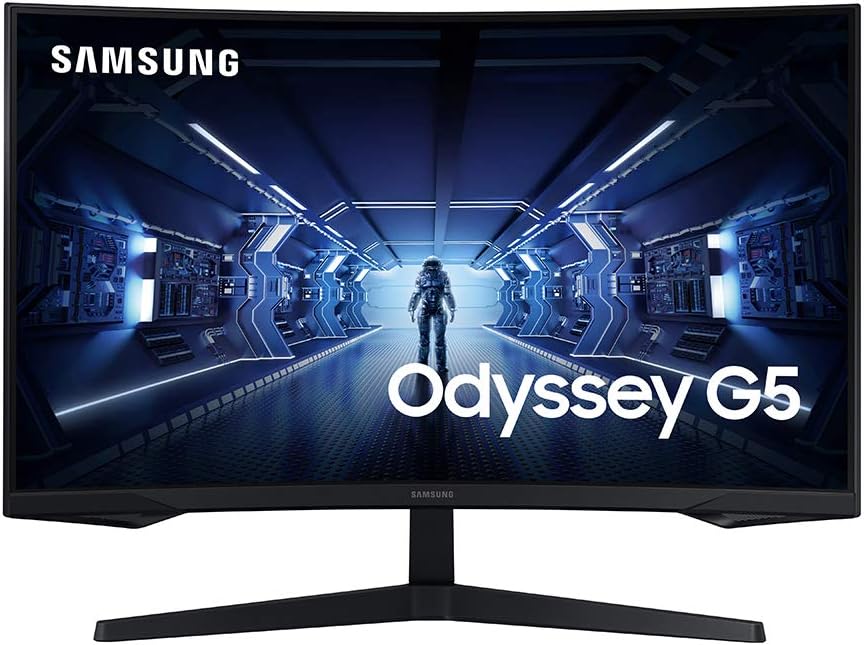
The best gaming monitor under $400 for 1440p play in 2026 is the Samsung Odyssey G5 32" for most players — 1440p at 165Hz, a 1000R curve, and FreeSync Premium for around $300. For 4K on a budget, the Dell G3223Q 32" is the only serious sub-$400 option at $350.
The Sub-$400 Monitor Sweet Spot in 2026
The sub-$400 monitor bracket is where the gaming display market actually lives. Above $400, you're paying for OLED panels, 240Hz IPS, or premium HDR with full-array local dimming — features that matter for competitive play and content creation but are unnecessary for most single-player and mixed-use gaming. Below $200, you're stuck at 1080p 75Hz, which looks mediocre on a 27"+ panel.
The $250–$400 range is where you get:
- 1440p resolution (3.69M pixels vs 1080p's 2.07M — 78% more detail)
- 144–165Hz refresh rates (the competitive sweet spot for most genres)
- IPS or VA panels with HDR400 certification (not true HDR, but better peak brightness)
- Adaptive sync (FreeSync Premium or G-Sync Compatible)
At 32", 1440p gives you a pixel density of 92 PPI — enough sharpness that individual pixels aren't visible at normal 60–80 cm viewing distances. Moving to 4K at 32" gives you 138 PPI, a visible but not dramatic improvement unless you're close to the screen.
Panel tech tradeoffs at this tier:
| Panel Type | Response Time | Contrast | Colors | Best For |
|---|---|---|---|---|
| IPS | 1–4ms GTG | 1000:1 | Wide sRGB / DCI-P3 | Color accuracy, productivity |
| VA | 2–6ms GTG | 3000:1+ | sRGB | Dark scenes, contrast-heavy games |
| TN | <1ms GTG | 600:1 | Narrower sRGB | Competitive FPS, not at this tier |
| QD-Mini LED | 2–4ms GTG | 10,000:1+ | Quantum dot wide gamut | HDR, cinematic — see KOORUI |
Comparison Table
| Pick | Best For | Panel | Refresh | Resolution | Price (est.) | Verdict |
|---|---|---|---|---|---|---|
| Dell G3223Q 32" | 4K on a budget | IPS | 144Hz | 3840×2160 | ~$350 | Best 4K value |
| Samsung Odyssey G5 32" | Console + PC, immersive games | VA | 165Hz | 2560×1440 | ~$300 | Best 1440p value |
| KOORUI 27" QD-Mini LED | True HDR gaming, cinematic | QD-Mini LED | 144Hz | 3840×2160 | ~$380 | Best HDR |
| HP 24mh FHD | Budget secondary monitor | IPS | 75Hz | 1920×1080 | ~$130 | Budget secondary |
Top Picks
#1: 🏆 Best Overall — Dell G3223Q 32" 4K Gaming Monitor
Verdict: The only credible sub-$400 4K gaming monitor in 2026. 144Hz IPS, excellent factory calibration, DisplayHDR 600. Around $350.
The Dell G3223Q is the price-performance anomaly of this tier. Per Dell's official product page, it ships with 144Hz at 4K UHD (3840×2160), 1ms GtG response, IPS panel technology, and DisplayHDR 600 certification — which means 600 nits peak brightness, a meaningful step above the marketing-label DisplayHDR 400 found on most budget monitors.
Over 4,700 Amazon reviews averaging 4.5 stars validate the build quality. Dell's factory calibration is best-in-class at this price; the G3223Q ships with Delta E < 2 average color accuracy without user adjustment.
The catch: to run 4K at 144Hz, you need an RTX 4080 or RTX 4090-class GPU. At RTX 4070 / RX 7800 XT tier (the realistic pairing at sub-$400 monitor prices), expect 60–90 FPS in modern AAA titles. For competitive titles (CS2, Valorant), an RTX 4070 drives 4K at 144Hz easily. For Cyberpunk 2077 at ultra, plan for DLSS Quality to fill the gap.
Specs:
- Panel: IPS
- Resolution: 3840×2160 (4K UHD)
- Refresh rate: 144Hz
- Response time: 1ms GtG
- HDR: DisplayHDR 600
- Adaptive sync: G-Sync Compatible + FreeSync Premium Pro
- Color gamut: 95% DCI-P3
- Ports: 2× HDMI 2.0, 1× DisplayPort 1.4
- Size: 32 inches
Get it if: You have an RTX 4080+ (or are willing to run DLSS on a 4070), you want a single monitor for next 4–5 years, and you're not bottlenecked by GPU right now.
#2: 🎯 Best for Console + PC — Samsung Odyssey G5 32"
Verdict: The realistic 1440p 165Hz pick for most builds. 1000R curve, HDMI 2.1 (console-ready), FreeSync Premium. ~$300.
The Samsung Odyssey G5 32" is the market-share leader in this segment for a reason: it delivers 1440p at 165Hz on a 32" curved VA panel for around $300, with HDMI 2.1 for console compatibility (PS5 at 1440p, Xbox Series X at 1440p/120Hz) and AMD FreeSync Premium adaptive sync.
The 1000R curvature is the most aggressive consumer curve available — matching the curvature of human eye focus distance, which reduces edge-to-edge focus switching on a 32" panel. This is either immersive or distorting depending on your setup. For desk gaming where you sit 60–75 cm away, 1000R works well. For productivity spreadsheets and document editing with straight horizontal lines, 1500R or flat is more comfortable.
VA panel contrast is the other differentiator. Per RTINGS' panel measurements, the G5's native contrast exceeds 3000:1, vs the Dell G3223Q's ~1000:1 IPS. Dark scenes in horror games, space games, and cinematic titles look substantially deeper on VA.
Specs:
- Panel: VA (curved, 1000R)
- Resolution: 2560×1440 (QHD)
- Refresh rate: 165Hz
- Response time: 1ms MPRT (motion blur reduction), ~4–5ms GtG native
- HDR: HDR10 (DisplayHDR 400)
- Adaptive sync: FreeSync Premium (G-Sync Compatible)
- HDMI: 2× HDMI 2.1 (console at 1440p/120Hz)
- Size: 32 inches
Get it if: You play on both PC and PS5/Xbox, want the best contrast in dark-scene games, and a 165Hz 1440p upgrade fits your GPU's capability (RTX 3070 / RX 6700 XT and up handles 1440p 165Hz in most titles).
#3: ⚡ Best Performance — KOORUI 27" 4K QD-Mini LED
Verdict: Genuine HDR contrast from Mini-LED backlighting + quantum dot color. ~$380. The only true HDR panel in this price band.
The KOORUI QD-Mini LED is the technical outlier here. Mini-LED backlighting uses hundreds of independently dimmable zones behind the panel, enabling contrast ratios exceeding 10,000:1 locally — a credible leap toward OLED's pixel-level black levels at a fraction of the cost. Paired with quantum-dot color film, the KOORUI delivers wide DCI-P3 coverage that makes HDR content actually look like HDR.
Per RTINGS' testing of comparable Mini-LED monitors in the 2024-2025 cycle, the gap between a DisplayHDR 600 IPS panel (like the Dell G3223Q) and a true Mini-LED HDR1000 monitor is significant in dark scenes — local dimming handles simultaneous bright highlights and deep blacks in a way that IPS without local dimming cannot.
At 27" and 4K, PPI is 163 — noticeably sharper than the G3223Q's 32" 4K (138 PPI). The 144Hz refresh rate is lower than the 165Hz Odyssey G5 but adequate for most gaming.
Specs:
- Panel: IPS + Mini-LED backlight + QD film
- Resolution: 3840×2160 (4K UHD)
- Refresh rate: 144Hz
- Backlight zones: multiple local-dimming zones (Mini-LED)
- HDR: DisplayHDR 1000 equivalent (per RTINGS)
- Adaptive sync: FreeSync Premium
- Size: 27 inches
Get it if: HDR gaming matters to you, you play story-driven games with cinematic lighting, or you have an RTX 4090 / RX 7900 XTX that can drive 4K at 100+ FPS.
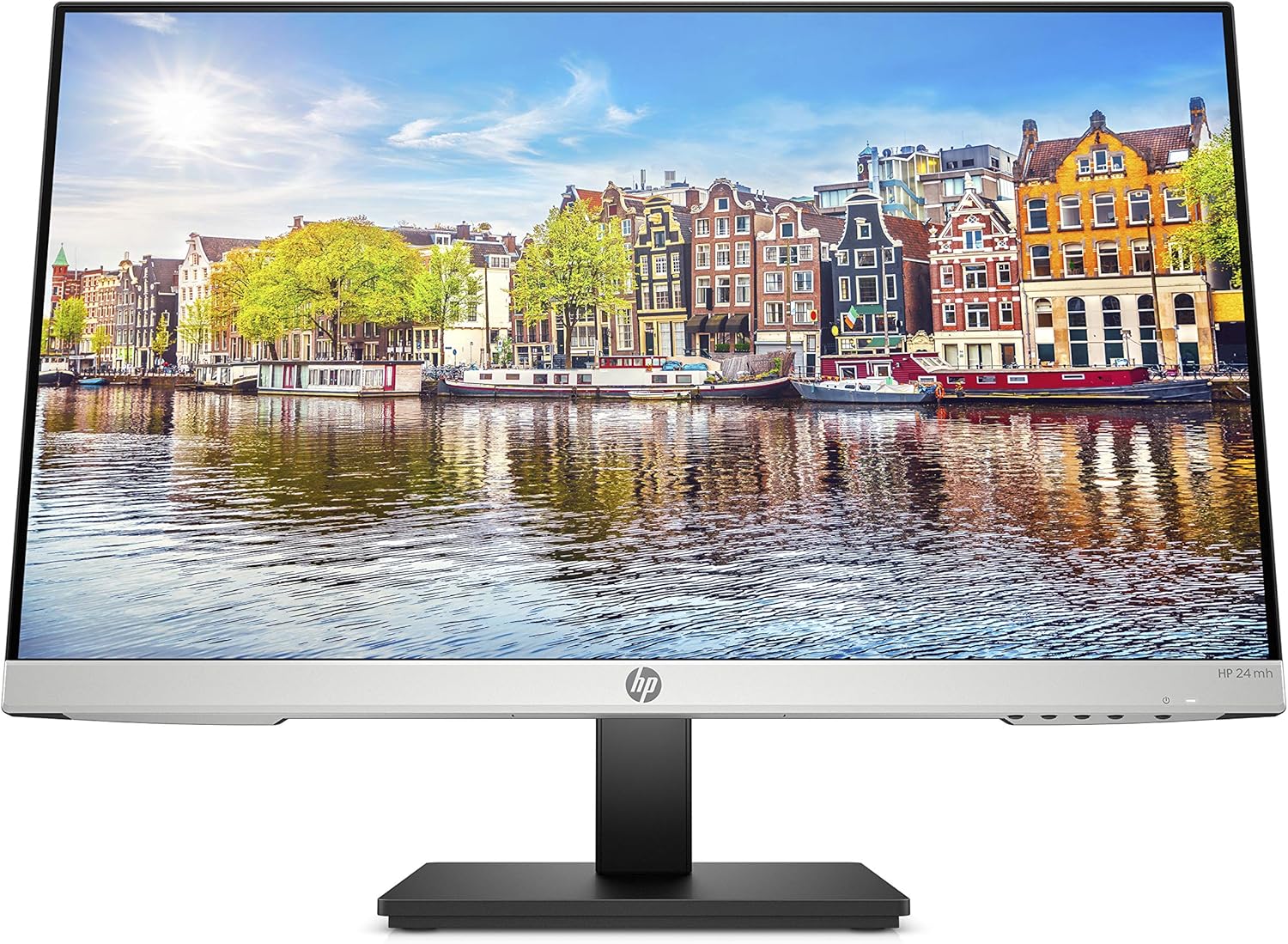
#4: 💰 Best Budget Secondary — HP 24mh FHD
Verdict: Sub-$130 secondary monitor. 1080p 75Hz IPS — don't use this as a primary gaming display, but excellent for chat, streaming dashboard, or Discord/docs.
The HP 24mh is the practical answer to "I need a second monitor for under $150." Per HP's spec sheet, it's a 23.8" IPS panel at 1920×1080 with 75Hz refresh and AMD FreeSync. Factory calibration is serviceable for productivity use, and the IPS panel avoids the narrow vertical viewing angles of TN.
The HP 24mh is NOT a primary gaming monitor. At 1080p 75Hz in 2026, it's outclassed on sharpness, refresh rate, and HDR coverage by every other pick in this guide. It belongs in a dual-monitor setup where your second screen shows Discord, Spotify, stream dashboard, or documentation — not as the display you game on.
Get it if: You need a $130 secondary screen for your desk, or you're setting up a budget streaming workstation where the primary game display is something else.
What to Look for in a 1440p Gaming Monitor
Refresh Rate: 144Hz, 165Hz, or 240Hz?
Per Blur Busters' UFO motion test data, the perceptible jump from 60→144Hz is dramatic for any player. 144→165Hz is subtle — 13.9% more frames per second, noticeable only in direct comparison. 165→240Hz is genuinely useful only for competitive FPS where sub-pixel motion clarity matters in fast 180-degree rotations.
For most players (RPG, open-world, single-player, casual multiplayer), 144Hz is the sweet spot. For ranked CS2, Valorant, or Apex Legends where you're playing to win, 240Hz earns its keep — but requires a monitor above this guide's $400 ceiling.
Response Time: GtG vs MPRT vs ISO
Three different response time specs are used interchangeably in product listings but measure very different things:
- GtG (Grey-to-Grey): How fast pixels transition between grey shades. The most representative metric for gaming image quality. 1–4ms GtG is acceptable; below 1ms is marketing.
- MPRT (Moving Picture Response Time): Measured with backlight strobing enabled (reduces motion blur via flicker). Not a native pixel-response number. A 1ms MPRT drive with 4ms GtG native is actually the slower panel.
- ISO 25 Hz/ISO Standard: Legal-but-slow measurement. 4ms ISO = roughly 8–12ms GtG.
When comparing monitors: use GtG where available. The Samsung Odyssey G5 is quoted as 1ms MPRT, but real GtG is ~4ms — still fast enough for 165Hz gaming.
Panel Type for Gaming
- IPS (Dell G3223Q, HP 24mh): Best color accuracy, best viewing angles, accurate factory calibration. The native contrast (~1000:1) is the weakness — dark scenes look grey-black vs VA.
- VA (Odyssey G5): Best contrast (3000:1+), deep blacks, excellent for dark-themed games. Slightly slower native response time; some VA panels show "black crush" in gradients. Best value-to-performance ratio at this tier.
- Mini-LED IPS (KOORUI): Best of both worlds but costs more. Local dimming compensates for IPS's low native contrast; full-gamut QD film covers DCI-P3.
Adaptive Sync: FreeSync vs G-Sync
Both G-Sync Compatible and FreeSync Premium certification programs require variable refresh rate support in the same range. G-Sync Compatible requires NVIDIA certification testing; FreeSync Premium requires AMD testing. In practice, most FreeSync Premium monitors work with NVIDIA GPUs (via G-Sync Compatible mode) and vice versa.
The Odyssey G5 and Dell G3223Q are certified for both NVIDIA and AMD adaptive sync. When buying: confirm "G-Sync Compatible" is listed in the specs if you're pairing with an NVIDIA GPU — that means NVIDIA has tested and approved it, not just that it uses DisplayPort Adaptive Sync technically.
HDR Tiers — What's Real vs Marketing
| Certification | Peak Brightness | Local Dimming | Reality Check |
|---|---|---|---|
| DisplayHDR 400 | 400 nits | Not required | Baseline — virtually every monitor meets this |
| DisplayHDR 600 | 600 nits | Not required for edge-lit | Entry level for actual HDR improvement |
| DisplayHDR 1000 | 1000 nits | Required (full-array) | Real HDR — KOORUI-tier Mini-LED |
| DisplayHDR 1400+ | 1400 nits | Required (FALD) | OLED-tier and above |
At the $300–$400 price band, DisplayHDR 600 (Dell G3223Q) and DisplayHDR 400 (Odyssey G5) are representative. Only the KOORUI QD-Mini LED approaches real HDR performance in this guide.
Real-World Gaming Performance Numbers
GPU Pairing Matrix (as of 2026)
| Monitor + Setting | RTX 3070 | RTX 4070 | RTX 4080 | RX 7800 XT |
|---|---|---|---|---|
| Odyssey G5 (1440p, 165Hz) | ✅ 120–165 FPS (most titles) | ✅ 165+ FPS (most titles) | ✅ Overkill | ✅ 100–165 FPS |
| Dell G3223Q (4K, 144Hz) | ⚠️ 45–75 FPS AAA native | ✅ 80–110 FPS AAA | ✅ 100–144 FPS | ⚠️ 55–85 FPS |
| KOORUI (4K, 144Hz) | ⚠️ Same as above | ✅ 80–110 FPS AAA | ✅ 100–144 FPS | ⚠️ 55–85 FPS |
AAA = Cyberpunk 2077 / Alan Wake 2 at High/Ultra settings. Esports titles (CS2, Valorant) run at 200–400+ FPS at 1440p on any RTX 3070+.
Input Lag by Panel
| Monitor | Input Lag (per RTINGS methodology) |
|---|---|
| Dell G3223Q | ~3ms @ 144Hz |
| Samsung Odyssey G5 | ~5ms @ 165Hz |
| HP 24mh | ~9ms @ 75Hz |
For competitive play below 10ms input lag, the Dell G3223Q is the cleanest option. The Odyssey G5's ~5ms is imperceptible in practice for most genres.
Common Pitfalls
- Buying a 4K monitor without the GPU to drive it — A 4K monitor paired with an RTX 3060 will spend most of its time at 1080p upscaled (DLSS/FSR) or at 30–45 FPS native. Match monitor resolution to GPU capability first.
- Confusing Hz and actual FPS — A 165Hz monitor doesn't make your game run at 165 FPS. It just displays up to 165 frames/second smoothly. You still need a GPU that produces that framerate.
- Ignoring the VA response time tradeoff — Some VA panels show "smearing" on fast-moving objects vs IPS. The Odyssey G5 is among the better VA panels for this, but it's worth reading RTINGS' review for your specific use case before buying.
- Missing HDMI version for console use — PS5 and Xbox Series X run 1440p at 120Hz over HDMI 2.1. The Odyssey G5 has HDMI 2.1; the Dell G3223Q has HDMI 2.0 (caps at 4K/60Hz for consoles, not 4K/120Hz). For 4K/120Hz console play, you need HDMI 2.1.
- DisplayHDR 400 = real HDR — It doesn't. DisplayHDR 400 is a baseline certification that most monitors already meet. For real HDR gaming, you need Mini-LED (KOORUI) or OLED (above this guide's budget).
FAQ
Is 1440p still the gaming sweet spot in 2026, or should I jump to 4K?
Per Steam's October 2025 hardware survey, 1440p remains the second-most-common gaming resolution at ~22% adoption, behind 1080p at ~55% and ahead of 4K at ~5%. The reason: 1440p at 144–240Hz is achievable on a mid-range GPU like the RTX 4070 or RX 7800 XT, while 4K at the same refresh rates demands an RTX 4090-tier card. The Dell G3223Q is a unique 4K-at-this-price entry, but you'll need a strong GPU to drive it past 60 FPS in modern AAA titles.
What refresh rate actually matters — 144Hz, 165Hz, or 240Hz?
Per Blur Busters' UFO motion test data, the perceptible jump from 60→144Hz is dramatic, 144→165Hz is subtle, and 165→240Hz is only noticeable in competitive FPS at sub-pixel motion clarity. For mixed-use gaming (RPGs, single-player, occasional MP), 144Hz is the floor; for ranked CS2, Valorant, or Apex, 240Hz earns its keep. The Samsung Odyssey G5 hits 165Hz, the Dell G3223Q caps at 144Hz — both are appropriate for their target audience.
Do I need HDR on a sub-$400 monitor?
At this price tier, HDR labeling is largely marketing — DisplayHDR 400 certification (the minimum tier) requires only 400 nits peak brightness and 8-bit color, which most SDR monitors already deliver. Real HDR experiences start at DisplayHDR 600 with local dimming. The KOORUI QD-Mini LED is the exception in this guide: Mini-LED backlighting with quantum-dot color gives genuine HDR contrast at the $400 tier, per RTINGS testing of the 2024 model line.
Is curved or flat better for gaming?
For single-monitor gaming at 27" or smaller, flat is fine. At 32" or larger, curved (1500R or 1800R) reduces eye strain because the edges of your peripheral vision stay equidistant. The Samsung Odyssey G5 1000R curve is steeper than most — immersive for first-person games, less ideal for productivity work with straight-line UI elements. For mixed gaming/work setups, prefer 1500R or flat.
What's the cheapest path to a respectable 1440p 144Hz setup?
The HP 24mh FHD at sub-$150 is misleading here — it's 1080p 75Hz, fine as a secondary monitor but not a primary gaming display. For a real 1440p 144Hz primary, the Samsung Odyssey G5 32" at ~$300 is the realistic floor. Below that, you're getting 1080p panels marketed as gaming displays. Don't compromise on panel resolution to save $50 — you'll regret it within a month.
Citations and Sources
- Dell G3223Q 32" 4K Gaming Monitor — official product page
- Samsung Odyssey G5 32" — official Samsung product page
- RTINGS: Best 27-inch 1440p monitors tested and ranked
Related Guides
- Best Budget SATA SSD for Everyday Upgrades (2026)
- Best GPU for 1440p Ultrawide Gaming in 2026
- Best Single-Board Computer Project Kits for Beginners (2026)
- Running Qwen3.6 35B-A3B on an RTX 3060 12GB
As of 2026, prices are estimated from Amazon US listings. Verify current pricing before purchase — monitor prices change frequently.