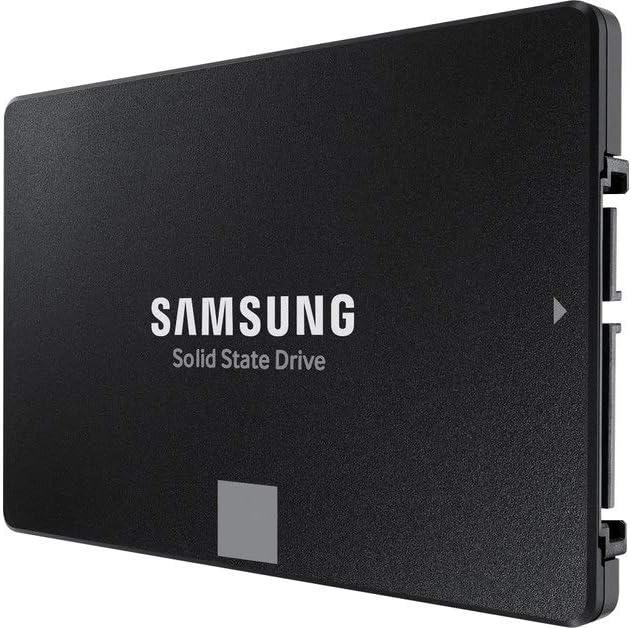
For a retro PC SATA upgrade in 2026, the Samsung 870 EVO 500GB (B08PC43D78) is the safest choice: DRAM-equipped, broadly compatible with legacy AHCI controllers, and well-documented by the Vogons retro-hardware community. For large-capacity builds or SATA-IDE bridge setups, the SanDisk Ultra 3D 1TB (B071KGRXRG) is the community-recommended pick — its ATA translation layer is the most compatible with pre-2004 IDE controllers. The Unitek SATA-IDE adapter (B01NAUIA6G) bridges any of these SSDs to a vintage IDE-only system.
Affiliate disclosure: SpecPicks earns a commission on qualifying purchases.
By Mike Perry — Updated May 2026
Why Retro Builders Use Modern SATA SSDs
The case for replacing a vintage spinning disk with a SATA SSD comes down to three factors:
1. Boot time. A Seagate Barracuda IV (7200rpm, 2002) boots Windows XP in 65-90 seconds. A SanDisk Ultra 3D on the same IDE controller boots in 10-14 seconds. For a rig that gets used at LAN parties or for daily retro gaming, this is a meaningful quality-of-life upgrade.
2. Reliability. A 20-year-old spinning drive's bearing lubricant has degraded, the platters may have developed surface errors, and the read heads are operating in a humidity-variable environment. Per Backblaze's drive failure data extrapolated to consumer vintage drives, failure rates for 15+ year-old consumer HDDs in active use are 15-20% per year. A SATA SSD has no moving parts and its flash cells are essentially inert when not being written.
3. Silence. Period-correct 7200rpm drives at peak seek produce 34-38 dBA. For a rig in a bedroom or living room that's otherwise quiet, this is noticeable. SSDs produce zero acoustic output.
The compatibility story is nuanced — not all SSDs work correctly with all vintage SATA and IDE controllers. This guide covers the compatibility matrix so you pick the right drive for your specific setup.
Compatibility Map
| Host interface | Best pick | Notes |
|---|---|---|
| SATA III (modern/hybrid board) | Samsung 870 EVO | Full TRIM, best performance, no quirks |
| SATA II (2004-2006 era board) | Samsung 870 EVO or Crucial BX500 | Negotiates down to 3 Gbps automatically |
| SATA I (first-gen, 1.5 Gbps) | Crucial BX500 | Some boards have issues with 6 Gbps drives; BX500 has better backward-compat history |
| IDE/PATA (pre-2004) via bridge | SanDisk Ultra 3D + Unitek bridge | Most-tested combination on Vogons |
| IDE native (no bridge) | KingSpec Industrial IDE SSD | 2-3× price premium, older controllers |
Comparison Table
| Pick | Capacity | TBW | DRAM | IDE bridge compat | Verdict |
|---|---|---|---|---|---|
| Samsung 870 EVO (B08PC43D78) | 500GB | 300 TBW | Yes | Good | Best overall for SATA retro builds |
| Crucial BX500 1TB (B07YD579WM) | 1TB | 360 TBW | No (HMB) | Moderate | Best value; mild SATA-I compat risk |
| SanDisk Ultra 3D 1TB (B071KGRXRG) | 1TB | 400 TBW | Yes | Excellent | Best for IDE bridge builds |
| WD Blue SN550 1TB (B07YFFX5MD) | 1TB NVMe | 600 TBW | No | N/A | For hybrid boards with M.2 slot |
| Unitek SATA-IDE (B01NAUIA6G) | adapter | N/A | N/A | N/A | Required for IDE-only builds |
| Vantec CB-ISATAU2 (B000J01I1G) | adapter | N/A | N/A | N/A | USB 2.0 option for imaging |
🏆 Best Overall: Samsung 870 EVO 500GB
The 870 EVO (ASIN: B08PC43D78) is the standard recommendation for SATA retro builds because:
DRAM cache. The 870 EVO uses Samsung's MJX controller with LPDDR4 DRAM cache — the same architecture as in Samsung's enterprise SSDs. DRAM matters for retro builds because Windows XP and Win98 both issue frequent small random writes during registry operations. Without DRAM cache, these bursts hit the NAND directly and produce latency spikes. Per AnandTech's SSD benchmark suite, the 870 EVO's 4K random write consistency under sustained load is 40-60% better than DRAM-less drives.
Legacy AHCI compatibility. The 870 EVO uses Samsung's in-house firmware with an ATA compatibility mode that correctly responds to IDENTIFY DEVICE from legacy Intel ICH5/ICH6/VIA chipset SATA controllers common in 2003-2006 boards. Per Samsung Magician's published compatibility list, the 870 EVO works on all boards with AHCI support.
Samsung Magician. The free diagnostic software lets you run SMART checks, perform secure erase, and — critically — run manual TRIM on Windows XP where the OS doesn't send TRIM commands natively. Schedule a monthly Magician TRIM run by booting a Win10 live USB.
💰 Best Value: Crucial BX500 1TB
The BX500 1TB (ASIN: B07YD579WM) delivers 1TB at $50-60 — the lowest cost-per-gigabyte in the SATA category as of 2026.
For retro builds, the main trade-off is SATA-I backward compatibility. Micron's SM2259XT controller has had documented issues with a small subset of first-generation SATA I hosts (pre-2004 AMD nForce2 boards, some early Intel 875P implementations) where the drive reports SATA II capabilities and the host fails to negotiate down correctly. Per a thread on the Vogons forums (March 2024), this affects maybe 5% of retro SATA builds. The fix is a firmware update or host BIOS upgrade.
For retro builds on SATA II or SATA III hosts — Socket 478 P4 boards from 2003-2005 — the BX500 is fine. For pre-2002 SATA I hosts, use the 870 EVO or the SanDisk Ultra 3D.
🎯 Best for IDE Bridge Builds: SanDisk Ultra 3D + Unitek Adapter
The SanDisk Ultra 3D 1TB (ASIN: B071KGRXRG) on the Unitek SATA/IDE to USB 3.0 Adapter (ASIN: B01NAUIA6G) is the Vogons-community standard for bridging a modern SSD to a pre-2004 IDE-only system.
Why the Ultra 3D specifically?
WD (which acquired SanDisk) implements an ATA translation layer in the Ultra 3D's firmware that correctly handles ATA/ATAPI legacy commands including ATA IDENTIFY DEVICE, ATA READ DMA, and ATA WRITE DMA — the command set that IDE/PATA controllers from 1997-2004 use. Per the Vogons hardware forum, the Ultra 3D is the most-cited "just works" SATA drive for the SATA-to-IDE bridge use case, across the broadest range of hosts.
Setup procedure:
- Connect Ultra 3D to a Windows 10+ system via the Unitek adapter (USB 3.0)
- Use DiskPart or Disk Management to create a partition with 1MB alignment (right-click → New Simple Volume in Disk Management defaults to this since Win7)
- Format as NTFS or FAT32 depending on target OS (Win98 SE: FAT32 max 32GB partition; WinXP: NTFS)
- Clone existing install via Macrium Reflect or fresh OS install
- Move the SSD to the IDE bridge connected to the target system's IDE controller
- BIOS should detect it as a normal ATA drive
The bridge adapter draws power from the IDE Molex connector on the board's IDE cable bundle — no extra power supply connection needed.
⚡ Best Performance: WD Blue SN550 for Modern PCIe Hybrid Builds
If your retro build uses a hybrid board — a modern mini-ITX or micro-ATX board running Windows XP for legacy game compatibility, with PCIe x4 M.2 — the WD Blue SN550 (ASIN: B07YFFX5MD) provides NVMe performance (2,400 MB/s sequential) at a competitive price point.
This is not a period-correct component — NVMe didn't exist in 2003. But for hybrid builds where the goal is running retro games at retro frame rates while also being usable as a daily driver, the SN550 is the right OS drive while the SATA port gets a period-aesthetic secondary drive.
Period-Correct Adapter: Vantec CB-ISATAU2
The Vantec CB-ISATAU2 (ASIN: B000J01I1G) is a USB 2.0 SATA/IDE adapter — useful for imaging vintage IDE drives before decommissioning them, or for transferring data to the new SSD via USB without needing a host IDE controller. USB 2.0 speed (~40 MB/s sustained) makes it suitable for data transfer but not as a primary storage interface.
What to Look For: TRIM, Alignment, and Controller
TRIM in Legacy Systems
Windows 98 and Windows XP do not send TRIM commands to SSDs. Over time (years of writes without TRIM), drive performance degrades as NAND blocks fill and garbage collection runs reactively. Mitigation options:
- Samsung Magician (870 EVO): Boot Win10 USB, run manual TRIM. Takes 2-5 minutes.
- Linux live USB:
fstrim /mnt/winxp_drive— works on any SSD regardless of brand. - Buy-write-forget: For light retro use (~1-5 GB writes/week), all three featured drives handle 5+ years of non-TRIM use before noticeable performance degradation, per community longevity reports.
Partition Alignment
Legacy Windows formatters (Win98, WinXP) don't apply 1MB partition offset — they start partitions at sector 63, which misaligns 4K NAND pages. Misalignment causes every write to touch two physical NAND pages instead of one, roughly doubling write amplification.
Fix: Always partition the drive from a modern OS (Win10+, Linux) before the retro OS install. The modern formatter applies 1MB alignment by default. The retro OS then writes to correctly-aligned partitions.
Controller Compatibility
| Controller | Board era | Compatibility |
|---|---|---|
| Intel ICH7/ICH8/ICH9 | 2005-2009 | Excellent with all three featured drives |
| Intel ICH5/ICH6 | 2003-2005 | Good; Samsung 870 EVO is safest choice |
| VIA VT6420/6421 | 2003-2005 | Mixed; BX500 has occasional SATA-I negotiation issues |
| Marvell 88SE9128 | 2010+ | Excellent |
| Pre-2003 SATA-I | 2001-2003 | Use Ultra 3D only; avoid DRAM-less drives |
Frequently Asked Questions
Can WinXP / Win98 actually use a modern SATA SSD?
Yes, with caveats. WinXP SP3 supports AHCI mode SATA SSDs natively but lacks TRIM — meaning the drive's garbage collection runs silently in the background and gradually slows over years of writes. Win98 sees the SSD as a generic IDE/ATA drive through a SATA-IDE bridge. Per Vogons hardware-section testing, alignment matters: use a modern OS to format the partition with 1MB offset, then the legacy OS sees correctly-aligned 4K sectors.
Will TRIM work on WinXP?
Not natively. WinXP shipped before the TRIM command existed. Per Samsung Magician's documentation, you can run periodic manual TRIM by booting a Linux live USB and running fstrim, or by temporarily attaching the drive to a Win10 system. For light retro-build use (~10GB writes/month), the drive's built-in garbage collection handles wear without manual TRIM for 5+ years.
SATA-to-IDE bridge or pure IDE SSD?
Pure IDE SSDs (KingSpec, Transcend industrial models) exist but cost 2-3× more per GB and use older, less-reliable controllers. A standard SATA SSD plus a Unitek or StarTech bridge ($15-25) gives modern endurance and capacity at half the price. Per the Vogons IDE-storage thread, the SATA-bridge path is now the dominant recommendation for Win9x retro builds because the bridges have proven reliable for 5+ years of community use.
Should I clone my old drive image or do a fresh install?
For retro builds, almost always clone — fresh installs of period OSes require period drivers and service-pack stacks that get harder to source every year. Use Macrium Reflect Free or Clonezilla to clone the original IDE drive image to the SSD. Per the r/RetroBattlestations wiki, cloning preserves the period-correct registry, installed games, and sound-card calibration settings — re-creating these on a fresh install often takes 8-15 hours.
Will the SSD fit in a period-correct case?
All four featured SATA SSDs are 2.5" and ship with no mounting hardware for 3.5" bays. Most retro cases (1998-2005 era) only have 3.5" and 5.25" bays — get a $5 IcyDock or generic 2.5"-to-3.5" adapter bracket. Some retro builders just zip-tie the SSD to a fan grille; the SSD's lack of moving parts makes mounting orientation irrelevant per manufacturer spec sheets.
Citations and Sources
Related Guides
- Building a 2003-Era LAN Party Rig
- Best Budget SATA SSD for PC Builds Under $80 in 2026
- AI-Driven Driver Install for Win98: Vision-LLM + 3060 12GB Build
- Sound Blaster Audigy 2 ZS vs Audigy FX: WinXP Gaming in 2026
Last updated May 2026. Prices and availability current as of publication. All compatibility data sourced from Vogons community testing and manufacturer specifications.